Sympathy messages are among the hardest words anyone is ever asked to write. The fear of saying the wrong thing is real, and it keeps a lot of people from saying anything at all, at exactly the moment when silence costs the most. What you will find here is a map through that, organized by who you are writing to, what the loss was, and where you are in the timeline of someone’s grief. No single message fits every situation. But in almost every situation, there is something honest you can say, and that is where it starts.

There Are No Perfect Words for Loss, But There Is a Difference
The moment someone you care about loses someone, something happens. You pick up your phone, open a blank message or a card, and the words that felt easy a moment ago are gone entirely. What you write down sounds hollow. You start over. You write something worse. You close the app and tell yourself you will do it later, and later turns into a week, and by then the window feels closed.
I have been in that loop more times than I can count. And what I have found, over time, is that the problem is almost never a shortage of things to say. It is that people are searching for words that will fix something words cannot fix. That search leads to borrowed phrases: “time heals all wounds,” “they are in a better place,” “at least they are no longer suffering.” These land badly not because the person who wrote them does not care, but because they reach for comfort and land on closure. Grief does not want closure. It wants to be seen.
The sympathy messages that actually help have something in common. They do not try to explain the loss, minimize it, or soften it into something easier to hold. They acknowledge it, name it, and sit with it for a moment. They say: I know this is hard, I am thinking of you, I am here. That is the whole job, and it is more than most people manage to do.

Start Here: Find the Situation That Fits
If you already know what you are dealing with, the list below will point you in the right direction without making you read through everything first. Finding the right words of sympathy is faster when you start from the right situation. The fuller picture follows for those who want it, but sometimes the most useful thing is simply knowing which door to walk through.
- Writing to a close friend: go personal, use their name, and say something specific about the person they lost.
- The loss was a parent: the tone for a mother and a father tends to differ in ways worth knowing before you write.
- The death came suddenly with no warning: skip the explanations. Name the shock.
- The loss was a pet: take it as seriously as you would any other loss, because it is one.
- The loss was a pregnancy or miscarriage: acknowledge it, even if it happened quietly and privately.
- The loss was a child: do not let the weight of it silence you entirely.
- Months have passed since the death: reach out anyway. It is not too late, and it will matter more than you expect.
- Faith matters to this family: choose language that fits their beliefs, not your assumptions about them.
- You are not sure what to write: start with what not to say, and the right approach tends to follow naturally.
If none of those fit exactly, the sections below go deeper into each situation, including what tends to go wrong and why it happens. What I have found is that understanding the why usually makes the what a great deal easier to write.
Who You Are Writing To Changes Everything
A condolence message to a colleague who lost a parent is not the same conversation as a message to your closest friend whose mother died. One calls for warmth at a respectful distance. The other can afford to be specific, to name the person who was lost, to say something true about who she was. Neither approach is better than the other. They serve different relationships, and what a message needs to do depends entirely on what exists between the two people.
The loss of a mother carries a weight that most people will eventually know firsthand. It changes how someone moves through the world, even when the death was expected, even when there had been time to prepare. What I have found is that messages referencing the specific person, not just the loss in the abstract, land differently. “Your mom made everyone feel like she had been waiting for them” does more work than “I am sorry for your loss.” One says you noticed her. The other says you noticed the absence. Both matter, but they are different things entirely.
Loss of a father tends to produce shorter messages, written more formally, followed by second-guessing about whether more should have been said. The instinct toward restraint is not always wrong. What matters is that whatever gets written is real, not assembled from phrases borrowed from somewhere else. If you are navigating either of these losses right now, the pieces on sympathy messages for loss of a mother and comforting messages for the death of a father go deeper into both, including what tends to land and what tends to miss in each case.
When a friend is the one grieving, you have more room to move. You can be more personal, more direct, less formal. You can use the name of the person who died and say something specific about what you knew of them. That specificity is a gift. Most people receive dozens of messages that could have been written by anyone. The one that could only have come from you is the one they will remember.
When the Loss Is Harder to Name
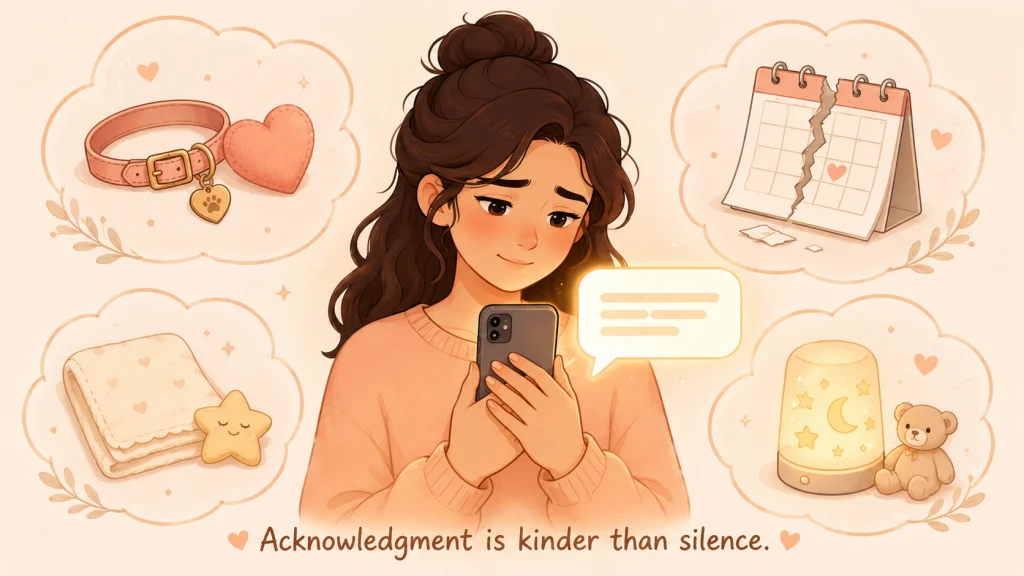
Some losses come without the social scaffolding that makes grief legible to the people around you. A miscarriage. The death of a pet. A pregnancy that ended before anyone outside the immediate family knew there was one. A death that came without warning, leaving no time for a goodbye. These situations make people especially uncertain about whether reaching out is appropriate, whether acknowledging the loss might feel intrusive, whether silence is the more respectful choice.
The answer, in almost every case, is that acknowledgment is safer than silence. A message that says “I heard what happened and I am so sorry, I am thinking of you” carries no real risk of offense. Silence carries more than most people realize, even when silence is chosen out of genuine care. The person who is grieving tends to notice who showed up and who went quiet. That is not a judgment on their part. It is just what grief does to memory.
Pet loss gets minimized in ways that cause real hurt. People who have never been genuinely close to a pet sometimes struggle to understand what the loss actually costs. The people who have lost a dog or a cat they lived alongside every day know exactly what that absence feels like, and it is not small. A message that takes it seriously is rare enough that it will mean something.
Sudden death is its own territory. When there was no warning, there was no preparation, no final conversation, no chance to say the things that still needed saying. Messages in these situations have to hold two things at once: the shock of the loss and the weight of what was left unfinished. That is genuinely difficult to write. But even a message that simply names the shock, without reaching for an explanation where none exists, will reach the person in a way that careful silence cannot.
The death of a child sits in its own category, and most people go completely quiet in the face of it. Not from indifference, but from the feeling that nothing they could say would come close to the scale of the loss. That silence is understandable, and it is also one of the loneliest things a grieving parent can experience. A message does not have to be adequate to be worth sending. With a loss this large, the fact that you showed up matters, even if the words are imperfect. The piece on sympathy messages for the death of a child is written specifically for that silence and what to do with it.
Faith is another dimension that changes what the right language looks like. When you know a family finds comfort in prayer, a message that honors their beliefs can carry more weight than a general one. When you are less certain of their beliefs, erring toward language that does not assume a shared theology is the safer path. “You are in my thoughts” lands for almost everyone. A message that assumes a specific belief about what comes after death does not always land the way it was intended, even when written with love. If faith is clearly part of how this family grieves, the piece on Christian sympathy messages and prayers covers how to write into that space without overstepping.
Format, Length, and What Usually Goes Wrong
The instinct, when something matters, is to write more. To demonstrate care through the quantity of words on the page. In sympathy writing, this almost always produces the opposite of what is intended. A three-paragraph card that tries to say everything ends up making the grief about the person writing the card. A short, honest message makes it about the person receiving it.
What tends to work is a message that is grounded in something real, kept short, and honest about the limits of what words can actually do. A card that says “I keep thinking about you, I do not have the right words, but I wanted you to know I am here” is more useful than something longer and more polished. If you were close to the person who was lost, you might want to say something specific about them, a memory, a detail, something true. That earns the length. What does not earn it is filling the space with condolence phrases that could have been pulled from a template.
Text messages and cards are different formats with different weights. A text can hold “thinking of you today, no need to respond” and that is enough. Sometimes it is exactly right. A card has more room, but more room also means more opportunity to reach for phrases that do not help. For the specifics of format and tone, the piece on what to write in a sympathy card covers when to go longer and when to hold back. For moments when brevity is the right call, short sympathy messages offers language for when you have little to say but still need to say something.
What tends to go wrong, across almost every format, is the reach for a silver lining. “She lived a long, full life.” “At least he is not suffering anymore.” “You will see them again someday.” These are said with genuine love and almost always received as a request to arrive at acceptance before the person is anywhere near ready. The messages that land sit with the grief instead of trying to move past it.
- Naming the person who was lost, by name, lands better than referring only to “your loss.”
- “I am here if you need anything” matters less than something specific: “I am bringing dinner Thursday, does 6 work?”
- Saying “I do not know what to say” honestly lands better than a borrowed phrase that sounds like one.
- Asking “how are you doing” too soon can close the conversation before it opens.
- Acknowledging that grief has no fixed timeline lands better than “I hope you are feeling better soon.”
None of these are rules so much as patterns. The common thread is that the messages which actually reach someone are the ones that give them permission to still be in the middle of something hard, rather than nudging them toward the other side of it. That permission, offered quietly and without expectation, is more useful than most people expect it to be.

The Grief That Does Not End at the Funeral
The first wave of sympathy messages comes fast, and then it stops. Cards and texts flood in during the first week, and then the world moves on. The person who is grieving does not move on at the same pace, and the silence from people who cared so visibly at the beginning can land strangely once that initial support drops away.
Reaching out months after a loss is one of the kindest things a person can do, and one of the things most reliably left undone. People genuinely struggle with what to say to someone grieving that far out from the death, and most end up saying nothing at all. They worry the message will reopen something. What I have found is that the wound does not close and then get reopened by a message arriving late. It stays open. A text that arrives three months later is not a reminder of the loss. It is a reminder that someone is still thinking about the person who is gone, and about the person left behind. Those are not the same thing, and both matter.
“I was thinking about her today” is enough. “I know the anniversary is coming up and I wanted you to know I am thinking of you” is more than most people in grief will receive. For more on how to reach out when time has passed and the moment feels harder to re-enter, the piece on what to say when someone is still grieving months later covers exactly that ground.
What Not to Say in a Sympathy Message
Most of the phrases that land badly are not said out of carelessness. They come from the same place as every other sympathy message: the desire to help, the discomfort of not being able to fix what happened, the instinct to reach for something that sounds right because the alternatives feel too small. Understanding why certain phrases miss is more useful than a list of things to avoid, because it changes how you approach the blank page in the first place. The problem is almost never cruelty. It is the attempt to make grief manageable when grief is not asking to be managed.
There is a piece here specifically on what not to say in a sympathy card that goes through the most common missteps, explains why they happen, and offers alternatives that do not require abandoning everything you already know about how to speak to someone in pain. It is worth reading before you write, not after. The difference between a message that helps and one that misses is often a single phrase, and it is almost always the one that was meant to reassure.

Final Thoughts: The Message You Send Matters More Than You Think
The hardest thing about sympathy messages is not the words. It is the fear that whatever you say will make things worse. That fear causes more harm through silence than any imperfect sentence ever could. A message that tries and falls slightly short lands better than no message at all, because the person on the other end can tell you tried. That is not a small thing.
What I keep coming back to is this: grief is isolating by nature. The person inside it often feels like the world has continued on without them, that everyone else has moved forward while they are still standing in the same place. A message that shows up, that says their name, that tells them you have not forgotten, does something nothing else quite does. It closes a distance, for a moment. That is what these words are for, and it is enough.
Below you will find every situation covered here, organized so you can go directly to what fits your moment. Start with the relationship or the type of loss, and let the specifics take it from there.
Find the Right Words for Your Situation
Grief comes in many shapes, and the words that help depend on who you are writing to, what kind of loss it was, and where you are in the timeline. Each piece below is written for a specific situation, so you can find the one that fits and go from there rather than adapting something that was never quite right.
| Situation | What you will find there |
|---|---|
| Words of Comfort for Someone Grieving | The phrases that actually help, and why they work when so many others miss. |
| What to Write in a Sympathy Card | How a card is different from a text, and what to write when the blank space feels impossible. |
| Sympathy Messages for Loss of a Mother | One of the most common griefs, and one of the hardest to find specific language for. |
| Comforting Messages for the Death of a Father | Messages for a loss that often arrives with its own kind of quiet and calls for a particular tone. |
| Messages When a Friend Loses Someone | When your friend is the one going through it and the usual rules of conversation no longer apply. |
| Short Sympathy Messages | When you have little to say, or do not know how, a shorter message done right is better than a longer one that misses. |
| Christian Sympathy Messages and Prayers | For families where faith shapes how they grieve, messages that speak to that without overstepping. |
| Pet Sympathy Messages | A loss that gets minimized too often, and the words that take it as seriously as it deserves. |
| Sympathy Messages for the Death of a Child | The hardest loss to write about, and the one where silence most often replaces reaching out. |
| What to Say When Someone Is Still Grieving Months Later | Grief does not end at the funeral, and the messages that arrive later often mean the most. |
| What Not to Say in a Sympathy Card | The phrases most people use without realizing they land wrong, and what to write instead. |
| Messages for Miscarriage and Pregnancy Loss | A loss that often happens privately, which makes the silence around it harder to break. |
| Condolence Messages for Sudden Death | When there was no warning and the shock is still part of the grief that needs to be acknowledged. |
FAQs
💬 What do you say to someone who just lost their mom?
Something specific and honest beats something polished and borrowed. If you knew her mother, say something about her by name. If you did not, say that you are thinking of her and that you are there. Short is fine. What matters is that you reached out at all.
🕊️ What is a good sympathy message to send?
The best sympathy messages are short, specific, and honest. Name the person who was lost if you can. Say you are thinking of the person grieving and that you are there. Avoid trying to explain or soften the loss. “I am so sorry, I am thinking of you and I am here” does more work than most people expect.
🤍 Is it okay to text a sympathy message instead of sending a card?
Yes. A text that shows up is better than a card that never gets written. Keep it brief and add “no need to respond” if it fits. The point is that the person knows you are thinking of them, not that you chose the most formal channel to say it.
😔 What should you not say in a sympathy message?
Avoid silver linings: “at least they are not suffering,” “they lived a long life,” “everything happens for a reason.” These are said with love and often received as a quiet request to stop grieving. Also avoid “let me know if you need anything” without a specific offer to back it up. Vague offers are easy to ignore. Specific ones are harder to refuse.
📅 Is it too late to send a sympathy message months after a death?
It is never too late. A message that arrives months later often means more than the ones that came in the first week, because most of those have long since stopped. “I was thinking about him today” is enough. The fact that you sent it is the point.
🐾 Should I reach out when someone loses a pet?
Yes, always. Pet loss is real loss, and the people going through it tend to remember exactly who took it seriously and who did not. A short message that acknowledges what they are going through is a kindness they will not forget.
✉️ How long should a sympathy message be?
Shorter than you think. Two or three honest sentences outperform a long paragraph trying to say everything. If you were close to the person who was lost, add a specific memory or detail. Otherwise, keep it brief and make sure every sentence is real.