The loss of a mother is one of the heaviest things a person carries, and the messages that help most are rarely the ones people reach for first. These 75 sympathy messages for the loss of a mother are organized by where your friend or family member actually is in their grief, not where you hope they are, because what someone needs to hear on day two is not what they need to hear in month six. There is also a section here for when the relationship was complicated, because that grief is real too, and almost no one writes for it. Use whatever fits. Change what does not. The only thing that matters is that the words feel like they came from you. For broader context, see sympathy messages for loss of mother.

Why the timeline matters more than the words
Most sympathy messages about the loss of a mother that appear when you search online are organized around the same moment: the first 48 hours. They assume you are reaching out while the news is still raw, when the family is still gathering, when there is still casserole on the doorstep. That is a real moment, and it needs the right words. But it is not the only moment, and treating it like it is leaves the person you care about very alone in the months that follow. For related message ideas, see condolence message for loss of mother.
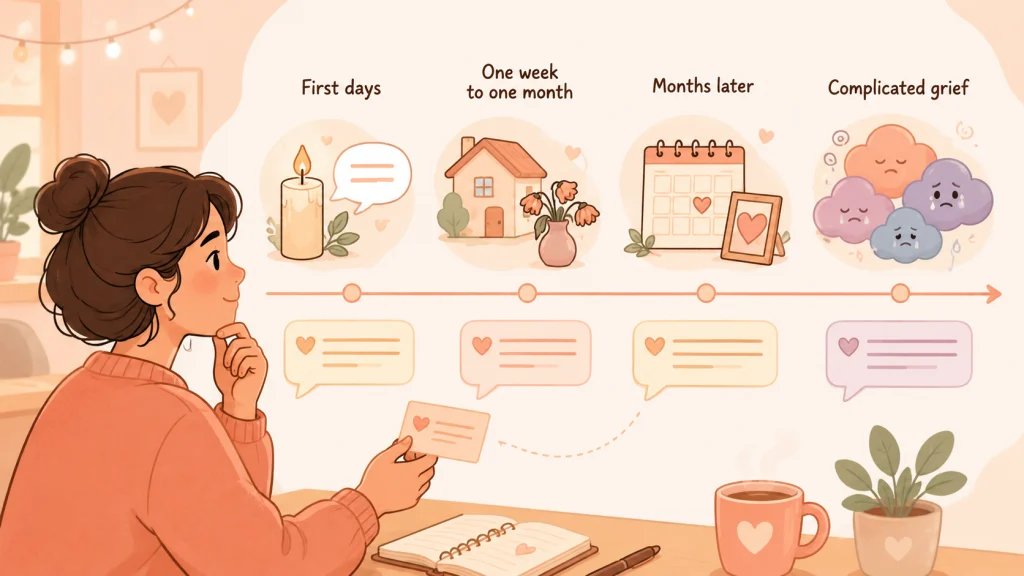
What I have found, reaching out to friends in grief more times than I ever wanted to, is that the messages people remember most are not always the ones that arrived first. They are the ones that arrived when everyone else had stopped arriving. The other thing that trips people up is sending a message meant for an earlier stage to someone who is already deep in a later one. A message that says “I am so sorry, please let me know if you need anything” reads very differently in the first week than it does in month four. The table below is a rough map. Use it before you scroll.
| Where they are | What helps | What to avoid |
|---|---|---|
| First days | Acknowledging the loss, offering presence, keeping it short | Silver linings, long stories, unsolicited advice |
| One week to one month | Checking in, naming that the noise has settled, no pressure to respond | Asking if they are “feeling better,” implying a timeline |
| Months later | Remembering her by name, validating that the grief is still real | Acting surprised they are still hurting, comparing to your own loss |
| Complicated relationship | Non-judgment, open door, no assumptions | Forced positivity, “at least” statements, pressure to grieve a certain way |
If you are not sure which section fits, pick the one that is slightly later than you think. People consistently underestimate how long grief stays active. Erring toward the later stage is almost always the right call.
Immediate condolences: messages for the first days
These messages are for the hours and first few days after the loss. The person you are reaching out to is probably surrounded by family, overwhelmed by logistics, and running on something that is not quite sleep. They need to know you heard, you care, and you are not going anywhere. They do not need to read a long message.
The most common mistake people make here is going too long. A long message puts pressure on the grieving person to respond in kind, to acknowledge everything you said, when what they actually need is to feel held without having to do any work. I once rewrote a message four times before sending two sentences. She told me later it was the first one that did not make her feel like she had to write back a paragraph. Short, honest, and clear serves them better every time.
- “I am so sorry. There are no words that fit this, but I wanted you to know I am here.”
- “I just heard. I am so, so sorry. I will check in again later this week, but you do not have to respond now.”
- “Losing your mother is one of the hardest things a person goes through. I am holding you in my thoughts today.”
- “Your mom was so loved. I am thinking of you and your whole family right now.”
- “I can’t imagine the weight of this moment. I love you and I am here whenever you need me.”
- “She raised someone remarkable. That is her legacy, and I see it in you every single day.”
- “I am so sorry for your loss. I hope you feel surrounded by love right now.”
- “Your mom mattered so much, to you and to everyone who knew her. I am so deeply sorry.”
- “There are no right words for this kind of loss. Just know I am thinking of you and I care about you deeply.”
- “I am so sorry. Please don’t worry about anything right now except being with your family.”
- “She was such a warm, wonderful presence. This is such a heartbreaking loss.”
- “I heard the news and my heart just broke for you. I love you. I am here.”
- “Sending you so much love right now. You don’t have to respond. Just know I am thinking of you.”
- “I am so deeply sorry. Your mother was someone very special, and she raised you with such love.”
- “I cannot take any of this pain away, and I wish I could. I am here. That is the only thing I know how to offer right now.”
- “My heart goes out to you and your family. Please know you are not alone in this.”
- “I am so sorry. If you need someone to sit with you, to talk, or to say absolutely nothing at all, I am that person.”
- “Losing a mother leaves a kind of silence that nothing else does. I am so sorry you are in that silence right now.”
- “I don’t have the right words, but I have all the time in the world if you need me. I am so sorry.”
- “She sounded like someone who loved fiercely. I am so sorry you had to lose her.”
If you offer help, make it specific. “Let me know if you need anything” is kind but rarely accepted. A concrete offer with a day and a task is the one that actually gets used.

One week to one month: when the numbness starts to lift
This is the stretch most people miss entirely. The immediate wave of support has passed, the relatives have gone home, and the person grieving is left alone with a loss that has, if anything, gotten heavier. Now they have to feel it without the buffer of activity. The world resumes its normal pace, and the person sitting in the middle of all of it is still very much not okay.
Messages sent in this window say something the first-day messages cannot: I am not just here for the dramatic part. Most people assume reaching out late is intrusive, or that bringing it up will remind the person of something they were trying to forget. That logic has it backwards. They have not forgotten. They are wondering if everyone else has. For even longer-term support, there is help for what to say when someone is still grieving months later.
- “I’ve been thinking about you so much. I know the first days were so full of people and movement. I wanted to check in now that things have gone quiet.”
- “I know a lot of people may have gone quiet by now. I haven’t stopped thinking about you.”
- “Grief doesn’t follow a schedule. I hope you are being as gentle with yourself as you deserve.”
- “The world keeps moving, but that doesn’t mean you have to keep pace with it. I am still here.”
- “I’ve been meaning to reach out. I didn’t want to add to the noise right after, but I’ve been thinking about you and your mom every day.”
- “I know the flowers have faded and the calls have slowed down. I didn’t want you to think the people who love you have stopped thinking about you.”
- “I’ve been sitting with this for days, trying to figure out what to say. There isn’t a right thing. I just miss hearing about your mom, and I miss seeing you.”
- “You don’t have to be okay right now. Not even a little bit. I just wanted to say that.”
- “It’s been a few weeks, and I wanted you to know that you are still on my mind every day. Grief doesn’t have a deadline.”
- “I know this part can feel quieter from the outside. I wanted you to know you are still very much on my mind.”
- “You are allowed to still be in it. You are allowed to have hard days when no one expects it anymore. I am here for those days too.”
- “I keep thinking about you in the quiet moments. The days right after are so chaotic. This stretch is harder in a different way, and I just wanted you to know I see that.”
- “She raised someone I love deeply. I am still thinking about that every day.”
- “I wanted to reach out before too much time passed. I don’t want you to feel forgotten in this.”
- “No expectations for how you respond or whether you do. I just wanted you to know I was thinking about you today.”
You will notice that none of these ask “how are you doing?” Saying something and leaving the door open works far better than asking a question that has no honest answer in this stretch of grief.
Months after the loss: the grief that outlasts everyone’s attention
The assumption is that grief fades on a predictable schedule, and that by a few months out, the person is somewhere on their way to fine. That assumption is wrong. The six-month mark can hit harder than the two-week mark. The first Mother’s Day after the loss can undo months of slow, painful recovery in the space of a morning. Grief does not leave on schedule. It just gets quieter, and lonelier, because by then most people have stopped asking.
- “I’ve been thinking about you today, and I realized I just wanted to say I am still here. Grief doesn’t end when everyone else stops talking about it.”
- “I know it has been a while. I think about your mom more often than you might know.”
- “There is no expiration date on this kind of loss. I wanted you to know that I still think about her, and I still think about you.”
- “Mother’s Day, her birthday, the random Tuesday when something reminded you of her. I know those moments still come. I am still here for them.”
- “I was thinking about a story you told me once about your mom. I still think about it. I wanted you to know she is still being remembered.”
- “Grief has a way of getting quieter in some ways and louder in others. I don’t want you to feel like you have to keep it quiet around me.”
- “I know it has been months. I also know that means absolutely nothing about how you feel. I am still here if you need to talk about her.”
- “She mattered. You matter. That has not changed just because time has passed.”
- “Some losses you carry for a long time. That is not a problem to fix. I just wanted to remind you that you don’t have to carry it alone.”
- “I’ve been thinking about you more than I’ve said. I didn’t want to bring up something painful if you had found some peace. But I also didn’t want you to think I’d forgotten.”
- “Today felt like a day to reach out. No reason other than that I was thinking about you, and about her.”
- “I still think about her. I hope that is a comfort and not a hurt. She made a real impression on everyone around her.”
These do not need a reason or an occasion. You do not need her birthday or a significant date to justify sending one. The fact that you were thinking about it is the reason, and the person on the other end will feel that immediately.

When the relationship was complicated: messages for a different kind of grief
This is the section that most sympathy message collections leave out entirely. Some people lose a mother they were estranged from. Some lose one they had a deeply painful relationship with, years of hurt that never fully healed. Some feel relief alongside grief, or anger, or something they cannot quite name. That grief is real too, and it can be the most isolating kind, because the people around them are offering condolences for a relationship that may not have looked the way anyone assumed.
The messages below do not assume anything. They do not say “she was wonderful” or “you were so lucky to have her.” They simply say: this is hard, whatever shape it takes, and I am here. Do not make assumptions about what the relationship was or was not, even if you know parts of it. Lead with presence, not analysis. The kindest thing you can offer is space for whatever they need to say, or not say.
- “Losing a parent is hard no matter what the relationship looked like. I am sorry you are sitting with all of this at once.”
- “Grief is complicated when love is complicated. You don’t have to explain any of it. I am here if you need to talk.”
- “You are allowed to feel whatever you are feeling right now. It doesn’t have to make sense to anyone else, including you.”
- “There is no rulebook for this. Whatever you are feeling is the right thing to be feeling.”
- “I know things between you and your mom were not always easy. I just want you to know that this grief, whatever shape it takes, is yours to feel.”
- “You are not required to feel a certain way. Whatever is there is real, and I am here for it.”
- “Sometimes the hardest grief is the kind that comes with unfinished business. I am not going anywhere if you need to sit with that out loud.”
- “I love you. Whatever you are feeling right now, I love you, and I am here.”
These messages work because they ask nothing of the person receiving them. There is no implied expectation about how they grieve or what they feel. That open space is often the most useful thing you can offer.
Short sympathy messages: for a text, a card, or when words feel impossible
Sometimes the right message is a short one. Not because you do not care deeply, but because brevity can be its own form of honesty. A short message that says exactly what it means can land harder than a long one that tries to say everything and ends up saying nothing in particular. These work for a text sent alongside flowers, a line in a card others will also sign, or a message to someone you are not as close to but still want to acknowledge.
Every message below is complete as written. None of them need anything added to be enough. The mistake people make with short messages is thinking they are not enough. They are, especially when the words are true and the timing is right.
- “I am so sorry for your loss.”
- “My heart is with you and your family.”
- “Thinking of you every day.”
- “I am here. Whatever you need.”
- “So much love to you right now.”
- “I am so sorry. She was wonderful.”
- “Sending you all my love.”
- “You are not alone.”
- “I am sorry. I love you.”
- “No words. Just love.”
- “She will be so missed by so many.”
- “Wishing you peace when you are ready for it.”
For a wider range across different relationships and situations, the full collection of sympathy messages covers many more moments you might be navigating. And if you are writing for a physical card and not sure how to approach the format, there is specific help with what to write in a sympathy card for those particular challenges.
When you knew her mother personally
These messages are for a specific situation: you did not just lose your friend’s mother in the abstract. You lost someone you actually knew, someone who made you dinner, who remembered your name, who said something that stayed with you. That experience is different, and the message you send can reflect it without pretending otherwise.
What makes these messages work is specificity. A general “she was such a wonderful person” can feel like something you could say about anyone. What people actually want to hear, when someone who knew their mother reaches out, is that she was specific. The brackets in some options below are placeholders. Fill them with whatever is real for you, and if you do have a particular memory, that is the thing worth saying.
- “I keep thinking about the time [a specific memory, even just one detail]. I am so grateful I got to know her.”
- “She was such a warm presence every time I was around her. I am going to miss her.”
- “I keep coming back to something she said to me once at [an occasion you remember]. That stayed with me. I am so sorry you lost her.”
- “She was so proud of you. She told me that once, and I never forgot it. I am so sorry.”
- “Your mom had a way of making everyone around her feel seen and welcome. I felt that every time I was with her.”
- “I keep thinking about [something specific she did or said]. She was a genuinely remarkable person, and I am so sorry.”
- “I loved her too. Not the way you did, but she mattered to me, and I am grieving alongside you.”
- “She raised you, which tells me everything about who she was. I am so sorry for the loss of someone so irreplaceable.”
If you do not have a specific memory you can put into words, the last two options work without one. But specificity is the whole difference between a message that feels written for this person and one that feels written for anyone.
Whether to use her mother’s name in the message
The answer is yes, usually. Using her mother’s name does something a general condolence cannot: it makes the message about a specific person. It says I know who you lost, not just that a loss occurred. The people grieving are often surrounded by language that treats their loss as a category, phrases like “loss of a loved one” or “thoughts for your family.” A message that says “I am so sorry about Carol” says something different from all of that. It says she existed, specifically, and I noticed her.
A few things to keep in mind. Spell the name correctly before you send. Getting it wrong in a condolence message can undercut an otherwise sincere message in a way that is hard to recover from. Use the name once, placed where it lands naturally, not scattered throughout. And if you did not know the mother personally and do not know her name, leave it out entirely. “Your mom” is warm and clear on its own. The name adds when you have it; it is not a requirement when you do not. For the broader question of what makes certain words close the gap and others miss it entirely, the section on finding words of comfort covers the principles behind it.
Final thoughts: the only thing that actually matters here
There is no perfect message for the loss of a mother. There is only the one that comes from you, that acknowledges the specific person in front of you, and that asks nothing in return. Use what fits from this collection, change what does not sound like you, and take out anything that feels like a formality. The person reading it will feel the formality immediately, and that is the one thing you do not want them to feel.
The loss of a mother is, for most people, one of the defining losses of their life. The person you are reaching out to is not looking for eloquence. They are looking for proof that someone noticed and cared enough to say something even when saying something is hard. You do not have to do it perfectly. You just have to do it, and do it for real.
FAQs
💬 What do you say to someone who just lost their mom?
Keep it short and honest. “I am so sorry. I love you and I am here” is enough. You do not need to explain, solve, or say anything more than that.
📱 What should I text a friend when their mom dies?
Brief, with no expectations attached. “I just heard. I am so sorry. You don’t have to respond, just know I love you” is complete and asks nothing of them in return.
🚫 What should you not say when someone loses their mother?
Avoid “at least she lived a long life,” “she is in a better place,” and “I know exactly how you feel.” These minimize rather than acknowledge. A vague offer to help with no follow-through also backfires.
🕰️ What do you say to someone still grieving their mom months later?
Just reach out: “I know it has been a while, but I am still thinking about you and your mom.” You do not need a reason or an anniversary. The fact that you noticed and said so is enough.
💙 What do you say when someone’s relationship with their mom was complicated?
Avoid phrases like “she was wonderful” if you do not know that to be true for them. “I know this is complicated. I am here for all of it” leaves space for whatever they actually need to say.
📝 Should you use her mother’s name in a condolence message?
Yes, if you know it and are sure of the spelling. Using her name once, placed naturally, makes the message feel personal. If you do not know it, “your mom” works just as well.