“Thank you” might be the simplest thing one person can say to another. But getting it right, in the specific moment, with the right words for the right person, is something most of us quietly struggle with more than we admit. Here is where those words and messages of gratitude live, sorted by format, reason, relationship, and tone. Whether you are writing in a card, sending a text, or looking for something with more weight behind it, there is a starting point here.
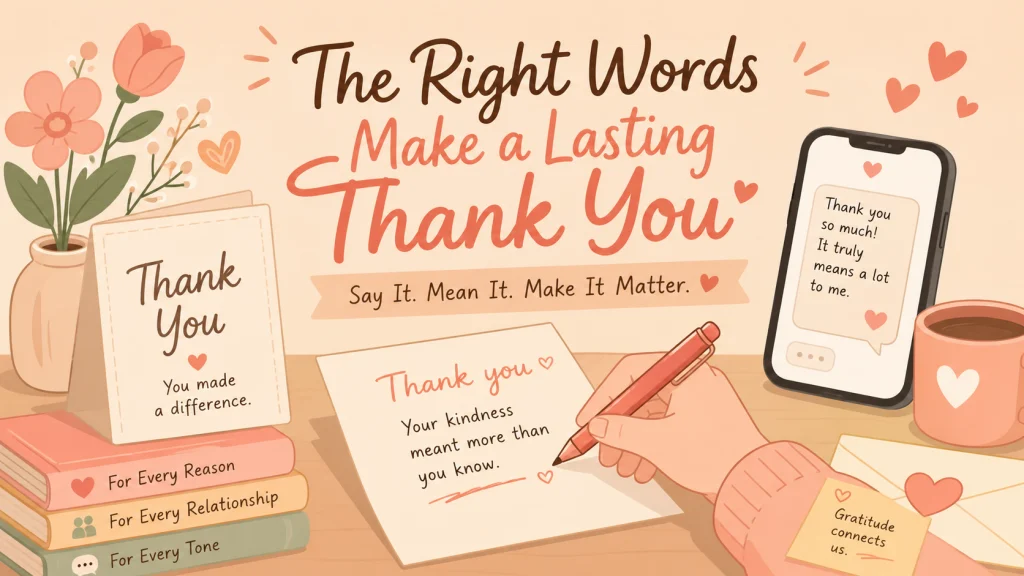
“Thank You” Is Two Words. The Rest Is Everything.
We say it dozens of times a day without thinking: to the cashier, to the driver, to the colleague who forwarded an email. What is harder is the version that actually means something. The one you send after someone showed up when they did not have to. The one that follows a gift you did not expect. The one that tries to say, without sounding like a greeting card, that what someone did changed something for you.
I have sat with a blank card more times than I can count, knowing exactly what I felt and having no idea how to write it. The feeling was not gratitude in the abstract. It was specific. It was for a particular person and a particular moment, and “thank you so much” felt like it missed entirely. That gap between what we feel and what we can actually write is the whole reason these thank you messages exist in the first place.
Most of the messages that fall flat share the same few problems:
- They are too careful and too long, hedging at every turn.
- They name the gift or the action but not what it meant.
- They reach for warmth and land on generic instead.
- They end with “it really means a lot” without saying what, exactly, it meant.
The fix is almost always the same: get specific, stay short, and trust the other person to feel the rest. The messages here are organized the way the moment usually presents itself, by format, reason, relationship, and tone. Start with what you already know.

Card or Text: Why the Format Shapes What Works
A card sits on a desk. A thank you text message disappears into a thread. Those are not just aesthetic differences; they are practical ones that change what will actually land. What reads as heartfelt in ink can feel flat on a screen, and what is just right in a message can come across as too casual when handwritten and placed inside an envelope.
For a card, there is room to slow down. One sentence to name what the person did. Another to say why it mattered. A third to close with something personal to that specific relationship. The structure almost writes itself when you stop trying to say everything at once. For a text, the same logic applies but compressed. A single sentence that lands cleanly does more than three sentences that soften and hedge and eventually say nothing.
If you are writing by hand and staring at the page, what to write in a thank you card breaks down exactly what belongs there and what is better left out. For the version that works as a quick message, short thank you messages are built for that format specifically.
The Reason You Are Writing Changes the Words
Most people are not searching for a thank you message in the abstract. They are looking for words for a specific thing someone did. Someone helped during a hard week. Someone gave a gift they did not have to give. A person who barely knew you did something kind and expected nothing back.
Each of those moments calls for something different. Gratitude for a gift wants to name the thing, say what it meant, and not linger too long. Gratitude for someone being there is more layered. It is not about an object but about time and presence, and that is harder to write without it sounding vague or somehow out of proportion. Gratitude for unexpected kindness has its own particular texture: you are thanking someone who did not have to, which means the message has to acknowledge that without making them uncomfortable about receiving it.
There is a message I almost did not send once, because I was not sure it would come across the right way. I sent it anyway, short and direct. The person told me later it was the only one that year that did not feel like a form letter. Specificity is almost always the thing that separates the ones that matter from the ones that get forgotten.
For the moments when someone showed up, thank you for being there messages focus on that quieter kind of presence, the kind that holds without needing to announce itself. After a gift, thank you messages for a gift cover everything from the simple to the deeply personal. When the kindness was unexpected, messages for unexpected kindness address that specific situation without making it bigger than it needs to be.

Who You Are Writing to Shapes the Register
A thank you to a parent is not the same as a thank you to a teacher, and neither of those sounds anything like a message to a colleague or a manager. The relationship sets the tone: how formal, how warm, how specific, how much can be left unsaid because it is already understood between two people.
Teachers, in my experience, are thanked frequently and generically. The messages blur together because most of them say the same things in the same order. The ones that teachers actually carry with them are the ones that name something specific: a moment in class, a piece of feedback that shifted how someone thought about something, a way of explaining an idea that finally made it click. Vague appreciation is kind but forgettable. A specific sentence is what stays.
Professional relationships add another layer. The warmth needs to be real, but the register has to hold a certain formality, especially when the relationship is newer or the hierarchy is clear. Getting that balance wrong in either direction, too stiff or too familiar, can undercut the message regardless of how genuine the gratitude behind it is.
Thank you messages for teachers are written with enough room to be specific rather than ceremonial. For workplace relationships and professional contexts, professional thank you messages handle the balance between warmth and appropriate register.
Heartfelt or With a Little Humor: Both Can Be Real
Not every thank you carries emotional weight, and it would be strange if it did. Some thank yous are for a friend who brought takeout when you were exhausted, or a sibling who covered for you without making a thing of it, or someone who did something kind and would clearly be embarrassed if you responded with something heavy. A too-serious message in those moments can land wrong, not because the gratitude is not genuine but because the tone does not match the relationship.
Humor in a thank you is not deflection. When it fits, it is its own form of warmth. It says: I know you well enough to know how you would rather receive this. The pattern I keep seeing is that the people we are most grateful for are sometimes the hardest to thank sincerely, not because the feeling is not there but because the relationship has always moved in a different register. Trying to shift it suddenly into something solemn can feel false to both of you. Matching the register is part of the respect.
For the moments that call for something with more emotional weight behind it, heartfelt thank you messages give you a better starting point than anything lighter would. When the relationship calls for something lighter and still genuine, funny thank you messages offer versions that land without tipping into something uncomfortable.

When Faith Is Part of the Gratitude
For some people, gratitude does not stop at the person being thanked. It moves through them toward something larger. A message rooted in faith is not just an acknowledgment of what someone did. It is a recognition that the kindness itself came from somewhere, that it was an expression of something beyond the ordinary exchange between two people.
Writing that kind of thank you asks for a particular kind of care. It needs to honor both the person and the faith without tipping into language that is too formal, too distant, or so general that it stops feeling personal. The best versions stay addressed to the individual even as they reach toward the larger meaning. That balance is what separates something that sounds like a blessing from something that actually feels like a note from one person to another.
Christian thank you messages keep that balance in mind, carrying the faith without losing the warmth of speaking to one specific person.
Start With the One That Fits
There is no universal thank you. There is only the version that fits this person, this moment, this particular relationship and what happened inside it. That is the whole reason these messages are organized the way they are, not by occasion alone but by the angle you are already approaching from.
If you are not sure where to start, start with the relationship. Who are you writing to? That will narrow it faster than anything else. Then the reason, then the tone. Most people find that once those three things are clear, the message practically writes itself. The stuck feeling almost always comes from trying to write before knowing what kind of message it needs to be.
For the quieter, everyday kinds of connection where gratitude is less about a single moment and more about someone’s presence over time, daily messages covers that territory in a different way. The right message is not the one that says the most. It is the one the other person will actually feel.
All the Ways to Say Thank You
Every angle on gratitude has its own particular challenges, and what works for one moment or relationship can feel wrong for another. The ten sections below cover the full range: from the format of the message to the person receiving it to the tone that fits where you two actually are. Pick the one that matches where you are starting from.
| Topic | What you will find there |
|---|---|
| What to Write in a Thank You Card | Structure and phrasing for handwritten notes, from the brief to the more personal. |
| Short Thank You Messages | Versions that work in a quick text or note without losing the sincerity. |
| Thank You for Being There Messages | For the people whose presence mattered more than anything specific they did. |
| Thank You Messages for a Gift | How to name the gift, say what it meant, and close without over-explaining. |
| Thank You for Unexpected Kindness | For when someone did something they did not have to, and you want to say so without making it awkward. |
| Thank You Messages for Teachers | Specific enough to stand out from the dozens of generic ones teachers receive. |
| Professional Thank You Messages | Warm but calibrated for workplace relationships, mentors, and colleagues. |
| Heartfelt Thank You Messages | For the moments that need real emotional weight, not just a kind word. |
| Funny Thank You Messages | Lighter versions for the relationships where humor is how warmth moves. |
| Christian Thank You Messages | Gratitude rooted in faith, written to feel personal rather than ceremonial. |
FAQs
💬 What should I say in a thank you message?
Name what the person did, say what it meant to you specifically, and close with something that feels personal to the relationship. Three sentences is usually enough. The more specific you are, the more it lands.
✍️ What do you write in a thank you card?
Open with the thing you are thanking them for. Say why it mattered. Close with something warm and personal. Avoid starting with “I wanted to thank you for” and avoid ending with “means a lot” without saying what, exactly, it meant.
📱 Is it okay to send a thank you by text?
For most situations, yes. The relationship and the context matter more than the format. A genuine text arrives faster and often feels more immediate than a card that takes a week to show up. If the occasion is formal or the gesture was significant, a handwritten note is worth the extra step.
🤔 How do you thank someone without sounding cheesy?
Skip the generic phrases: “words cannot express,” “from the bottom of my heart,” “truly blessed.” Name the specific thing they did and say what it actually changed or meant for you. Specificity is what separates genuine gratitude from something that reads like a template.
💌 What is the difference between a heartfelt and a funny thank you?
Mostly the relationship. A heartfelt message names something real and says it plainly. A funny message does the same thing through a different register. Both can be equally genuine. The one that fits is the one that matches how you and this person actually talk to each other.