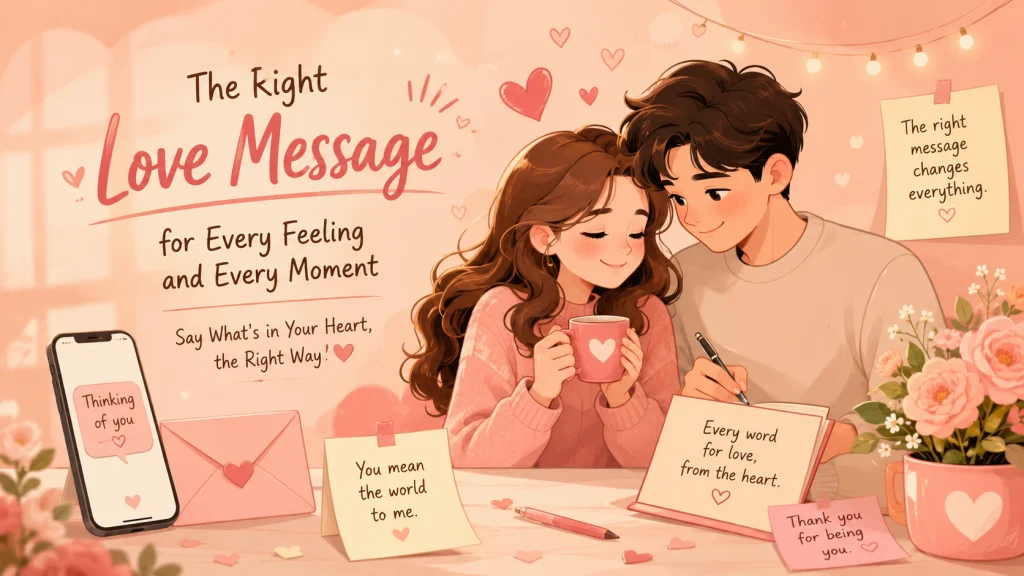
Love messages are not one thing. They are the short text that arrives on a quiet afternoon and stays with someone for the rest of the week, and the long paragraph rewritten twice at midnight before it finally gets sent. They are the words for love that is brand new and still tentative, and the ones for love that has been tested enough to know it is not going anywhere. What you will find here is where all of those versions live, sorted by what you are actually trying to say and who you are trying to say it to.
Love Is Not a Single Feeling, and the Words for It Are Not Either
The hardest part of writing love messages is not finding something to say. Most people have more than enough to say. The problem is that love does not stay in one register. Some days it is enormous and almost impossible to name. Other days it is quiet and specific, the kind that notices small things and wants the other person to know. The right message depends on which version of the feeling you are actually in, not on which version sounds the most romantic in the abstract.
I have written love messages that were too long, too formal, too careful, and once so precisely worded they needed three follow-up texts to explain. What I keep finding is that a message fails before a word is written when it starts from the wrong template. When it starts from the actual feeling, something closer to the right words tends to follow on its own. The goal here is not a list of formulas. It is helping you find the version of love you are in right now, and the words that belong to it.
When Casual Does Not Cover It: Depth and the Words That Go There
There is a kind of love that does not fit in a light or easy message. It has been accumulating for a long time. It has seen the person at their most tired and most difficult and not flinched. When you are trying to say something from that place, a casual text misses entirely. Not because the message is too small, but because it comes from the wrong depth.
Deep love messages are for exactly that. What makes them deep is not dramatic vocabulary. It is specificity. A message is deep when it names something real about this person and this relationship, something that could not have been written to anyone else. That distinction is what separates a message that actually reaches someone from one that only sounds serious.
Then there are the I love you messages, which carry their own particular weight. Those three words mean more to some people than others. For some, saying them plainly is exactly right. For others, the sentence needs something before or after it to feel complete rather than abrupt. Knowing which situation you are in matters before you write anything.
Writing for Someone Specific Changes Everything
A love message that works for anyone tends to feel like it was written for no one. The more a message reads as though it could have been sent to ten different people, the less it lands with the one who receives it. Writing for a specific person means starting from what is true about this particular love, not from what sounds like love in general.
The love messages for her guide takes this seriously, not as a formula but as a way of thinking about what a message needs when it is written for a woman you love in a specific way. The tendency is to go either very grand, which tips into performance, or very safe, which tips into generic. What tends to work is in between: honest, specific, and addressed to her rather than to the idea of her. A message that makes her feel genuinely seen is worth ten that could have been written for someone else.
Sweet Without Sounding Like It Came From a Card
Sweet has a reputation it does not deserve. People assume it means lightweight, something you reach for when you do not have anything real to say. That is not right. A message can be warm, tender, and uncomplicated while still carrying real weight. Sweetness done well is not the absence of depth. It is depth that is not trying to prove anything.
There is a sweet message I almost did not send once, because I thought it would come across as too small for what the moment was. I sent it anyway, two sentences, nothing dramatic. She told me later it was exactly what she needed that day. That is the thing about sweet: it often does more than you expect when you let it be what it is. The sweet love messages guide gets into where that line is, and how to stay on the right side of it without overcorrecting into something that just sounds pleasant.
Short or Long: Format Is Part of What You Are Saying
How long a message is tells the reader something before they have read a word. A paragraph says you sat with this. A single sentence says you knew exactly what to say and did not need more. Neither is better. But choosing the wrong format for the moment can make the right words land wrong anyway. A long, detailed message in response to something small can feel like pressure. A short one sent when more was needed can feel like an afterthought.
Whether you are writing love texts for an ordinary morning or longer romantic messages for a letter or a card, the format question matters as much as the content. Romantic love paragraphs are for the times when you have something to say that genuinely needs space. The challenge with longer messages is keeping them from becoming lists of things you love about the person, which sounds meaningful but often reads as inventory. Length works when each sentence earns the next one.
Short love messages are the other side of that. Some of the most effective ones I have seen were two sentences. Not because the writer had run out of things to say. Because they understood that saying less was saying more. There is a real skill in that, and it is not the same as being brief by default.

Where You Are in It Matters: New Love and Long Love
A love message written at the beginning of a relationship and one written years into it are not the same kind of thing, even when they are trying to say something similar. New love is still learning the other person, still marveling at specifics, still aware that nothing is settled. It tends to be more careful. That carefulness is not a flaw. It is honest about where things actually stand.
The new relationship love messages guide takes early-stage love seriously without treating it as a rehearsal for something more real later. The feelings are real. The uncertainty is real. The message needs to hold both of those things at once, without overclaiming or underplaying either one. I sent a message like that once, near the beginning of something that later became important to me. It was tentative and I knew it when I sent it. What I did not know was that the tentativeness itself, when it is genuine, has its own kind of weight.
Long love is different in specific ways. A couple with years between them has a private language that newer couples have not built yet. Messages in a long relationship can reference things no outsider would understand, and they are better for it. The risk in long love is not that the feeling has diminished. It is that expressing it starts to feel optional. The long-term relationship love messages guide is about writing from that accumulated history with intention, not habit.
How to Find the Version You Need
Most people arrive with a general sense of what they want to say and no clear path to how. That is fine. The question is not which type of love message sounds best in theory. It is which one matches what is actually true about what you feel and what the moment is asking for.
A few things that tend to clarify it:
- Who you are writing for. Writing for someone specific narrows the field immediately. Start with the person before you start with the tone.
- What stage you are in. New love and long love have different needs. The message that works in the first months is not the same as the one that works after years of shared history.
- How much space the moment calls for. A love text sent mid-morning lands differently than a paragraph written for an occasion. Format shapes what the message says before the content even starts.
- What you are actually trying to say. Depth, sweetness, and an I love you are not interchangeable. If you are carrying something enormous, a sweet message may not carry it. If you want warmth without weight, a deep one may not be right.
If you are not sure where love messages fit within a broader moment, love and relationship messages is where the larger picture lives. The table below is where the specific versions are.
Final Thoughts: The Right Message Is the One That Sounds Like You
Every version of a love message covered here has one thing in common: the ones that work are the ones that feel like they came from a real person in a real moment. Not because they use unusual words, but because they are grounded in something true and specific.
Whatever version you are looking for, that is the test worth applying. Not whether it sounds romantic enough or deep enough or long enough. Whether it sounds like you, writing to this person, from where you actually are. That is what closes the distance. Everything here is in service of helping you find it.
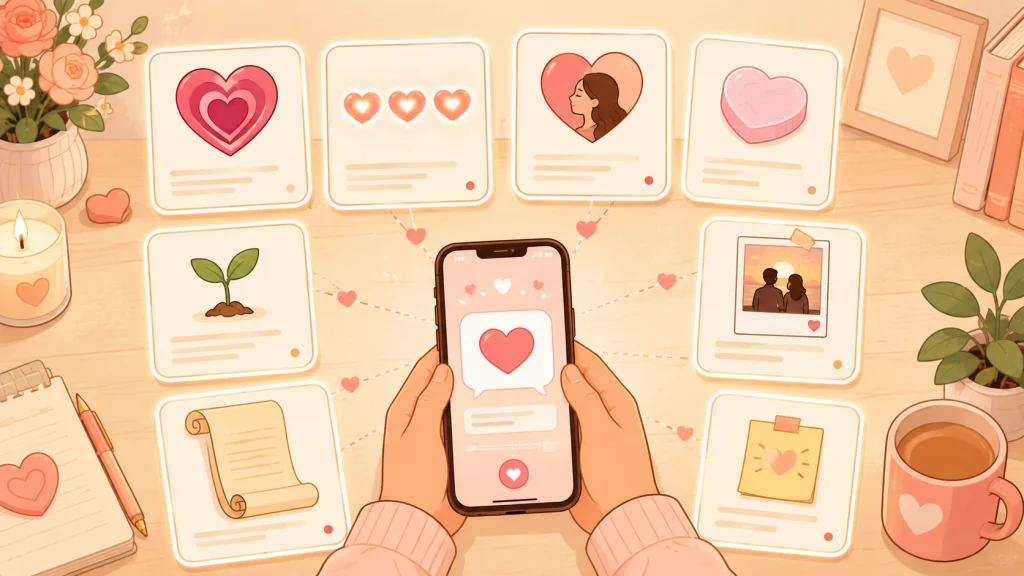
All the Versions, in One Place
Each of the specific love message types below has its own dedicated space, with honest guidance on what works in that context, what tends to go wrong, and how to write something that actually reaches the person on the other end.
| Type | What it covers |
|---|---|
| Deep Love Messages | When the feeling has been accumulating for a while and a casual message no longer carries it |
| I Love You Messages | Variations on those three words, for the moments when plain works and the ones when it needs something around it |
| Love Messages for Her | Writing for one specific person rather than for love as a general idea |
| Sweet Love Messages | Warm and tender without tipping into greeting card territory |
| New Relationship Love Messages | For early love that is real but still finding its footing |
| Long-Term Relationship Love Messages | Writing from accumulated history, with something to say that has been earned |
| Romantic Love Paragraphs | When you have something to say that a few sentences would cut short |
| Short Love Messages | When economy is the point, and the right sentence says everything a paragraph would |
FAQs
💬 What makes a love message feel real instead of generic?
Specificity. A message that could have been sent to ten different people usually lands with none of them. What makes a message feel real is something true only about this person, this relationship, this moment. It does not have to be elaborate. It just has to be yours.
📏 How long should a love message be?
As long as it needs to be, and not a word more. A single honest sentence is worth more than a paragraph filling space. The question to ask is whether each part of the message earns its place. If it reads the same without a sentence, cut it.
🌊 What is the difference between deep love messages and sweet ones?
A sweet message is warm and tender. A deep one is saying something with weight behind it, something that names the relationship rather than just the feeling. They are not opposites, and a message can be both. But if you are trying to reach someone at a different depth, sweet alone may not carry it.
✍️ How do you write romantic messages that do not sound awkward?
Read it out loud before you send it. If you would not say it in person, it will read awkwardly on screen too. Stop trying to sound romantic and write what you actually feel in plain language. Warmth comes from honesty more often than it comes from finding the right poetic phrase.
🤔 Is there ever a time when not sending a love message is the right call?
Yes. If you are sending something because you feel like you should, and the feeling is not actually there, the person receiving it will usually sense that. A message sent from the right place can close a lot of distance. One sent from obligation tends to create a different kind of it.