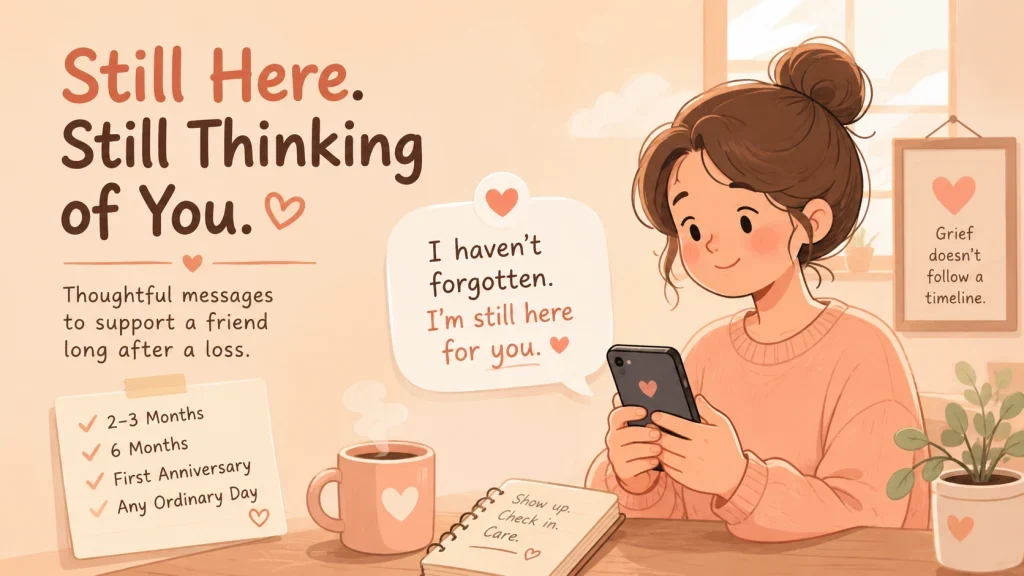
Most people show up in the first weeks after a loss. Very few are still showing up at month three, or month six, or on the first anniversary. These messages are for the people who want to be the rare kind of friend who still remembers when everyone else has moved on. They are organized by where someone is in that long, quiet stretch of grief that the world tends to stop acknowledging far too soon: the two-to-three month mark, the six-month stretch, the first anniversary, and the ordinary days in between that no one marks but are often the hardest. For broader context, see what to say to someone who is still grieving months later.
When Everyone Else Has Moved On
The funeral was months ago. The casseroles stopped coming. The calls slowed and then mostly stopped. Your friend is still grieving, just quietly now, the way grief tends to work once the world has decided it has been long enough. This is the part that almost nothing is written about, not because it doesn’t matter, but because most people don’t know what to say once the obvious window has closed and reaching out starts to feel strange. For related message ideas, see messages for ongoing grief.
What I’ve found, having been on both sides of this more than once, is that a message arriving months after a loss is almost always received as something close to a gift. The person grieving has often started to brace themselves for the silence, for the assumption that they should be okay by now, for the slow disappearing. A text that shows up at the three-month mark or the six-month mark, or on a random afternoon in month eight with no occasion attached, can land harder than anything sent in the first week. Not because the words are better. Because showing up at all at that point is the thing. It is rare enough to mean something.
This is a different kind of reaching out than the words you send in the immediate aftermath of a loss. If you’re still looking for something to say in those early days and weeks, there is a full set of messages for when a friend loses someone that covers that earlier stretch. What is here is for after. The months that follow, when most people have moved on, and a few haven’t.
Why This Is the Hardest Time to Reach Out, and the Most Important
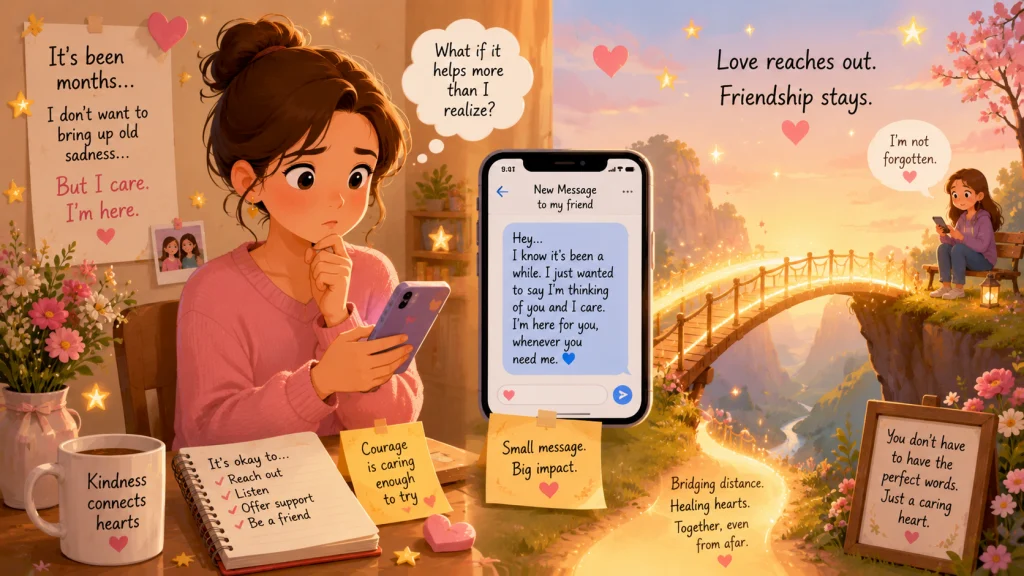
The strange thing about ongoing grief support is that it requires more courage than the immediate kind. When someone loses a person right now, reaching out is easy: the action matches the moment, it’s expected, there is a script. Reaching out four months later means overcoming the feeling that you’ve missed your window, that it might be strange, that they’re probably fine now and you’d just be dredging something up. Almost none of that is true. But it feels true, and that is why most people don’t do it.
The table below is a rough map of what tends to be happening at each stage, and the kind of tone that fits it. Every loss and every friendship is different, so treat it as a starting point rather than a formula.
| When You’re Reaching Out | What’s Often Happening for Them | What to Lead With |
|---|---|---|
| 2 to 3 months after the loss | Support has faded; grief moves in waves with no warning | “I’m still here” / “I haven’t forgotten” |
| Around 6 months | Quiet isolation; the world expects them to be okay by now | Acknowledge the time; let them know you still remember |
| First anniversary | The date itself carries enormous weight | Name the day directly; don’t pretend it’s a normal one |
| Ongoing, no specific date | Random hard days with no warning or reason | Low-pressure check-ins with nothing expected back |
The instinct to wait for a good reason to reach out is one of the things that keeps people from reaching out at all. An ordinary Tuesday in month seven can be harder than the day of the funeral. Thinking about them is reason enough.
What to Text Someone Grieving 2 to 3 Months After the Loss (10 Messages)
This is when the casseroles have stopped, the calls have slowed, and the person grieving has started to feel the loneliness of doing this without an audience. The world has moved on. They haven’t. That gap can feel to them like something is wrong with them, as if they should be further along by now. A message at this point that simply says “I’m still here” is not nothing. It is, for a lot of people, exactly what they needed to receive.
None of these demand a response, a performance, or any particular emotional state. They are just presence, on record, without conditions attached.
- I know the calls have probably slowed down by now. I haven’t. Still thinking about you.
- It’s been a few months. I just wanted to check in and remind you that I haven’t forgotten.
- The world moves fast. Your grief doesn’t have to. I’m still here whenever you need me.
- I was thinking about you this morning and wanted to say so. No need to respond.
- A few months in and I know this can be one of the lonelier stretches. Just wanted you to know I’m still around.
- Still thinking about you. Still here. Nothing else to add, just that.
- I know people stop asking after a while. I’m still asking, whenever you’re ready to talk.
- You don’t have to be okay. And you don’t have to convince me you are. Just checking in.
- Whatever today is like for you, I wanted you to know someone was thinking about you.
- Grief doesn’t follow anyone’s timeline except yours. I’m just here to say I’m not going anywhere.
Keep these short and send them. The message you keep rewriting for a week and never send may never reach them. These are enough exactly as they are.
What to Send Around 6 Months After: The Quiet Milestone (8 Messages)
The six-month mark tends to arrive without ceremony. The world has long since assumed the person is doing better, and the griever has often learned to perform being okay just to get through conversations. What they are rarely told is that this stretch can be one of the harder ones, precisely because the isolation is complete by now. Everyone has moved on. The loss hasn’t.
These messages acknowledge the time without treating it as a deadline or a checkpoint. They say: I know where you are, I know what this stretch is, and I’m still here in it with you.
- Six months is coming up. I’ve been thinking about you more as it gets closer.
- I know the six-month mark can feel like the world expects something from you that you can’t give. Just checking in.
- Half a year, and I’m still thinking about you. Some things don’t get smaller. They just change shape.
- I know this part can be one of the quieter ones, where people assume you’re okay because it’s been a while. I know better.
- Six months. I wanted to say something to mark it. I’m still thinking of you.
- I didn’t want this to pass without saying something. Still here, still with you.
- The world tends to forget that grief keeps going. I wanted to let you know I haven’t forgotten.
- Six months since you lost them. I’m still thinking about you on the hard days and the easy ones.
If you do not know exactly when the six-month mark falls, reaching out close to it is fine. The specific date matters far less than the fact that you reached out at all.

For the First Anniversary of the Loss: Messages That Acknowledge the Day (10 Messages)
The first anniversary of a death is one of the most loaded points in the calendar of grief, and it is often one of the most quietly isolated. Some people receive a wave of messages. Many receive nothing, because the people around them aren’t sure whether bringing it up is the right thing. It is almost always the right thing. The person already knows what day it is. Saying something does not make it heavier. Saying nothing can feel like they’ve been forgotten entirely.
These messages don’t try to make the day better. They name it, acknowledge it, and offer presence without asking anything in return. That is what the day calls for.
- I know what today is. I’ve been thinking about you all week, but especially today.
- A whole year. I can’t imagine what today feels like. I just wanted you to know I remembered.
- Today is one of those days I didn’t want to let pass without saying something. I’m thinking of you.
- One year. There is no good thing to say about that, except that I still love you and I still remember.
- I’ve been meaning to reach out all week. I didn’t want today to pass without saying: I remember, and I’m thinking of you.
- You’ve carried this for a whole year. That is not nothing. I just wanted you to know I see it.
- The first anniversary is one of the hardest things there is. I’m not going to pretend otherwise. I’m just here if you need me.
- A year since they died. I’m thinking about you today specifically, not just in general.
- I don’t expect you to be okay today. I’m just here.
- One year. I haven’t forgotten. I won’t.
Short is fine. The day is already heavy. A sentence or two that shows you remembered is more than most people will send, and more than enough.
For Ongoing Daily Grief: Simple Check-Ins That Don’t Demand They Be Okay (8 Messages)
Not every hard day has a name on the calendar. Grief has a way of arriving without warning in the middle of ordinary afternoons: a smell, a song, a Tuesday with no particular significance. These are often the hardest to talk about because there is nothing obvious to point to. People stop asking about these days because they assume the acute grief has passed. The person grieving knows otherwise.
These messages are for any day, any time, for no reason other than: you are still thinking about them, and you want them to know. They ask nothing back.
- Just thinking about you today. No reply needed.
- Checking in. Not because I expect an update, just because I wanted you to know I’m here.
- I saw something today that made me think of them. Just wanted to say that.
- Hi. Just a quick note to say I’m thinking about you and hoping your day is as okay as it can be.
- No agenda, no expectations. Just checking in.
- Still here. Still thinking about you. Still not going anywhere.
- Grief doesn’t have an end date. Neither does this friendship. Just wanted to remind you of that.
- Some days I just want to say hi and let you know you haven’t been forgotten. Today is one of them.
Send these on an ordinary afternoon. Send them on no occasion at all. The fact that there is no obvious reason to reach out is exactly what makes it matter.
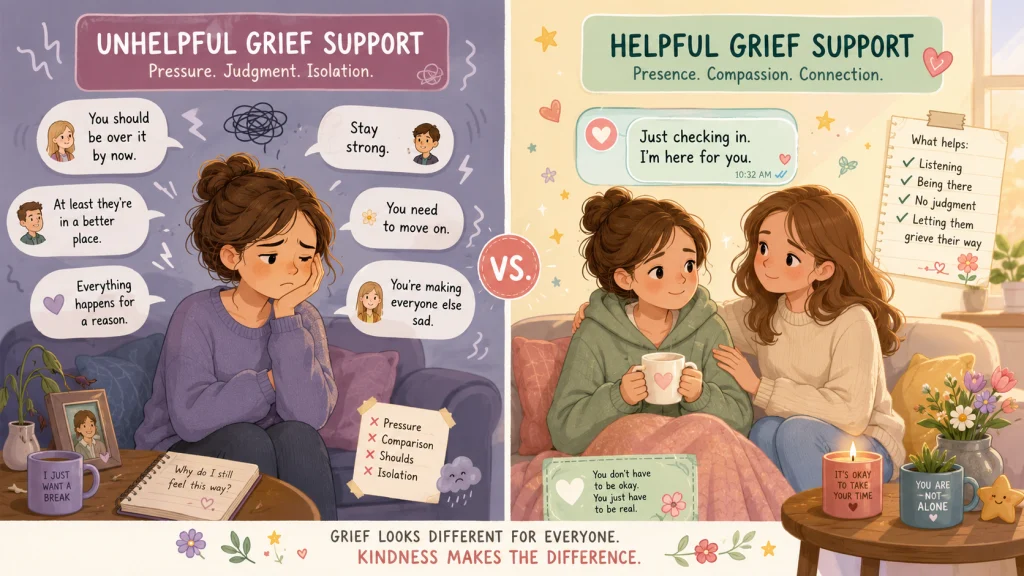
What Not to Do When Someone Is Still Grieving
There is a version of checking in that makes things harder. It usually happens when the person reaching out is trying to resolve their own discomfort rather than the griever’s isolation. It sounds like: “You should be focusing on the good memories now,” or “It’s been a while, are you feeling more like yourself?” or, most commonly, a check-in that expects the person to say they’re fine so the conversation can move forward. None of these are really reaching out. They are requests for the grieving person to manage someone else’s feelings about grief.
What actually helps is low-pressure presence: reaching out without an agenda, without an expectation of a particular response, and without a signal that the grief has gone on longer than it should. Most people who have grieved for a long time can describe the exact moment someone said the equivalent of “but it’s been months.” It tends to close something off. The words themselves are almost never the problem. The implication underneath them is.
The other pattern worth avoiding is checking in only on the marked occasions: the anniversary, the birthday, the holidays. Those dates matter and deserve acknowledgment. But they are also the days the grieving person already knows to brace for. The harder ones are often the random days with no warning. Showing up only on notable dates and going quiet in between still leaves a person alone most of the time. The real work of ongoing support looks less like remembering the anniversary and more like a text on a Wednesday for no reason at all.
For a broader range of words across different situations and relationship types, the sympathy messages collection is a good place to look when you’re not sure where to start.
Final Thoughts: The Message That Arrives Months Later
The text that says “I still remember” months after a loss is one of the more generous things one person can offer another. It costs very little: a few sentences, a few minutes, a willingness to acknowledge something difficult when the easier choice is to say nothing. It lands in a way that is hard to explain until you have received one yourself. The person on the other end is usually not expecting it. That is exactly what makes it matter.
None of the messages here need to be perfect. They just need to be sent. A short, honest text that arrives on a random afternoon in month four will do more than any carefully worded message you thought about sending for three weeks and then didn’t. Send the imperfect one. Send it today.
FAQs
💬 What do you say to someone who is still grieving months later?
Keep it simple and without expectation. “I’m still thinking about you” or “I know it’s been a few months and I just wanted to check in” is enough. The goal is not to say the perfect thing. The goal is to say something that lets them know they haven’t been forgotten. Short, warm, and with nothing required back.
🌅 How do you check in on a grieving person without making it awkward?
Send a message with no agenda attached. “Just thinking about you, no need to respond” removes the pressure entirely. Most of the awkwardness comes from expecting the grieving person to reassure you that they’re okay. Remove that expectation and most of the awkwardness goes with it.
📱 How often should you check in on someone who is grieving long-term?
More often than most people do, and without expecting a response each time. Once a month is a reasonable starting point, but the frequency matters less than the consistency. What matters most is reaching out beyond the obvious dates: not just the anniversary and the birthday, but the ordinary day in month five when there is no occasion at all.
🤔 What should you not say to someone who is still grieving?
Avoid anything that implies the grief has gone on longer than it should. “They’re in a better place,” “you should focus on the good memories,” and “it’s been a while, are you feeling more like yourself?” all signal, even unintentionally, that the grief is becoming inconvenient. What helps is saying something that makes room for however they are, not something that nudges them toward a different state.
💭 Is it okay to reach out on the anniversary of a loss?
Yes, and it means a great deal to most people. The grieving person already knows the date is coming. Saying something does not make it heavier. Saying nothing can feel like you’ve forgotten. A short message that simply names the day and says you’re thinking of them is exactly right. You do not need to say anything profound.
🌟 What if the person seems to be pushing people away?
Keep reaching out with less pressure, while still respecting any space they clearly ask for. Switch to messages that ask nothing: “Just wanted you to know I’m still thinking about you, no reply needed.” Some people pull back during long grief not because they want to be alone, but because they don’t have the energy to hold up their end of a conversation. A message that requires nothing except reading it is one of the few things that still lands. Keep sending those, quietly and without expecting anything back.