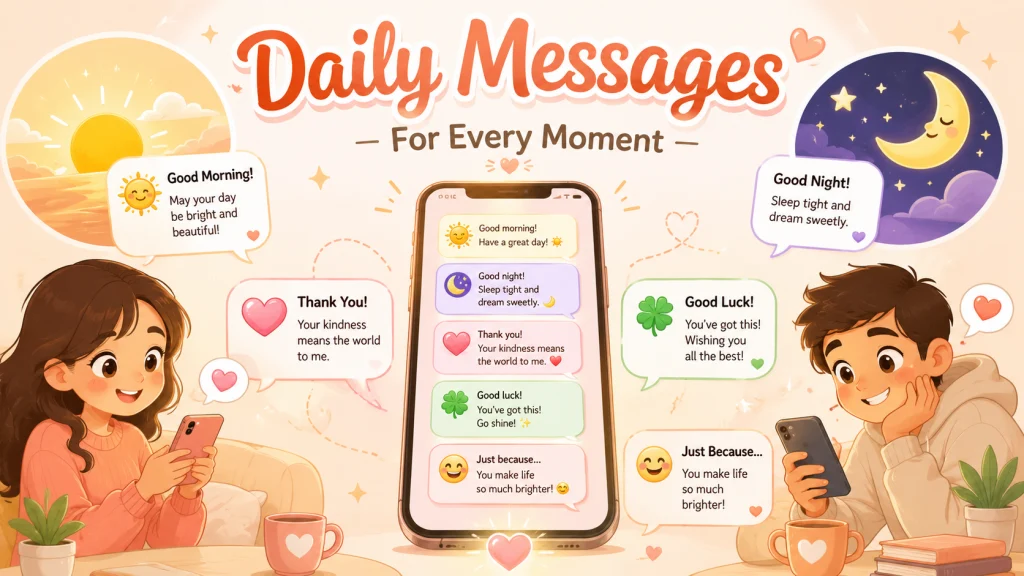
The messages most people underestimate are the daily ones: a good morning that arrives before the noise does, a thank you that finally gets said out loud, a good night that closes a hard day with intention, a just-because text that carries no occasion and more weight than almost anything else you could send. These are the everyday messages that accumulate over time into something that looks, in retrospect, like a relationship that was genuinely tended to. What follows is where to find the words for all of them, organized by the moment they belong to.
The Messages You Keep Almost Sending
Daily messages tend to live in a category people feel they should already know how to write. And yet. A good morning sits in the draft folder for twenty minutes because it feels too small, or too much, and then the moment passes. A thank you never gets sent because it has been a week and now it seems late. A good night text gets replaced with a thumbs-up emoji because nothing else seemed right in the moment. A good luck message goes out as two words and a prayer emoji when the person deserved more than that.
I have sent all of these wrong versions. I have also watched, enough times to believe it, how differently things go when you send the right one. The messages to send daily are harder to write not because they require more skill than special-occasion messages, but because there is no occasion behind them. No social prompt. No external pressure that says now is the time. Just the choice to say something. And that choice, the act of making it, is almost never the wrong one.
What I keep noticing is that the messages people describe as the most meaningful are rarely the ones sent at milestone moments. Not the birthday cards, not the congratulations. It is the everyday messages: the good morning that arrived on a Tuesday when someone was already dreading the week. The thank you that finally named something true. The text sent for no reason other than that someone was thought of. Morning and night messages, gratitude, encouragement, the ones sent with no occasion at all. These are the five areas this covers. Each one is below, with the words for every version of it.
- Good morning messages: for the first moment of someone’s day, across every relationship and every kind of morning.
- Good night messages: for the last thing someone reads before sleep, from romantic to funny to the end of a genuinely hard day.
- Thank you messages: for gratitude that goes past the surface, in cards, texts, and the moments when thank you does not feel like enough.
- Good luck messages: for the exams, the interviews, the surgeries, the first days, and every moment someone is walking into something difficult.
- Messages to brighten someone’s day: for the ones sent with no reason except that you thought of someone and did not talk yourself out of it.

Good Morning Messages
A good morning message is not just a greeting. It is the first voice that arrives before the day’s noise begins, and depending on why you are sending it, it carries entirely different weight. I used to send them the way most people do: a few words, usually the same words, at roughly the same time every day. Then I noticed that the morning messages I remembered receiving were never the routine ones. They were the ones that said something specific. The one that acknowledged what I had mentioned the night before. The one from a friend in a different time zone who had done the math. The one that arrived on a morning I already knew was going to be hard.
The context of a morning message changes what it needs to be. Something for a romantic partner in a new relationship sounds nothing like the same message to a spouse of ten years. A funny good morning for someone who genuinely hates being awake before nine works for a different reason than an inspirational one for someone trying to believe the week is worth showing up to. A faith-based morning message for an anxious day needs different words than a short check-in sent across a time zone just to say you thought of someone first.
For all of these, organized by the relationship and the reason behind them, good morning messages for every relationship and every kind of day has the full range. Whether the morning is hard or hopeful, whether the relationship is new or long, whether you need two sentences or twenty, that is where to start.
Good Night Messages
If a good morning message is the first voice of the day, a good night message is the last. It lands differently for exactly that reason. There is something specific about the message a person reads before they close their eyes. It tends to stay longer than anything else sent that day. The tone matters more at night than it does in the morning because there is no remaining day to reset the impression. A good night text sent with intention, one that acknowledges what the day actually was, lands in a way that a generic sleep well never does.
The version that works is the one that does not pretend. Ending a hard day with a message that says I know what today was for you is different from one that says have a great night. Closing an ordinary evening with something warm and specific is different from closing it with two words and an emoji. And a funny good night sent to someone who has been difficult since dinner serves a completely different purpose from a message of quiet comfort to someone who is facing something real.
The right words depend on the relationship and what the day actually held. For the romantic, the long-distance, the funny, the faithful, and the ones meant to close a day that could not be fixed, good night messages for every relationship and the end of every kind of day has them organized by what you are actually closing the day with.
Thank You Messages
Thank you is one of the most underdone messages most people send. Not because people are ungrateful, but because the instinct is to say it quickly and move on, which produces thank yous that are technically correct and somehow empty. The recipient reads it, registers that you sent it, and has nothing to hold onto by the end of the day. I know this from the wrong end of the experience. I wrote versions of this for years before I understood what the difference was.
The shift is small but it changes everything: instead of thanking someone for what they did, you thank them for what it revealed about who they are. Thank you for the gift becomes thank you for knowing me well enough to know I needed exactly that. Thank you for being there becomes thank you for showing up before I knew how to ask. That distinction moves the message from a receipt to something that actually means something. It works in a card, in a text, in a professional note, and in the gratitude that has been sitting unvoiced for longer than it should have.
Whether you are writing in a card, texting a friend who showed up during something hard, thanking a teacher who changed something quietly, or trying to say something to a stranger whose generosity surprised you, thank you messages for every reason, every relationship, and every level of gratitude is organized by what you are actually trying to say, not just the occasion behind it.
Good Luck Messages
Good luck is one of the most reflexive messages people send, and one of the least useful. It says: I hope chance is on your side. What most people actually mean is: I believe in you, I know what you have done to prepare, I am with you even though I cannot be there. Those are completely different things. And they produce completely different messages when you let yourself write them.
The context matters here more than almost anywhere else. The night before an exam needs different words from the morning of the same exam. A message for someone who is terrified and one for someone who is ready are not interchangeable. The good luck sent before a job interview, a first day of work, a surgery, or a performance all have different emotional stakes, and the best message for each one acknowledges what is actually at stake rather than covering it with a generic best of luck.
I sent someone a two-word good luck text before one of the hardest professional moments of her life. She told me later it was fine, and I could tell she meant it the way people mean it when they are being kind. What she needed was something that named what she was walking into. I have not made that mistake since. For every version of pre-event encouragement, from the specific and the vision-based to the funny and the short, good luck messages that go beyond good luck is where the right words are.

Messages to Brighten Someone’s Day
This is the category with no occasion behind it. No birthday, no hard moment to respond to, no milestone to mark. Just the decision to send something because a person crossed your mind and you did not talk yourself out of it. These are also, in my experience, the messages people describe as the most unexpected and the most meaningful precisely because of that. The birthday message everyone sends is expected. The text on a Wednesday afternoon that says I thought of you today is not. That gap between expected and unexpected is where a lot of the weight lives.
The range here is wider than most people assume. A compliment that names something specific about who someone is. An appreciation that has been sitting in your head for months without ever being said out loud. An affirmation for someone who is going through something quiet and hard and needs to know they are not invisible to you. A funny text with no context. A just-because message to a family member you have not called in too long. None of these need an occasion. They just need the decision to send them.
The challenge is knowing what to say when nothing has prompted it. For all of these, from the compliments that land to the appreciations that finally get voiced, messages to brighten someone’s day, for no reason and no occasion has the words organized by what you are actually trying to do.
Final Thoughts: The Message You Keep Not Sending
There is a version of every message in this space that someone sent and a version that they did not. The ones that were sent imperfectly, or too late, or on a Tuesday for no reason at all, are almost never the ones people regret. What I have found, more times than I can easily count, is that the messages people regret are the ones that went undrafted entirely. The ones that had no occasion to force the moment, so the moment never came.
The accumulation of those unsent messages is what the distance between people is actually made of. The words for every version of the daily message are here. The only thing left is the moment you decide to send one.
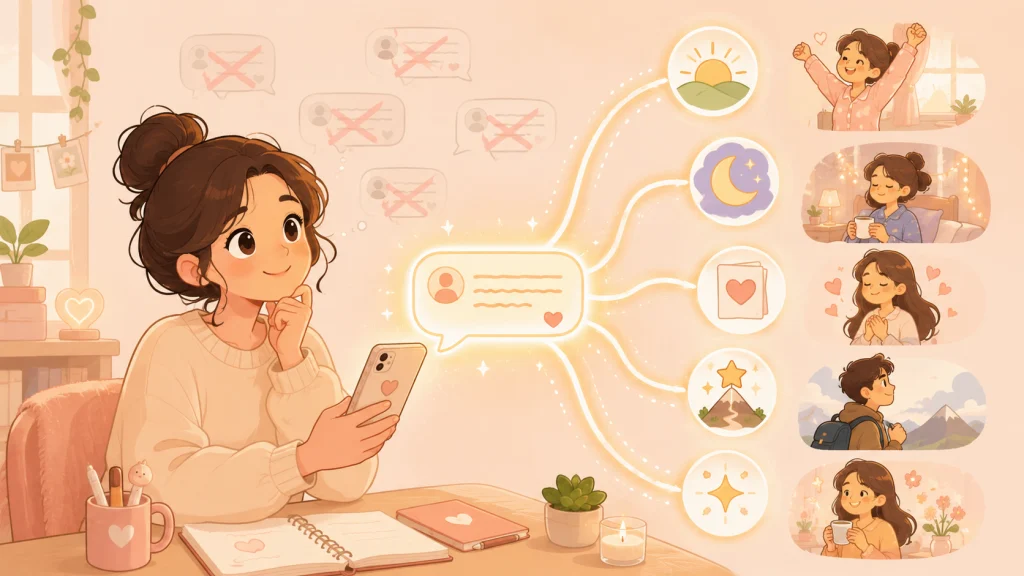
How to Choose the Right Daily Message
The easiest way to find what you need is to start with what is happening for the person you are thinking about right now. The right message is less about what you want to say and more about where they are in their day.
If they are waking up and the day ahead is already on your mind for them, start with good morning. If you want to close the day with something that tells them they are thought of before they sleep, that is good night. If someone did something for you and the thank you has been sitting unvoiced longer than it should have, that is the thank you category. If they are walking into something difficult, an exam, a conversation, a first day, a medical appointment, the good luck section is where the specific encouragement lives. And if none of those apply, if you simply thought of someone and want them to know it, the messages with no occasion at all are the ones that tend to land the hardest.
Where to Find What You Need
Each area below covers a full range of messages for that specific moment, organized by relationship, context, tone, and occasion. Start with the one that matches what you are trying to say right now.
| Category | What It Covers |
|---|---|
| Good Morning Messages for Every Relationship and Every Kind of Day | Romantic, friendship, long-distance, funny, inspirational, faith-based, short, and morning messages for hard days, organized by who you are sending to and why. |
| Good Night Messages for Every Relationship and the End of Every Kind of Day | Romantic and friendship good nights, sweet dreams, funny, faith-based, long-distance, and messages to close a day that was genuinely difficult. |
| Thank You Messages for Every Reason, Every Relationship, and Every Level of Gratitude | Card writing, short messages, gratitude for someone who showed up, professional thank yous, teacher appreciation, gift thank yous, heartfelt, funny, and faith-rooted. |
| Good Luck Messages That Go Beyond Good Luck | Exams, job interviews, surgery, first days at work, performances, funny good luck, you’ve got this messages, and break-a-leg for performers. |
| Messages to Brighten Someone’s Day: No Reason, No Occasion, Just Because | Messages to make someone smile, appreciation, affirmations, just-because texts, random compliments for friends, and declarations for the people who mean everything. |
FAQs
💬 What counts as a daily message?
Any message sent as part of the ordinary texture of a relationship rather than in response to a milestone or crisis. Good mornings, good nights, thank yous, pre-event encouragement, and the unprompted texts sent just because you thought of someone. These are the messages that build something over time without anyone announcing that they are doing it.
🌅 How is a good morning message different from a regular check-in?
A check-in asks how someone is doing. A good morning message tells them you thought of them before the day started. The difference is directional: one is a question, the other is a gift. Neither is wrong, but they do different things.
🙏 How do you write a thank you that doesn’t sound like a form letter?
Name one specific thing they did, then name what it meant or what it changed for you. The formula is that simple, and it almost never fails. Generic thank yous stay at the level of the action. Specific ones get to the level of the person.
🍀 Should you send good luck the night before or the morning of?
Both, if you can. The night-before message is about calm and rest. The morning-of message is about focus. They serve different purposes for the same person at different points in their anxiety. If you can only send one, match it to what you know about how that person handles the hours before something big.
✨ What do you send when you have no reason, just want someone to know you’re thinking of them?
Something short and honest. The absence of a reason is the reason, and you do not need to explain or justify it. “I thought of you today” is enough. What makes these messages land is that they were not required. That is the whole point of sending them.
🌙 Is it okay to send a good night message to a friend, not just a partner?
Yes, and it is underused in friendships. A good night that says I know today was hard for you is something most people would not expect from a friend and would not forget for a while. The intimacy level adjusts to the relationship; the warmth does not have to.