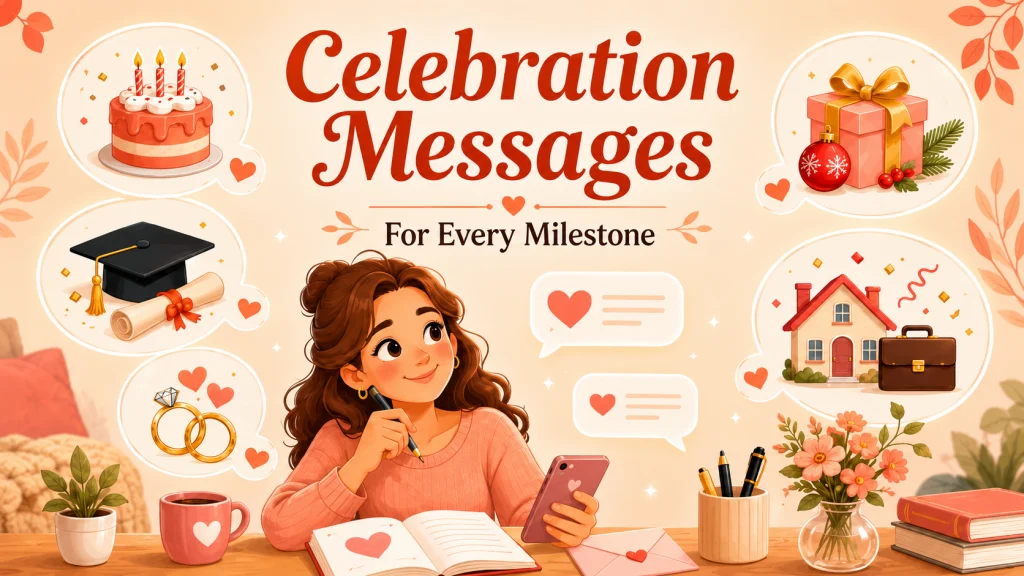
Celebration messages cover more emotional ground than most people expect when they sit down to write one. A birthday message for a childhood friend calls for something entirely different from one written for a manager you respect but barely know, and a graduation note for a kindergartener is a different task entirely from one sent to someone finishing a doctorate. The feeling is almost always clear. The words are what require work. This page is organized by occasion so you can move quickly to the angle that actually fits what you need.
Every Milestone Needs the Right Words
Every milestone needs the right words. Here is where to find them. That sounds simple enough, but the work of finding celebration messages that actually say something, rather than words that gesture in the direction of the occasion and stop there, is harder than most people expect until they are the ones holding the pen or staring at a blank text field with a good intention and nothing to put behind it.
I have written a lot of these messages from places that were never quite right for the moment: hotel lobbies, airport gates, time zones that put me hours behind the birthday or the anniversary or the thing I wanted to acknowledge. What I have figured out, slowly and sometimes the hard way, is that knowing what to write for a celebration is not really a vocabulary problem. The words are not what trip people up. What is hard is finding the one true thing and then stopping before it gets buried under qualifications and warmth that belong to no one in particular. Milestone messages fail in recognizable ways, and those ways are different depending on the occasion. The table below is a quick orientation to what each category needs and where things most commonly go sideways.
| Occasion | What the message needs to do | What usually goes wrong |
|---|---|---|
| Birthday | Name one specific thing about this person or this year | Phrases so familiar they have lost all their weight |
| Graduation | Acknowledge the work behind the moment, not just the moment itself | Projecting excitement the graduate may not actually be feeling |
| Anniversary | Name something specific to this couple or this particular year together | Sentimental language that could apply to any relationship in existence |
| Holiday | Sound like it was written for this specific person | A message that could have been sent to anyone on the contact list |
| Congratulations | Name what happened and say one honest thing about why it matters | Length that outweighs the actual meaning inside it |
Each of those categories has its own emotional register, its own version of the right thing to say, and its own set of situations that pull in completely different directions. The sections below take them one at a time.
Birthday Messages: Every Format, Situation, and Tone
Birthday messages are the most common kind of celebration writing, and the most likely to end up reading like a form letter. Not because people do not care. It is because certain phrases have been in circulation for so long that they arrive before a more specific thought can form. “Hope you have an amazing day.” “Wishing you all the best.” “Happy birthday, you deserve the world.” By the time those celebration wishes reach someone’s screen, they may have already read them a half dozen times that morning. The phrases are kind. They are just not specific to anyone.
What makes birthday writing genuinely difficult is how much the problem changes depending on who you are writing to and what format you are writing in. These are not the same challenge:
- Writing in a physical card means working within limited space, with a pen in your hand, and no ability to edit after you have already written it
- Texting a close friend allows for a looser, more personal tone that would feel odd or overfamiliar in a card
- A milestone birthday, a thirtieth, a fiftieth, a seventy-fifth, carries a particular weight that a simple “happy birthday” may not be built to hold
- Writing for someone you are not especially close to, a coworker, an acquaintance, a friend of a friend, requires warmth without reaching for false intimacy
- Writing when the birthday falls in a genuinely hard year requires something more honest than cheerfulness performed over the top of what the person is actually going through
Each of those calls for a different approach entirely. The birthday messages section is organized by format, tone, relationship, and milestone so you can move directly to the version that fits the birthday in front of you, rather than having to sort through everything at once. Graduation presents an entirely different kind of writing challenge, and the reasons are worth understanding before you try to write for it.
Graduation Messages: From Kindergarten to Cap and Gown
Graduation occupies a strange emotional position, which is part of why it is harder to write for than it looks. It is supposed to be a celebration, and it usually is. But underneath the celebration is almost always something more layered: exhaustion, relief, grief for what is ending, and real uncertainty about what is about to begin. A message that lands purely on congratulations and ignores the rest can feel true and also slightly beside the point, as if it is celebrating the version of the moment the writer imagined rather than the one the graduate is actually living inside.
What changes the message significantly is the level of school and the relationship between sender and graduate. A note for a kindergarten graduation is warm and simple and written as much for the parents as for the child. A message for someone finishing a law degree or a doctorate is written for a person who spent years inside something difficult, and may feel more relief than triumph at the end of it. Between those two points, from elementary school through high school and into graduate programs, the emotional register shifts completely. The graduation messages section covers that full range, with attention to both the milestone being marked and who is doing the writing. Anniversary messages present yet another version of this problem, one shaped by a different question entirely.
Anniversary Messages: From Year One to Year Fifty
Anniversary messages are unusual in one specific way: who is sending the message matters almost as much as who is receiving it, in a way that most other celebration writing does not demand. A message from one partner to the other is intimate and rooted in a shared history that only two people have access to. A message from a friend or family member celebrating the couple is warm but written from outside the relationship, from a vantage point with different access and very different emotional stakes. Both are anniversary messages. They require completely different words, and the mistake of writing one as though it were the other is easy to make and hard to recover from.
The milestone year also changes what the message should do. In the first year, an anniversary message is something like proof: evidence that the relationship held through a full rotation of the calendar, and the words can carry a lightness that belongs to early things. By the twentieth or thirtieth year, the message is doing something more weighted: acknowledging duration, honoring what has been built, naming what has changed and what has quietly remained. At fifty years, it is something else again. That full range, from the first anniversary to the fiftieth and everything between, is what the anniversary messages section covers, organized around both who is writing and how long the relationship has been. Holiday messages introduce a completely different challenge, one rooted less in intimacy and more in volume.

Holiday Messages: More Than the Season
Holiday messages have a volume problem. They arrive in batches. They tend to use the same language. They compete for attention at precisely the moment when everyone else is doing the same thing, sending the same seasonal phrases to everyone on their list. That is what makes a holiday message that actually lands feel like such a small, specific thing. It is the one that reads like it was written for this person, not assembled for the occasion.
Christmas, Valentine’s Day, Mother’s Day, Father’s Day, Thanksgiving, and the New Year each require a different approach, and within each holiday the relationship changes what the message should do. A Christmas message to someone you have not spoken to in two years is not the same as one to someone you will share a table with the following morning. A Valentine’s Day message at the beginning of a relationship, when everything is still slightly uncertain and new, is nothing like one written after fifteen years together. Those distinctions, the different tones required for different holidays and for different relationships within each of them, are what the holiday messages section works through, so you can find the version that fits rather than defaulting to whatever phrase forms first. Congratulations messages ask a similar question from a different angle.
Congratulations Messages: When Achievement Needs Words
Congratulations messages for special occasions cover an enormous range of milestones: a new job, a promotion, a new baby, a home purchase, an engagement. What they share is that the person receiving the message has crossed some kind of threshold, and the message is meant to mark that crossing. What they do not share is much else. The emotional context of a new job announcement is completely different from the emotional context of a birth, and the words that fit one will rarely fit the other. Organizing by milestone is not a convenience; it changes what you actually say.
I remember sending a congratulations message once that I had spent too long writing. I was trying to capture the full significance of what the person had accomplished, and the message ended up long and slightly overwrought. She was kind about it. But what I should have sent was three sentences: what happened, why it mattered specifically to this person, and something honest about what I hoped for her next. That is the shape most congratulations messages work best in, and it is harder to land than it looks because the instinct is almost always to say more. The congratulations messages section covers new jobs, new babies, promotions, new homes, and more, organized by milestone so you can find the version that actually fits without having to wade through everything that does not.
Final Thoughts: Before You Start Writing
A celebration message does not need to be long or perfectly constructed. What the best ones share is not elegance: it is that they sound like they came from a real person who noticed a real moment. The impulse to say more, to cover every feeling, to make sure nothing is missed, almost always works against that. The extra words rarely carry the weight we try to put them in to carry.
Whatever you are writing for, the categories above are the right place to start. Not the blank card or the blinking cursor, but the specific section that fits the occasion in front of you. Each one is organized to get you to a useful starting point without having to sort through everything that does not apply.

Every Occasion, in One Place
Each section below covers one category of celebration writing in full: the situations that come up within it, the tones that fit, and the angles that actually differentiate one message from the next. If you know the occasion but not the tone or format, start with the category and narrow from there. If the moment carries real emotional weight, like a birthday that falls in a difficult year, an anniversary for a relationship that has been through something hard, or a graduation that feels more complicated than triumphant, the relevant section will have a part built for that. If you need something quickly, the format and relationship filters inside each category will get you to a specific starting point without having to read through everything that does not apply.
| Occasion | What you will find there |
|---|---|
| Birthday Messages | Organized by format, tone, relationship, and milestone so you can skip to the angle that actually fits the birthday in front of you |
| Graduation Messages | Covers every level from kindergarten through graduate school, with separate sections for different senders and different emotional registers |
| Anniversary Messages | Addresses both partners writing to each other and outside senders celebrating the couple, organized by milestone year |
| Holiday Messages | Separates major holidays by their distinct emotional registers and the different relationships within each one |
| Congratulations Messages | Organized by milestone so the right version for a new job, a baby, a promotion, or a new home is easy to find |
FAQs
🎉 What makes a good celebration message?
It sounds like it was written for this specific person rather than assembled for the occasion. That usually comes from one detail: something about the relationship, a reference to what this milestone actually means for them, or a word that only someone who knows them would think to use. Brief and grounded in the real relationship gets further than long and thoroughly worded.
📝 How long should a celebration message be?
Shorter than most people expect. Three to five sentences is almost always enough. The length should match the relationship and the occasion, not a sense of obligation. A card message for a coworker can be two lines. A birthday paragraph for someone you are close to can run longer, but only if every sentence is doing something real.
💬 What do you say in a celebration message when you do not know what to say?
Start with what is actually true: why this person or this moment matters to you. You do not have to say everything. Name the one thing that feels most honest and say it directly. The simplest version is usually the one that reaches people.
🤝 What is the difference between a celebration message and a congratulations message?
Celebration messages cover occasions more broadly: birthdays, anniversaries, graduations, holidays. Congratulations messages are specifically for achievements, a promotion, a new job, a baby, a home. The emotional territory overlaps, but the context changes what you say and how specific you need to be about the thing that actually happened.
🎂 How do you write a celebration message for someone you are not very close to?
Keep it warm and honest about the distance between you. Acknowledge the occasion, say something genuine, and do not reach for intimacy that is not there. The goal is for the person to feel noticed, not for the message to perform a closeness that does not exist in the relationship.