Most sympathy cards say the same four things, and most of them land the same way: appreciated for a moment, then set aside. The ones that stay with people do something different. They meet the person where they actually are in their grief, not where we imagine grief should be. These messages are organized by grief phase, because what helps in the first raw days is not the same as what helps three weeks later, when everyone else has moved on and the quiet has settled in. The card matters. The timing matters just as much.
You Have the Card. Here Is What to Write.
The card is in your hands. The pen is ready. And suddenly the blank space inside it feels impossible.
This is one of the most common things I hear from people trying to help someone who is grieving: not that they don’t care, but that they can’t put the care into words without it sounding hollow, borrowed, or small. The feelings are real. The words won’t come. And the longer you sit with the blank card, the worse it gets.
What to write in a sympathy card is one of those questions that sounds simple until you’re actually there, pen in hand, trying to say something that doesn’t sound like every other card the person is going to receive. You want to say something real. You just don’t know what that looks like on paper.
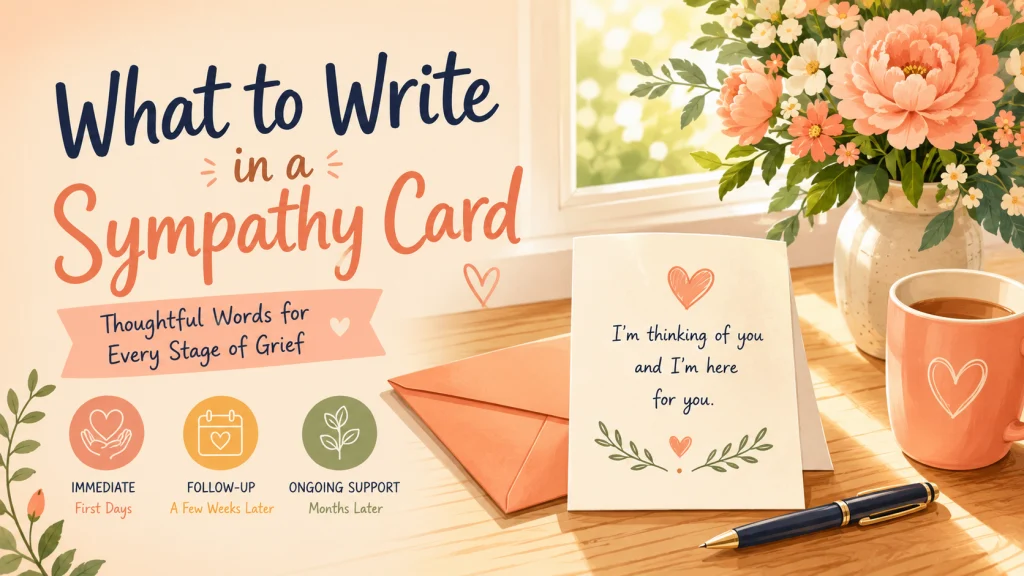
The approach here is organized differently from most lists of sympathy card messages. Most are sorted by relationship or tone. What I’ve found, over and over, is that timing matters more than almost any of that. A card sent the day after a loss calls for something different from one sent three weeks later, when the sympathy flowers have died and the world has quietly moved back to normal. The messages below are organized by grief phase for exactly that reason. If you’re looking for more on what to say across other moments and formats, there is a broader set of sympathy messages for loss and grief that covers texts, calls, and longer conversations.
If you want to write your own message rather than use one of the examples below, a simple three-part structure works for almost any phase: acknowledge the loss directly, name your care for the person without conditions, and offer presence without pressure. That’s it. Most of the messages in this collection follow some version of that shape, even when it isn’t obvious.
| Grief phase | What the card should do | Tone to aim for |
|---|---|---|
| First days (within a week) | Acknowledge the loss. Show up. Say you’re there. | Simple, direct, present |
| A few weeks later | Remind them they haven’t been forgotten | Warm, unhurried, specific |
| Months later | Name the quiet grief others have stopped asking about | Gentle, patient, honest |
The table above is a rough frame, not a rigid rule. Some people grieve quickly and openly. Others carry it quietly for a long time. What you know about the person you’re writing to matters more than any chart. But if you’re uncertain, the phase-based approach gives you a better starting point than tone or relationship alone.

What to Write When the Loss Just Happened
In the first days after a loss, the person you’re writing to is almost certainly surrounded by things to do and no space to feel any of them. Phone calls to make, arrangements to handle, a steady stream of people who mean well but take up energy. A card that arrives in this window doesn’t need to say much. It needs to say: I know. I’m here. That’s it.
The mistake most people make in immediate condolence cards is trying to say too much. They explain, reassure, and offer comfort in ways that slide past the reality of what just happened. The better move is almost always simpler. Name the loss, say you’re sorry, and let that be enough. One more thing that makes a real difference: when you use their name, or the name of the person who died, the card stops feeling like a form letter. “I’m thinking of you and [Name]” does something that “I’m thinking of you and your family” simply doesn’t.
These ten messages are written for that first week:
- I am so deeply sorry for your loss. [Name] meant so much to so many people, and I know this grief is real and heavy.
- There are no words for a loss like this. I’m holding you in my thoughts and wishing I could do more.
- I don’t know what to say except that I love you and I’m here, for whatever that’s worth right now.
- Thinking of you and your family every single day. I’m so sorry.
- I’m heartbroken for you. Please know you don’t have to go through this alone.
- What [Name] meant to you, and to all of us, does not end here.
- I’m so sorry. I’m here whenever you need anything, and also whenever you don’t, just to sit with you.
- This is such a hard loss. I’m thinking of you more than you know.
- I’m holding you close in my heart right now. All my love to you.
- No words feel adequate. I know I can’t fully understand what you’re carrying right now, but I’m not going anywhere.
You don’t need to pick the most beautiful message on that list. Pick the one that sounds most like you. A card that sounds like the person who sent it will always land better than one that sounds like it came from a greeting card writer.

What to Write a Few Weeks After the Loss
This section is the one most people skip over, and it’s the one that often matters most.
The first wave of sympathy cards arrives within the first two weeks. They’re appreciated, genuinely. But then the flowers die, the casseroles stop coming, and everyone else’s life picks back up. The grief doesn’t follow that schedule. For many people, it deepens in the weeks after the funeral, once the distraction of arrangements and visitors has lifted and they’re finally alone with the loss.
A card sent three or four weeks after, or even a month later, carries a different weight entirely. It says: I haven’t forgotten. The world moved on, but I’m still thinking about you. That message, sent at the right moment, can mean more than a dozen cards that arrived in the first week.
I sent something like this once, about six weeks after a friend’s mother died. I’d almost talked myself out of it, thinking it was too late, that it might feel like I was dredging something up. I sent it anyway. She told me later it arrived on a day when she hadn’t heard from anyone and had started to feel invisible in her grief. One card, six weeks late, did something nothing earlier had managed to do. I think about that every time I hesitate to send something. If you’ve found the right words of comfort but worried the moment has passed, it almost certainly hasn’t.
These eight messages are written for that later window:
- I’ve been thinking about you. The world has moved on a little, but I haven’t.
- I know the first wave of support often passes before the grief does. I just wanted you to know I’m still here.
- I’ve been checking in on you quietly from here. I hope you’re finding small moments of peace in between the hard ones.
- Grief doesn’t follow a schedule, and neither does my care for you. I’m still thinking about you, often.
- It’s been a few weeks, and I wanted to reach out. You don’t have to be doing okay yet.
- I think about [Name] often. I imagine you do too. I just wanted you to know you’re not carrying that alone.
- Still here. Still thinking of you. Still sending love.
- I know this time of year feels different without them. I’m holding you in my thoughts more than you know.
Keep these short. A follow-up card doesn’t need to be long. What it needs is to arrive, and to sound like it came from a person who genuinely remembered.

What to Write Months After the Loss
There is a kind of grief that gets quieter on the outside while growing heavier on the inside. The further you get from the loss, the less anyone asks. It can feel like the world has moved on completely. The person grieving is left holding something that has, if anything, become more present, not less, now that the noise has died down.
A card sent months after a loss lands in a different place entirely. It doesn’t try to say the right thing in the first wave of shock. It says something harder and more honest: I still remember. I haven’t moved on in the way everyone else seems to have. That kind of message, arriving unexpectedly in the quiet months, can carry more weight than almost anything sent earlier.
What changes in this window is the texture of the grief. There are anniversaries, ordinary days that used to mean something, the first holidays without them. There is also the specific exhaustion of having to appear okay because it’s been long enough that people expect it. A card that names any of that, without demanding a reply, is rare. Which is exactly why it matters.
These eight messages are written for the months that come after, when the grief is older but no less real:
- I know the world has mostly moved on. I haven’t. I’m still thinking about you and [Name].
- I know people probably ask less often now. I just wanted you to know I still think about you, more than I let on.
- The quiet anniversaries are the ones no one else marks. I wanted you to know I remember.
- You don’t need to reply to this. I just didn’t want another month to go by without reaching out.
- I don’t know how ordinary days feel for you now. I only know you’re still on my mind, and that’s not going to change.
- Some grief gets louder in the quiet moments. I hope today is one of the gentler ones.
- I remembered something about [Name] recently, and I just wanted you to know they’re still part of conversations here too.
- I’m still here. I know that doesn’t fix anything, but I wanted you to have it in writing.
None of these require a response. Leaving the message open enough that the person doesn’t feel any obligation to reply is part of the point. The whole goal is to show up without adding weight.
Heartfelt Sympathy Card Messages for Any Loss
Some situations don’t fit neatly into a timeline. You’re writing for a coworker’s loss and don’t have enough context to get specific. You care deeply but aren’t close enough to say something personal. Or the loss is complicated, something quiet and hard to name, where the standard phrases feel especially inadequate.
These twelve messages are written to work across a range of relationships and losses. They’re specific enough to feel genuine and open enough to fit almost any situation. None of them require you to know the deceased, the circumstances, or the full shape of what the person is carrying.
- I am so deeply sorry. Loss like this doesn’t announce itself. It just changes everything, quietly.
- There is no right way to move through something like this. Take all the time you need.
- I wish I could take some of this weight from you. Since I can’t, I’ll just stay close.
- The love they had for you doesn’t disappear with them. That part stays.
- I don’t have the right words. I only have my love for you, and I’m sending it all.
- Grief has a way of arriving in waves you don’t expect. I hope the quiet moments are finding you gently.
- I’m so sorry. I’ll keep showing up for you, for as long as you need.
- They mattered. You mattered to them. Nothing about this changes that.
- Please don’t try to be strong right now. Just let yourself feel it.
- I think about you more than I probably say. That part hasn’t changed, and it won’t.
- I’m so sorry for your loss. I hope you feel held right now, from wherever I am.
- Some losses take time to become real. I’m here through all of it, whatever that looks like.
A few of these work particularly well when writing to someone whose relationship to the loss is complicated: an estranged parent, a long illness, a grief that comes mixed with other feelings. They leave room for complexity without naming it.
When the Card Is From a Group or Team
Group sympathy cards are one of the hardest things to write, and most people write them wrong. The instinct is to find something vague enough that everyone can sign without it feeling awkward. The result tends to read like it was written by no one, which is exactly how it lands. What works is a single, clear message that happens to speak for more than one person. One person should write it, and it should sound like one person wrote it.
These six messages are written for that purpose:
- We are all thinking of you right now. This team is quieter without your usual presence, and we want you to know you are not carrying this alone.
- Our whole team is sending love. You don’t have to come back until you’re ready. We mean that.
- We wanted you to know that [Name] has been part of our conversations, and still is. You have all of us behind you.
- From all of us: we’re so sorry. Take the time you need. We’ll be here when you come back.
- Our whole team is holding you in our thoughts. Please reach out if there is anything we can do. We mean it more than this card can say.
- We all care for you deeply. There is no rush, no expectation, just our love, from all of us.
After the message, the signatures matter too. If one person on the team knew the grieving person better than the others, a short handwritten line beneath the shared message, something brief and personal, can make the whole card feel less like an office obligation and more like what it actually is.
Short Sympathy Card Messages
Sometimes the card is small. The space runs out before the feeling does. A short message isn’t a lesser message. It’s a different kind of precision, and when the words are stripped down to only what actually needs to be said, they often land harder than anything longer. If you need more options for different relationships and tones, short sympathy messages has a fuller collection.
These eight messages are for when the card is small, the space is limited, or you simply need to say something true in very few words:
- I’m so sorry. Thinking of you.
- No words. Just love.
- I love you. I’m here.
- Holding you close right now.
- So sorry for your loss. I mean every word of it.
- Thinking of you every day.
- You are not alone in this.
- Still here. Always.
Short messages work best when they sound like you. If “No words. Just love.” doesn’t feel like something you would say out loud, it won’t feel right in writing either. Pick the one that sounds most like how you actually talk to this person, and trust it.

What Not to Write
Four phrases appear in sympathy cards more than almost any others. They have a way of landing hollow, not because the person who wrote them doesn’t care, but because they’ve been used so often that they’ve lost whatever meaning they once had. The full list with more context on why each one misses and what to say instead is in what not to say in a sympathy card. For now, here are the four to avoid:
- “They’re in a better place.” This may be true for you. It may not be true for the person receiving the card. It also has a way of redirecting attention away from the loss itself, which is the one thing the person is trying to sit with.
- “Everything happens for a reason.” It’s meant as comfort. It lands as dismissal. The person grieving is not looking for a framework. They’re looking to feel less alone.
- “I know exactly how you feel.” Even if you have been through something similar, the specific grief belongs to them. This phrase reaches for connection but arrives as comparison.
- “At least…” Whatever comes after “at least” is almost always something the person already knows and cannot yet feel. It closes the space before they’ve had a chance to stand in it.
The reason people reach for these phrases is not carelessness. It’s fear, the fear of saying the wrong thing, of making it worse, of being inadequate to the moment. These phrases feel safe because they’re familiar. But the person receiving the card can feel the distance in them. What they want is to know that you see their grief, not that you’ve found a way to frame it.
Final Thoughts: Sending Something Is Already Enough
There is a sympathy card I almost didn’t send because I wasn’t sure it was enough. It was short, it didn’t say anything remarkable, and I kept rewriting it trying to make it better. Eventually I sent the plain version, the one that just said I was thinking of her and that [Name] was still present in how I moved through my days. She told me later she’d carried the card in her bag for weeks. Not because the words were perfect, but because it arrived when she had started to feel like everyone else had stopped remembering. I think about that every time I hesitate.
The card you’re holding does not need to be perfect. It does not need to fix anything, because it can’t. What it can do, when it’s written honestly, is make someone feel less alone for a moment. That is not a small thing. It is, in fact, the only thing a card can actually promise, and it’s worth more than most people give it credit for.
Send the card. Write something true. Use their name if you can. And if none of the messages above felt quite right, write the thing that has been sitting in your chest since you heard the news. That version, imperfect and yours, is usually the one that lands the deepest.
FAQs
✍️ What do you write in a sympathy card when you don’t know what to say?
Write the simplest true thing you can. “I’m so sorry. I’m thinking of you.” is enough. You don’t need to explain, reassure, or fill the space. The card’s job is to show up, not to solve anything. If you knew the person who died, use their name. That alone changes what the card feels like.
📏 How long should a sympathy card message be?
Two to four sentences is usually the right length. Shorter messages often land harder than longer ones because they don’t hedge or over-explain. If you have something specific and genuine to say, say it. If you don’t, keep it brief and honest rather than filling space with phrases that don’t mean much.
🗓️ Is it okay to send a sympathy card weeks after the death?
Yes, and often it’s the cards that arrive later that mean the most. The first wave comes quickly, then the world moves on. A card sent three weeks or a month after the loss says: I haven’t forgotten you. That message, at that moment, can do something earlier cards couldn’t.
💼 What should you write in a sympathy card for a coworker?
Keep it warm but not overly personal if you’re not close. Something like “I’m so sorry for your loss. Please know the whole team is thinking of you” works well. If you knew the person they lost, a brief mention of what you know, even just their name, adds genuine warmth without overstepping.
💛 What is the most comforting thing to write in a sympathy card?
In my experience, the most comforting cards are the ones that name the loss without trying to reframe it, that say “I’m here” without conditions, and that sound like a specific person wrote them. Specific and simple beats eloquent and generic every time.
🚫 What should you never write in a sympathy card?
Avoid phrases like “they’re in a better place,” “everything happens for a reason,” “I know how you feel,” and anything that starts with “at least.” They’re meant as comfort but tend to redirect or minimize the loss. Saying less, and meaning it, is almost always better.