A check-in message has one job, and it almost never does that job by accident. Most of us reach for something that sounds caring but actually asks for proof that the other person is fine, and that small ask is the difference between presence and pressure. What follows are fifty-five ways to say I’m thinking of you without attaching a string to it, sorted by the kind of moment you’re actually in. Some need nothing back, others leave room for whatever the person has the energy to give. By the end you’ll have language for the friend going through something hard, the one you haven’t spoken to in months, and the day that’s harder than most, all without making anyone feel like they owe you a response.
The Check-In That Doesn’t Ask Anything Back
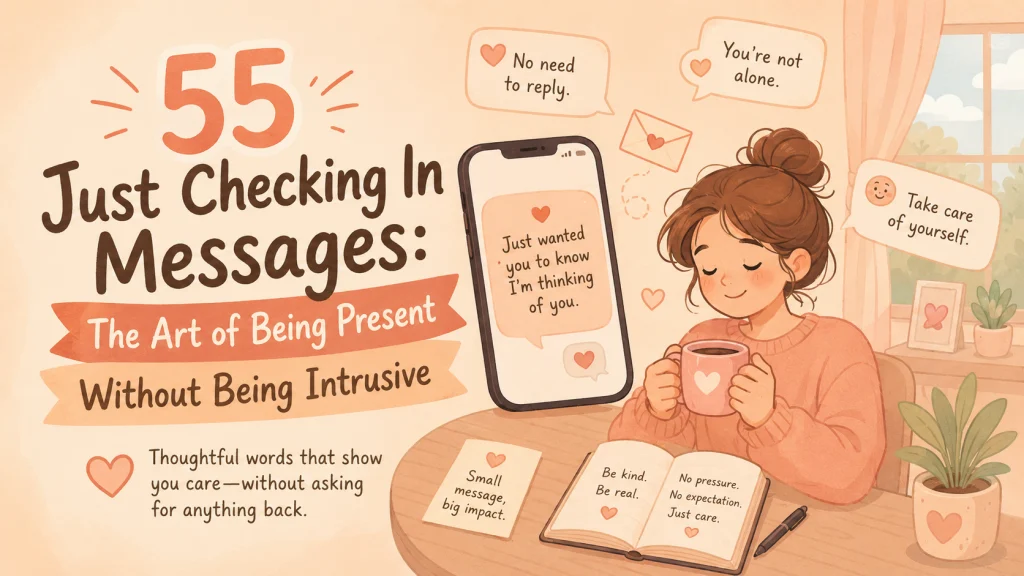
Just checking in messages work best when they don’t actually require an answer. That’s the whole secret, and it’s almost insultingly simple once you see it. The moment a check-in starts to sound like a question on a form, the person on the other end feels it, even if they can’t name why. I learned this the slow way, sending messages that were warm on the surface and demanding underneath, the kind that say “thinking of you” but mean “tell me you’re okay so I can stop wondering.” The shift happened when I started writing check-ins that gave the other person an exit instead of an assignment.
Most people get this wrong in the same way. They send something that sounds gentle, then add a line that turns it into homework, something like “let me know how you’re doing” or “call me when you can.” It’s not malicious. It usually comes from real concern, the kind that wants confirmation the worry can rest. But for someone who is already stretched thin, even a kind question can feel like one more thing on a list they didn’t ask for. The fix isn’t to care less. It’s to write the message so the caring stands on its own, with nothing attached that needs a response to feel complete.
| Scenario | Tone | Does it need a reply? |
|---|---|---|
| No particular reason, just thinking of them | Light and brief | No |
| They mentioned something hard | Steady and direct | Optional |
| Haven’t talked in a while | Warm, no guilt attached | Optional |
| A hard day or a date that means something | Quiet and simple | No |
Once you see the pattern, the rest is just matching the words to the moment. Some of what follows needs absolutely nothing in return. Some leaves a door open for whichever way the conversation wants to go. None of it asks the reader to perform being okay.

Short Texts That Need No Response At All
These are the lowest-stakes version of checking in, and that’s exactly the point. Nobody has to write back. Nobody has to explain how their week has been. The message exists, the other person reads it, and that’s the whole transaction, finished the moment it lands.
I send these constantly, more than almost any other kind of message, because they cost the sender almost nothing and somehow still land. A friend told me once that one of these, three words long, was the only message that week that didn’t feel like it wanted something from her. That’s the bar. If it reads like an invoice for attention, rewrite it. If it reads like someone just thought of you, it’s done.
- Thinking of you today, no reply needed.
- Just wanted to check in. No pressure, no rush.
- You crossed my mind. That’s it. That’s the whole message.
- Saw something that reminded me of you. Hope today’s kind to you.
- No big reason, just wanted you to know I’m thinking of you.
- Sending this with zero expectation of a reply. Just wanted you to feel it.
- Hey. Just checking on you, no need to write back unless you want to.
- Hope your day has at least one easy moment in it.
- You don’t owe me anything, I just wanted to say I’m thinking of you.
- Quick one: I’m thinking of you. Carry on with your day.
- No update needed, just wanted you to know you’re on my mind.
- Just sending a small reminder that you matter to me today.
- Just a small hello from me to you today.
- Wanted you to know someone’s thinking of you, even on an ordinary Tuesday.
These work because they ask for nothing. The next kind takes a little more care, since the moment they’re for is heavier, and heavier moments deserve language that doesn’t flinch from naming what’s actually happening.

When Someone Is Going Through Something Hard
This is where most check-ins go wrong, not because the sender doesn’t care, but because they overcorrect. They write three sentences explaining why they’re reaching out, apologize for bothering the person, then ask four questions in a row. None of that helps. What helps is naming the hard thing without making them relive it, then leaving the door open instead of pushing them through it.
I’ve sent the over-explained version more than once, and I’ve watched it land wrong every time. The shorter, steadier version, the one that says “I know this is hard” and stops there, almost always does more. If what they’re carrying needs more than a text can hold, that’s the moment to point toward something with more room to sit in, like a set of words of comfort for someone struggling, rather than trying to fit everything into one message.
- I know this is hard right now. I’m not going anywhere.
- You don’t have to be okay for me to care about you.
- I’m thinking about what you’re carrying. No need to update me, just wanted you to know.
- This is a lot. I see that, and I’m here regardless.
- Whatever today looks like for you, you’re not doing it alone.
- I’m not asking how you are because I expect a good answer. I’m asking because I care either way.
- You’ve been on my mind. Reach out whenever, or don’t. I’ll still be here.
- Hard days don’t need a brave face with me.
- I know words don’t fix this. I just didn’t want you to feel unseen today.
- Take whatever you need today. I’m not keeping score.
- I’m here if you want to talk, and just as here if you don’t.
- You’re allowed to not have it together right now. I’m still in your corner.
- Just checking in on you. Whatever this week is, you don’t have to carry it alone.
- No advice, no fixing, just wanted you to know I’m thinking of you.
Some of what’s hard isn’t a single event so much as time passing without contact, the kind of distance that builds quietly until reaching out feels harder than it should.
For the Friend You Haven’t Talked to in a While
The longer the gap, the more people talk themselves out of closing it. They imagine the other person keeping score, counting weeks, waiting for an apology before they’ll accept a hello. Almost nobody actually does that. Most people, when they hear from someone they haven’t spoken to in months, just feel glad to be remembered.
What stops the message from going out is usually the opening line, not the friendship itself. People think they need to explain the silence before they’re allowed to say hello, so they draft an apology, decide it sounds wrong, and close the app instead. If the gap feels too big to bridge with a single text, there’s a longer way through it, the kind covered in reconnecting with a friend after losing touch, but most of the time, a short message is the entire bridge you need.
- It’s been too long. Just wanted to say hi, no explanation needed.
- I thought about you out of nowhere and figured I’d just say so.
- We’re overdue for a real conversation, but for now, just checking in.
- No apology required from either of us. Just wanted you to know I’m thinking of you.
- Time passed faster than I meant it to. Still glad to know you.
- Hey stranger. Hope life’s been kind to you lately.
- I keep meaning to reach out and kept not doing it, so here it finally is.
- You came to mind today, and I didn’t want to let that pass without saying something.
- Distance doesn’t erase how much I value knowing you.
- Just wanted to break the silence with something easy, not a big catch-up.
- Whatever’s kept us out of touch, it doesn’t change that I’m glad you exist.
- No pressure to write a long reply. One small sign you’re here is plenty.
- It’s strange how time passes without anyone deciding it should. Anyway, hi.
- Just wanted to check in and send a small hello, no big catch-up required.
Some gaps are about time passing. Others are about a single day that changed the shape of everything after it, the kind of day where checking in means something different altogether.
After a Hard Day, an Anniversary, or a Moment You Both Remember
Some days carry weight that doesn’t show up on a calendar unless you already know to look for it. An anniversary of a loss, the date a diagnosis came in, the day a marriage ended. These aren’t days to ask “how are you” and wait for an honest answer, because the honest answer is often complicated, and they may not have the words for it yet, or the energy to find them.
What works here is naming the day without asking the person to walk you through how they’re handling it. A short message that says “I remember” does more than a long one asking them to explain their feelings. If the day belongs to a loss specifically, there’s language built for exactly that weight in messages for being there through a hard time, written for the moments when presence matters more than advice.
- I remembered what today is. Thinking of you.
- No need to talk about it if you don’t want to. I just wanted you to know I haven’t forgotten.
- Today’s a hard one. I’m not going to pretend it’s not.
- You don’t have to perform fine for me today of all days.
- I know this date carries weight. I’m here, quietly, however you need.
- Some days don’t need words from you back. Today’s one of them.
- I’m thinking of you and of what today means. Nothing more to add.
- Whatever shape today takes, I didn’t want it to pass without reaching out.
- I remember. That’s the whole message today.
- Today doesn’t need to be explained to me. I already understand why it’s hard.
- Sending this without expecting a response. Just wanted you to feel less alone today.
- You’re allowed to feel however you feel today, no version is the wrong one.
- I’m not asking how you’re doing today, because I already know it’s a lot.
Eventually, every check-in reaches the same fork, the part nobody talks about as much: what to do once the message is sent and nothing comes back.

What to Say If They Don’t Write Back
Silence after a check-in message isn’t a verdict. It usually means the person is somewhere they can’t reply yet, not that the message landed wrong. The mistake people make here is following up with a second message that quietly raises the stakes, something like “did you see this?” or “just making sure you’re okay.” Both versions turn presence into a check-up, the exact thing the first message was supposed to avoid.
If you want to follow up, keep it just as light as the first message. A few ways to do that without raising the stakes:
- No pressure to answer this either. Just thinking of you again today.
- You don’t need to explain the silence. I just wanted to send another small hello.
- Still here, still not asking for anything back.
- No reply needed. I just didn’t want the week to pass without checking in once more.
- Whenever you’re ready, I’m right here. No countdown attached.
And if nothing comes back at all, that’s fine too. The message did its job the moment you sent it, regardless of what happens after. For more ways to say it without asking anything in return, there’s a wider set of thinking of you messages for any occasion worth keeping on hand.
Final Thoughts: What Showing Up Actually Looks Like
The best check-in messages I’ve ever received didn’t ask me anything. They just told me someone had thought of me, and then let me decide what to do with that. That’s the entire skill of it, not finding clever words, just removing the parts that turn care into an obligation. If you take nothing else from this, take that one shift: say it, mean it, and let it stand on its own without needing anything back.
Send the one that fits the moment you’re in, and resist the urge to add anything extra at the end. The fewest words that still feel true to you are almost always the ones that land. That’s been true every time I’ve tested it, on myself and on the people I care about most.
FAQs
💬 What’s a good check-in text message for someone going through a hard time?
Keep it short and skip the questions. Something like “I know this is hard. I’m not going anywhere” says more than a string of how-are-yous, and it doesn’t ask them to manage your worry on top of their own day.
🌙 How do you check in on someone without making them feel like they have to perform okay?
Tell them they don’t have to answer. A line like “no need to reply, just wanted you to know I’m thinking of you” removes the pressure before it even has a chance to build.
📵 Is it weird to send a check-in message and not expect a reply?
Not at all, that’s actually the version that tends to land best. A message that doesn’t wait for anything back reads as care instead of a request, and most people notice the difference even if they can’t explain it.
🔄 What if I check in and they don’t write back?
Let it go. Silence usually means timing, not rejection, and following up to ask if they saw it tends to undo the gentleness of the original message. If you do follow up, keep it just as light as the first one.
☎️ Is it okay to just check in on a friend after months of no contact?
Yes, and skip the apology for the silence. A simple “it’s been too long, just wanted to say hi” works better than an explanation for why you went quiet, since most people are just glad to hear from you at all.
🕯️ What do you say to someone on a hard anniversary without overstepping?
Name the day without asking them to explain how they’re handling it. Something like “I remembered what today is, thinking of you” does the work without requiring them to perform an answer they may not have yet.