Most people hesitate before writing a sympathy card not because they have nothing to say, but because they are afraid of making it worse. That fear is worth taking seriously. Some of the most commonly used phrases in sympathy cards carry a quiet damage the writer almost never sees, not because the intention is wrong, but because certain words ask something of a grieving person that they are not in a position to give. Here are 12 of them, with a look at why each one fails and a shorter, simpler version to use instead. For broader context, see what not to say in a sympathy card.
Why the Wrong Words Can Hurt More Than Silence
People who have been through grief describe the cards they received with a specificity that is striking. They remember the ones that got it right, and they remember, with equal clarity, the ones that did not. Not because the sender was careless. Because certain phrases, however warmly intended, land as instructions, comparisons, or redirections, and grief does not respond well to any of those. For related message ideas, see things not to say when someone dies.
I have been on both sides of this. I have written things in sympathy cards that I later regretted, not because I did not care, but because I reached for familiar language without stopping to think about what it was actually asking of the person reading it. The phrases that missed were rarely cold. They were usually trying very hard. That is part of what makes them worth examining, because knowing why a phrase fails is what actually changes the instinct to reach for it.
The 12 phrases below are among the most common ones to avoid. Each has a brief explanation of the mechanism, what it does to the reader and why, and a shorter, safer version to reach for instead. The table is a quick reference. The full explanations follow.
| Phrase | The problem | A simpler alternative |
|---|---|---|
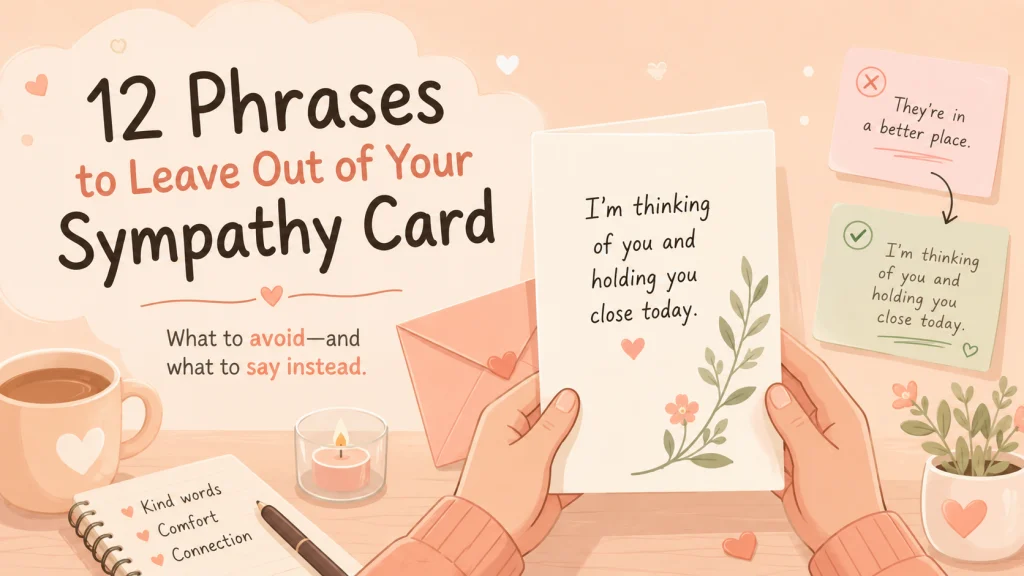
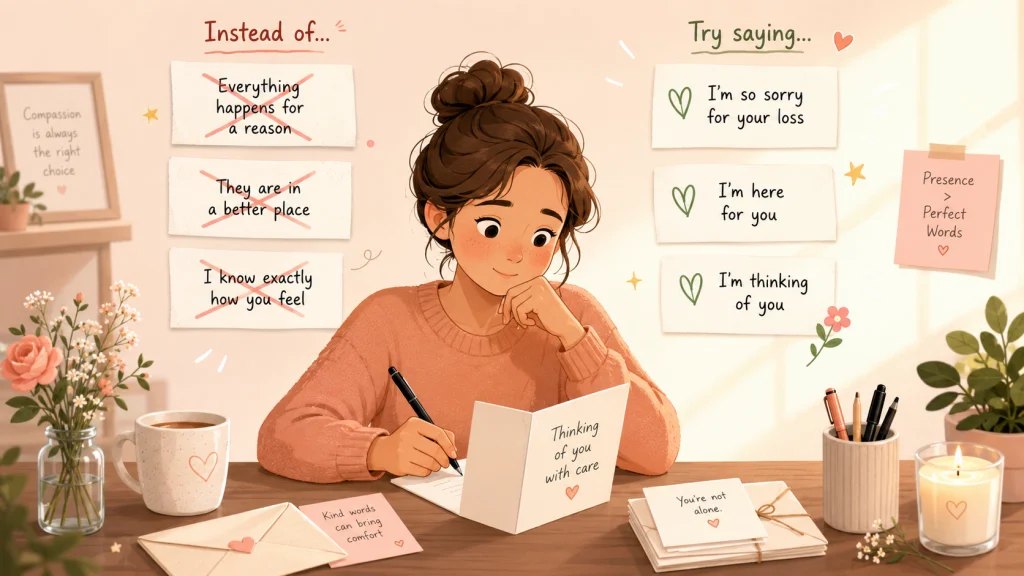
| “They’re in a better place” | Redirects away from grief, assumes shared belief | “I’m thinking of you and holding you close today.” |
| “Everything happens for a reason” | Demands the mourner find meaning in the loss | “There are no words for this. I’m so sorry.” |
| “I know how you feel” | Redirects the conversation from them to you | “I can’t imagine what this is like. I’m just here.” |
| “At least they lived a long life” | “At least” tells them their grief is too large | “What a life they lived. I’m so glad I knew them.” |
| “They wouldn’t want you to be sad” | Instructs the correct way to grieve | “There’s no right way to feel. I’m here for all of it.” |
| “Time heals everything” | Places comfort in the future, dismisses the present | “I’m not going anywhere. Take all the time you need.” |
| “Let me know if you need anything” | Puts the burden of asking on the person least able to carry it | “I’m bringing dinner Thursday. No need to answer the door.” |
| “Stay strong” | Makes their grief feel like a problem to manage | “You don’t have to hold it together around me.” |
| “It was their time” | Assigns predetermination to a death they may not be ready to accept | “I loved them too. I’m so glad they were in our lives.” |
| “You need to be strong for your family” | Doubles the weight by removing permission to grieve | “You’re allowed to fall apart too. I mean that.” |
| “At least you still have [X]” | Asks them to offset grief against other blessings | “I’m not looking for a silver lining. I’m just sorry.” |
| “I’ve been so upset about this too” | Shifts the card’s center from their loss to your feelings | “This moment belongs to you. I’m so deeply sorry.” |
The 12 Phrases to Leave Out of Your Sympathy Card
1. “They’re in a better place.”
People reach for this one because it sounds comforting. The intention is to offer peace, to name a destination beyond the loss. What it can do instead, for someone in the middle of acute grief, is redirect the conversation away from their pain and toward a belief system they may or may not share. Even when the mourner holds that belief themselves, having it handed to them from outside can feel like being asked to skip ahead. They are allowed to miss the person who is gone. They do not have to process the theology of it in the first week.
The phrase also implies, however gently, that their sadness is slightly misplaced. The person is fine. They are somewhere better. What is there to mourn? That logic does not land the way it is meant to.
A version that works better: “I’m thinking of you and holding you close today.”
2. “Everything happens for a reason.”
This is the phrase I hear described most often, by people who have been through loss, as the one that stings. Not because it is offered cruelly. Because it assigns meaning to loss in a way that functions like a demand: find the reason. It implies that the death fits into a larger pattern that makes sense, which means the grief that comes from it is, at some level, a misreading of the situation. No one should have to hold a loss and simultaneously be told to locate its justification.
There is also a particular cruelty to this phrase when the death involves a child, an illness, an accident, or any loss where the “reason” is genuinely impossible to locate. In those moments, this phrase does not offer comfort. It offers a task, and it is a task the mourner cannot complete.
A version that works better: “There are no words for this. I’m so sorry.”
3. “I know how you feel.”
Even when said with total sincerity, and even from someone who has experienced a similar loss, this one shifts the center of the conversation from the mourner to the writer. No two griefs are identical. No two relationships are identical. What is meant as solidarity can arrive as a redirect: here is my experience, which is like yours, and now we are talking about both of us.
There is a version of this that works, but it requires the opposite movement. Instead of asserting shared feeling, it acknowledges the limits of understanding. The mourner needs to know that you see their loss as theirs, not as a category you have already visited.
A version that works better: “I can’t imagine what this is like for you. I don’t want to guess. I’m just here.”
4. “At least they lived a long life.”
“At least” is almost always the wrong move in grief, regardless of what follows it. The phrase introduces a comparison, and comparisons in loss carry an implicit message: your grief is larger than it should be, given the circumstances. A long life is something worth acknowledging. But it does not make the grief proportionally smaller. The person misses who they miss, regardless of how many years they had together.
The longer version of this phrase, sometimes extended to “at least they didn’t suffer” or “at least you had so much time,” follows the same logic. It asks the mourner to measure their grief against a favorable condition and adjust accordingly. Grief does not calculate that way.
A version that works better: “What a life they lived. I’m so glad I got to know them.”
5. “They wouldn’t want you to be sad.”
This phrase instructs the grieving person on the correct emotional response to their loss, using the authority of the person who died to do it. Whether or not it is true, it puts the mourner in an impossible position. Their sadness becomes a kind of betrayal of the deceased’s wishes. They are not just grieving. They are doing grief wrong.
It also places the mourner in a position of having to defend or suppress how they actually feel, which is the opposite of what a sympathy card should do. A card that makes someone feel that their grief is inappropriate has not comforted them. It has added a layer of something to manage.
A version that works better: “There’s no right way to feel right now. I’m here for whatever you need.”
6. “Time heals everything.”
The comfort this phrase intends is real. It is trying to say: this will not always feel this way. What it does instead is place all available comfort somewhere in the future and leave the present moment without anything to hold. The person is not in the future. They are in the middle of a loss that is happening right now, this week, possibly this morning. A phrase that tells them to wait for healing gives them nothing for today.
There is also a kind of pressure embedded in it. What happens when time passes and the healing is incomplete? A timeline has been set that the mourner may not meet, and that has its own quiet cost.
A version that works better: “I’m not going anywhere. Take all the time you need.”
7. “Let me know if you need anything.”
This one is worth examining carefully, because it sounds generous and the intention behind it almost always is. The problem is structural. It places the entire burden of identifying a need and then asking for it on the person who is least equipped to do either of those things. Grief takes away people’s ability to inventory what they need, let alone communicate it to someone else. Putting the task of reaching out back on them is a kindness that does the opposite of what it intends.
The better version of this offer is specific and unconditional. It does not ask anything in return. It names what it will do and then does it, without requiring the mourner to engage, decide, or respond.
A version that works better: “I’m bringing dinner Thursday. I’ll leave it on the porch. No need to answer the door.”
8. “Stay strong.”
What this phrase communicates, underneath the encouragement, is that the writer is counting on the mourner’s strength. Which means their grief, their falling apart, their inability to hold it together, is something to be resisted. An expectation lands on them at the exact moment they should be free of expectations entirely.
For people who are already carrying others through the same loss, a parent whose children are also grieving, a spouse holding a household together, this phrase lands particularly hard. They are already performing strength for everyone around them. A sympathy card that asks for more of it is not a comfort.
A version that works better: “You don’t have to hold it together around me. I’m here for all of it.”
9. “It was their time.”
This phrase assigns a framework of predetermination to a death that the mourner may not be ready, or willing, to accept. Even for people who hold beliefs about fate or timing, having that framework pressed on them from outside removes their agency in arriving at it themselves. There is a meaningful difference between reaching a place of peace about something and being handed that peace before you have walked toward it.
When the death is unexpected, accidental, or involves someone young, this phrase can feel almost aggressive in its insistence that the timing was correct. It asks the mourner to agree to something they have not agreed to, in a card, from someone who was not there.
A version that works better: “I loved them too. I’m so glad they were in our lives.”
10. “You need to be strong for your kids or family.”
The mourner is already carrying their own loss. This phrase adds a second weight: the expectation that they carry it invisibly, for the sake of others who are also grieving. It sounds practical, and sometimes the people who say it genuinely believe it is useful. What it functions as is a removal of permission. It tells the mourner that their grief has to wait, or be performed away from the people who need them.
No one in the middle of loss needs to be told to hold it together. If they are doing that already, the phrase offers no new information and no relief. If they are not doing that, the phrase is instruction disguised as support.
A version that works better: “Your family is lucky to have you. But you’re allowed to fall apart too. I mean that.”
11. “At least you still have [your health / other family / so much to be grateful for].”
This is a specific variation of the “at least” structure, and it operates as what could be called the comparison pivot: instead of staying inside the loss with the mourner, it asks them to look elsewhere and feel better about what remains. The word “at least” signals that their grief is partially unjustified because of something they still have. That is not how grief works. Having other good things in your life does not reduce the specific weight of a specific loss.
This phrase also carries a gentle implication that the mourner is failing to see their blessings clearly, which is the last thing a grieving person needs to hear from anyone.
A version that works better: “I’m not going to look for a silver lining. What you lost is real, and I’m so sorry.”
12. “I’ve been so upset about this too” / “I feel terrible that I couldn’t reach out sooner.”
This last one is worth its own category because it is one of the subtler things to avoid in a condolence message. It comes from genuine feeling. The writer is upset. They did feel bad about the delay. But centering your emotional state in a sympathy card shifts the card’s focus from the mourner’s loss to your grief, your guilt, your difficulty. It asks the mourner to hold space for what you are going through, at a moment when they do not have space to hold.
Even a brief version of this, one sentence placed early in a card, changes what the card is about. The mourner is now reading a message that is, at least in part, about making you feel better. The best sympathy cards do the opposite. They keep the center exactly where it belongs.
A version that works better: “This moment belongs to you. I’m so deeply sorry for your loss.”

What the Cards That Land Have in Common
They do not try to fix anything. They do not offer frameworks, timelines, or instructions. They say: I see your loss, I am here, and I am not going anywhere. That is, in almost every case, enough. A short sentence that stays inside the loss with the mourner does more than a long card that tries to lift them out of it.
The instinct to comfort by offering meaning or resolution comes from a good place. But grief, especially in the immediate weeks after a loss, is not looking for resolution. It is looking for witness. The cards that people hold onto are the ones that offered exactly that, and nothing more.
If you have worked through what to leave out and are looking for the right language to reach for instead, the full collection of sympathy messages organized by relationship, tone, and occasion covers most situations in detail. For more on how to structure a card message, how long it should be, and what to open and close with, writing a sympathy card from start to finish walks through the whole thing.
None of this has to be perfect. A card that is short, honest, and free of the 12 phrases above will do exactly what it is meant to do.
FAQs
❌ What are the worst things to say in a sympathy card?
Phrases that assign meaning to the loss (“everything happens for a reason”), instruct the mourner on how to feel (“they wouldn’t want you to be sad”), or introduce a comparison (“at least they lived a long life”) consistently land the hardest. The common thread is that they ask something of the grieving person instead of simply offering presence.
🤍 Is it better to say nothing than to say the wrong thing?
For most people, receiving something, even an imperfect card, means more than receiving nothing. The fear of saying the wrong thing is worth listening to, but it should not result in silence. A short, simple message that avoids the phrases above will almost always be welcome, even if it feels insufficient to the person writing it.
✉️ What should you avoid writing in a condolence message?
Avoid anything that assigns meaning to the death, compares the loss to something else, instructs the mourner on how to feel, redirects the message toward your own emotions, or places the burden of asking for help back on the grieving person. Short, present, and uncomplicated is almost always the right direction.
💬 Why do people say “everything happens for a reason” and is it always wrong?
It is said because it is meant to offer comfort through meaning. Whether it is wrong depends on context and relationship. If you know with certainty that the mourner holds a sincere belief in that framing and would find it comforting, it may land. In most cases, especially in a written card where you cannot see the reaction, it is safer to stay away from it. The risk of harm is high enough that a simpler phrase almost always serves better.
📝 How do you avoid making a sympathy card about yourself?
Read the card back before you send it and ask: who is the subject of most of these sentences? If the answer is you, rewrite. Phrases like “I’ve been so upset,” “I feel so terrible,” or “I can’t stop thinking about how this must feel” put your emotional experience at the center. The card should belong, entirely, to the person receiving it.