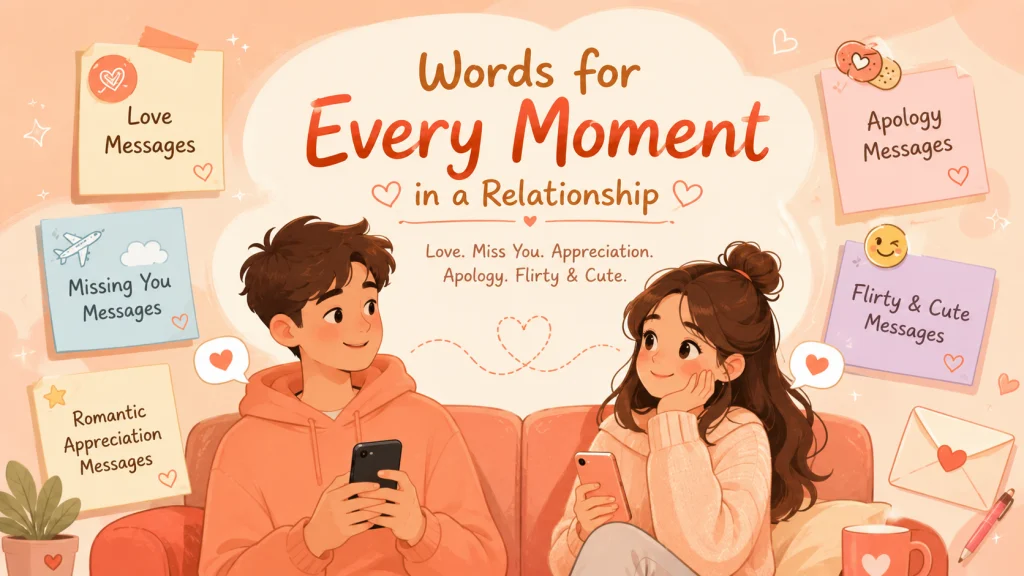
Some moments in a relationship ask for words, and the words do not come. Not because the feeling is not there, but because what you feel is layered, or too specific, or too much to fit into a text box without losing something. This part of the site is built around the full range of what a relationship actually asks of you: the everyday love declaration, the long-distance ache, the appreciation that goes deeper than habit, the apology, and the kind of message that just makes someone smile. Each category has its own logic and its own traps. Whatever brought you here, there is a place for it.
When You Know What You Feel but Not What to Say
Love and relationship messages are, in my experience, the category people struggle with most. Not because the emotion is unclear, but because it is the clearest thing in the room, and somehow that makes it harder to put into words. You know exactly how you feel. You just cannot figure out how to write it in a way that does not come out flat, or wrong, or like something pulled from a card at the pharmacy.
What I have found, more times than I can count, is that the problem is rarely a lack of feeling. It is a surplus of it. When you love someone, or miss them, or need to tell them you are sorry, the weight of what you are trying to say makes the words feel inadequate before you have even started. So people default to vague, or they default to long. Neither tends to land the way they hoped.
The categories below were built around the moments that actually come up in a relationship, not the abstract version of love but the specific, daily, sometimes difficult version. Each one works differently. Each one asks something different of the person writing it. The table below is a quick way to find where to start.
| The moment you are in | Where to start |
|---|---|
| You feel it and there is no occasion for it | Love messages |
| You are separated by distance or time zones | Missing you messages |
| They did something worth naming out loud | Romantic appreciation messages |
| Something went wrong and needs to be said | Apology messages |
| You just want to make them smile | Flirty and cute messages |
Most people, when they arrive here, already know which category they need. They just need help with the words. A few are not sure yet, and that is fine. Start with what feels closest to the moment you are actually in.

Love Messages: For the Feeling That Needs No Occasion
The everyday love message is, I think, the most underestimated category here. Not the anniversary declaration. Not the birthday message. The Tuesday afternoon text that says something real about how you feel, with no occasion to justify it, no event to point to. That is the one that tends to land hardest, because it is the one nobody was waiting for.
I have sent versions of these from hotel lobbies and airport gates and the kind of quiet moment that arrives in the middle of an ordinary day when you are suddenly and specifically aware of how much someone matters. The ones I am most glad I sent were almost always the shortest. A single sentence. Something specific enough that the person on the other end knew it was only for them.
The mistake most people make with love messages is trying to cover too much ground at once. They want to say everything, so nothing comes out clearly. What usually works is the opposite: one thing, said directly, without the apology for saying it. “I have been thinking about you all day” lands further than three paragraphs of explanation about why. Romantic messages work best when they do not try to justify themselves.
People in longer relationships, in particular, tend to stop sending the unprompted ones. Not because the feeling is gone, but because it seems like it should already be understood. It should. But saying it anyway is still worth doing, maybe more than it was at the beginning, because by now it is entirely a choice.
A few starting points, for when you want to say something and just need a sentence to build from.
- “No reason for this. I just wanted you to know I was thinking about you.”
- “I noticed you today in a way I forget to say out loud. I love who you are.”
- “Something reminded me of you earlier and I could not stop smiling. That is all.”
- “I was in the middle of something completely unrelated and thought of you. That happens more than you know.”
If this is the moment you are in, the full love messages collection has more variations, including ones broken down by situation and relationship stage.
Missing You and Long Distance: Writing Across the Gap
Long-distance messages are their own category, and they deserve to be treated that way. The feeling of missing someone is not simply “I wish you were here.” It is more specific than that. It is the thing you saw on the walk home that you wanted to tell them. The meal that tasted better in your memory of making it together. The moment that happened and immediately became something you needed to share with exactly one person who is not reachable right now.
I know this kind of distance well. Not the dramatic version, not the one that makes a good story, but the quiet daily kind, the kind where you are fully present somewhere and still, underneath it, aware of the absence. The messages that help in those moments are not the ones that try to paper over the gap. They are the ones that acknowledge it without being swallowed by it.
There is a real difference between “I miss you” and “I walked past that place we used to go on Sundays and immediately wanted to call you.” Both are true. The second one reaches further. It names something specific. It says: I was living my life and you were in it, even from here. That is what a missing-you message does at its best, and it is the thing that separates the ones worth sending from the ones that just add to the weight.
Messages for your partner who is far away also carry a responsibility not to make them feel worse than they already do. The message that says “I cannot do this anymore” when what you mean is “I miss you so much it hurts today” does damage that was not intended. The feeling is real. The job is to name the right version of it before hitting send.
These are the kinds of messages worth having ready for the moments when the distance hits hardest.
- “I walked past that little place on the corner today. You would have said something funny about it. I missed having you there.”
- “It is late and I keep wanting to tell you about my day. That is what I miss most, actually.”
- “I know we talked this morning. I still miss you. I think that is a good problem to have.”
- “Something happened today that I cannot wait to tell you. Saving it for when you call.”
For more, including messages for the harder sides of long distance, the missing you and long distance messages page goes deeper into both.
Romantic Appreciation: Naming What You Usually Leave Unsaid
Appreciation messages are the ones people skip most often, not because the feeling is absent, but because it seems like it should already be understood. The relationship is good. The person knows they are loved. What is there to say that has not already been said by now?
There is actually quite a lot to say, and the difference between feeling appreciated and knowing you are loved is real. A message that names something specific, something your partner actually did or said or is, carries more than a dozen reflexive declarations. People forget this. Relationships coast on the assumed, and then one day someone feels taken for granted and neither person can quite explain when it started. The appreciation message is a small piece of the answer to that.
The examples I keep returning to are the granular ones. Not “you are so supportive” but “the way you handled that conversation with me last week changed how I was feeling about the whole thing.” Specific. True. Impossible to mistake for a form letter. The person reading it knows you were paying attention, which is, more often than not, the thing they actually needed to know. There is a birthday message I almost did not send a few years ago because I thought it would come across as obligatory. I sent it anyway, short and honest. She told me later it was the only one that year that did not feel like a form letter. That is the whole thing right there.
- Name a specific moment or action, not a general quality. “You are so patient” fades. “The way you handled that call yesterday” stays.
- Avoid leading with “I just wanted to say” or “I know this is random, but.” Start with the observation itself.
- Do not save it for a special occasion. The message that arrives on a Tuesday, for no reason, is the one that tends to land differently.
- If you have been meaning to say something for a while, send it now. The delay does not improve it. It just extends the silence.
The pattern above is what I keep seeing when these messages land versus when they fall flat. It is not complicated. It just requires noticing something real and saying it before the moment passes.
Here are a few examples that follow that pattern.
- “The way you showed up for me last week, without making it a big thing, I have been thinking about it since.”
- “You make hard days easier just by being someone I get to come home to. I wanted to say it instead of assuming you know.”
- “I do not say this enough: you are good at this. At us. And I notice.”
The romantic appreciation messages page has more, including ones for specific moments and for partners who are harder to reach with words.
Apology and Relationship Repair: The Message That Has to Hold Up
An apology message is not the same as saying sorry out loud. Putting it in writing commits you to the words in a way a spoken apology does not, and the person on the receiving end can return to it. That means it has to hold up under re-reading, which most apologies written in distress do not.
The most common failure I see in apology messages is not insincerity. It is structure. People explain the context so thoroughly that the acknowledgment gets buried. By the time they reach “I’m sorry,” the reader has already felt the deflection. What started as an attempt to help the other person understand ended up sounding like a defense. The writer did not mean it that way. But the reader felt it anyway.
What tends to work is shorter and less defended than most people’s first draft. Say what happened. Say it was wrong. Say what you understand about why it hurt. Then stop. An apology that keeps going starts to sound like it is more about the writer’s discomfort than the other person’s experience. Relationship messages in the repair category have one job: to make the other person feel seen. Everything else is secondary.
There is also the question of what not to include. “I’m sorry you felt that way” is not an apology. Neither is “I’m sorry, but.” If the word “but” appears anywhere in the first message you send after something went wrong, it is worth asking whether the apology is actually complete before you send it. Usually, it is not.
These are examples of what it looks like when an apology does not try to do too much at once.
- “What I did was wrong, and I knew it when I did it. I am sorry. Not as a formality.”
- “I said something I should not have and I have been thinking about it since. You deserved better from me.”
- “I got that wrong. I am not trying to explain it away. I just want you to know I understand why it hurt.”
For the harder situations, the ones where there is more damage to repair and more care required in how you write it, the apology and relationship repair messages page covers the full range.
Flirty and Cute: The Messages That Keep the Connection Warm
These are the easiest category to dismiss, and maybe for that reason, the easiest to neglect. A flirty or playful message does not ask much of the reader. It does not carry weight, does not require a particular response, and does not announce itself as significant. That is exactly why it works, and why skipping it over time costs more than people realize.
I have heard from people, more times than I expected, that the small playful messages are the ones they hold onto. Not the long declaration on an anniversary, but the ridiculous inside joke that arrived on a random Wednesday. The message that said “I was thinking about you” without the weight that sometimes comes with saying it directly. Those messages stay because they ask nothing in return. They just say: I noticed you today, and I liked it. 😄
What makes these land is specificity to the two people involved. A generic flirty message reads like a template, and the person receiving it can feel the difference without being able to name it. What works is when the message references something only those two would understand, when it says “I know you, and I am still paying attention” without the ceremony of saying that out loud.
They also matter more in long-term relationships than people tend to expect. Early on, flirting is instinct. Later, it becomes a choice. Making that choice, keeping the line warm even when nothing requires it, is one of the things that keeps a connection from gradually going quiet.
A few examples, for the moments when you want to say something light without the ceremony of saying something meaningful.
- “Thinking about you. Not in a serious way. Just in a you-know-what-I-mean way.”
- “Still my favorite person. Thought you should know.”
- “I had a whole thing I was going to say. I got distracted thinking about you instead. Anyway.”
- “Do you ever randomly think about the time we… never mind. Just me apparently.”
For more, including ones that work for new relationships as well as long ones, the flirty and cute messages collection has the full range.
Every Category in Full
Each of the five categories below goes deeper into one specific type of message: what tends to go wrong, how to get it right, and examples grounded in real moments. Pick the one closest to your moment, then use what you find there as a starting point.
| Category | What you will find there |
|---|---|
| Love messages | The unprompted everyday declaration, what makes love messages land when there is no occasion to hide behind, and examples for every version of the feeling. |
| Missing you and long distance messages | How to write across the gap without making the distance heavier than it already is, including the difference between messages that reach and messages that just add weight. |
| Romantic appreciation messages | How to name what you feel about someone beyond the reflexive, and why one specific sentence will almost always land further than a paragraph of general warmth. |
| Apology and relationship repair messages | What makes an apology hold up under re-reading, what gets in the way, and the structural mistakes that turn genuine sorry into something that reads like a defense. |
| Flirty and cute messages | The small playful messages that keep a connection warm, and why they matter more in long-term relationships than most people give them credit for. |

Final Thoughts: The Right Words Are the Honest Ones
Every category here comes back to the same thing. Not eloquence. Not the perfect turn of phrase. The willingness to say what is actually true, in enough words to be understood and not so many that the feeling gets lost inside the explanation. That is what a good relationship message does, in any category, at any stage.
What I know from being a person who has sent messages I was not sure about, and received ones that changed something in me, is that the right message is almost always simpler than the one people first reach for. Less defended. Less dressed up. More honest about what the moment actually asks of you.
The categories here are not formulas. They are starting points. The best version of any relationship message you send will be the one that sounds like you, saying something true, to someone specific. That is the only thing that actually bridges the distance between two people, whether the distance is measured in miles or in silence.
FAQs
💬 What do you say to your partner when you don’t know what to say?
Start with something specific and true. “I have been thinking about you” is a beginning. From there, name the thing: a moment, a feeling, something you noticed. You do not need a complete thought. You just need an honest one, sent instead of held.
💌 How do you write a romantic message that doesn’t sound cheesy?
Avoid anything that could have been written for anyone. Cheesy usually means generic. The more specific the message is to the actual person and the actual moment between you, the less it sounds like a card. Write what is true for you, not what sounds romantic in the abstract.
📱 How do you apologize in a text without making things worse?
Keep it short and undefended. Say what happened, say it was wrong, say you understand why it hurt. Do not explain your reasoning inside the apology. The explanation belongs in a later conversation, after the person knows you have actually heard them.
🌍 What is a good message to send someone you miss who is far away?
Name something specific, something that reminded you of them or that you wanted to tell them in the moment it happened. “I walked past that place today and immediately thought of you” reaches further than “I miss you.” Both are true. One of them feels more like the real thing.
😄 How do you flirt over text in a long-term relationship?
Use something only the two of you would understand. A reference, an inside joke, something specific to your shared history. Generic flirting reads like a template and the other person can feel the difference. What makes it land is when they know it could not have been sent to anyone else.
❤️ How long should a love message be?
Short, almost always. Most people write love messages that are longer than they need to be because the feeling is large and the words feel inadequate. One honest sentence will almost always land harder than a paragraph of explanation. Trust the sentence.