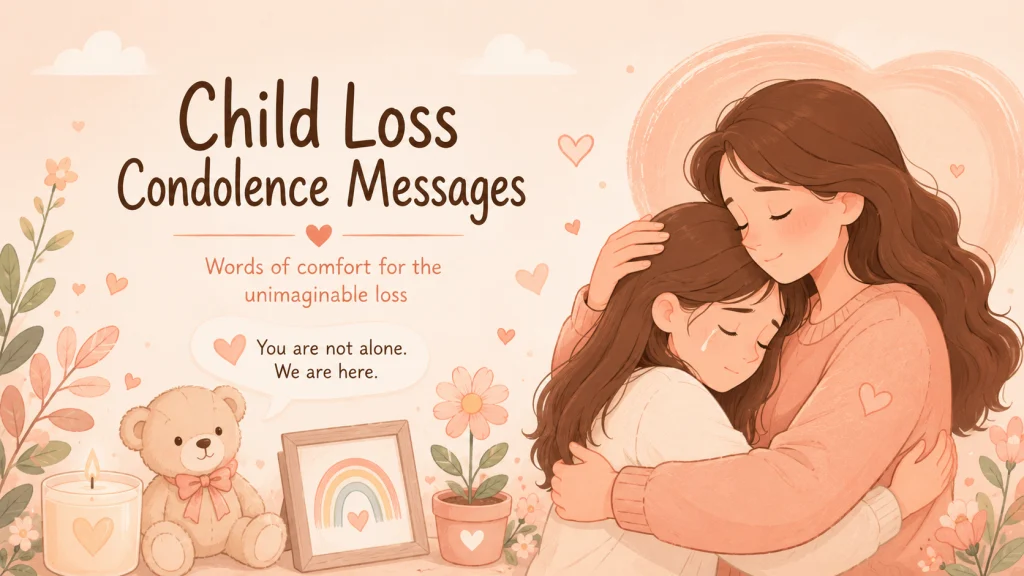
The death of a child breaks every rule about what sympathy is supposed to sound like. The comfort phrases that work in other losses, the ones about time and peace and better places, fall apart here, and most people feel it the moment they pick up their phone to type. These 60 child loss condolence messages are written for that specific ache: wanting to say something real to someone living through the unimaginable, without flinching, without explaining, and without pretending any words will be enough.
When Every Sympathy Script Breaks Down
This is the hardest message most people will ever have to write. Not because they don’t care, but because the death of a child dismantles something fundamental in the way grief is supposed to work. We expect loss to follow a certain order. Parents go before children. When that order is broken, the language of comfort breaks with it, and the phrases we reach for in other losses suddenly feel not just hollow but almost cruel. For related message ideas, see condolence message for loss of child.
I’ve only had to send this kind of message once. A friend of mine lost her young son in an accident, and I sat with a blank screen for close to an hour before I typed anything. Everything I wrote felt wrong. What I eventually sent was four sentences. She wrote back weeks later to say she had read it many times. I still don’t know if I said the right thing. But I think I said something honest, which may have been the only option available.
The reason the usual phrases fail here is not accidental. “Everything happens for a reason” suggests the death was designed. “Time heals all wounds” promises a relief that many bereaved parents will tell you isn’t coming, at least not in the way that phrase implies. “They’re in a better place” offers their child somewhere other than their arms. These phrases come from love, which is what makes them so hard to stop reaching for. But they try to resolve something that cannot be resolved, and the parent can feel that effort. What tends to help is the opposite: acknowledgment, presence, someone saying this is incomprehensible and I’m not going anywhere. That is what these messages try to do. For more on sympathy messages across different kinds of loss, and how tone shifts with relationship and situation, that’s worth reading alongside this.
Immediate Sympathy for Loss of a Child (12 Messages)
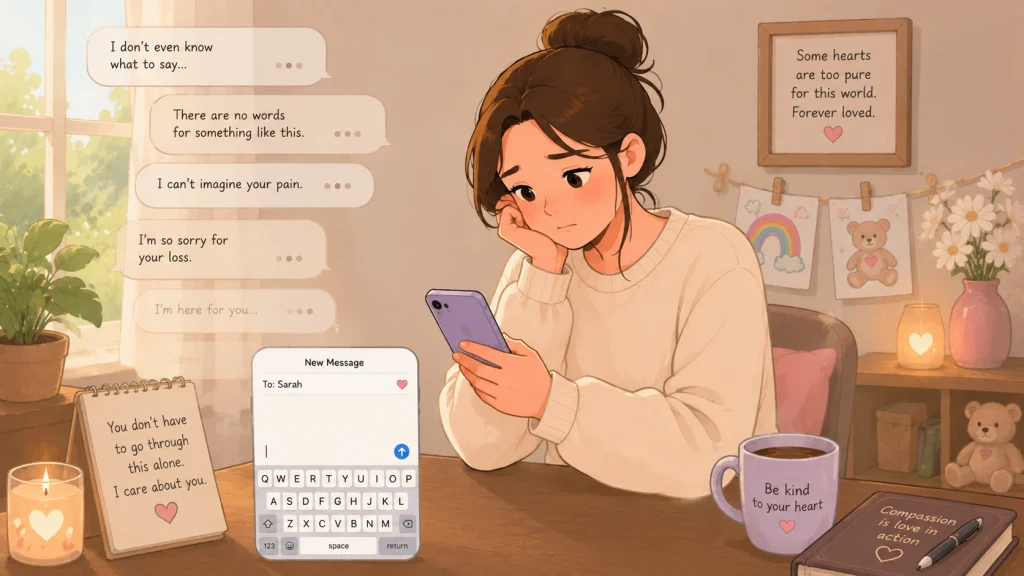
In the first hours and days, the goal is not to say something profound. It’s to say something real and quickly enough that the parent knows they are not invisible in their grief. These messages don’t try to explain anything or offer comfort that isn’t available. They just show up. Use the child’s name if you know it. Keep the focus entirely on the parent, not on your own shock or disbelief.
The instinct many people have is to lead with their own reaction: “I was so shocked” or “I can’t believe it.” That centers the message on the sender instead of the parent. You can acknowledge that words feel impossible, but anchor the message there, not in your own disbelief. A short true sentence is better than a long careful one.
- I am so sorry. There are no words for this, and I won’t pretend there are. I am just here.
- My heart broke when I heard. I love you, and I’m not going anywhere.
- [Child’s name] was so loved. That doesn’t make any of this easier, but I want you to know it.
- There is nothing I can say that will help, and I know that. I just needed you to know that I’m with you in this.
- I am so deeply sorry for your loss. You don’t have to respond to this. I just wanted you to hear from me.
- I’ve been thinking about you every hour since I heard. I am so, so sorry.
- I don’t have words. I just want you to know I’m holding you in my heart right now.
- My deepest condolences to you and your family. [Child’s name] will never be forgotten by those who knew them.
- I am so sorry. I am here, whatever you need, including nothing at all.
- This is an unbearable loss. I am so sorry. I love you.
- I heard, and I didn’t know what to say then, and I still don’t. But I wanted you to know I’m thinking of you.
- Please know that you are surrounded by people who love you. We’re not going anywhere.
Heartfelt Messages That Acknowledge the Incomprehensible (12 Messages)
These messages are for people who want to say something beyond “I’m sorry,” who have a close enough relationship with the parent to go deeper, but who don’t want to wander into explaining or comforting in ways that miss. They sit inside the grief rather than trying to move the parent through it.
The pattern I keep seeing, in what people who have lost children describe, is that the messages they remember most were the ones that asked nothing of them. No response was expected. No emotional labor was required. The message just named what was true: that this was devastating, that the child mattered, that the person sending it wasn’t going anywhere. That simplicity is harder to write than it sounds, which is probably why most people don’t manage it.
- No parent should have to go through this. It is wrong, it is devastating, and your grief makes complete sense.
- I keep finding myself thinking about [child’s name] and about you. I’m so sorry. There is no making sense of this.
- The love you have for [child’s name] is something I’ve always seen clearly. That love doesn’t end here. It never will.
- I don’t believe in silver linings for this kind of loss. I just believe in being honest: this is one of the hardest things a person can face, and I’m so sorry it’s yours.
- [Child’s name] changed the world by being in it. I know that doesn’t come close to comfort, but I mean it.
- I want you to know that I will never stop thinking of [child’s name]. They mattered. Your love mattered. Their life mattered.
- There is a kind of grief that has no edges, and I think this is it. I’m so sorry. I love you.
- I’m not going to tell you it gets better, because I don’t know that it does. What I can tell you is that I will be here.
- You don’t have to be strong. You don’t have to feel anything other than what you feel. I’m just here.
- [Child’s name] deserved so much more time. I am so sorry the world didn’t give them that.
- I keep wanting to say something that helps, and I can’t find it. So I’ll just say this: I see you. I see your grief. I’m with you.
- Some losses change who you are, and this is one of them. Please know you don’t have to carry any of it alone.
None of these messages tell the parent what to feel, what comes next, or how they will eventually be okay. That restraint is intentional. Grief at this depth doesn’t want a roadmap. It wants witness.

When You Knew the Child Personally (10 Messages)
If you had a real relationship with the child, say so. One thing bereaved parents consistently describe fearing most is that their child will be forgotten. A message that includes a specific memory, a particular quality, something true and particular about who the child was, can land differently than any amount of general sympathy. It tells the parent: someone else carries a piece of them too.
Be specific, but be honest. Don’t construct a memory you don’t have, or reach for a quality that sounds nice but doesn’t reflect who you knew. “They had such a laugh” is nothing. “I can still hear the way they laughed when something actually caught them off guard” is something different entirely, and the parent will feel that difference immediately.
- I keep thinking about [specific memory]. That is who [child’s name] was to me. I’m so glad I knew them, and I’m so deeply sorry.
- [Child’s name] had such a way of [specific quality]. I’ve been thinking about it since I heard. My heart is with you.
- I will never forget [child’s name]. They left a mark on everyone who spent any time with them.
- When I think of [child’s name], I think of [specific moment]. I am holding onto that memory. And I am so sorry.
- I had the honor of knowing [child’s name], and that is something I will carry forever. My deepest condolences.
- [Child’s name] was one of those people you just don’t forget. There was something about them. I am so sorry this happened.
- I didn’t say it enough when I had the chance, but [child’s name] brought something good into my life. I’m grateful for that. And I’m so sorry.
- There is a specific kind of loss for someone like [child’s name], someone with that much light. I feel it too, and I am so sorry you are living in the center of it.
- I’ve been remembering [child’s name] all week. If you ever want to talk about them, or just hear someone else say their name, I’m here.
- I can’t stop thinking about [child’s name]. They deserved so much more time. I’m so sorry.
If you have a photo from the time you spent with the child, sharing it alongside a message like one of these can mean a great deal. Not as a gesture, but as evidence: someone else was there, someone else remembers, someone else is keeping the child alive in the world. Parents notice that more than most people realize.
When You Didn’t Know the Child or Are Writing From a Distance (8 Messages)
Not everyone who needs to write this message had a relationship with the child. Colleagues, acquaintances, someone whose loss touched a community you’re part of: these relationships have their own rules. The instinct is to say less because you feel you have less right to speak. That instinct is partially right. You shouldn’t claim a grief you don’t have. But something sincere is far better than silence, and a specific offer of practical help, rather than an open-ended “let me know,” is the kind of message that actually gets used.
The table below offers a rough sense of how tone and length shift depending on how close you are to the parent. What matters more than length is honesty, and what matters more than tone is the absence of phrases that accidentally minimize what they’re going through.
| Relationship to the parent | Appropriate length | What to focus on |
|---|---|---|
| Close friend or family member | Longer, as personal as you can make it | A specific memory of the child, unconditional presence, no timeline pressure |
| Someone who knew the child | Medium, grounded in something real | A particular quality or moment, honoring the child’s individual life |
| Acquaintance or neighbor | Brief and warm | Acknowledgment without overstepping, a concrete offer if possible |
| Colleague or professional contact | Short, sincere, no pressure | Acknowledgment, a specific practical offer, space to not respond |
| Card or text in any relationship | One to four sentences | Clarity over completeness. A short true sentence matters more than a long careful one. |
- I was so sorry to hear of your loss. Please know that you are in my thoughts.
- I didn’t know [child’s name], but I can hear how loved they were in everything you’ve shared. My sincere condolences to you and your family.
- Please accept my deepest sympathies. If there’s anything practical I can do in the coming weeks, like [specific offer], I mean that genuinely and there’s no pressure to respond.
- I’m so sorry for your loss. There’s nothing more I can say than that, and I won’t try.
- My condolences to you and your family. Take whatever time you need. We’re here.
- I heard what happened, and I wanted you to know I’m thinking of you. I’m so sorry.
- I’m sorry. If it would help, I’m happy to [specific offer]. No response needed at all.
- Please know my thoughts are with you. Wishing your family some steadiness in the difficult days ahead.
Whatever your relationship, the one rule that holds across all of them is this: don’t make it about managing your own discomfort. The parent doesn’t need to take care of you in this moment. Write toward them, not toward your own relief.
Short Messages for Texts and Cards (10 Messages)
Short messages are not lesser messages. In the immediate hours after a child’s death, a parent may not be able to absorb much. A sentence that says “I know, and I love you, and I’m here” is everything a message needs to do in this moment. Most people go longer because they feel that length signals effort. In practice, the opposite is often true. A message that gets to the point quickly and asks nothing of the reader is often the one that lands hardest.
Write the first honest thing you feel. Send it. Don’t revise it into something more polished and less true. If you’re writing in a card, even one handwritten sentence matters more than the most carefully chosen printed message, because it costs something, and that cost is visible.
- I love you. I’m so sorry. I’m here.
- No words. Just love.
- There are no words for this. I’m so sorry.
- Thinking of you and [child’s name] every single day. 💙
- I’m so sorry. Take all the time you need. I’m not going anywhere.
- My heart aches for you. I love you.
- Holding you close right now. So deeply sorry.
- [Child’s name] will never be forgotten. Not by me.
- I’m sorry. I’m here. Call me whenever you’re ready.
- My deepest condolences. I’m thinking of your whole family.
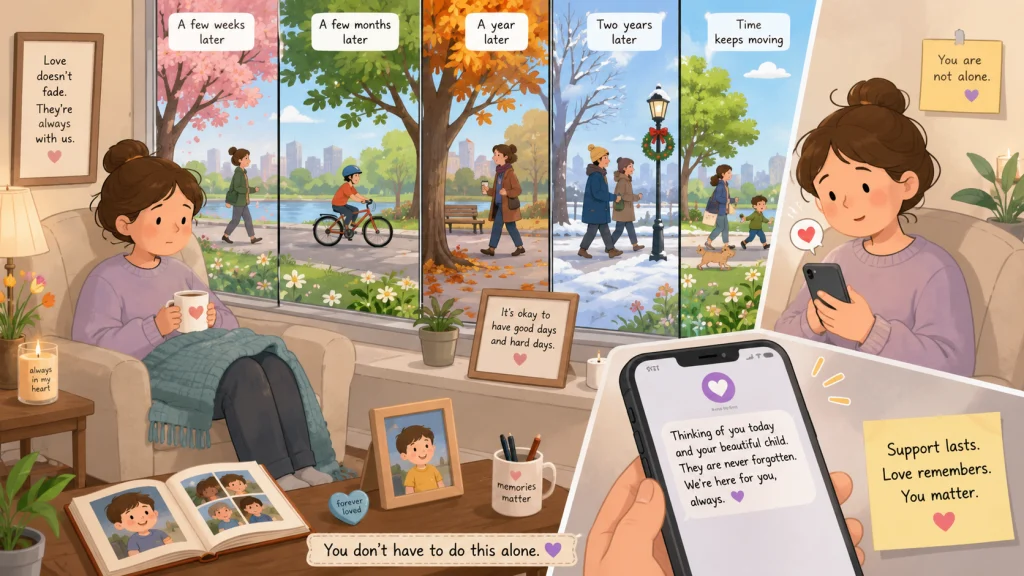
For the Weeks and Months After, When the World Has Moved On (8 Messages)
One of the most consistent things bereaved parents describe is the silence that falls after the first few weeks. The messages stop coming. People assume the worst has passed. The parent is left carrying grief in a world that is visibly moving on, wondering if they’re supposed to be somewhere further along. This is when a message, unexpected and unprompted, can mean more than anything sent in the immediate aftermath.
These aren’t check-ins meant to assess how the parent is doing. They’re reminders that the child is still thought about, that the parent hasn’t become invisible. What to say to someone still grieving months later goes deeper into this moment, because it’s one that most people aren’t equipped for and that matters enormously to the people living through it.
- I know it’s been a while, and I think about [child’s name] often. I didn’t want another day to go by without you knowing that.
- Today would have been [child’s name]’s birthday. I’m thinking of you, and of them, and I wanted you to know it.
- I’ve been thinking about you a lot. Grief doesn’t run on a schedule, and I’m not expecting you to be anywhere but where you are.
- I don’t want to assume how you’re doing, but I think about you often. I’m here whenever you want to talk, or not talk.
- I know the noise around a loss quiets after a while, and I want you to know I’m still here. Still thinking about [child’s name].
- The world moves on, but I haven’t forgotten. And I know you haven’t either. I’m still here.
- I just wanted to check in. No need to respond. I’m just thinking about you this week.
- I saw something the other day that made me think of [child’s name]. I’m not going to tell you it gets easier. But I am going to keep thinking of them, and of you.
Sending one of these on the child’s birthday, or on the anniversary of the death, or on what would have been a milestone, tells the parent: I remember. Many bereaved parents say the people who did this, unprompted, became the ones they trusted most through their grief.
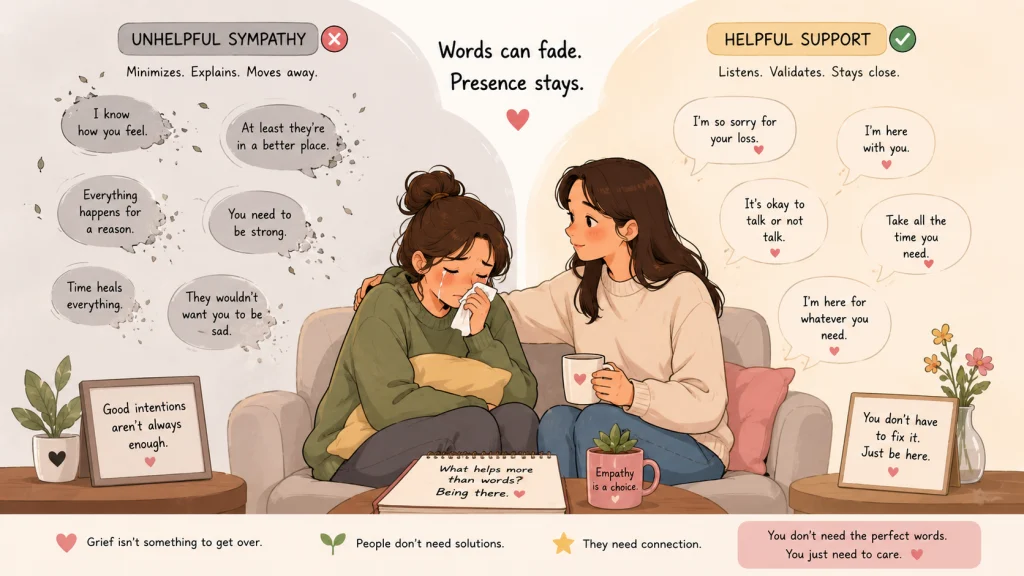
What to Absolutely Not Say to a Parent Who Lost a Child
Every phrase on this list comes from love. That’s the uncomfortable truth. The people who say these things mean well, and yet bereaved parents remember them years later with the same clarity they remember the call that told them their child had died. The problem isn’t the intention. It’s that these phrases try to make sense of something no parent should be asked to make sense of. Understanding why each one fails is more useful than just knowing to avoid it, because the same instinct will keep producing new versions. What not to say in a sympathy card covers the broader landscape, but the five below are specific to child loss and particularly likely to cause harm.
1. “Everything happens for a reason.” Most parents do not believe their child died for a reason, and even those who hold some version of that belief often find this phrase enraging when it comes from outside. It suggests the death was designed. That is not comfort.
2. “They’re in a better place.” There is no better place a parent can imagine for their child than alive and with them. If the parent has expressed this belief themselves, you can echo it. If they haven’t, leave it out.
3. “At least you have other children” or “You can always try again.” One child does not replace another. There is no version of this that helps. Grief doesn’t divide. It compounds.
4. “Time heals all wounds.” What bereaved parents more often describe is becoming more skilled at carrying grief that does not diminish. This phrase promises a relief that may not come, and asking a parent to wait for it is its own kind of cruelty.
5. “I know exactly how you feel.” You don’t. No two losses are the same, and child loss is a grief so specific that even other bereaved parents often say they couldn’t fully understand another’s experience. “I can’t imagine what this is like for you” is more honest, and honesty is more useful than false certainty.
If You Have Lost a Child Yourself
Some people arrive here not because they’re writing a message, but because they have lost a child and are searching for something that names what they’re living. If that’s you, you don’t need to find words right now. You don’t need to be anywhere other than where you are. The grief you’re carrying is real, and it is enormous, and it doesn’t follow a schedule.
If you want connection with people who understand this particular loss from the inside, The Compassionate Friends is a peer support organization founded by and for bereaved parents. It costs nothing. It just offers what most people around a bereaved parent cannot: the presence of someone who already knows.
Final Thoughts: What You’re Really Trying to Do
Sixty messages is a lot, and none of them will be exactly right without some adjustment for your situation. What they’re meant to do is close the distance between what you feel and what you’re able to say, which for most people feels impossibly inadequate. That gap is where people get stuck, sitting with a blank message field, unsure whether to send anything at all.
Send something. That is, from what I have found, almost always the right call. Not a perfect message, not one that explains what cannot be explained, but something that places you clearly in the parent’s corner without conditions. A message that says: I know this is enormous, I’m not going to pretend otherwise, and I’m here. That is not a small thing to receive when your world has collapsed.
For a broader sense of how words of comfort work across different kinds of grief, and why the instincts that fail us in child loss sometimes serve us in others, that’s worth reading when you have the space.
FAQs
💔 What do you say to a parent who lost a child?
Keep it honest and simple. Say the child’s name. Acknowledge that this is incomprehensible without suggesting it will pass. Offer your presence without conditions and don’t ask anything of them in return. “I love you, I’m here, and I’m not going anywhere” is not too simple. For many parents, it’s exactly right.
🚫 What should you never say to a parent who lost a child?
Avoid anything that explains or softens the loss: “everything happens for a reason,” “they’re in a better place,” “at least you have other children,” and “time heals all wounds” land harder than most people expect, and not in a good way. They reach for a resolution that isn’t there.
📱 Is it okay to text a condolence when a child has died?
Yes. A parent overwhelmed with visitors and phone calls may find a text easier to receive than a call. Keep it short and sincere, and say clearly that you don’t expect a response. The text itself is not less than a card.
🕊️ What do you say to a grieving parent months after their child died?
Say that you’re still thinking about them and their child. Say the child’s name. You don’t need to ask how they’re doing or expect a reply. Showing up in the silence, unprompted, is often more meaningful than anything sent in the first week.
✍️ How do you start a condolence message after a child’s death?
Don’t open with what you feel. Open with them. “I’m so sorry” or “My heart is with you” keeps the focus where it belongs. If you knew the child, saying their name immediately is a powerful way to start.
🤍 Should you mention the child by name in a condolence message?
If you know it, yes. Bereaved parents often say that hearing their child’s name is one of the few things that provides any comfort. It tells them the child existed for others too. Don’t be afraid of it.