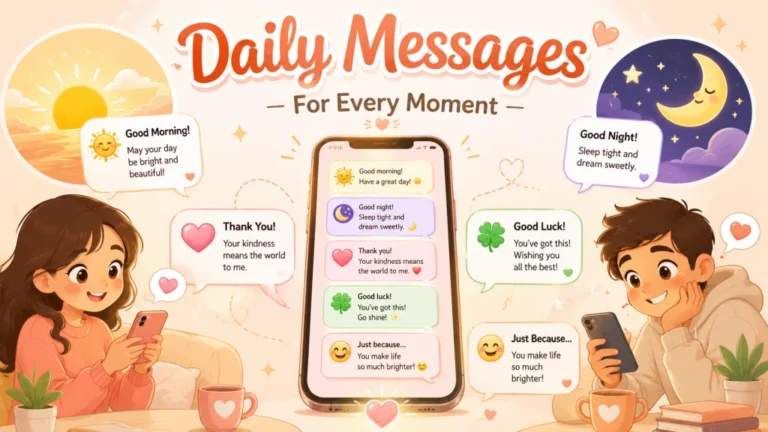

Not every moment that calls for words is a heavy one. Sometimes someone just needs to know you are thinking of them, or that the world still has something worth smiling about. Uplifting messages are for those moments: the ordinary Tuesday, the quiet comeback, the friend who needs a reminder that things can shift. This is a space for finding the right words whenever life could use a little more light, sorted by what the situation actually calls for. Whether you are reaching out to someone going through something hard or simply want to leave a person’s day a little better than you found it, the sections here are a starting point.
Uplifting Messages That Brighten Any Day
The hardest thing about sending an uplifting message is that most people reach for something bigger than the moment needs. They write three paragraphs when the person on the other end just needed to feel seen for thirty seconds. The version that lands is almost always shorter than the first draft. I know this because I have written the long version more times than I can count, sitting in airport lounges and coffee shops in between cities, trying to fix something with words that only needed a single gesture.
What makes a message genuinely uplifting, rather than just cheerful, is specificity. “You’ve got this” is pleasant but hollow. “I keep thinking about how hard you have been working on this, and I think it is going to pay off” is the same sentiment with something real underneath it. The difference is not the length. It is that one of them says something, and the other one fills space. Generic warmth washes over people. A detail catches them.
The other thing that tends to go wrong: people overload uplifting messages with advice. Someone is having a hard week and the response comes back loaded with suggestions, timelines, silver linings. What the person needed was not a plan. They needed to feel less alone for a moment. Encouragement and problem-solving are different things, and mixing them up is the most common mistake I see in messages like this. A good uplifting message does not try to fix anything. It just makes the person feel less like they are standing in it alone.
A few that work for the ordinary day:
- Thinking about you today. Hope it is a little easier than yesterday.
- You are doing better than you think. I genuinely believe that.
- Just wanted you to know you were on my mind today. That is all.
- I saw something earlier and it made me think of you. Hope you are okay.
- No agenda. Just wanted to say I am glad you are in my life.
None of these require a response. That is part of what makes them land. The person on the other end is not obligated to reply with something equally warm or emotionally present. They can just receive it. That low pressure is not an accident. It is the whole point.

Fresh Starts and New Chapters
New beginnings are one of the few moments that genuinely ask for words. A new job, a move, a decision someone has been working toward for a long time: these are moments where a person is likely to feel excited and terrified in the same breath, and a message that acknowledges both of those things is the one they will remember. The messages that miss the mark are the ones that only see the exciting part. “Congrats, this is so great!” is fine. But it leaves the whole underside of the moment untouched.
I sent a message to a friend once when she finally left a job she had been wanting to leave for a long time. I almost wrote something celebratory. I almost wrote “finally!” Instead I wrote: “This took courage. I know it did not feel like courage at the time, but it was. I am proud of you.” She told me later she read it three times. The celebration could have come from anyone. The acknowledgment of what it actually cost her could only have come from someone who knew.
For new beginnings, the message does not need to predict success or promise things will go well. What it can do is say: I see you stepping into something, and I am behind you. That is enough. That is actually more than enough for most people at the start of something new.
There is a lot more to say about how to get these messages right across different kinds of fresh starts. If you are writing for someone in a specific situation, messages for new beginnings and fresh starts goes deeper into the different moments: new jobs, new cities, big decisions, and what each one tends to need from the words around it.
Words That Make People Think and Feel
There is a category of inspirational messages that does not cheer someone up so much as slow them down for a moment. The kind that makes a person stop, re-read, and feel something shift slightly. These are not motivational in the run-through-a-wall sense. They are quieter than that. They are the message that arrives on a random afternoon and reminds someone of something they already knew but had forgotten to believe.
Messages like this tend to come from actual observation, not from a quote database. “I have been thinking lately that the people who keep going without anyone watching them are the most impressive people I know. You are one of them.” That is a message. It says something the person did not already have. It is not a borrowed sentiment. It belongs to the specific person and the specific relationship, and you can feel that when you read it.
Tone matters most here. A message that is trying too hard to be profound ends up reading as hollow. The ones that actually work read like something someone thought while washing dishes and then sent because they meant it. Unpolished. Direct. True. That combination is harder to manufacture than it sounds, but easy to recognize when you feel it.
The difference between a message that lands and one that just floats past is almost always the same thing: it sounds like it was written for this person, not assembled from pieces that could go anywhere. Not “you are such a strong person” but “I think about the way you handled last year and I still do not know how you did it.” One is a compliment. The other is a witness. For the kinds of words that carry real weight without tipping into lecturing, life wisdom messages covers that territory in more detail.
Celebrating What Is Good
Gratitude messages are the ones that get delayed the most. Someone does something kind, or meaningful, or just present when they did not have to be, and the moment passes without anything being said. Then it is weeks later and it feels too late to bring it up. I have been on both sides of that delay and it never feels good from either direction. The message you almost sent still matters when you eventually send it. Late is better than never, and most people receive it with more warmth than the sender expected. 🌿
The shape of a good gratitude message is simple: say the specific thing that mattered, say why it mattered, and stop. Three sentences or fewer, more often than not. “I have been thinking about what you said to me last month. I did not say it at the time, but it actually helped me get through something hard. Thank you for that.” That is it. No performance required.
| Situation | What to include | What to leave out |
|---|---|---|
| Thanking someone for showing up | What they specifically did, how it landed | Apologies for taking so long to say it |
| Celebrating a shared good moment | A detail only the two of you share | Generic sentiment that could apply to anyone |
| Acknowledging quiet support | The thing they did that they probably thought went unnoticed | Over-the-top language that does not match the relationship |
| Expressing gratitude for who someone is | One real, specific quality and why it matters to you | A list of their best qualities, which reads like a eulogy |
The table above is not a formula. It is more of a filter: when you feel pulled to add something, ask whether it adds to the message or adds noise. Gratitude lands hardest when it is clean. The more you load it with context and explanation, the more it starts to feel like the gratitude is actually for you, not for them. A little restraint is one of the most generous things you can bring to this kind of message. For more on getting this right across different relationships and moments, gratitude messages and positive living covers the full range.

Choosing the Right Tone for the Moment
The reason people end up with a blank message field longer than they planned is rarely a lack of words. It is a lack of clarity about what the moment is actually asking for. Not every situation calls for the same register. Sending a light, cheerful message to someone in the middle of something genuinely hard can feel dismissive, even when the intention was the opposite. Getting the tone right starts with being honest about where the person on the other end actually is.
| What the person is going through | What the message should do | What to avoid |
|---|---|---|
| A hard week, nothing specific | Acknowledge it exists, signal you are there | Cheerful deflection, silver linings |
| A new beginning, nervous energy | Recognize the courage it took, not just the excitement | Predicting success or promising outcomes |
| A quiet stretch, nothing dramatic | Remind them they are seen on ordinary days too | Framing it as a check-in, which adds pressure |
| A win worth celebrating | Be specific about what you saw them do to get there | Generic praise that could apply to anyone |
| A moment of self-doubt | Offer a real observation, not a pep talk | Dismissing the doubt, listing their strengths |
The one thing all of these situations share: the person receiving the message will feel the difference between something written quickly from habit and something written because it was true. That does not mean every message has to take thirty minutes to write. It means the sentence has to mean something. Even the shortest message earns its weight when it says something specific and real.
If you are reaching out to someone particular, the sections above are a good starting point. But for a closer look at messages shaped around one specific relationship, uplifting messages for a friend goes into the texture of that kind of sending: the friend who is struggling, the one you have not talked to in a while, the one who would never ask for a message but needs one anyway.
The Message Sent on an Ordinary Day
The most underrated message is the one sent on a day when nothing particular is happening. Not a birthday, not a crisis, not a milestone. Just a Tuesday when you thought of someone and decided to say so. From what I have found, those are the messages people hold onto longest. Not because they arrived at a dramatic moment, but because they arrived when there was no reason to expect them.
The pattern I keep seeing is that people wait for the right moment to send something kind. They want to have something worth saying. They want the message to justify itself. And in the waiting, the moment passes, and so does the next one, and eventually it starts to feel like too much time has gone by. It has not. A message that says “I was thinking about you today” needs no occasion. It is its own occasion.
The sections above cover the main kinds of moments that call for words: the uplifting message for a rough day, the note for someone stepping into something new, the words that carry a little more weight, the gratitude that has been waiting to be said. None of them require a perfect sentence. They require an honest one. That is a lower bar than most people set for themselves, and a more important one than almost any other standard you could apply.

Short Uplifting Messages You Can Send Today
Sometimes you do not need guidance on how to write the message. You just need somewhere to start. These are short enough to use as they are, or to adjust until they sound like you. Whether you are looking for uplifting words to send a friend on a rough week or something quieter for an ordinary day, the situation shapes which one fits. In my experience, most people know immediately when they read the one that matches the moment.
For an ordinary day
No occasion needed. The absence of a reason is half of what makes these matter.
- Thinking about you today. Hope it is a good one.
- No reason for this message. Just wanted you to know I am glad you are around.
- Saw something earlier and it made me think of you. Hope you are doing well.
- You were on my mind. That is the whole message.
- Thinking of you from afar. I hope today is treating you kindly.
For a hard week
These are not fixes. They are a hand on the shoulder from a distance. Keeping them short is not laziness. It is the kindest thing you can do when someone is already carrying something heavy.
- I know this week has been a lot. I am thinking of you.
- You do not have to have it together right now. I just wanted you to know I see you.
- No need to reply. Just wanted to say I am here if you need anything at all.
- I hope today is a little lighter than yesterday. Rooting for you.
- Hard weeks end. And you are tougher than this one.
For a fresh start
The best motivational messages for a new beginning are not predictions. They are witnesses. These say: I see what you are doing, and I am behind you, whatever happens next.
- This is a big step and you are ready for it, even if it does not feel that way yet.
- New chapter, same you. And the you I know is more than enough for this.
- I am excited for what comes next for you. You have earned this.
- Whatever happens, I am proud of you for doing it. That part was never in question.
- Fresh starts take courage. So do you.
These are starting points, not scripts. The version that works best is always the one that sounds like you wrote it. Adjust the phrasing until it fits your voice and the relationship, and the rest will follow.
More on Each Moment
Each of the themes above has its own space where the ideas go further. Whether you are writing for a specific relationship, a particular kind of occasion, or a moment that does not fit neatly into one category, the pages below are where to go next.
| Where to go | What you will find there |
|---|---|
| Uplifting messages for a friend | Messages for the specific texture of friendship: the hard stretch, the quiet check-in, the friend who never asks for support but needs it |
| Messages for new beginnings | Words for fresh starts of every kind: new jobs, new cities, big decisions, and the nerves that come with all of them |
| Life wisdom messages | Messages that carry weight without lecturing, for the moments that call for something more than encouragement |
| Gratitude and positive living | How to say thank you in a way that actually lands, across every kind of relationship and occasion |
FAQs
💬 What is a good uplifting message to send someone?
The best ones are specific. Skip the generic encouragement and say something you actually noticed about the person or the situation. Even something short like “I keep thinking about how hard you have been working on this, and I think it is going to pay off” lands harder than anything borrowed from a list.
✍️ How do you write a positive message without sounding fake?
Say something you actually mean, about something specific. Hollow warmth reads as hollow because it is. If you are reaching for a phrase that could apply to anyone, keep looking for the one that only applies to this person, this moment.
🌱 What should you say to someone starting something new?
Acknowledge the courage in the decision, not just the excitement. New beginnings come with nerves, and a message that sees both sides of that feels more honest than pure celebration. You do not need to promise things will go well. You just need to say you are behind them.
🙏 How do you send a gratitude message without it feeling awkward?
Name the specific thing, say why it mattered, and stop. Three sentences is usually enough. The awkwardness most people feel comes from over-explaining, which makes it sound like the gratitude is being auditioned. Keep it short and it reads as genuine.
📱 Is it okay to send an uplifting message when nothing specific has happened?
Yes, and those are often the best ones to send. A message that arrives on a random day with no occasion attached tells someone they are thought of when there is no reason to think of them. That means more than most people realize.
⏳ What if it has been a long time since I reached out? Is it too late to send something?
It is not too late. Late is better than never, and most people receive a message from someone they have not heard from in a while with more warmth than the sender expected. You do not need to explain the gap. Just say what you want to say.