Your friend just lost someone. Society has a script for that, but it was written for the family, not for you. You’re the friend: close enough that silence feels wrong, uncertain enough that every draft you type feels either too much or not enough. These 60 messages are for that exact position. You’ll find texts for the first hours, for the quiet weeks when the world moves on and your friend does not, and for the kinds of loss that don’t always get the acknowledgment they deserve. For broader context, see messages when a friend loses someone they love.

The Sympathy Gap Nobody Talks About
When someone loses a parent or a spouse, people usually know what condolence is supposed to look like. There are cards designed for it, leave policies built around it, rituals that tell everyone how to behave. When your friend loses someone and you are the one who wants to reach out, none of that infrastructure exists. You are just you, with your phone, trying to say something that matters to someone you care about. For related message ideas, see sympathy message for a friend who lost someone.
What makes this position hard is not lack of caring. It is the opposite. You care enough to want to get it right, and that caring is exactly what makes you freeze. I have been there. I waited two weeks to reach out to a close friend after she lost her dad because I kept rewriting the message, trying to find the sentence that would somehow be adequate. When I finally sent something short and honest, she wrote back that she had been wondering if I had seen her post. She did not say it unkindly. But that line stayed with me a long time.
Silence, even well-intentioned silence, reads as absence to the person who is grieving. Most people who go quiet in these moments are not uncaring. They are afraid of saying the wrong thing. What I have found, over time, is that the message people agonize over for a week could usually have been three short, honest sentences, already sent.
There is a broader range of sympathy messages for loss across every relationship if you need a wider starting point, but the specific position of supporting a grieving friend deserves its own space. That is what this page is for.
What to Text Your Friend the First Day
In the first 24 hours, your friend is flooded. Well-meaning people are reaching out from every direction and most of what they say sounds similar. Your job is not to say something brilliant. It is to show up, clearly and without pressure, so your friend knows you are one of the people they can lean on.
These ten messages do not try to fix anything. They do not reach for silver linings or promise that things will get better. They simply say: I see you, and I am here.
- “I just heard. I don’t have the right words, but I wanted you to hear from me anyway. I love you.”
- “I heard about [name]. I’m so sorry. Please don’t feel like you need to respond to this. I just didn’t want to say nothing.”
- “I’m coming over tonight with food. You don’t have to talk. I just want to be near you.”
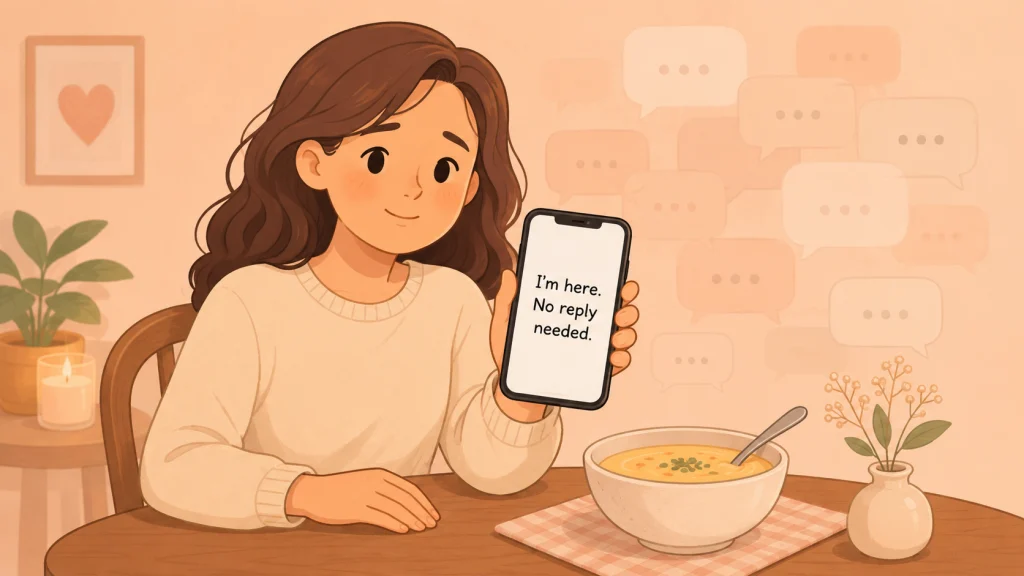
- “You don’t need to reply. I just wanted you to know I’m thinking of you and I’ll keep checking in.”
- “I wish I could be there right now. I can’t, but call me any time, for any reason. I mean that.”
- “I know how much they meant to you. This is an enormous loss and I’m not going to pretend otherwise.”
- “I’m not going to try to say the right thing because I don’t think there is one right now. I just love you.”
- “Tell me when you want company and when you need space. I’ll follow your lead completely.”
- “I just found out and I’m so, so sorry. Take all the time you need. I’m not going anywhere.”
- “Thinking of you so much today. I love you.”
Notice that most of these are short. That is not an accident. A long message in the first day can feel like something your friend has to receive, process, and respond to, all things that take energy they do not have. Short says: I am here. You do not have to do anything with this.
Heartfelt Messages for a Close Friend Who Is Grieving
These messages are for when you are someone’s person, or close to it. Not a peripheral contact sending condolences, but someone who knows the weight of what this loss actually means for your friend’s life. They can be personal. They can reference the person who died, the relationship your friend had with them, the specific texture of what you are watching them carry.
How you adjust the tone depends partly on closeness and partly on timing. This is a rough guide.
| How close you are | In the first 48 hours | Weeks and months later |
|---|---|---|
| Best friend, chosen family | Raw and direct. No polish needed. Name what they’re feeling if you know it. | Reference specifics. Name what they’re carrying. Don’t wait for them to bring it up. |
| Good friend, not daily contact | Warm and brief. No expectation of a response. | Smaller gestures work well. “Thinking of you today” is enough. |
| Friendship that has drifted | Honest about the distance. Short. Let them lead on whether they want more. | One check-in is enough. Leave the door open, but don’t push. |
The messages below land somewhere in the middle range: warm enough for a close friend, honest enough to feel real.
- “The world felt different when I heard. I keep thinking of you and hoping you can feel how much you are loved right now.”
- “I’ve been thinking about [name] all day. Their absence is going to leave a shape in your life that takes time to understand. I’m here for that.”
- “Some people leave a mark that doesn’t fade. I believe [name] was one of those people, and so do you.”
- “I don’t want to say the wrong thing, so I’ll say the simplest true thing: I love you, I’m here, and you don’t have to be okay.”
- “You’re allowed to feel all of it, however it comes, in whatever order. I’ll be here for every part.”
- “You don’t have to be fine. Not today, not next week, not whenever the world seems to expect it. I’ll keep showing up.”
- “There’s no timeline for this. I just wanted you to know I’m thinking about you at exactly this moment.”
- “I know words are doing very little right now. But I wanted you to have this one: you are not alone in this.”
- “Whatever you’re feeling, even if it doesn’t make sense or seems contradictory, it’s real and it matters.”
- “The love you had for [name] doesn’t go anywhere. I hope you can feel that even when everything else is shifting.”
- “I’m not going to pretend this gets better quickly. But I’m in it with you for however long it takes.”
- “Some grief is quiet and some is loud and most of it is both at once. I’m here for all of it.”
One thing I have noticed across all of these: the ones that mention the person who died, even briefly, tend to land better than the ones that don’t. Naming someone who is gone tells your friend that person is real to you too, not just a category of loss.
When You Don’t Know What to Say but Want to Show Up
The most common mistake people make when a friend is grieving is saying nothing. Not because they do not care, but because they are afraid. They are waiting for the right words to arrive, and those words do not come, and the days pile up, and eventually reaching out feels overdue and then it feels almost impossible.
What I have found is that the message you are most afraid to send, the one where you admit you do not know what to say, is often the one that lands deepest. It does not perform comfort it cannot deliver. It just says: I see this, I am not equipped to fix it, and I am here anyway. For someone in the middle of grief, that honesty is its own kind of relief.
- “I’ve been sitting with my phone for an hour trying to figure out what to say. I don’t know. I just know I love you.”
- “I don’t have the right words. I’m not sure they exist. But I wanted you to hear from me anyway.”
- “There’s probably nothing I can say that helps right now and I know that. I just didn’t want you to not hear from me.”
- “I keep thinking of you and coming up blank. That feels like nothing compared to what you’re carrying. I’m here.”
- “I wish I had something better. All I have is this: you matter to me, and what you’re going through matters to me.”
- “I don’t know what the right thing to say is. But saying nothing felt worse, so: I love you, I’m sorry, I’m here.”
- “You don’t have to talk. You don’t have to explain anything. I just wanted to say something because silence felt wrong.”
- “I’m not going to pretend I know what this feels like. I don’t. But I’m not going anywhere either.”
- “I’ve been thinking of you constantly, and every time I pick up my phone I don’t know what to type. So I’m just sending this before I talk myself out of it.”
- “No advice. No silver linings. Just me, on your side, for as long as this takes.”
What these messages have in common is that they do not pretend. They arrive imperfectly, and that imperfection is the point. Your friend does not need you to have found the right thing. They need you to have shown up at all.
Practical Support Embedded in the Message: Offers That Actually Help
One of the most common things people say to someone who is grieving is “let me know if you need anything.” It comes from a genuine place. But it almost never leads to anything. The reason is that it places the burden entirely on the person least equipped to carry it. Your friend has to identify a need, formulate a request, and reach out to ask for help, all at a moment when they have very little energy for any of those things.
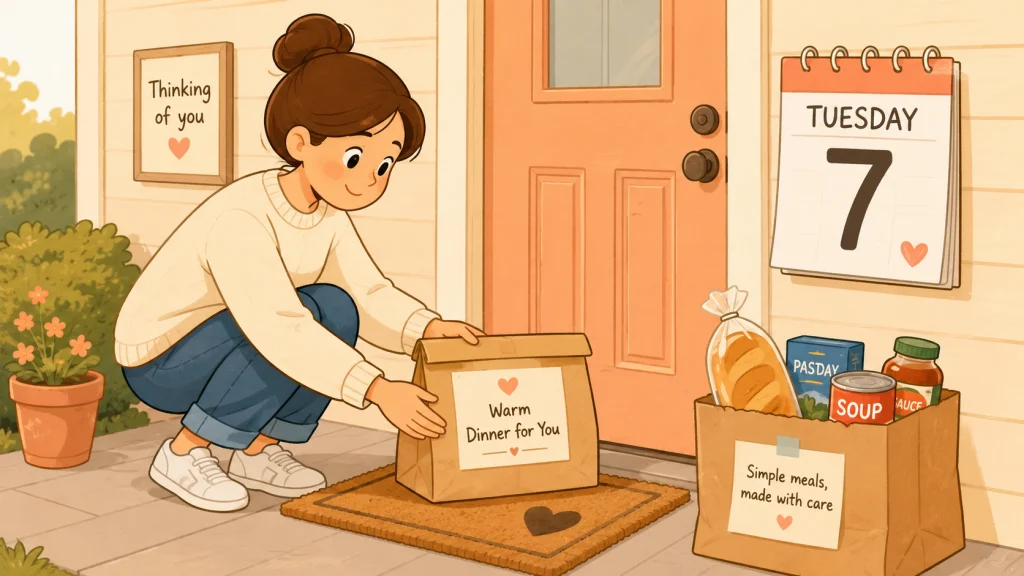
A specific offer is a different thing entirely. “I’m bringing dinner Tuesday, does 7 work?” requires only a yes or a no. It is easy to receive. These ten messages each contain a named offer, something concrete your friend can accept or redirect without having to think too hard about what they need.
- “I’m making dinner tonight and bringing it over around 7. You don’t have to be ready or cleaned up. I’ll leave it at the door if that’s easier.”
- “I can take the kids Saturday. I’ll pick them up at 10 and bring them back after dinner. You don’t have to figure out anything.”
- “I’m going to the grocery store this afternoon. Send me a list if you can, or I’ll just get the basics.”
- “I’ve blocked off Sunday afternoons for the next few weeks. Whatever that looks like for you, I’m available.”
- “Can I sit with you tomorrow morning? No agenda. Just coffee and company if you want it.”
- “If there are phone calls or emails to handle that you don’t have energy for, send them to me. I’ll take care of them.”
- “I’m going to call Thursday afternoon. Pick up if you want to talk. If you’re not ready, I’ll call again next week.”
- “I’m dropping off groceries tomorrow morning. Is 9 okay, or would later work better?”
- “Tell me one thing I can take off your plate right now. Anything. I’m asking because I want to do something specific.”
- “I’ll be at your door at 2 tomorrow unless you tell me otherwise. You don’t have to do anything. I just want to be there.”
If your friend says no to an offer, offer again in a different form a few days later. The “no” is often not about not wanting help. It is about not having the bandwidth to coordinate it. Keep showing up with specific things, and the right moment will come.
When the Grief Is One Society Doesn’t Always See
Not every loss comes with a script attached. When your friend loses a pet, or a pregnancy, or someone whose relationship with your friend was complicated, or a person the world has long since moved on from, the usual rituals are absent. There may be no bereavement leave, no public ceremony, no flood of cards. And yet the grief is real, and your friend is carrying it without the support that other kinds of loss usually bring. ❤️
What makes these situations particularly hard is that your friend may feel they are not allowed to grieve as deeply as they do. The best thing you can do is refuse to require them to justify it. These eight messages do that. They do not minimize the loss or try to fit it into a shape it was not meant to fill. They simply name what is happening and stay.
- (Pet loss) “I know some people won’t understand this loss the way it deserves to be understood. I do. I’m so sorry.”
- (Pet loss) “Losing a companion who was with you every day is losing something real and constant. That kind of grief matters.”
- (Pregnancy loss) “This is a grief that doesn’t always get the space it deserves. I see it, and I’m here.”
- (Loss of an ex or complicated relationship) “A relationship doesn’t have to still be ongoing for the loss to be real. I’m not going to minimize this.”
- (Long illness) “I know you’ve been losing them slowly for a long time. That kind of grief is its own particular weight, and I see it.”
- (Long illness) “Relief and grief can live in the same moment. You don’t have to sort that out alone or explain it to anyone.”
- (When the loss is hard to name) “You’re allowed to grieve this, fully, regardless of what anyone else seems to think. I’m here.”
- (When the world has moved on) “I know most people have probably moved on by now. I haven’t. I’m still here and still thinking about you.”
You do not need to understand the full weight of what your friend is feeling. You just need to not require them to explain it.
Checking In Over Time: Texts to Send Weeks and Months Later
The first week of grief is crowded. People show up, messages arrive, there is a momentum of condolence that carries your friend through the initial days. Then it stops. Within two weeks, most of the people who reached out have moved on. Life returns to its usual shape, and your friend is still inside the grief, now largely alone with it.
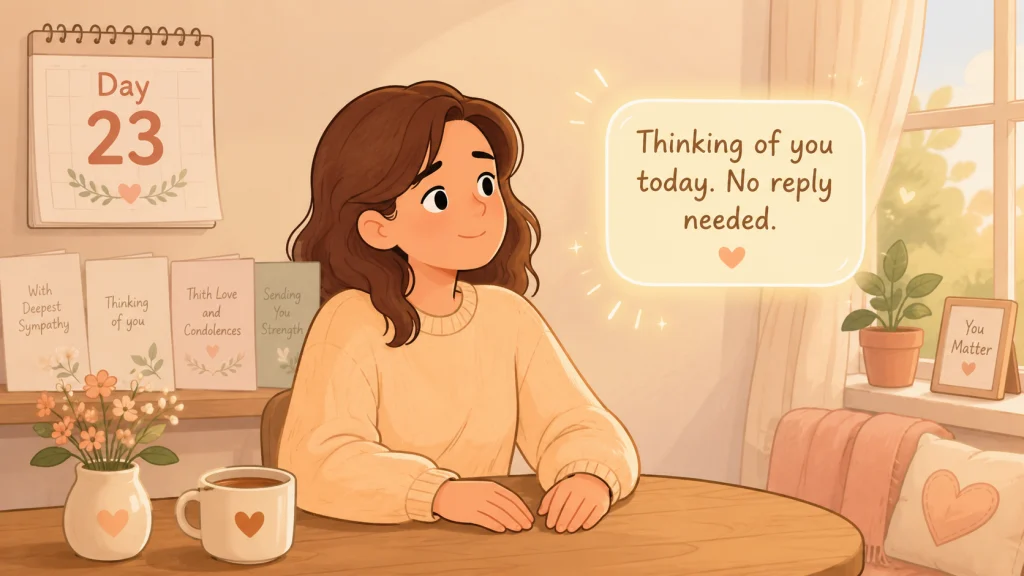
This is when your message matters most. Not day one, when your friend is surrounded. Day twenty-three, when they are not. The people who show up then are the ones who are remembered. These ten messages are for that stretch of time: weeks after the loss, months later when the grief has settled into something quieter but no less present. If you want to think through the longer arc of words of comfort for grief over time, there is more on that as well.
- “Thinking of you today. No reply needed. I just wanted you to know.”
- “It’s been a few weeks and I imagine the world has quietly expected you to return to normal. I haven’t forgotten. I’m still here.”
- “I know it’s been a while. I’m still thinking about what you’ve been carrying. How are you, really?”
- “I’ve heard the weeks after the first week can be harder, not easier, once everyone else has gone home. How are you doing?”
- “I saw something today that made me think of you. Just wanted to say hi.”
- “I don’t want to be one of the people who disappears after the first week. Check in with me whenever you need to.”
- “I know the holidays are coming, and I’ve been thinking about what that might feel like for you. No pressure to talk. Just know I’m aware.”
- “Grief doesn’t follow a timeline. I’m just checking in on a random Tuesday because random Tuesdays are sometimes the hardest.”
- “It’s been a few months, and most people around you have probably stopped bringing it up. You can still bring it up with me. Anytime.”
- “I remembered the date today and I’ve been thinking about you. I love you.”
These do not require a response. That is built into most of them deliberately. The pressure of having to reply is one more thing a grieving person does not need. A message that arrives and asks for nothing is easier to receive than one that needs to be answered.
Final Thoughts: What You’re Really Doing When You Send One of These
None of these messages will fix what your friend is going through. That is not what they are for. What a message can do, when it is written honestly and sent without condition, is close the distance between two people for a moment. It says: I am thinking about you. You are not invisible to me. I am not going to disappear just because I do not know what to say.
That is not everything. But for someone in the middle of grief, it is not a small thing either. The message does not have to be perfect. It has to be true. Pick the one that feels closest to what you actually mean, adjust the words until they sound like you, and send it before you talk yourself out of it.
That last part matters more than anything else on this page.
FAQs
💬 What do you text a friend who just lost someone?
Keep it short and honest. Something like “I just heard and I wanted you to know I’m here” does more than a long message trying to find the right thing. What matters is that you send something. Your friend does not need the perfect sentence. They need to know you are one of the people who showed up.
🤐 What should you not say to a grieving friend?
Avoid anything that starts with “at least.” Phrases like “at least they’re not suffering” redirect the grief instead of sitting with it. The same goes for “I know exactly how you feel” and “they’d want you to be happy.” Those things are said to manage the discomfort of the person speaking, not to help the person grieving.
🤍 Is it okay to say “I don’t know what to say” in a message?
Yes. Saying “I don’t have the right words, but I didn’t want to say nothing” is honest, and your friend will feel that. What hurts is silence. An imperfect message that shows up is almost always better than a perfect one that never does.
📅 How do you check in on a grieving friend weeks later?
Pick a specific day and send a short text that does not require a response. Even “thinking of you today, no need to reply” tells your friend they have not been forgotten, which is exactly what matters most after the first few weeks when most other people have stopped reaching out.
🙋 What’s wrong with saying “let me know if you need anything”?
It places the burden on the person least equipped to handle it. Grief is exhausting, and reaching out to ask for help takes energy most people in that state simply do not have. A specific offer, “I’m bringing dinner Tuesday, does 6 work?”, is easier to receive than an open-ended one that asks the grieving person to do the work of identifying a need.
🌿 What do you say when you didn’t know the person your friend lost?
You do not need to have known the person to say something real. Something like “I know how much they meant to you, and that’s enough for me to understand this is enormous” acknowledges the relationship your friend had, even if you did not share it. Your friend does not need you to have known the person they lost. They need to feel that you know them.