Losing a father is a specific kind of loss, and the words for it do not always come easily. These 65 comforting messages for the death of a father are organized by relationship, tone, and situation so you can find something that fits the moment you are actually in. Some are for the immediate hours after the news arrives. Some are for a bond that was deep and uncomplicated. Some are written for the kind of grief that does not fit the version most people expect. Take whatever fits, adjust it to the person you know, and trust that reaching out at all is almost always the right call. For broader context, see comforting messages for death of a father.

The Loss That Often Gets Fewer Words
Losing a father is the end of the person who set your first standard for how the world works. That is not always a warm standard. Sometimes the father was everything steady and good. Sometimes the relationship was fractured, or absent, or full of things that never got resolved. But the loss lands differently than most others, because it closes something that cannot be reopened, whatever form it took.
What I keep seeing, over time, is that father-grief tends to attract fewer messages than other losses. When a mother dies, there is a kind of cultural fluency most people can reach for. When a father dies, the response is often quieter. Not less sincere, just smaller. For men grieving their fathers, the gap can be especially pronounced, because the expectation to hold steady runs deep. For anyone whose relationship with their father was complicated, the grief can feel almost invisible, because it does not match the simple, clean version that everyone else seems to be writing toward.
This is where the right message can do something real. Not by having all the answers, but by naming the loss directly without reaching past it toward comfort before the person has had a chance to sit in it. Writing a sympathy message for someone who is grieving is already difficult. Writing one for a father’s death adds another layer. What makes the difference is almost never the eloquence. It is whether the person reading it feels seen. These comforting messages for a father’s death try to do that, and only that.
Before the messages, a quick note on what tends to go wrong. The impulse to offer comfort is genuine and sincere, but some phrases miss the mark almost every time. These are the ones worth avoiding:
- He is in a better place now. (True or not, it turns away from the grief rather than toward it.)
- At least he lived a long life. (Age does not make the loss smaller for the person left behind.)
- Everything happens for a reason. (This almost never gives the grieving person anywhere softer to land.)
- I know exactly how you feel. (Even if you have lost a parent, grief is not interchangeable.)
- He would want you to be strong. (The person needs to be allowed not to be strong right now.)
None of these come from bad intentions. They come from the genuine desire to say something that makes a difference. The shift is in direction. The phrases above reach past the grief toward comfort. The messages that actually land sit with the grief first.
Before you choose, here is a quick tone reference by relationship:
| Your relationship to the bereaved | What tends to land | What to leave out |
|---|---|---|
| Close friend or family member | Personal memories, acknowledgment of who the father was as a person, an open offer to be present | Generic phrases, silver linings, anything that reframes the loss as positive |
| Coworker or professional acquaintance | Warmth, sincere acknowledgment of the loss, a simple offer of support without pressure | Emotional intensity that exceeds your closeness, assumptions about the father-child relationship |
| Someone who knew the father personally | A specific memory of him, something he said or did that stayed with you | Overclaiming the grief, centering your own loss instead of theirs |
| Someone reconnecting after a long silence | A simple, honest reach-out with no expectation of a reply | Long explanations of the silence, apologies that make the message about you |
With that as a backdrop, here are the messages, sorted by situation and relationship.

Immediate Condolences for the Loss of a Father
The first message is often the hardest to write, because the loss is still raw and you are not yet sure what the person needs. What works in those first hours and days is almost always simple. Not hollow simple, but honest simple: an acknowledgment that the loss is real, that you are thinking of them, and that you are not going anywhere. You do not need the perfect words. You need words that sound like they came from you.
I have watched people sit with a blank screen for an hour trying to write three sentences after hearing that a friend’s father died. The search for the right thing is often what produces the most wooden results. The messages below are meant as starting points. Take the one closest to your voice, adjust a single line if needed, and send it. Waiting until you have something better will almost always mean not sending anything at all.
- I am so sorry for the loss of your father. He raised someone I am very glad to know.
- There are no words that cover this, but I wanted you to know I am thinking of you today and in all the days ahead.
- I am so sorry. Losing your father leaves a space nothing else fills. I am here.
- My heart is with you and your family right now. Your father mattered, and this loss matters.
- I am so deeply sorry. Please know you do not have to navigate this alone.
- I heard about your father. I am so sorry. If there is anything I can do, I mean that sincerely.
- Thinking of you today. Losing a parent changes everything, and I am sorry you are in the middle of it.
- Your father’s love shows in the person you are. I am sorry he is gone, and I am thinking of you.
- I am so sorry for your loss. If the grief gets heavy in the coming days, please reach out.
- There is nothing I can say that makes this easier, and I know that. But I am here, and I am thinking of you.
- My deepest sympathies to you and your family. The loss of a father runs deep.
- I am so sorry for the loss of your father. Please take all the time you need, and know that you are not alone.
- I cannot imagine how today feels. I am so sorry, and I am here if you need anything at all.
- I just heard about your father and I am so sorry. He was part of your world in ways no one else can replace.
- My heart goes out to you. Losing a father is a profound thing, and I am thinking of you through all of it.
- I am here if you need me, for anything, at any hour. I am so sorry.
- Sending you all my love right now. I am so sorry about your father.
- I just wanted you to know I am thinking of you. Please lean on the people around you, and know I am one of them.
If none of these feel quite right, do not try to combine several of them into one message. Pick the one closest to your voice and adjust a single line. The effort to sound more eloquent often makes these messages feel less personal, not more.
For Someone Who Had a Close and Loving Father
When the relationship between a person and their father was genuinely warm, the loss can feel proportionally enormous. The steady presence, the person you called when something happened, the voice at the other end of a phone that felt like home. That kind of bond does not prepare you for its own absence, which is part of what makes it so disorienting. The right message for this kind of grief does not try to find the silver lining. It acknowledges the weight of what was actually there.
These messages are for when you knew the relationship was good, or when you have heard enough stories over the years to understand what that father meant. A specific detail, if you have one, will always do more than any phrase you can borrow. But when you do not have the specific detail, these work as a foundation.
- He sounds like he was one of the good ones. I am so sorry he is gone.
- Watching you love your father the way you did was always something to witness. I am so sorry for this loss.
- Your father raised someone I am grateful to know. I hope he knew that.
- I have heard so many stories about your father over the years. He clearly shaped who you are, and that is something he leaves behind.
- The love between the two of you was something real and rare. I am so sorry you are having to live with his absence now.
- The way you speak about him says so much about the kind of father he was. I am so sorry he is gone.
- Your dad was one of a kind. I hope the memories of him bring some comfort, even now.
- I am so grateful I got to meet your father, even briefly. His warmth was immediate.
- A father who showed up the way yours did leaves a particular kind of absence. I am so sorry for what these days feel like.
- He sounds like he gave you a kind of love and steadiness that mattered deeply. I am thinking of you as you grieve someone like that.
- So much of his care seems to live on in you. I am so sorry for your loss.
- He loved you fiercely, and you loved him the same way. That does not disappear. I hope it brings some small comfort alongside everything else.
- I keep thinking about your father, and about you. I am so sorry, and I am here.
- The kind of relationship you had with your father is one most people hope for their whole lives. Losing that is profound, and I am thinking of you.
If you knew the father personally, use that. A single specific memory of something he said or did will carry more weight than any of these messages as written. The one that works hardest is the one that says: I saw him. He was real. He will be missed.

When the Relationship Was Complicated: Messages That Don’t Ask You to Pretend
Not every father-child relationship was close, and not every death leaves behind the kind of grief that fits on a condolence card. Some people are grieving a father who was absent, or difficult, or someone they loved and resented in equal measure. Some are grieving the relationship they never had more than the person himself. That is a real and specific kind of loss, and it almost never gets the language it deserves.
Finding words of comfort for someone whose grief is tangled up in complicated history is a different exercise, because the goal is not to summarize the loss or offer reassurance about a relationship you did not witness. The goal is simply to acknowledge that grief exists here too, and that the person does not have to justify it. These messages try to do exactly that.
The most honest message I ever saw sent in a situation like this was very short: “I do not know what shape this takes for you. I just wanted you to know I am thinking of you.” No assumptions. No pressure to feel a particular way. That restraint was the whole gift. Use it as a model if nothing below fits.
- Grief for a complicated relationship is its own kind of grief. You do not have to explain it to anyone, and you do not have to feel it in any particular way. I am just sorry for the loss.
- I know your relationship with your father was not simple, and I am not going to pretend I understand exactly how this feels. I just wanted to reach out.
- Losing a parent is never just one feeling. I am here for whatever you are carrying right now, without any expectation of what that should look like.
- I am sorry for your loss, and I am sorry for all the things that will never be resolved now. That is a hard kind of grief to sit with.
- Whatever you feel right now, there is no wrong way to feel it. I am here if you want to talk, and equally here if you do not.
- I know the two of you had a complicated history. I am not going to tell you what to feel. I just wanted you to know I am thinking of you.
- This kind of grief does not always look the way people expect, and that can feel very isolating. I am here if you need someone who is not going to ask you to explain yourself.
- I am so sorry. Loss is loss, even when it is complicated. Maybe especially then.
- I wanted to reach out because I was thinking of you. Whatever shape the grief takes, I hope you are not navigating it alone.
- I do not have the right words for a loss like this, and I am not going to pretend I do. Just know that I am here, and that nothing about how you feel is wrong.
What most people get wrong with these messages is overclaiming. Saying “I know this is complicated” in a way that implies you understand the full history. You probably do not, not fully. What you are offering is presence, not comprehension. These messages stay on that side of the line.
Short Condolence Messages for Texts and Cards
For texts, flower cards, and moments when a long message is not what the situation calls for, shorter almost always works better than people expect. There is a particular kind of fatigue that sets in when someone is receiving condolences from many directions at once. A short message that says exactly what it means will often cut through in ways that longer ones cannot.
These are written to stand alone. Each one works as a text, a note tucked with flowers, or a line on a sympathy card when you do not have the relationship or the words for something longer. None of them require anything back, not a reply, not a particular feeling in response.
- I am so sorry for the loss of your father.
- Thinking of you and your family today.
- I am here for you, whatever you need.
- My deepest sympathies to you and your family.
- So sorry for your loss. Sending all my love.
- Thinking of you. No reply needed.
- I am so sorry. You are not alone in this.
- My heart is with your family right now.
- Sorry for your loss. Please take care of yourself.
- Sending love and thinking of you today.
- I am so sorry about your dad. Here for you.
- Holding you in my thoughts.
- So sorry for your loss. I am here whenever you need.
- Your family is in my thoughts and in my heart.
- I am so sorry about your father. Take all the time you need.
If you are writing on a card and want to add one more line, “I am thinking of you” at the end of any of these is enough. The act of showing up with flowers or a card already says something. The words just need to confirm it, not carry everything themselves.
The Message That Uses His Name
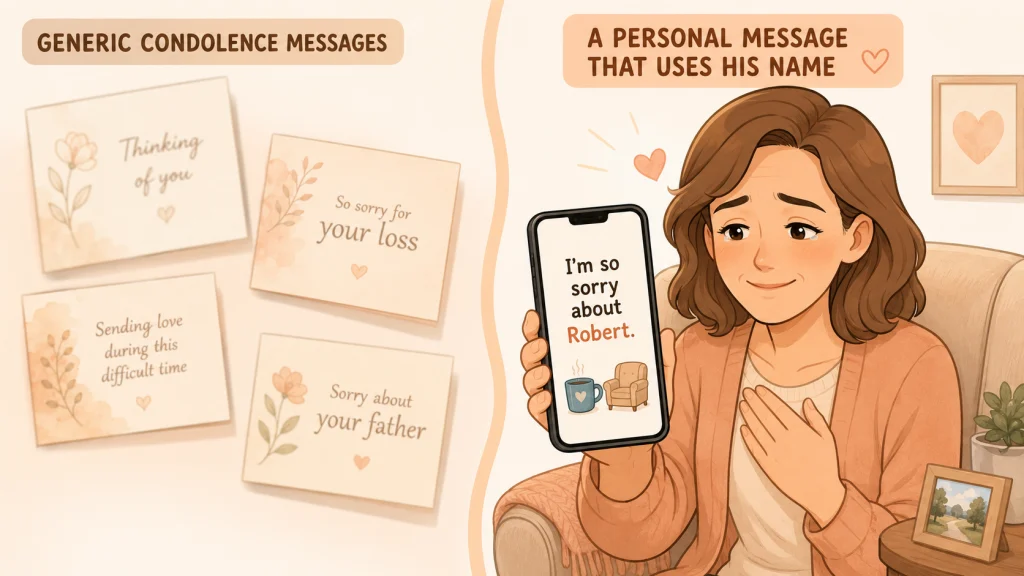
One of the things I keep noticing about condolence messages that actually land is how rarely they use the name of the person who died. Most messages say “your father” or “your loss,” which is accurate but keeps the whole thing at a certain distance. There is a real difference between receiving a message that says “I am sorry for the loss of your father” and one that says “I am so sorry about Robert. He was one of a kind.” The second message is not just about a category of loss. It is about a specific person, and that specificity is exactly what grief needs.
Using his name does two things. It signals that you knew him, or that you have listened carefully enough to know what he was called. And it makes the message impossible to have sent to anyone else. For the person receiving it, in a week where everything feels blurred, that specificity can cut through in a way that nothing else does.
The messages below use [his name] as a placeholder. Replace it with the father’s actual first name before sending. A first name works for most contexts. A title is right when you want to express respect and did not know him personally.
- I am so sorry for the loss of [his name]. He mattered to a lot of people, and he clearly mattered most to you.
- [His name]’s care still shows in the person you are. I am thinking of you and your family.
- I keep thinking about [his name] and about you. I am so sorry for this loss.
- [His name] had a way of making people feel at home. That kind of warmth stays with people.
- I just wanted to say how sorry I am for the loss of [his name]. He left his mark on the people around him.
- [His name] sounds like he was one of a kind. The way you talk about him tells me everything. I am so sorry he is gone.
- I am so sorry about [his name]. If you want to talk about him, I want to hear it. Now or in six months, whenever you need.
- I have been thinking about you since I heard about [his name]. The loss of a father takes a long time to settle, and I just wanted you to know I have not forgotten.
There is a condolence message I almost did not send once because I was not sure it would land. I sent it anyway, and used the father’s name in the first line. The person told me later that almost no one had used his name, and that it made the message feel like it was actually about him and not just about the loss in the abstract. That stayed with me. The name is often the whole thing.
Final Thoughts: What the Right Message Actually Does
A message does not fix grief. It does not resolve a complicated history, bring someone back, or tell a person how long to hurt or in what direction. What it can do, when it is honest and specific and sent without expectation of a response, is make someone feel less alone for a moment. For a loss as particular as a father’s death, one that so often gets fewer words than it deserves, that matters more than usual.
The messages here are starting points. The ones that will do the most work are the ones you adjust to the person you know, the relationship you actually have, and whatever specific thing you know about his father. If you knew the man, say something you remember. If you only know his child, say something true about that. The details are where the difference lives.
If the person you are writing to has also lost their mother, or if you are navigating both losses at once, the companion collection on what to say when someone loses their mother covers that particular grief with the same attention. Father-grief and mother-grief are not the same thing, but the impulse behind the right message for both of them is.
FAQs
💬 What do you say when someone loses their father?
Keep it simple and direct. Acknowledge the loss, say you are thinking of them, and offer your presence without conditions. You do not need the perfect words. You need something honest that sounds like it came from you.
🕊️ How do you comfort someone who has lost their dad?
Show up consistently, not just in the first few days. The second and third weeks are often when people start to feel especially alone. A short text that says “still thinking of you” two weeks after the funeral can mean more than the most carefully written note sent on the day itself.
💙 What should you not say when someone loses their father?
Avoid silver linings and age-based reassurances. “He is in a better place,” “at least he lived a full life,” and “I know exactly how you feel” are all well-intentioned and almost all miss. Say what is true without trying to fix it.
✉️ How long should a condolence message for a father’s death be?
Three to five sentences is right for most contexts. Longer is fine if you have something specific to say. Shorter works if that is what the relationship calls for. The length matters far less than whether the message sounds like it actually came from you.
🌿 Is it okay to reach out weeks after someone’s father died?
Yes, always. There is no window that closes. A note that comes weeks or months later often carries more weight, not less, because most people have stopped reaching out by then.
💭 What do you say when you didn’t know someone’s father?
Focus on the person you do know. “I know how much he meant to you” says something true without requiring you to have met him personally. You do not need to have known the father to acknowledge the size of the loss.