Short sympathy messages are harder to write than long ones, not easier. When you have two sentences instead of two paragraphs, every word has to carry more weight. This is a collection of 55 short sympathy messages organized by where you are actually sending them, because a flower tag has different rules than a group card, and a text message is not the same thing as a public post. You will find options for each format here, along with some honest notes on why the format shapes what you should and should not say.
Why the Format Is Part of the Message
People often reach for short sympathy messages when grief makes even simple words feel out of reach, and most of what comes up organizes them by relationship: what to say to a close friend, what to say to a coworker, what to say to someone you barely know. That is useful, but it misses something. The harder variable is not always who you are writing to. It is where the words are actually going. A flower card travels with the flowers and arrives in someone’s home to be read by anyone there. A text message lands in a private conversation. A group card is co-signed by everyone in an office. A post on social media is, for better or worse, public.
The same message does not fit all of these. What lands warmly in a text, something personal and immediate, reads as oddly intimate when it appears alongside twelve other people’s signatures on a group card. What works perfectly on a flower insert, a clean one-liner with nothing extra, would feel cold in a direct message from a close friend. Brief sympathy messages work best when they are written for the specific container they are going into, not just shortened versions of longer ones.
I filled out a flower card insert at a florist in Lisbon once, for a friend whose mother had just died back home. I had maybe four printed lines. What came out was cleaner than anything I had spent ten minutes trying to write on other occasions, because there was simply no room for the version that circled the truth. The constraint, in that case, was a kindness.
| Format | Ideal length | Tone | What to avoid |
|---|---|---|---|
| Text message | 1 to 4 sentences | Personal, immediate | Long explanations; questions that put pressure on the reader |
| Flower card | 1 to 2 lines | Simple, sincere | Anything that needs context to land |
| Group card | 1 to 2 sentences | Shared warmth | Personal anecdotes that belong in a private message |
| Social media | 1 to 3 sentences | Brief, public | Long personal stories; grief that is more for you than for them |
| When you barely knew the deceased | 1 to 2 sentences | Respectful, warm | Over-explaining your connection; claiming more closeness than you had |
The sections below follow this logic. Format is the organizing principle, and the messages are written for where they are actually going. Find the one that fits your situation and take what feels right.
Short Sympathy Messages for a Text Message
Texting is the format that most people overwrite, and I think it is because there is no natural stopping point. You can keep going. There is no physical card running out of space, no insert that forces brevity. So people add qualifiers and soften the edges and then add a little more, and the message that arrives is longer and more fraught than anything the situation required.
The best sympathy texts are short enough to read in a glance and specific enough to feel like they came from a real person. The person on the other end is probably not in a state to read much. What they need is to know you showed up. One thing that consistently goes wrong here: ending with “let me know if you need anything.” It comes from a genuine impulse, but it shifts the burden back onto someone who is already overwhelmed, asking them to figure out what they need and ask for it out loud. If you want to offer something, make it concrete. If you cannot make it concrete right now, leave it out of this message entirely.
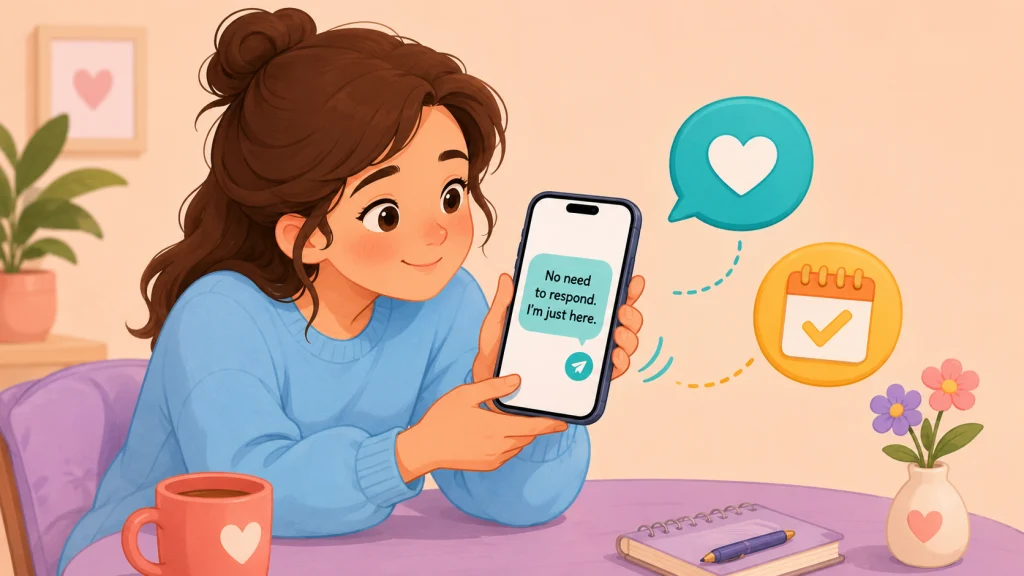
- I heard the news and I’ve been thinking of you. No need to respond. I’m just here.
- I’m so sorry. Wishing you gentleness right now.
- Thinking of you today. Take all the time you need.
- I’m so sorry for your loss. No reply needed. I’m just with you from here.
- No words feel right, so I’ll just say: I love you and I’m here.
- I heard about [name]. I’m so sorry. I’ll be thinking of you.
- Sending you so much love right now.
- I’m thinking of you and your family. I’ll check in again soon.
- I’m sorry. This is a hard one. I’m not going anywhere.
- Just wanted you to know you’re on my mind today.
- I heard, and my heart goes out to you. Truly.
- So sorry for your loss. Take care of yourself.
- I’m keeping you close in my thoughts. No rush, no reply needed.
- I don’t know what to say except that I love you and I’m with you.
- Thinking of you and sending all the warmth I have.
If the relationship calls for something more layered than a few lines, words of comfort that go a little further might be what you need. But for the moment when you just want to say something true and send it, these hold up.
Short Sympathy Messages for a Flower Card
The flower card is its own particular challenge. It is small, it travels separately from you, and it arrives in someone’s home to be read by anyone who happens to be there. It gets read more than once, over the days the flowers last. What you write on it needs to work without your presence, without explanation, without any context beyond the flowers themselves sitting in the room.
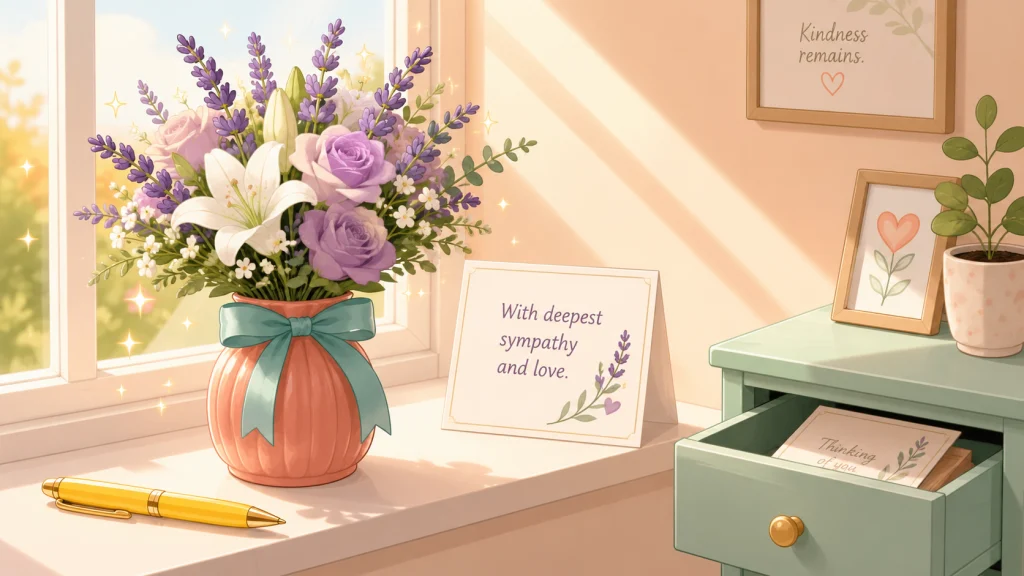
Longer is almost never better here. I have seen inserts where someone tried to write a full paragraph in a two-inch card. The handwriting gets cramped, the lines blur together, and what could have been something to hold onto becomes hard to read in every sense. One clear line, written with intention, does the work. The other thing worth knowing is that these cards often outlast the flowers. People keep them. They end up in drawers and on windowsills months later. Write something you would want still sitting there in a year.
- With deepest sympathy and love.
- Thinking of you in this difficult time.
- With love and sorrow.
- In memory of someone deeply loved.
- Wishing you peace and comfort.
- You are in our thoughts.
- With heartfelt condolences.
- Sending love as you grieve.
- May these flowers bring a small moment of comfort.
- With sympathy and warm thoughts.
- In loving memory.
- You are not alone in this. With love.
These are short sympathy card messages in the truest sense. They are not trying to say everything. They are trying to say one true thing, and let the flowers, and the act of sending them, say the rest.
Short Sympathy Messages for the Group Card
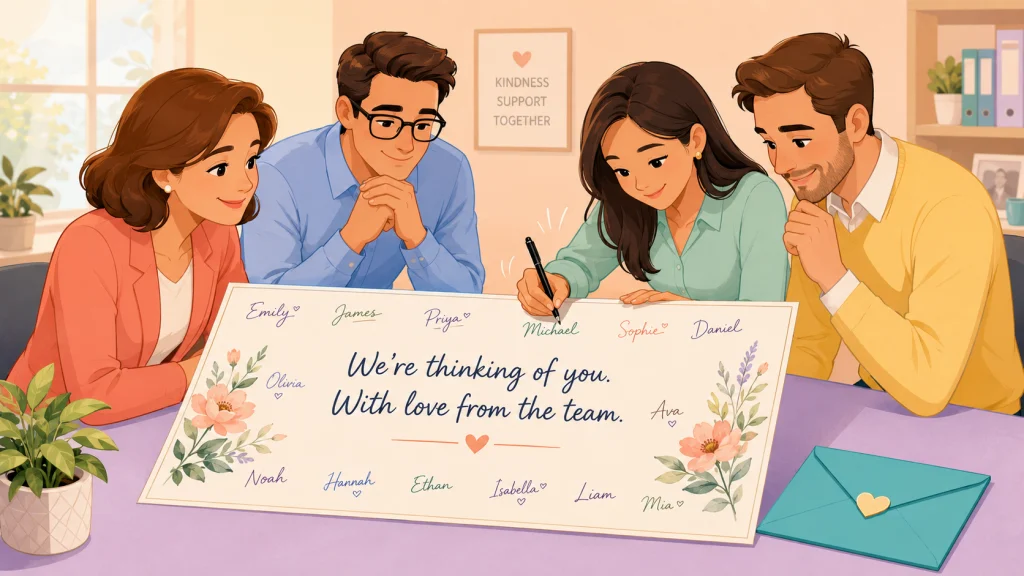
The group card has a social dimension that no other format has. Everyone can see what everyone else wrote. You are one name among a dozen, contributing to something collective. What reads as warm and personal in a private text can feel oddly intimate when it appears alongside twelve other people’s signatures. And what fits perfectly in a group card would feel impersonal and thin coming from a close friend in a direct message.
What tends to go wrong: people see that others have already signed and try to distinguish themselves, writing longer or more emotionally than the format calls for. The result is a card with one or two sprawling messages and a lot of short ones, and the whole thing feels uneven. The better instinct is to add your warmth to the collective voice, not to stand apart from it. Short condolences work especially well on group cards because they are legible, dignified, and easy to receive. The weight of this kind of message comes from the accumulation of names, not from any single one.
- So sorry for your loss. Thinking of you.
- Our deepest condolences to you and your family.
- With sympathy from all of us.
- We are so sorry. Please know we’re here.
- Sending our love and thoughts during this time.
- Your loss is felt by all of us. With sympathy.
- We’re thinking of you. With love from the team.
- In memory of [name], with love.
- Wishing you peace and strength in the days ahead.
- Our hearts go out to you. We’re so sorry.
If there is room on the card for something more personal alongside the shared message, or if you want to follow the group card with something written just from you, what to write in a sympathy card covers longer formats organized by relationship and tone.
Short Sympathy Messages When You Barely Knew the Person Who Died
This is the situation a lot of people do not have language for. You knew the person who is grieving, but you never met the person they lost. Or you knew the person who died, but only in passing. The loss still calls for something. It just calls for something that does not overclaim.
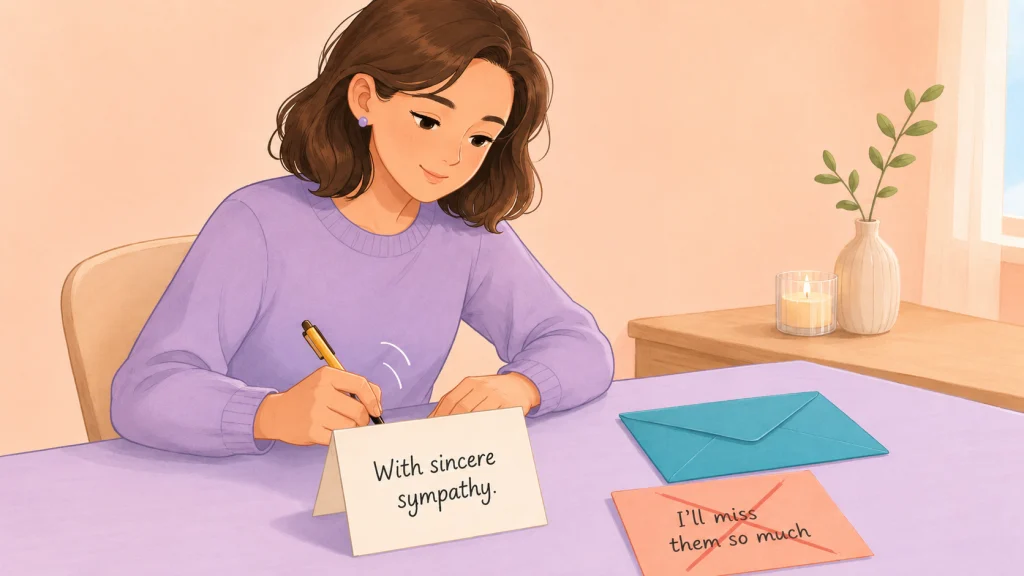
What does not work here is trying to reach for closeness you did not have. Writing “I will miss them so much” when you only met someone once is a kind of inflation that the grieving person can usually sense, even if they cannot name it. But going so far in the other direction, being so formal that it reads like a notice from an institution, is not right either. You do not need to explain your relationship or qualify your sympathy. A short condolence message sent with genuine care does not require credentials. The person receiving it does not need you to have been close to the deceased. They need to know you saw their loss, and that it mattered to you that it happened.
- I’m so sorry for your loss. Wishing you peace and comfort.
- Please accept my sincere condolences during this difficult time.
- I was saddened to hear of your loss. Wishing you comfort.
- My thoughts are with you and your family.
- With sincere sympathy.
- I’m sorry to hear of your loss. Wishing you peace.
- Sending my condolences to you and your loved ones.
- My heartfelt sympathies to you during this time.
- I was so sorry to hear this. I hope you feel held right now.
- You are in my thoughts today and in the days ahead.
Short condolences sent with sincerity carry more than long ones sent with uncertainty. What matters is not how much you knew the person who died. What matters is that you said something honest to someone who is grieving, and that you sent it.
Final Thoughts: Sending Something Is Almost Always Better Than Silence
There is a fear underneath most sympathy writing, and it is the fear of saying the wrong thing. The instinctive response to that fear is usually length: more words, more qualifiers, more reassurance stacked up until the whole thing becomes something no one in grief has the bandwidth to read. But brevity is not coldness. A short message sent without hesitation often lands better than a long one that arrived three days late because you could not get it right.
The messages here are a starting point, not a script. Take what fits the relationship and the format, change a word if it does not sound like you, and send it. The person on the other end does not need a perfectly constructed message. They need to know you were thinking of them. In almost every case I have seen, the sending matters more than the phrasing.
If you want to go further, the full collection of sympathy messages covers longer options by relationship, occasion, and tone. And if you are not sure where the line is between something helpful and something that lands wrong, what not to say in a sympathy card is worth reading before you send anything you feel uncertain about.
FAQs
💬 What is a good short sympathy message?
Something warm, brief, and honest. “I’m so sorry. I’ve been thinking of you.” is enough. The goal is to let the person know you saw their grief, not to fill a page. Short condolences sent without hesitation almost always land better than longer ones held back while you tried to get them perfect.
🌸 What do you write on a flower card for sympathy?
One or two lines are all you need. “With deepest sympathy and love” or “Sending love as you grieve” travels well. Avoid anything that requires context to make sense, since the card will arrive without you there to explain it.
✍️ What do you write in a group sympathy card?
Add your warmth to the collective message without trying to stand out. Something like “So sorry for your loss. Thinking of you.” fits the format well. Short and sincere is the right register for a card that many people are signing together.
💻 What should you post on social media when someone dies?
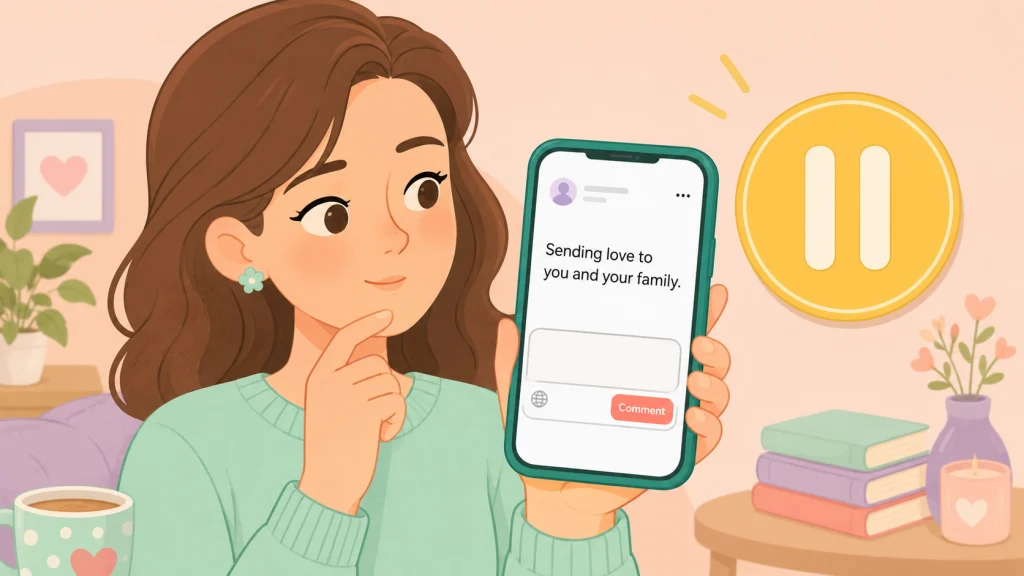
Keep it brief and focused on the person receiving your words, not on your own grief. “Sending love to you and your family” or “So deeply sorry to hear of this loss” is enough. Public acknowledgment does not need to be long to matter.
❓ Is it okay to send a really short sympathy message?
Yes, always. A short sympathy message sent promptly and honestly is almost always better than a longer one delayed because you could not get the wording right. The person receiving it needs to know you showed up. Length has nothing to do with that.
🤍 What do you say when you didn’t know the person who died?
You do not need to explain your connection or qualify your sympathy. Something simple like “I’m so sorry for your loss. Wishing you peace.” is more than enough. The person grieving does not need you to have been close to the deceased. They need to know that you saw their loss.