

You Had Something to Say. And Then Nothing.
You had the perfect moment to say something that mattered. And nothing came out. If you have wondered why we cannot find the right words precisely when it counts, the short answer is that your brain was not failing you. It was doing exactly what brains do under load. The longer answer is worth understanding, because it changes what you think of yourself in those moments.
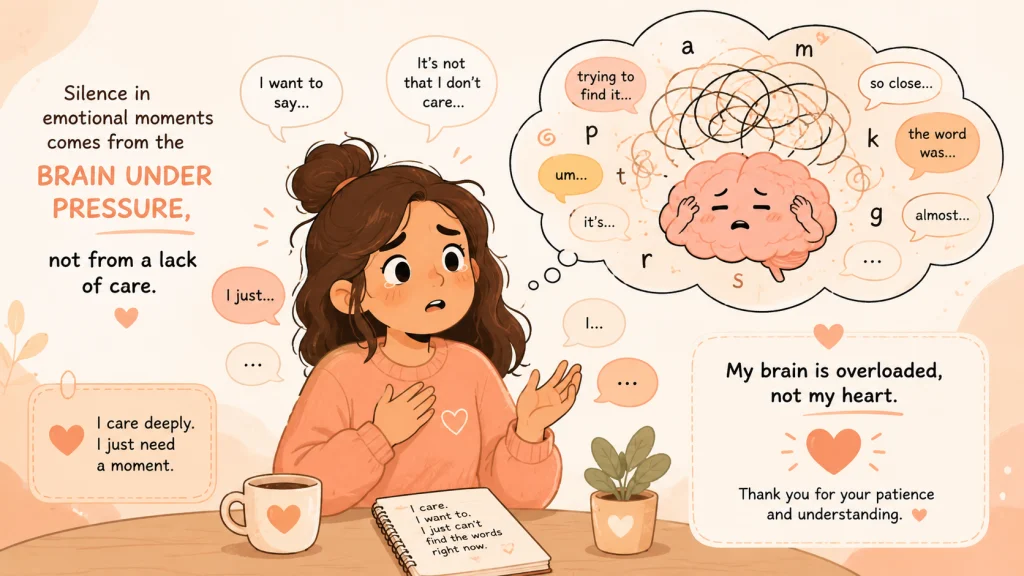
This is one of the more disorienting experiences in human communication. You know what you feel. The person is right there. And somewhere between the feeling and the sentence, something breaks down entirely. People describe going blank, freezing, or suddenly finding that every word they try sounds completely wrong. What they rarely know is that there is a documented reason for this, and it has almost nothing to do with how deeply they care.
In fact, the people who lose words at funerals, at apologies, at the moment someone they love is in pain, are often the ones carrying the most weight in the room. From what I have found, the silence and the feeling tend to arrive together.
What Your Brain Is Actually Doing
When emotional stakes rise, the body floods with cortisol. This is the stress response doing its job, preparing you to respond to something significant. The problem is that cortisol disrupts the neural pathways specifically involved in word retrieval. Connected Speech Pathology’s 2026 research confirms that anxiety actively interferes with language production systems, and that chronic stress can cause structural changes in the brain regions tied to word access. The moment you need language most can become the moment your brain is least equipped to produce it.
Producing spoken words under normal conditions is already a complex operation. According to research summarized by The Conversation in October 2025, speaking requires selecting a word from your mental lexicon, retrieving its sound pattern, and executing the physical act of articulation, all in real time. Under emotional load, any one of those steps can fail. Selecting the right word from memory becomes harder. Retrieving how it sounds becomes harder. And putting it into your voice while your body is in a stress state becomes harder still. The three systems that need to work together stop coordinating.
I have felt this firsthand. Standing at a graveside, certain I had prepared something, certain the words were there, and then standing in silence while nothing came. It felt, in the moment, like failure. It was not. It was cortisol at work on a brain that was overwhelmed by exactly the kind of grief it was supposed to be expressing. Those two things were happening at the same time.
The Tip-of-the-Tongue Effect at Exactly the Wrong Time
There is a documented cognitive state called the tip-of-the-tongue phenomenon, where a word exists clearly in memory but temporarily cannot be retrieved. You know the word. You can almost feel its shape. And you cannot reach it. This experience is more common in high-stakes moments, and more likely when attention is divided between what you are feeling and what you are simultaneously trying to say.
It is why the perfect thing to say almost always arrives twenty minutes after the moment has passed. The pressure lifts. The cortisol drops. The retrieval system comes back online. And there it is, the sentence that would have been exactly right, arriving too late to be delivered. Struggling to find the right words in the heat of a difficult moment is not the same as not having them. The words exist. The system for reaching them is temporarily closed. There is a meaningful difference between those two things, even when it does not feel like one.
This also explains the particular frustration of the experience. It is not that you had nothing to say. You had something specific, something you had even thought about before. The problem was access, not content. Introvert Dear’s research from May 2025 confirms that cortisol’s disruption of hippocampus function, which is central to memory retrieval, is more pronounced when emotional investment is higher. The stakes are not working against your feelings. They are working against the retrieval mechanism those feelings depend on.
Why Some People Experience This More Than Others
Not everyone loses words to the same degree in emotional moments, and the difference tends to get misread as a character flaw. People who process emotions deeply, who are highly attuned to what others are feeling and to the full weight of a situation, carry more cognitive load in high-stakes moments. More is being taken in. More is at stake internally. More cognitive resources are being used just to be fully present, which leaves fewer available for the separate task of constructing language.
This is not a deficit. It is a difference in wiring. Feeling deeply and being at a loss for words are not opposites in these moments, even when they feel like they should be. The person who goes completely silent at a difficult conversation is not less equipped for emotional connection than someone who speaks fluently through it. They are, in many cases, more saturated by the moment, which is exactly why the language system buckles.
What I keep seeing, over time, is that this pattern is hardest on the people who most want to show up for the people they love. The silence reads to them as failure. To the person on the other side, who sees the tears or the frozen expression or the visible effort to speak, it rarely reads that way at all.
Before Language, There Were Tears
Language is a recent development in human history. Before it existed, humans communicated distress through tears, gesture, and touch. These systems are older and more deeply wired than the language centers of the brain, and when emotion becomes intense enough, the brain reverts to them. Scientific American has documented that tears take us where syntax and syllables cannot. The body speaks when language stops working, and it has been doing that for far longer than language has existed.
This explains why some of the most genuine responses to grief, to love, to a moment where someone needs to know they are not alone, have no words in them at all. Sitting with someone in silence. Crying when you try to speak. Reaching for someone’s hand instead of finding a sentence. These are not failures of communication. They are the older, pre-verbal form of it, and in some moments, they land with more weight than anything that could have been said.
Why words fail us at these moments is less a question of language capacity and more a question of depth. When the feeling runs deeper than the verbal system can carry, something older comes up instead. That is not something to correct. It is something to recognize for what it actually is.

What the Silence Is Actually Saying
There is a thing that happens when someone goes quiet at a funeral, or mid-apology, or when someone they love is in pain. The silence gets interpreted, by them and sometimes by the other person, as absence of feeling. As not knowing what to say because there is nothing genuinely felt underneath.
The pattern I keep seeing tells a different story. The people who go the most silent are often the ones holding the most. The person who could not say anything at a parent’s memorial was not unmoved. The person who froze in the middle of the most important apology of their relationship was not indifferent. The system that produces words shuts down under the weight of something real. That weight is the feeling. The silence and the feeling are not separate.
The situations where this tends to happen most are recognizable. Not because they are unusual, but because they are the ones that carry the most:
- Gravesides and memorial services, where the weight of loss sits in the room and nothing feels adequate to say inside it
- Apologies for something significant, where the stakes make every word feel both necessary and wrong at once
- Confessions of love, where the vulnerability is high enough that the voice changes before the sentence even forms
- Comforting a friend in real crisis, where you know nothing you say will be adequate, and that knowledge freezes the attempt
- Reunions with people you have missed deeply, where the fullness of what you feel cannot fit inside a sentence at all
In every one of those situations, the silence is not empty. It just cannot be spoken in the moment it is happening.

What Written Words Give You That the Moment Cannot
The reason written messages work so well in exactly these situations is not that they are easier. It is that they remove the specific part of the problem that causes the breakdown. When you cannot find the words to say in real time, the pressure of the moment is doing most of the work against you. Writing removes that pressure entirely. There is no one watching. There is no real-time performance. The cortisol drops. The retrieval system comes back. And what remains is just you and the words, found at whatever pace they need to be found.
Having words prepared in advance is not dishonest. This is a thing people worry about, and it is worth saying clearly: it is emotionally intelligent. The feeling behind the words is real. The work of finding language that matches the feeling is just being done before the moment rather than inside it. One does not undermine the other. A message written the night before a difficult conversation, or the morning after a funeral, carries the same weight as anything that might have been said out loud, and often more, because it was arrived at with care.
| What real-time speech demands | What writing allows |
|---|---|
| Immediate word retrieval under stress | Time to find the exact phrase |
| Managing vocal tone while overwhelmed | Words written from a calmer place |
| No chance to revise once spoken | Revision until it sounds right |
| Performance in front of another person | Honesty without an audience |
| Words that disappear once said | Words that can be re-read |
Finding words when it matters most does not have to mean finding them inside the moment. Some of the most meaningful things ever said between people were written down first, sent when ready, and read when the other person had the space to take them in. If what you are looking for is language for a moment of loss, there are sympathy messages here written for exactly these situations. And if the silence you are trying to break belongs to a relationship, messages for the people who matter most can be a place to start.
Final Thoughts: The Words Will Come
Losing words at important moments is one of the most universally human experiences there is, and one of the least talked about, possibly because the moment it happens feels so personal and so isolating. But the research points in one direction, and the older story of human communication points there too. The feeling that has no words around it is not smaller for the silence. It is, most of the time, the opposite.
What you can do, when the moment passes and the pressure lifts and you finally know what you want to say, is say it. It does not have to be immediate. A message sent two days after a difficult moment can matter as much as one sent inside it. An apology written out and delivered when the words are finally ready is not a lesser version. It is honest, and it arrived. Those two things together are almost always enough.
If you went quiet and that silence is sitting with you now, you do not have to pretend it did not happen. You can return to it, gently. Something like, I went quiet because I cared and I could not find the words in time, is often more honest than anything that might have been said in the moment. That kind of return tends to land.
If you are searching for the words that would not come in the moment, you are not looking for something invented. They are already there. You just need a lower-pressure way to find them.
FAQs
🧠 Why do I go completely blank when I try to say something emotional?
Cortisol released during emotionally charged moments disrupts the neural pathways involved in word retrieval. It is not a failure of feeling or intelligence. The more significant the moment, the more the stress response interferes with the language system. The silence is the brain under load, not the absence of something to say.
💭 Why does the right thing to say always come to me after the moment has passed?
The word or sentence was in your memory the whole time. Once the pressure of the moment lifts and cortisol drops, the retrieval system comes back online. What felt like a blank was a temporary access failure, not an absence. The fact that the words arrived later is evidence that they were always there.
🤍 Does going silent mean I do not care enough?
Almost always, it means the opposite. Silence at a funeral, mid-apology, or in a moment of someone else’s pain tends to come from feeling too much rather than too little. The language system shuts down under the weight of something real. That weight is the care. The two are connected, not separate.
✍️ Is it okay to write down what I want to say instead of saying it out loud?
More than okay. Writing removes the real-time pressure that causes the breakdown in the first place. The words are no less genuine for being written rather than spoken. A message that arrives after the fact, crafted when you could finally find the right language, is not a lesser version of the thing. In many cases it is the one that gets saved and re-read.
🔇 What do I do when I literally cannot speak at all, like at a funeral?
Nothing, if nothing is what the moment allows. Tears, presence, a hand on someone’s shoulder, these are older forms of communication than language and they carry real weight. Being there without words is not the same as being absent. When you are ready to say more, writing it is always an option, and there is no expiration on that.
😶 Is this more common for people who feel things deeply?
Yes, and it is worth understanding why. Deeper emotional processing means more cognitive load in high-stakes moments, which leaves less bandwidth for language. The people most affected are often the ones most invested in the moment. It is not a wiring problem. It is just what full presence sometimes costs.