
You read a message and your eyes filled before you understood why. The response felt automatic, almost involuntary, and nothing about the moment prepared you for it. What was actually happening is a sequence of events the brain runs every time language carries real emotional weight. This is the science behind why certain words make you cry, why the response arrives before the thought does, and what the tears are actually telling you about the words that matter most.

When the Body Responds Before the Mind Does
You read a message from someone you love and something inside you broke open. Not grief, exactly. Not even entirely surprise. Just a release you did not choose and could not have predicted. If you have been trying to understand why certain words make you cry when the rest of the day does not, the answer starts well before the rational part of your brain finishes reading the sentence.
The amygdala, the part of the brain that processes emotional content, can respond to meaningful language faster than the prefrontal cortex can calmly evaluate it. The emotional response to words that matter runs through some of the oldest systems in the brain. This is why a single sentence can land in your chest before you have time to brace. You are not being oversensitive. You are experiencing what the brain does when it encounters something that registers as emotionally significant, which is to say, something real.
I have read messages in airports, in the middle of other conversations, standing on a train platform with nowhere to be private. The ones that hit do not wait for the right moment. They arrive, and the response begins before the words are fully parsed. That gap between the reading and the feeling is not accidental. It is the brain signaling that what just happened is worth paying attention to.
The Chemistry Behind the Tears
Crying triggered by meaningful words is not a collapse or an overreaction. According to research from Holy Family University, emotional crying releases both oxytocin and endorphins. What feels like losing control may also be the body responding to a genuine connection. The discomfort that comes with tears is real. So is the loosening that often follows, that particular kind of relief, and it is chemical.
Emotional tears are physiologically different from other kinds. They contain stress hormones, which the body expels through the process of crying. The Calm Blog notes that this shift, from stress to regulation, is part of why crying at something meaningful often leaves people feeling unexpectedly calmer afterward. The tears are not simply overflow. They are doing something specific. The body is processing what the language delivered.
Scientific American described it plainly: tears take us where syntax and syllables cannot. This is part of why the hardest things are sometimes impossible to say out loud. There is a form of communication that predates language entirely, and when words reach deep enough, they touch that older system directly. What makes messages move people to tears is not always the words themselves. It is what the words reach.
A friend sent me a message on what was, by any measure, a completely ordinary Wednesday. No occasion, no crisis, no reason to reach out except that she felt like it. She wrote about something I had said to her almost a year earlier, something small I had not been sure she registered at the time. I read it twice before I noticed I was crying. Not because I was sad. Because sometimes kind words reach the place that has been holding itself together, and the body responds as soon as it feels safe enough to stop bracing.

Why Unexpected Kindness Hits Harder Than It Should
Research published by the APA, conducted by Liu, Rim, and Min, found that people consistently and significantly underestimate how much others appreciate an unprompted contact. The gap between how much the sender expects the message to matter and how much it actually means to the person receiving it is large and consistent across relationships and contexts. The sender almost always underestimates. The recipient is often more moved than expected.
Part of this comes down to surprise. When something arrives outside a familiar pattern, the brain can process it with more attention and more depth. An occasion-based message has a container: birthday, holiday, condolence. It fits a category, and fitting a category is not a failure, but it does mean the emotional defenses are already in place. An unexpected message on an ordinary afternoon has no container. It means someone thought of you for no reason other than that you exist and that you crossed their mind. That specific signal, unprompted care, is rarer than most people realize, and the body can feel the difference.
This is why a message sent to mark an occasion and a message sent for no occasion at all can feel entirely different in the body, even when they say similar things. The occasion-based message is expected, and something expected arrives with its emotional defenses already built. The unexpected message bypasses all of that. It arrives somewhere the sender never knew they had access to.

The Recognition Response
There is a particular kind of emotional release that comes from reading words that name something you have been carrying but never found language for. It is distinct from being comforted, and it can feel more intimate because it is more exact. Being accurately seen by another person is rarer than it sounds, and when it happens, the brain treats it as significant. The relief is real. So is the charge that accompanies it.
If you have ever wondered why certain words make us emotional even when the message is not about anything painful, this is often the reason. Someone has named the precise thing you have been feeling, not a general version of it but the actual texture of it, and the brain responds to that with something close to relief. This is also why the words that move people are rarely the ones that say “I am always here for you” in a general way. They are the ones that say “I know this specific thing about you, and I have been thinking about it.”
The most common mistake people make when trying to write something meaningful is going long in the hope that length signals effort. It does not. Volume can read as hedging. What tends to land, from what I have found, are the messages that choose exactly what to say and then stop. A few things tend to separate a message that causes a genuine emotional response from one that only sounds polite:
- It names something specific rather than a general category of feeling.
- It arrives when not expected, with no occasion to justify the reach.
- It acknowledges what the person is carrying rather than attempting to resolve it.
- It comes from someone the reader did not know was paying that level of attention.
- It contains a detail, a reference, a word that proves the sender was actually listening the last time.
None of this requires length. Some of the most precise messages I have ever read were two sentences. When you are searching for words for someone in a hard stretch, the words of comfort on this site are written with that kind of specificity in mind, not toward comfort as a category, but toward the specific weight of a specific moment.
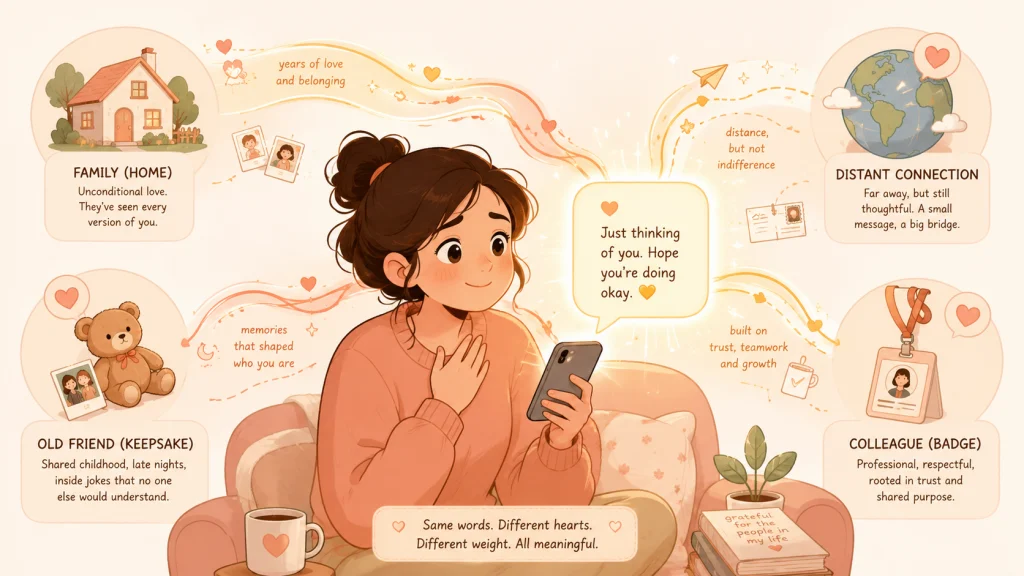
Why the Same Words Land Differently Depending on Who Sends Them
The content of a message is only part of what the brain is processing. The other part is the relationship. A compliment from a stranger and the same compliment from a parent can be processed in very different emotional contexts. The brain does not read words in isolation. It reads them in context, and the context includes everything it knows about the person on the other side of the screen.
This is part of why the most moving messages are sometimes from people the recipient did not expect to be seen by. Someone who has been watching quietly for longer than the reader knew. Someone the reader had almost stopped hoping would notice. The accumulated weight of a relationship lives inside the language, beneath the surface of the specific words, and the brain processes all of it at once.
| Relationship | Why the same words land differently |
|---|---|
| Close family | Carries the full weight of shared history. A single sentence can activate everything underneath it. |
| Old friend you rarely speak to | The rarity of contact makes the message feel chosen rather than obligatory. It arrives outside the pattern. |
| Colleague or acquaintance | Lower emotional charge by default, unless the timing or the specificity is unusually right. |
| Someone you have been distant from | Charged with everything unsaid. Can land harder than words from someone you speak to every day. |
Research from the University of Chicago, published in Nature Human Behaviour in December 2025, found that emotional arousal enhances memory encoding by strengthening cohesion across brain networks. Words that move you are not processed like words that merely inform you. The emotion is part of how the brain decides that something deserves attention. This is why a message can feel so much larger than the sentence on the screen.
For the love and relationship messages that carry the most weight, the emotional context is already present before a single word is written. The relationship does most of the work. What the words do is give that weight somewhere to land.
Final Thoughts: What the Tears Are Actually Telling You
When a message makes you cry, the response is not confusion or overreaction. It is a form of recognition. The body registering that what just happened was real, and specific, and worth feeling. People often apologize for crying at messages, as if the response were disproportionate. The biology suggests otherwise. When the response arrives that quickly, something genuinely meaningful has reached you.
What this means for the messages you send is, ultimately, simpler than most people make it. Specificity matters more than length. Timing matters, and unexpected timing matters most. The relationship context is always present, even when it is not written down. And the most powerful thing a message can do is not simply comfort or encourage but name something accurately. If you are looking for words built to lift someone up without sounding hollow, you will find them organized by situation throughout this site.
FAQs
💬 Why do I cry when someone says something nice to me?
Your brain processes kind words through the amygdala before the rational mind catches up, and that processing can trigger a release of oxytocin and endorphins. The tears are not overreaction. They are the body marking that something genuine just happened. That is worth more than it might feel like in the moment.
🧠 What does science say about why words make us emotional?
Emotional words can activate the amygdala faster than the prefrontal cortex can calmly evaluate them, which is why the response often arrives before the conscious thought does. Research from Holy Family University confirms that emotional crying releases both oxytocin and endorphins. The tears are not simply a loss of control. They are part of how the brain and body respond when something feels real.
💌 Why do I sometimes cry reading a message but not when I hear the same words spoken out loud?
Written words slow the processing down. You read at your own pace, which means the meaning has time to arrive fully. There is also no performance pressure in reading. You can absorb it privately, re-read it, sit with it. That privacy makes the emotional response easier to feel all the way through rather than managing it in real time.
😢 Is it normal to cry at a message from someone I am not even close to?
It is, and the research helps explain why. APA-published studies show that people consistently underestimate how much being reached out to affects others. Unexpected kindness can bypass emotional defenses precisely because there is no occasion to explain it. The response is tied to the rarity of the signal, not only to the closeness of the relationship.
❤️ Why do certain people’s words affect me more, even when they say the same thing as someone else?
The brain does not read words in isolation. It reads them in the context of everything it knows about the sender: the shared history, the distance, what was said before and what was never said. The relationship is always part of the message, even when it is not written down. A compliment from a parent and the same compliment from a stranger can feel like two entirely different emotional events.
🕰️ Why can one sentence affect me more than a long message?
Length is not what makes words land. A single sentence can affect you deeply if it names the exact thing you have been feeling, arrives at the right moment, or comes from someone whose attention matters to you. The body responds to emotional accuracy more than volume. Sometimes the shortest message is the one that gives the feeling nowhere to hide.