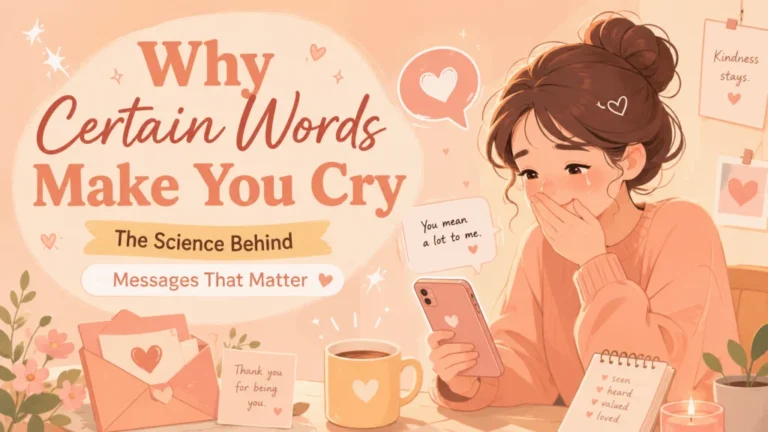
Some messages you delete without a second thought. Others you keep for years, rereading them in quiet moments long after the conversation has moved on. The difference is not how long the message was, not the platform, and not how well the sender knew you. It comes down to a small set of things that happen in the brain when a message lands a certain way, and understanding them changes how you write.
Why Your Brain Keeps Some Messages and Discards Others
Someone sent you a message once that you still have. Maybe it was a text after a hard week. Maybe it was two lines in an email you forwarded to yourself across three different devices just to avoid losing it. You did not consciously decide to hold onto it. Your brain made that decision for you, and it did so for specific, documented reasons.
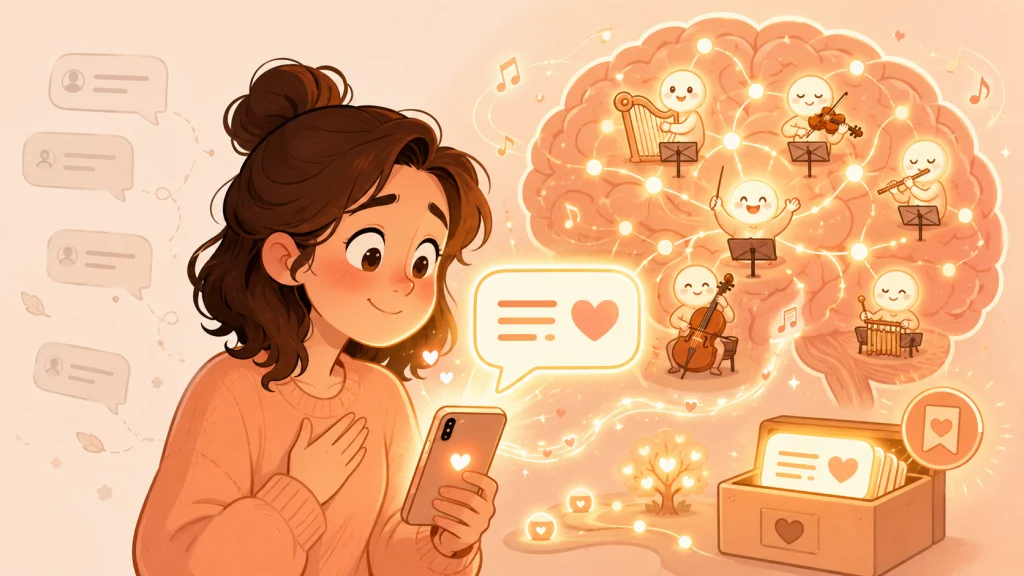
A team at the University of Chicago published findings in Nature Human Behaviour in December 2025 on exactly this: emotional arousal enhances memory encoding by strengthening cohesion across brain networks. The lead researcher described it this way: when emotional arousal is present, the brain operates like an orchestra in harmony, with different sections moving together rather than separately. The memories formed in that state become more lasting. This is more than a metaphor. It is a way of describing what happens in the brain when something actually matters to us.
What this means for personal messages is concrete. A message that triggers emotion is not just felt in the moment. It is encoded differently, more completely, more durably than a neutral one. The birthday text that could have been sent to anyone is read, acknowledged, and forgotten within the hour. The one that made you feel, even briefly, like someone genuinely saw you gets filed somewhere the brain does not easily release. Why some messages are memorable has less to do with eloquence than with what they do to the person reading them. And that is something anyone can learn to do.
The Specificity Factor: Why Concrete Words Stay Longer
Ada Aka, a professor at Stanford Graduate School of Business, shared research through Think Fast, Talk Smart in March 2026 finding that certain words are intrinsically more memorable than others. Concrete, specific language consistently outperforms vague language in retention. The brain encodes sensory, tangible detail more easily than abstract categories. Details stay. Concepts blur.
“I remember the exact Tuesday you drove two hours in the rain to help me move” gives the brain something to hold: a day, a distance, an action, a weather detail. “I will always be there for you” gives the brain a concept. Both might be equally true. Only one gets remembered a year later. The first describes a thing that happened. The second describes an intention, and intentions, however sincere, do not encode the same way.
I noticed this in my own inbox long before I understood why. The messages I have returned to are almost never the ones that said something grand. They are the ones where someone named a thing I did not know they remembered: a phrase I repeat when I am nervous, something I said once in passing that apparently landed differently for them than it did for me. Specificity signals attention. And attention, more than almost anything else, is what people remember being given.
The pattern I keep seeing in love and relationship messages bears this out: the ones that get saved are rarely the ones with the biggest feeling. They are the ones with the most specific feeling. Not “I love you so much” but “I love the way you always ask how the conversation ended, even when you are tired.”
The Unexpectedness Factor: Saying Something Before the Occasion Calls for It
Chip and Dan Heath, in their widely cited work Made to Stick, identified unexpectedness as one of the core mechanisms that make information memorable. Surprise forces deeper processing. When a message arrives in a way we did not anticipate, or says something we did not expect to hear, the brain cannot simply slot it into an existing pattern. It has to actually engage with it, and what the brain works harder to process, it tends to retain.
This applies directly to personal messages. A condolence message that arrives three weeks after the funeral, when everyone else has gone quiet, lands differently than the one sent the same day everyone else sent theirs. A celebration message that acknowledges the specific struggle behind the achievement lands differently than “so proud of you.” Not because the words are more eloquent, but because they were not expected. The brain was not already primed to receive them, and so it had to actually take them in.
I sent something once on what I thought was a completely ordinary Tuesday. No occasion, no reason, just something I had been thinking about for weeks and kept not saying. The person told me later it had arrived on the worst day of their month, which I had no way of knowing. The timing was coincidence. But the unexpectedness was not: a message that arrives without a prompt, that says something before the moment requires it, gives the brain something it was not prepared to process. And the brain tends to remember those.
The messages that get saved are rarely the ones the calendar told someone to send.
The Recognition Factor and the Length Paradox
There is a third thing that makes certain messages stay, and it is harder to name precisely, but most people have felt it: the experience of reading something and thinking, yes, exactly, that is it. When a message accurately names something we have felt but never heard articulated, the brain treats it as significant. Being seen clearly by another person is rare enough that the brain marks the moment and holds it.
This is distinct from being complimented. Compliments can be generic. Recognition is specific to you. “You are so strong” is a compliment. “I have watched you hold everything together for months without once asking anyone to notice, and I just wanted you to know that I noticed” is recognition. The first is kind. The second is the kind of message people read again at two in the morning.
| A message that gets remembered | A message that gets forgotten |
|---|---|
| Names something specific to this person | Could have been sent to anyone |
| Arrives when not expected, or at exactly the right moment | Follows the predictable timing (holiday, birthday prompt) |
| Reflects what you actually see in them | Reflects the category they belong to (grieving friend, new parent) |
| Is shorter than you think it needs to be | Is longer than it needs to be |
| Makes the reader feel seen | Makes the reader feel acknowledged |
The length paradox is real, and it catches most people off guard. The most remembered messages tend not to be long. The brain encodes the precise detail, not the volume. A message that runs three paragraphs often buries the one sentence that actually mattered inside the ones that were circling it. Shorter, more specific messages are remembered longer than long, general ones, not because brevity is a virtue in itself, but because it forces you to name the actual thing rather than gesture at it from a safe distance.
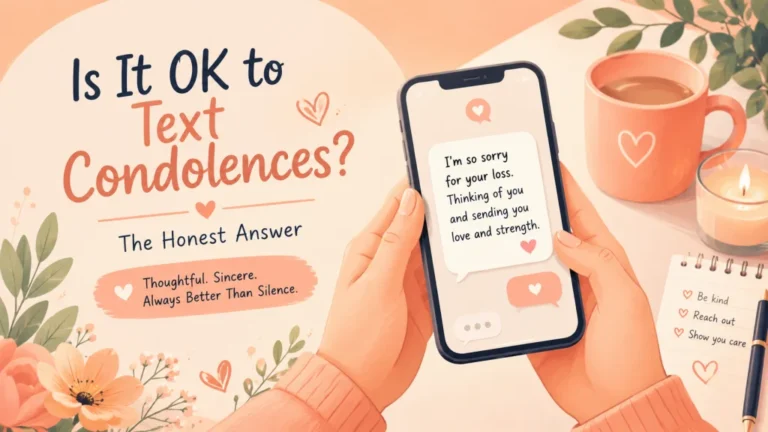
If you are trying to find the right thing to say after a loss, words of comfort follow the same principle: not more words, but the right ones, pointed at something true.
What This Means for How You Write
None of this requires a gift for language. What it requires is attention to the person you are writing to, enough to name something real about them or about the moment between you. Research covered by Harvard Business Review on message memorability reaches the same conclusion from a different angle: the gap between a message that is forgotten and one that is kept for years comes down to a single shift, from writing for the category (grieving person, birthday person, someone going through something hard) to writing for the actual person in front of you.
The most common mistake I see is the instinct to say more. When something feels important, there is a natural pull to fill the weight of the moment with words, to prove care through volume. But the message that lands is almost always the one that trusts itself to say less, and says it precisely. A sentence that names the exact thing, from the exact angle, to the exact person, does more than three paragraphs of warmth aimed generally at their situation. This happens not because shorter is inherently better, but because length without specificity dilutes the point until it could belong to anyone.
Here is what the most memorable messages tend to share:
- A specific detail that proves you were paying attention, something only someone who actually knows them would notice or remember. Not their general situation, but a particular thing about them in it.
- A clear moment, not a general statement of feeling, but a reference to something real: a day, a decision they made, a thing they said once that stayed with you.
- The right length, which is almost always shorter than your first draft. Write what you mean, then cut the part where you explain what you meant. The explanation is usually the part that buries it.
- No hedging. The phrases that soften a message (“I just wanted to say,” “I know this might be weird but,” “I hope this is okay”) dilute the thing you actually came to say. If you mean it, say it directly.
- Something the person did not already know you thought. The messages that get saved are the ones that told the reader something they were not certain of. Confirming what someone suspected does not land the same way as saying something they did not know you saw.
None of this is a formula. The same sentence that opens something for one person reads as hollow to another. What the research points to, and what the pattern I keep seeing confirms, is that memorability is not about craft in the traditional sense. It is about the decision to actually look at the person and write toward what you find, rather than toward what the occasion asks for. That choice is available to anyone, in any message, on any platform. For moments when words feel harder to locate, uplifting messages on this site are built around this same idea: specific, grounded, written for a person, not a situation.
Final Thoughts: The Message Worth Keeping
Someone, somewhere, has a message from you that they have kept longer than you know. It probably was not the one you labored over most carefully. It was more likely the one where you said the specific, true thing without overthinking it, the one where you named what you actually saw instead of what the moment seemed to require. That is not luck. That is what happens when a message reaches someone at the level the brain actually encodes.
The science is useful because it explains what people who write well have always known without being able to fully say: a message that makes someone feel genuinely seen outlasts anything written for the occasion. Not because feelings are magic, but because being accurately perceived by another person is rare enough that the brain marks it. Those moments are rarer than they should be. When a message delivers one, it tends to stay.
You do not need to write beautifully. You need to write honestly, specifically, and toward the person rather than the moment. The message someone remembers may not be perfect. It may simply be the one that felt like it could only have come from you, to them, in that exact moment. That is enough. That is, from what I have found, almost always enough.
FAQs
💬 Why do some texts stay with you for years?
Because they triggered genuine emotion, and the brain encodes emotionally charged moments more durably than neutral ones. A message that made you feel seen, surprised, or deeply understood is not just felt in the moment. It gets filed differently, at a deeper level, and tends to stay there long after you have forgotten what the conversation around it was even about.
🧠 What makes a message psychologically memorable?
Three things, consistently: specificity (concrete details rather than vague warmth), unexpectedness (arriving when not anticipated, or saying something surprising), and recognition (naming something the person felt but had never heard articulated). A message that does all three is hard to forget. Most memorable messages do at least one of them well.
📏 Does message length affect whether someone remembers it?
Yes, and usually in the opposite direction from what people expect. Shorter, more specific messages are remembered longer than long, general ones. Length signals effort. Specificity signals attention. The brain holds onto attention.
✍️ How do I write a message that someone will actually remember?
Name something specific to them. Skip the general warmth and point at something real: a moment, a quality, a detail that proves you were actually paying attention. Then say it directly, without hedging. The message that gets saved is almost always shorter and more precise than the one you first thought to send.
🤔 Why do generic messages feel forgettable even when they are kind?
Because the brain knows the difference between warmth directed at you and warmth directed at anyone. A message that could have been sent to a hundred different people registers as exactly that. It is kind, but it does not encode. Specificity is what transforms a message from acknowledgment into something a person actually holds onto.