Most of us have someone we have been meaning to contact for months. We circle back to the thought, talk ourselves out of it, and wait for a better moment that never quite arrives. Research consistently shows that the people we are hesitant to reach out to want to hear from us far more than we assume, and that the gap between what we think our message will mean to them and what it actually means is wide and measurable. This is about that gap, why it exists, and what it costs us to keep waiting.
There Is a Message You Have Been Meaning to Send
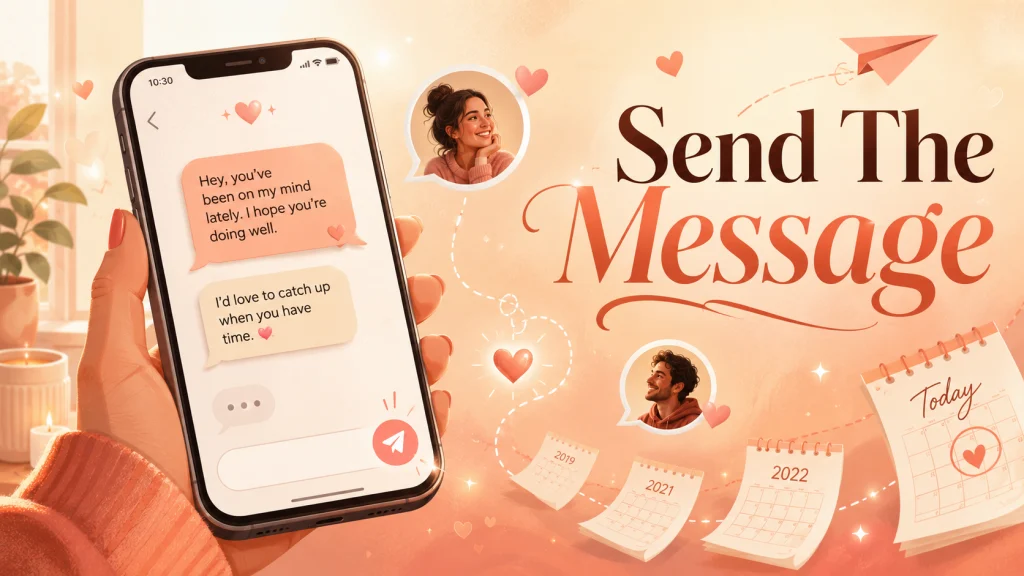
There is a message you have been meaning to send for six months. Maybe longer. You keep circling back to it, then talking yourself out of it. Most of us understand, at least in theory, why reaching out matters. We just avoid it in practice, usually for reasons that feel logical and are mostly wrong. The timing never feels quite right. The message never feels quite enough. And so another month goes by.
I have done this more times than I can count. There was a friend I had been thinking about for almost a year, someone I had lost touch with after a move that took us both in different directions. I kept drafting something in my head and putting it away. Too much time had passed. She would think it was strange. Eventually I sent three sentences. She wrote back within the day and told me she had been thinking about reaching out too, and hadn’t, for exactly the same reasons. That is not a rare story. It is almost universal.
What the Research Actually Shows
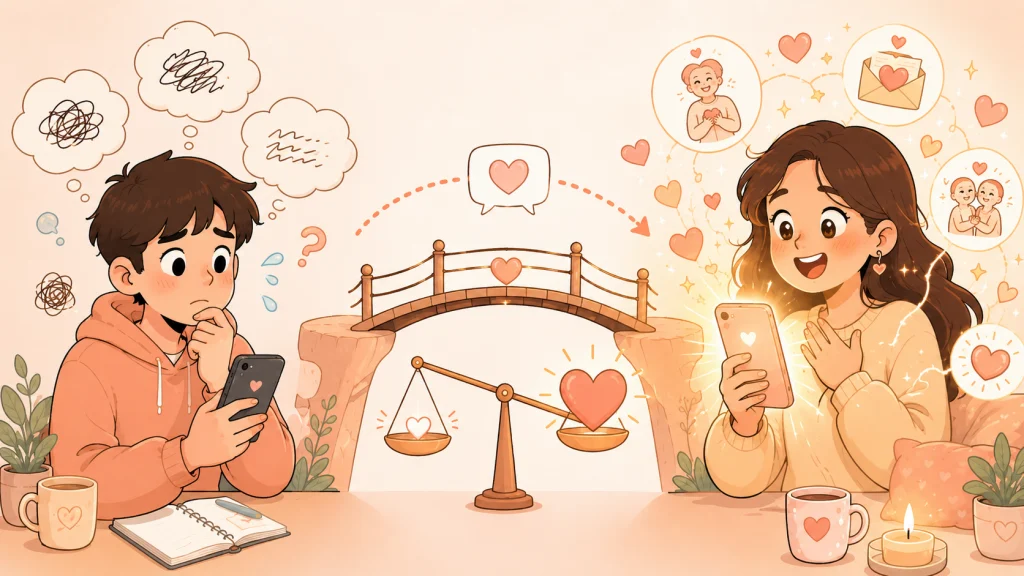
A study published by the American Psychological Association found something that should change the way we think about this entirely. Researchers Liu, Rim, and Min ran a series of experiments in which one group estimated how much an unexpected message of connection would mean to the recipient, and another group reported how they actually felt upon receiving one. The gap between the two was consistent and large. People routinely and significantly underestimate how much others appreciate being reached out to, especially when the contact is unprompted and occasion-free.
Part of what makes this finding so striking is how reliable it is. It held across different types of relationships, different kinds of messages, and different levels of closeness. The hesitation is not a quirk of personality. It is a near-universal miscalculation. We assume our message will feel like an intrusion, or an obligation, or something slightly awkward. The person receiving it often feels something much warmer than that.
Separate research from the University of North Carolina found that people who engage in unexpected positive gestures, the kind that happen for no particular reason on no particular occasion, report significantly higher relationship satisfaction than those whose positive contact is mostly predictable. The pattern holds across different kinds of relationships. The benefits of reaching out to friends appear to depend less on how often you do it and more on whether it ever feels genuinely spontaneous.
The Calculations We Make That Are Almost Always Wrong
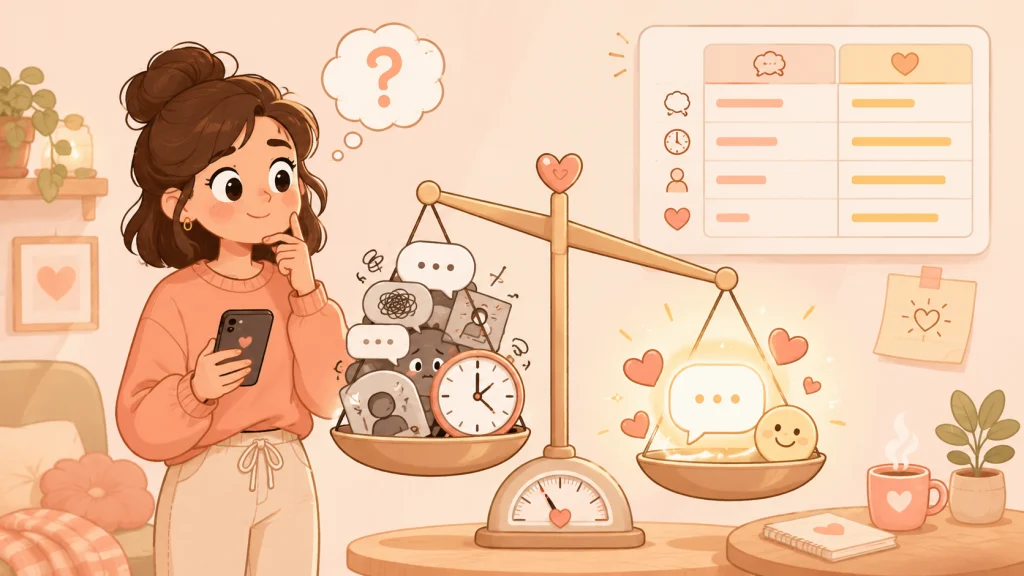
There are a few thoughts that come up reliably when someone considers reaching out to a person they have not spoken to in a while. It has been too long. It will seem weird. They are probably busy. I do not want to bother them. Each of these feels like reasonable self-awareness. According to the research, each of them is often an overestimation of the awkwardness and an underestimation of the welcome.
One of the reasons why we lose touch with people, even people who genuinely matter to us, is that we apply a kind of social cost-benefit analysis to each potential message. We weigh the imagined discomfort of an awkward send against the imagined benefit of a warm response. What the research makes clear is that we are not very good at this calculation. We inflate the cost and deflate the benefit, reliably enough that the pattern shows up across multiple studies.
Reader’s Digest noted in May 2025 that abbreviated messages, the kind we send when we are trying not to impose, can register as less sincere to the people receiving them. When we trim a message to the bone to avoid feeling like too much, we often achieve the opposite of the effect we intended. The instinct to make ourselves smaller in these moments is not always kindness. Sometimes it is hesitation wearing a polite face.
| The thought that holds us back | What the research actually says |
|---|---|
| It has been too long, it will seem strange | Recipients consistently report that the gap in time matters far less than the act of reaching out |
| They are probably too busy for this | People underestimate how welcome an unexpected message is, regardless of timing |
| My message will not matter enough to send | This belief is, according to multiple studies, often wrong |
| A short message seems insufficient | A brief, specific, genuine message lands better than a long, vague one |
The table reflects a pattern, not a guarantee. Context matters, and relationships are complicated. But for most of the unsent messages sitting in most people’s heads, the pattern above probably applies.
What an Unexpected Message Signals That an Occasion-Based One Cannot
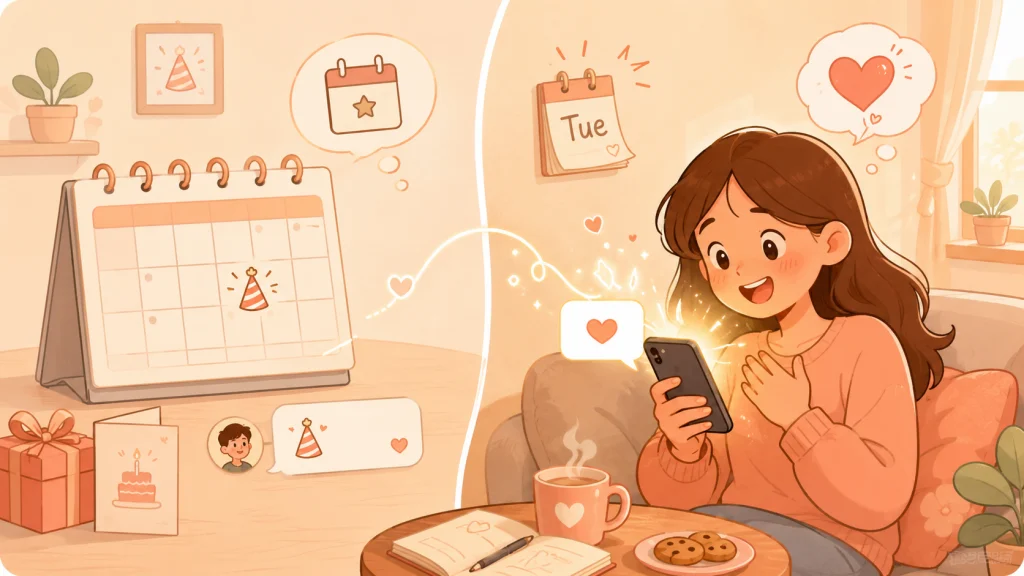
There is a difference between the birthday message and the message that arrives on a Tuesday for no reason at all. Both can be meaningful. Only one of them carries a signal that is almost impossible to fake: that someone thought of you when they had no particular reason to, and decided that thought was worth sharing. That is the signal that most relationships are quietly running on, and it is the one most of us are not sending nearly enough.
Routine contact has a habituation problem. The same good morning text every day can become background noise, not because the sender cares less but because the brain responds more strongly to the unpredictable than to the predictable. An unexpected message on a Wednesday afternoon breaks through in a way that the scheduled one does not. How to maintain friendships over time is, in large part, a question of how to keep showing up in ways that feel genuine rather than automatic. Spontaneous contact is one of the few reliable answers to that question.
Research cited by Thurlow and Brown found that roughly two thirds of all text messages are sent for the purpose of creating, developing, or maintaining a relationship. That is the actual function of most messages most of the time. Not information transfer, not logistics, but connection. An unexpected message does this more directly than almost anything else, because it removes any ambiguity about why you reached out. You reached out because the person mattered. That is the whole message, underneath whatever words you use.
What the Message Actually Needs to Say
Not much. This is the part people most often get wrong. There is a tendency to feel that an unexpected message needs to earn its send by being substantial, eloquent, or timed to something meaningful. None of that is true. Texting people more is not really about finding the perfect words. It is about deciding whether to send the thing at all, and the answer is usually yes.
The messages that tend to land the hardest are rarely the ones that took the longest to write. A few directions this can take in practice:
- I was thinking about you today and wanted you to know.
- That conversation we had back in the spring is still with me. I hope things are good.
- I saw something that reminded me of you. No news, just wanted to say hi.
- I have been meaning to reach out for a while. No agenda, just wanted you to know you are on my mind.
- I remember what you told me last time we talked. I hope it got a little easier.
None of these are scripts. They are examples of the direction: specific, personal, low-pressure, honest. The act of sending matters more than the precision of the wording. A message that says something real and slightly imperfect will almost always land better than a carefully crafted one that feels assembled rather than felt. If you have something to say but are not sure where to start, encouragement messages for the people in your life can help close the distance when the words are not quite coming on their own.
The One Thing That Keeps Getting in the Way
Most people who do not reach out enough are not indifferent to the people in their lives. They care. Sometimes they care so much that the thought of sending a message that does not fully capture what they feel becomes its own kind of paralysis. The standard they are holding the message to is higher than the standard any real message actually needs to meet, and the gap between the two is where most unsent messages live permanently.
The research is consistent on this point: the belief that a message will not matter enough to justify sending is wrong more often than we expect. And the cost of that belief is not neutral. Every unsent message is a moment of connection that did not happen. For some relationships, those moments accumulate into a distance that feels impossible to cross, when the only thing that created it was a series of small hesitations that each felt reasonable at the time.
Staying connected with people you care about is not, at its core, a logistical problem. Most people know how to send a message. It is a psychological one: the quiet, persistent sense that what we have to offer is not quite enough to bother with. The research disagrees with that sense. So do many of the people who would be glad to hear from you. For those moments that involve something more layered in a relationship, love and relationship messages can help give language to what is already there but hard to say.
Final Thoughts: Send the One You Have Been Sitting On
You probably have one right now. A name that comes up, a person you have been meaning to contact, a message that exists somewhere between a thought and a draft. The evidence says they would be glad to receive it. The evidence also says you are probably underestimating that by a significant margin, and that the feeling you are waiting for, the one that tells you the moment is finally right, is not coming.
This is not about flooding people with messages or performing connection. It is about the small, specific, human act of letting someone know you thought of them. The research on reaching out is not really about psychology or neuroscience at its core. It is about something simpler: most of us matter more to the people in our lives than we realize. And most of those people would like to know we are still there.
The message does not need to be perfect. Send it.
FAQs
💬 What do you say when you reach out to someone after a long time?
Keep it honest and low-pressure. Something like “I have been thinking about you and wanted to reach out” is enough. You do not need to explain the gap or apologize for the silence. Most people are just glad to hear from you.
🤔 Is it weird to text someone out of nowhere?
It feels that way to the sender far more than it does to the recipient. Research consistently shows that people appreciate unexpected contact more than the person sending it expects. The awkwardness is mostly on your end, not theirs.
💡 Why do we lose touch with people we actually care about?
Usually because we wait for the right moment, and the right moment never quite arrives. Life moves fast, the gap gets longer, and reaching out starts to feel like it requires an explanation. It doesn’t. A simple, honest message is enough.
📱 How often should you reach out to friends to stay close?
There is no right number. What matters more than frequency is whether the contact feels genuine, and sometimes unexpected. One honest message sent for no particular reason can do more for a friendship than a month of routine check-ins.
🔁 What if the other person never reaches out first?
That is worth noticing over time, but it is not a reason to stay silent. Some people are bad initiators and still deeply value the people in their lives. If the relationship matters to you, reaching out first is not a concession. It is just what care looks like in practice.