When a mistake is serious enough, “I’m sorry” lands like a single note where the situation calls for a whole conversation. These 60 messages are built around the three things that make an apology feel real: taking responsibility for what happened, naming what the other person went through, and saying something specific about what comes next. None of them are a fix. But any of them, used honestly, gives the person you hurt something to hold onto while they decide what they need. For broader context, see sincere apology messages for a serious mistake.
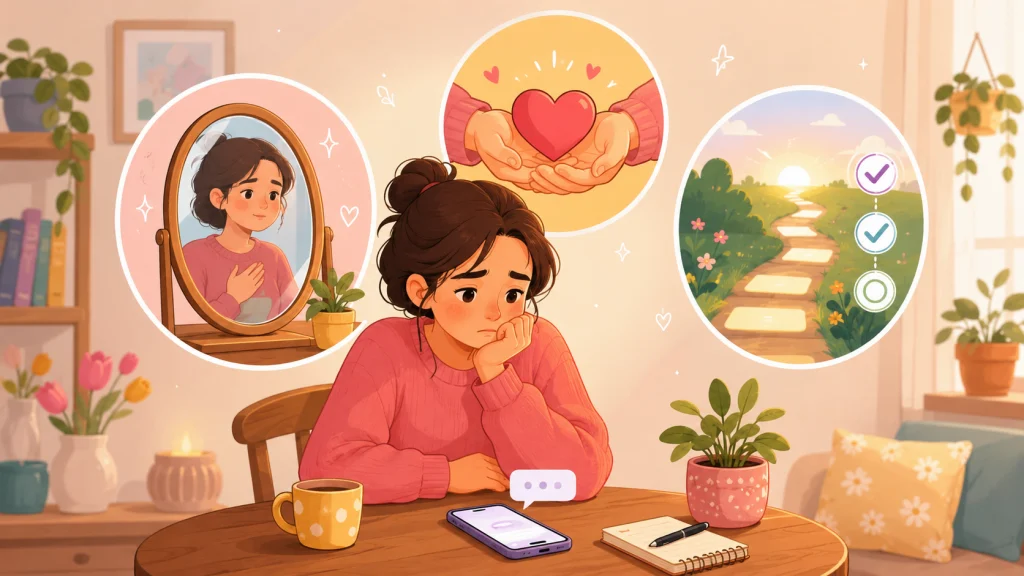
When “I’m Sorry” Is Only the Beginning
A sincere apology message for a serious mistake has to do more than mark the moment. “I’m sorry” covers a lot of territory, from bumping into someone in a doorway to breaking something that cannot be put back together. The word is the same. The weight is not. When the mistake is serious, the person you hurt already knows you feel bad. What they do not yet know is whether you understand what you actually did, what it cost them, and whether anything is going to be different going forward. For related message ideas, see deep apology message.
The gap most apologies fall into is not insincerity. It is incompleteness. Someone sits down, genuinely remorseful, types something that starts with “I’m so sorry” and ends with “please forgive me,” and wonders why it does not land. It does not land because it skips the middle. The middle is where accountability lives, where the other person’s experience gets named, where the commitment to change gets made. Without those three things, an apology is a feeling statement. With them, it becomes something the other person can actually do something with.
The Three Things a Real Apology Has to Do
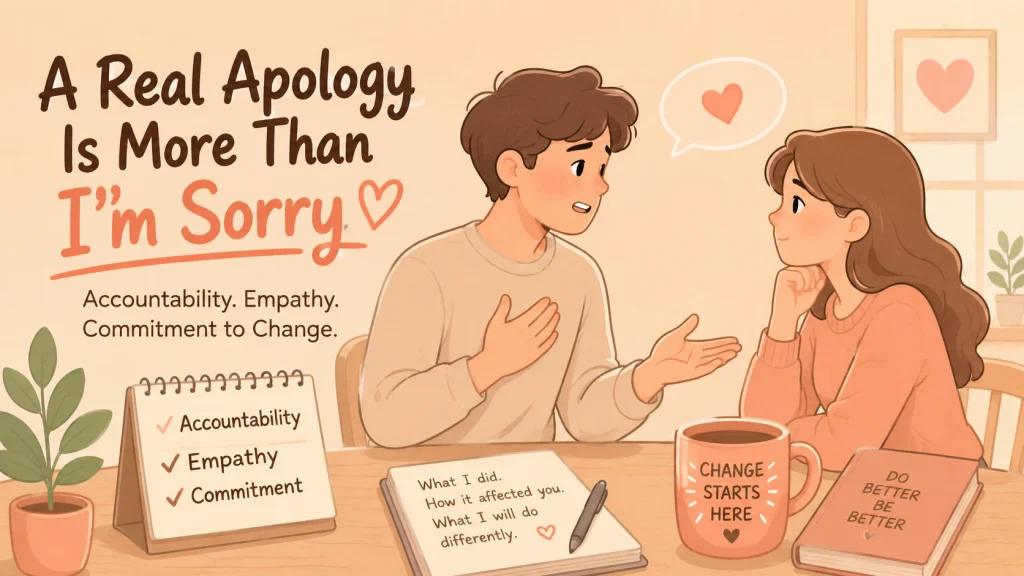
There is a structure underneath every apology that actually lands, whether the person writing it knows it or not. Accountability: you name what you did, specifically, without softening it. Empathy: you acknowledge what the other person experienced, not what you intended for them to experience. Commitment: you say something real about what changes. Not “I’ll be better.” Something specific enough that the other person can actually measure it against your behavior later.
The reason so many apologies feel hollow is not that people do not mean them. It is that they collapse two of these three into the first one. They say “I’m sorry I hurt you” and feel like they have covered both accountability and empathy in one sentence. They have covered neither. Accountability requires naming the action. Empathy requires naming the impact on the other person, not on yourself. These are two different things, and the person receiving the apology can tell immediately when they have been combined and diluted. I have sent that kind of apology before, and I have received one too. Both times, the feeling afterward was the same: close, but not quite there. You can find more on how apology messages for relationships need to shift depending on what happened and where you both are, but for a serious mistake, all three parts are non-negotiable.
| Apology component | What it sounds like when done right | What usually replaces it |
|---|---|---|
| Accountability | “I was wrong. I made that choice.” | “I’m sorry you were hurt by what happened.” |
| Empathy | “I can see what this cost you.” | “I never meant to hurt you.” |
| Commitment to change | “Here’s what I’m doing differently, specifically.” | “I promise it won’t happen again.” |
The right column is not a list of bad intentions. It is a list of what happens when someone is trying to apologize and retreating slightly from the full weight of it. Most people do not notice they have done it. The messages below are organized to help you stay in the left column.
Accountability First: Messages That Lead with Taking Responsibility
These messages open with the action, not the feeling. The instinct most people fight when writing an apology is the urge to explain first. To give context. To set the scene so the other person understands how you got there. The problem is that context, delivered before accountability, reads like mitigation. It can make a genuine apology sound like a defense. Starting with the action and the responsibility removes that ambiguity entirely.
A note on the word “but”: Any message below loses its footing the moment you add “but” after the apology. “I’m sorry, but I was under a lot of pressure” is not an accountability message. It is an explanation dressed as one. If you feel the urge to add a “but,” that urge is worth sitting with before you send anything.
- “I’m not going to pretend I didn’t know what I was doing in that moment. I did, and I chose wrong. I’m sorry.”
- “What I did was my fault. I’m not looking for circumstances or reasons. I made the choice and I own it.”
- “I’ve gone over it, and there’s no version where I come out okay. I was wrong. I’m sorry for choosing the way I did.”
- “I take full responsibility for what happened. You didn’t cause this. You didn’t push me into it. This was mine.”
- “I’m not going to ask you to factor in the context or the timing. What I did was wrong, and you deserve a straightforward ‘I’m sorry for that, and I own it.'”
- “I could spend time explaining how I got there. But explanations aren’t accountability, and you deserve accountability first.”
- “The honest truth is I made a bad choice. I knew better and I did it anyway. I’m sorry, and I mean that without any asterisks.”
- “I’m sorry, and I want to be clear: I’m apologizing for what I did, not for how it made you feel. I did something wrong. That’s what this is about.”
- “There’s no one else to point to here. I did this. I’m the one who needs to make this right.”
- “I’ve been trying to find words that feel big enough, and I keep coming back to the simplest ones: I was wrong. I’m sorry. I know that’s only the start.”
- “I’m not asking you to let me off the hook. I’m asking you to know that I see exactly what I did and I am not making excuses for it.”
- “What happened was not a miscommunication. It was a choice I made, and it was the wrong one. I’m sorry.”
- “I let you down in a way I can’t undo, and I don’t want to pretend I can. I can only be honest about it: I was wrong, and this is me saying so.”
- “You deserved better from me. Not the version of me that existed in that moment. I’m sorry for choosing the way I did when I knew I could have chosen differently.”
- “I’m taking responsibility for this. Not because I want credit for the apology, but because you deserve to hear me say it plainly: I did this, and I’m sorry.”
What you will notice about these messages is that they do not ask for anything. No “please forgive me” at the end. No “I hope we can move past this.” That is intentional. An accountability-first message is not a transaction. It is a statement. Asking for something at the end turns the other person into someone who has to respond on your timeline, which is its own kind of pressure they did not ask for.

Empathy First: Messages That Lead with Their Pain, Not Yours
Most people who send an apology know what they feel. What they communicate far less clearly is that they have considered what the other person feels. These messages flip the center of gravity. Instead of starting with your remorse, they start with what the other person went through. That reordering does more work than it looks like it should, because the person on the receiving end has been wondering, quietly, whether you have actually thought about them or only about yourself.
The mistake I see most often in apologies like these is “I never meant to hurt you.” I understand why people reach for it. It is true. It feels important. But it moves the conversation immediately to your intentions, which is the last thing the other person is thinking about right now. They are thinking about what happened, and what it felt like. Meeting them there is the only way in.
- “I’ve been thinking about what this must have felt like from where you were standing, and I’m sorry. Not just for what I did, but for making you carry that.”
- “I know you trusted me, and I can only imagine what it feels like to have that trust broken by someone who should have protected it. I’m sorry.”
- “The worst part of this, for me, is knowing how much it must have hurt you. And knowing I was the one who caused it.”
- “You didn’t deserve to be in this position. You didn’t do anything to earn this hurt, and I’m sorry you’re sitting with it because of something I did.”
- “I can’t pretend I know exactly how this landed for you. But I know it wasn’t okay, and I’m sorry for making you feel that.”
- “I’ve been thinking about you more than me in all of this, which I should have been doing long before now. I’m sorry for the hurt I caused.”
- “You probably had to keep it together after what I did, and I hate that I put you in that position. I’m sorry.”
- “I know this changed something between us, and I’m sorry for being the one who changed it. You didn’t choose this.”
- “Whatever you’re feeling right now is fair. I just want you to know I see it, and I’m sorry it’s there because of me.”
- “I think about how you must have felt in that moment, and I’m ashamed. Not in a performative way. In a quiet, certain way. I’m sorry.”
- “You had every reason to expect better from me, and I failed that expectation. The hurt from that is real, and I’m sorry.”
- “I don’t want to rush past what this cost you. I want to sit with that for a moment and say: I’m sorry for the pain I put you through.”
- “You’ve been the one carrying this, and I should be the one carrying it. I’m sorry I made it yours to hold.”
- “I know words don’t undo things. But I need you to know I’m not taking what happened lightly. I see how it affected you, and I’m sorry.”
- “The fact that you’re even here, reading this, means something to me. I know I hurt you. I’m sorry for that, deeply.”
If any of these feel close but not quite right, that is usually a sign that the empathy needs to be more specific to what actually happened between you. The more precisely you can name what the other person went through, rather than gesturing at it, the more clearly the apology reads as real.
Commitment to Change: Messages That Look Forward
This is the part most apologies skip, or land badly. “It won’t happen again” is a commitment to change in the same way “I’ll be better” is a commitment to change. It sounds like one. It does not function like one. The person hearing it has no way to hold you to anything specific, which means it reads as a closing line rather than an actual promise. These messages try to do something harder: say what changes without turning the apology into a plan presentation.
- “I don’t just want to apologize. I want to show you, over time, that I understand what needs to be different. You’ll see it in what I do, not in what I say right now.”
- “I’m sorry, and I’m also asking you to hold me to something: if I slip back into the behavior that caused this, tell me. I want to know. I’m committed to changing that pattern.”
- “I’m not going to make you a promise about the future right now, because I know promises are cheap after something like this. What I’ll do instead is show you.”
- “I want you to eventually see, through my actions, that this was a turning point and not just an incident. I’m working on that.”
- “I’m sorry for what I did, and I’m telling you now that it will not happen again. I’m not saying that to make you feel better. I’m saying it because I mean it.”
- “I know you need to see it, not hear it. I’m prepared for that. I just wanted to start here, with honesty, before I show you with everything that comes after.”
- “What I’m promising you is attention. The kind I should have been paying before. I’m sorry I had to learn this the hard way.”
- “I’m sorry, and I want you to know I’ve already started looking at the patterns that led here, not just the one moment that exposed them.”
- “You shouldn’t have to monitor me or watch and wait to see. I’m telling you now: I’ve seen what this caused, and I’m not going to put you in that position again.”
- “I know rebuilding trust takes time. I’m not in a hurry. I just want to be clear about where I’m starting from: I’m sorry, and I want to earn your trust back, one day at a time.”
- “The apology is real. What comes after it will be more real. I’m committed to showing you, not just saying it.”
- “I’m sorry for what I did, and I’m going to do the work that comes after sorry. That’s not a small thing. I know that. I’m ready for it.”
- “I’ve thought about what I’d need to do differently, and I have some specific ideas. I’d like to share them when you’re ready to hear them. For now, I want you to know I’ve thought about it seriously.”
- “I don’t expect forgiveness on any particular timeline. I do expect myself to behave differently, starting now. I’m sorry, and I mean that through what I’m about to do, not just through these words.”
- “I’m sorry. And I want you to know that this apology has something behind it, not just a feeling. I’m ready to show you what changes.”
There is a version of the commitment message that tips over into pressure, where the other person feels like they are being recruited into a project of forgiving you. These try to avoid that. The goal is to say something forward-looking without putting the other person in the position of having to respond to a plan.

For the Gravest Mistakes: When the Apology Has to Carry a Heavier Weight
Some mistakes sit in a different category. Not because the person who caused them is different, but because the damage is. The messages below are written for situations where the word “sorry” is clearly insufficient but still necessary, where trust may be broken in a way that is not easily repaired, where the person you hurt has every right to need more than a message and you know it. These do not try to minimize that.
There is a pull, in situations this serious, to say too much. To go longer, to say more, to fill the space that the mistake has opened up with enough words that it starts to feel like repair. It almost never works that way. I have seen long, carefully worded apologies land worse than short, honest ones because the length started to feel like it was about the person apologizing, not the person being apologized to. These messages try to stay honest and stay short.
- “I know ‘I’m sorry’ isn’t going to be enough for this. I’m saying it anyway, because it’s where I have to start. I also know that words aren’t what will matter most now.”
- “I’m not going to ask you to forgive me today, or anytime soon. What I’m asking is that you know I understand what I did, and I’m genuinely ashamed of it.”
- “There is nothing I can say that will undo what happened. I know that. I’m not trying to undo it. I’m trying to be honest with you about how sorry I am.”
- “I’ve hurt you in a way that may change things between us permanently, and I need to live with that possibility while still telling you: I am so deeply sorry.”
- “I don’t expect this to make it better. I just need you to know that I see the weight of what I did, and I’m not setting it down.”
- “I understand if you’re not ready to hear this, or if you read it and nothing shifts. The apology is still true. I’m still sorry.”
- “What I did was wrong in a way I’m going to have to sit with for a long time. I’m not looking for relief right now. I just want you to know: I’m sorry, and I understand why.”
- “This isn’t a situation where I get to feel better after apologizing. I know that. I’m saying I’m sorry because you deserve to hear it, not because I need the relief of saying it.”
- “I want to be careful not to make this about what I need you to feel. You get to feel whatever you feel. I’m just trying to be honest: I was deeply wrong, and I’m sorry.”
- “I know that the damage here is real and it’s mine to carry, not yours. I’m sorry for creating it. I’ll spend a long time making that true through my actions.”
- “You deserved a version of me that would have done differently. I’m sorry I wasn’t that person in that moment.”
- “I don’t have words big enough for this. I have only the honest ones: I’m sorry. I know what I cost you. I’m not going to minimize it.”
- “If you need space from me to process this, I understand. If you need to talk, I’m here. Either way, I want you to know this: I’m sorry, and I know exactly why.”
- “I’m not asking you to trust me right now. I’m asking you to know that the apology is real and that I understand the gravity of what I did.”
- “I’m sorry. That’s not enough. But it’s real, and I hope that in time I can show you something more substantial than words.”
If you are navigating something this serious and the apology is only one piece of a much larger situation, it helps to have words for more of those moments. The collection of love and relationship messages covers more of what that full range sounds like, from reaching out to making space to saying the things that have been sitting unsent for too long.
Final Thoughts: What You Send, and What You Do After
Whatever message you choose from this collection, it works best when it is actually yours. Read it, sit with it, and change any word that does not sound like you. The person receiving it knows your voice. A message that sounds polished but not like you will register as something assembled, even if the feeling behind it is genuine.
The other thing worth saying: a message is a beginning, not a completion. The apology opens a door. What happens after you send it, the consistency, the behavior change, the patience while trust rebuilds, is the real substance of what you are promising. The words here are the start of that conversation, not the conclusion of it. If they help you say the thing you have been trying to find a way to say, they have done what they are here to do.
FAQs
🤔 What should I say in an apology for a serious mistake?
Start with what you did, not how you feel about it. Name the action specifically, acknowledge what it cost the other person, and say something real about what changes next. Three components, in that order. Skipping any one of them leaves the apology incomplete in a way the other person will feel even if they cannot name it.
💬 What is the difference between a real apology and a hollow one?
A hollow apology centers the person apologizing, their feelings, their discomfort, their need for forgiveness. A real one centers the person who was hurt. The difference usually comes down to a few specific words: “I’m sorry I hurt you” is about your guilt. “I’m sorry for what I did and I understand what it cost you” is about them.
📱 Is it okay to apologize for a serious mistake by text?
It depends on the situation and the person. A text can open the door when someone is not ready to talk in person, or when distance makes a conversation impossible right now. The risk is that it can feel like you took the easier road. If you send a message, be honest about why and make clear you are available to have the fuller conversation whenever they are ready.
😔 What do you say when “I’m sorry” isn’t enough?
Say exactly that. “I know ‘I’m sorry’ isn’t going to be enough for this, and I’m not sending this because I think it is” is a more honest start than a longer message that pretends the words can carry the full weight. Naming the inadequacy of the apology is sometimes the most sincere thing you can do.
⏳ How long should I wait before apologizing for a serious mistake?
Soon enough that the other person does not feel like an afterthought, but not so soon that you are apologizing before you have actually thought about what happened. A rushed apology written while you are still defensive tends to miss the mark in ways that are hard to fix. Give yourself enough time to be honest, not enough time that your silence becomes its own message.
🔄 Should I apologize more than once for the same mistake?
One honest apology lands better than three that start to feel like pressure. If you have apologized sincerely and the other person has not responded, repeating the message risks making the situation about your need for a response rather than their need for space. Say it once, mean it fully, and then let them set the pace.