Playful messages for an established relationship work differently than anything you would send in the first few months. They rely on shared history, private references, and the specific kind of humor that only exists between two people who have been paying close attention to each other for a long time. This collection of 60 messages is built around exactly that: the inside language, the everyday life you share, the affectionate teasing that would land wrong with anyone else, and the good morning texts that reflect how well you actually know each other. Use them as they are or let them remind you of something only yours. For broader context, see playful messages for established relationship.
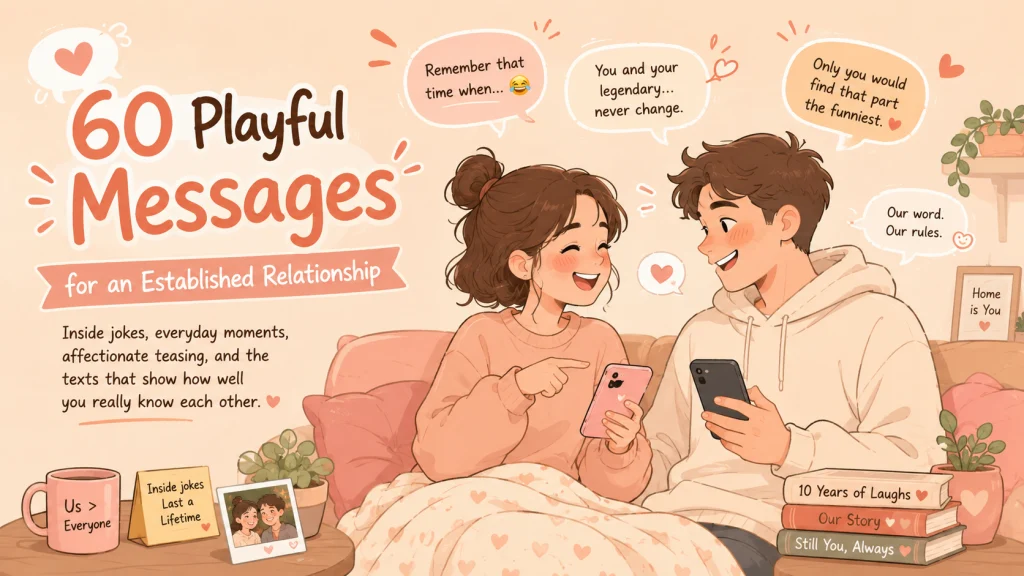
The Humor in a 10-Year Relationship Is Nothing Like the Humor in a 3-Month One
The playful texts you sent early on had a specific job: to impress, to signal interest, to make someone feel like you saw them. They were good texts, probably. But they were also working harder than they needed to, trying to be clever in front of someone who was still deciding what to make of you. That era has a kind of charm, and I am not dismissing it. What comes after it, though, is something entirely different. For related message ideas, see funny messages for long term relationship.
Established-relationship humor does not try to impress. It does not need to establish anything. It operates on a shorthand so compressed that someone reading over your shoulder would see only a few words and understand nothing. The funniest text you have ever sent your partner probably makes no sense to anyone else on earth. That is not a flaw in the joke. That is the whole point of the joke. The inside language of a long relationship is one of its most underrated pleasures, and almost no one writes playful messages aimed at people who already have it.
That is the gap I keep noticing when I look at what is out there. Everything is aimed at the early stage: flirty openers, cute ways to express interest, the carefully crafted text designed to land well with someone you are still trying to win over. For couples with years of love and relationship history between them, very little of that fits anymore. Not because the playfulness is gone, but because the playfulness has evolved into something more specific, more comfortable, and honestly more interesting.
These 60 messages are organized around four things that tend to define playful communication in a long-term relationship: the private language you have built together, the texture of your shared daily life, the affectionate teasing that only works between people who genuinely know each other, and the good morning and good night exchanges that reflect how familiar you have become. Take what fits, leave what does not, and let some of them remind you of your own version.
| New relationship playful | Established relationship playful |
|---|---|
| Tries to be clever or witty | Relies on something only you two would find funny |
| References something recent and shared | References something from years ago that never stops being funny |
| Playful teasing feels a little risky | Affectionate teasing is a form of intimacy |
| Good morning texts signal you are thinking of them | Good morning texts reflect exactly how well you know their morning |
| Needs context to land | Often works because there is no context needed at all |
The shift is real, and once you see it, you notice it everywhere. The couple at the restaurant who says four words and laughs for a full minute is not speaking in code to be exclusive. They have just built a language over time, and it has gotten very efficient. That is what these messages are trying to speak to.

Playful Messages About Your Life Together
These are the texts that could only come from people who share a fridge, a couch, a set of habits, and a running commentary on all of it. They are not glamorous. They are about the grocery store and the wrong coffee and the drawer that neither of you can organize correctly. They are also, in my experience, some of the most genuinely affectionate messages you can send.
There is a version of romantic communication that tries to lift everything above the ordinary. And then there is the version that says: I notice our ordinary, I find it funny, and I like that it belongs to both of us. The second version tends to land better after years together. Not because the grand gestures stop mattering, but because the small ones carry more weight than they used to.
- I am at the grocery store and I have already forgotten two of the three things you told me. Describe them again but worse and see if that helps.
- The couch is noticeably less good without you on your half of it.
- I reorganized [the drawer/shelf/thing] and then immediately realized I did it wrong. Come home and do it your way. I give up.
- Reminder that you made the rule about [the household thing] and you are currently the one breaking it. I have noted this.
- I was going to do the thing. And then I did not. I am reporting this to you voluntarily as a gesture of honesty.
- You have been gone for [X hours] and I already watched our show without you. I regret nothing. I regret everything. Both are true.
- I just made [the meal] and it was not as good as when you make it and I will never say this to your face.
- The [cat/dog/plant/the thing you named] is fine. I am the one who misses you. Do not make it weird.
- Currently using your pillow. This is not an apology. This is a disclosure.
- I found receipts from [that trip/event] and got unreasonably emotional on a completely ordinary Tuesday.
- We need to have a serious conversation about [completely unserious household debate]. I have prepared arguments. They are good.
- I have decided that [the small thing you disagree on] is something I am willing to let you be wrong about. You are welcome. This is a gift.
- Our life is very ordinary today and I mean that as a compliment.
- I think we should add [something slightly ridiculous] to the routine. Thoughts? I have already committed either way.
- Just remembered [the funny thing that happened at home recently]. You were there. Still better now that I have remembered it with you.
What makes this category work is specificity. The more specific the detail, the better the text. “The drawer” is funnier if it is the actual drawer. “Our show” hits differently when it is actually your show. Generic versions of these messages exist everywhere. The version only you can send is the one that will get the response you want.

The Affectionate Teasing That Only Works When You Know Each Other
This is the category that tends to get people in trouble when they try it too early. Affectionate teasing requires a foundation. It requires the other person to know, without any doubt, that the teasing is coming from a place of genuine warmth. In a new relationship, that certainty is not there yet. In an established one, it is the whole context. The tease is the compliment.
I want to be careful here, because there is a difference between teasing that celebrates someone’s quirks and teasing that is actually criticism wearing a smile. The messages below are the first kind. They are about the small, lovable, ridiculous things that make your partner specifically them. If any of them sting when you imagine sending them, they are probably not the right ones for your dynamic. Only you know the difference.
- The confidence with which you said [the wrong thing] was genuinely impressive. I admire it even now.
- I love you and also you have been humming the same seven notes for forty-five minutes.
- You are objectively not as good at [thing they think they are good at] as you believe yourself to be, and I find it deeply endearing.
- The way you explain [the thing] every time as if it is new information is one of your best qualities. I mean that.
- I have seen your face in [unflattering context] and I still choose you every day. Let that land.
- Somehow you still surprise me. Not always in the expected direction. Always in an entertaining one.
- You were very confident about [the thing that turned out to be wrong]. I remember this. I will always remember it.
- Your [specific habit] is something I have made peace with and also grown very fond of, in that order.
- You have opinions about things you know very little about and it is genuinely one of my favorite things about you.
- The enthusiasm you bring to [a niche thing they love] is unmatched and also slightly alarming to outside observers.
- I watched you try to [do the thing] for ten minutes before I said anything. The restraint I showed was significant.
- You are very wrong about [the small ongoing disagreement] and I will never stop finding this oddly charming.
- Your [quirk] is iconic and I will be referencing it at some point in the future in front of people we both know.
- I just defended you to someone who has not witnessed your [the thing]. I stand by it. I also cannot entirely believe I stand by it.
- You are the exact right amount of a lot.
You are objectively bad at [the thing you think you’re good at] and the fact that this hasn’t become a problem yet is entirely because of me.
That last line in the blockquote is one I would only send to someone who would laugh at it immediately and then send something worse back. That back-and-forth is what this whole category is really for. The message is just the opening move.
If you want more ways to stay playful across the full range of a long relationship, the collection of flirty messages for every dynamic covers territory that pairs well with this kind of affectionate humor.
Playful Good Morning and Good Night Messages Specific to Your Dynamic
Morning and night texts in a long relationship have a very specific energy. They are not trying to impress. They are not establishing anything. They are checking in with someone you know so well that the check-in itself can be funny, specific, and a little bit ruthless about what you have both witnessed in each other at 7am.
The best ones I have ever received were not poetic. They were just very accurate. Accurate to the specific human I am in the morning, accurate to the specific habits we had both observed in each other, accurate in a way that only comes from paying close attention over time. That accuracy, delivered with warmth and a little irreverence, is its own form of intimacy.
- Good morning. I am aware of your exact sleep position from last night and it was a choice. A committed one.
- Wake up. I have thoughts. They are not urgent. I just want to tell them to you.
- Good night to you specifically, in this bed, which is a size smaller than it should be because of your spatial choices.
- Good morning. You looked very peaceful sleeping and I was already awake and I resented it a little.
- Going to sleep now. I was thinking about [the thing from today] and I am glad I get to tell you about it tomorrow in person instead of typing it into the void.
- I woke up thinking about [the random thing] and you were the only person I could possibly tell, so. Good morning. Here we are.
- It is only [time] and I have already had three thoughts I specifically wanted to tell you. Sleep well.
- Good morning. How are you? I know exactly how you are. You are like this every morning. I like it.
- You are asleep and I have a thought and I am choosing not to wake you. Please acknowledge this growth the next time you get the chance.
- Good night. Thank you for [the specific small thing from today]. You probably did not even know you did it.
- I just woke up and remembered what we were talking about yesterday and immediately wanted to pick it back up. Is that weird? Do not answer that.
- Good morning. The coffee is ready. I made yours the wrong way and I knew it was wrong while I was doing it. You are welcome.
- Good night. Today was very ordinary. That is not a complaint. That is the whole point.
- I fell asleep thinking about [something small and real from today] and woke up thinking about you still. Some mornings are just like that. 🌅
- Good morning. I have opinions about last night’s [show/dinner/conversation] and they have been developing since approximately 3am. Buckle in.
There is something particular to that last category, the 3am thought that became a fully formed opinion by morning. It is very specific to long relationships, where you have the comfort of knowing your unsolicited 7am commentary is actually wanted. That comfort took a while to build. It is worth noticing.
Final Thoughts: On the Humor That Took Years to Earn
The texts in this collection are not universally transferable. That is the whole point. Some of them will feel exactly right for where you are, and some will feel like they belong to a different relationship entirely. What I would encourage you to notice is not the specific messages, but what they are made of: the specificity, the shorthand, the comfort of knowing you do not have to explain yourself. You already have that. These are just reminders of how to use it.
Playfulness in a long relationship is not about keeping things light or avoiding seriousness. It is about signaling, over and over again, that you still notice each other. That the specific, particular, occasionally ridiculous person you chose is still the one you are paying attention to. A good text does not have to do more than that. When it is honest and specific, that is more than enough.
FAQs
💬 What makes playful texts different in a long-term relationship?
They rely on shared history rather than charm. In an established relationship, the funniest texts reference something private between the two of you: an inside joke, a recurring bit, a specific habit you have both observed. That context is what makes them land. A new-relationship flirty text is trying to win someone over. An established-relationship playful text is talking to someone who already knows you completely.
😄 How do I know if affectionate teasing will land well?
Ask yourself whether the tease celebrates the quirk or quietly criticizes it. Teasing that lands well in a long relationship comes from genuine warmth and pokes at things your partner already knows you love about them. If you are uncertain how it will be received, that uncertainty is probably worth paying attention to.
🤔 What if we don’t really have inside jokes?
You almost certainly have more than you realize. Inside jokes are not always grand recurring bits. They are also the specific words you use for things, the observations that only make sense between you two, the story you both tell slightly differently. Start there. The messages in the shared language section are designed to surface what you already have.
💑 Is it strange to send playful texts when you live together?
Not at all. Some of the best ones are sent from one room to another. The text is not about distance. It is about noticing something and deciding to share it. That is worth doing whether you are across the city or across the couch.
✍️ Can I use these messages exactly as written?
Some of them, yes. The ones with brackets are meant to be filled in with your specific details, and they will work better that way. The more you personalize them, the more they sound like you instead of something you found online. That specificity is what makes a text actually land.
🌙 How often should couples send playful texts?
There is no rule. What matters more than frequency is whether the texts feel genuine. One well-timed, specific, playful message carries more weight than a daily string of messages that feel obligatory. Let them come when they are actually funny or true, and they will land better every time.