Some of the shortest thank yous I’ve ever sent are the ones I think about most. A line dashed off from an airport gate, two sentences inside a card I almost didn’t send, a quick reply under someone’s post late at night. What follows is 55 short thank you messages, but instead of sorting them by occasion the way most lists do, I’ve organized them by where you’re actually sending them: a text, a card, a work message, or a comment in public. Each of those calls for a slightly different kind of short, and knowing the difference is most of what makes a brief thank you land instead of falling flat.

Where You’re Sending It Changes What “Short” Should Sound Like
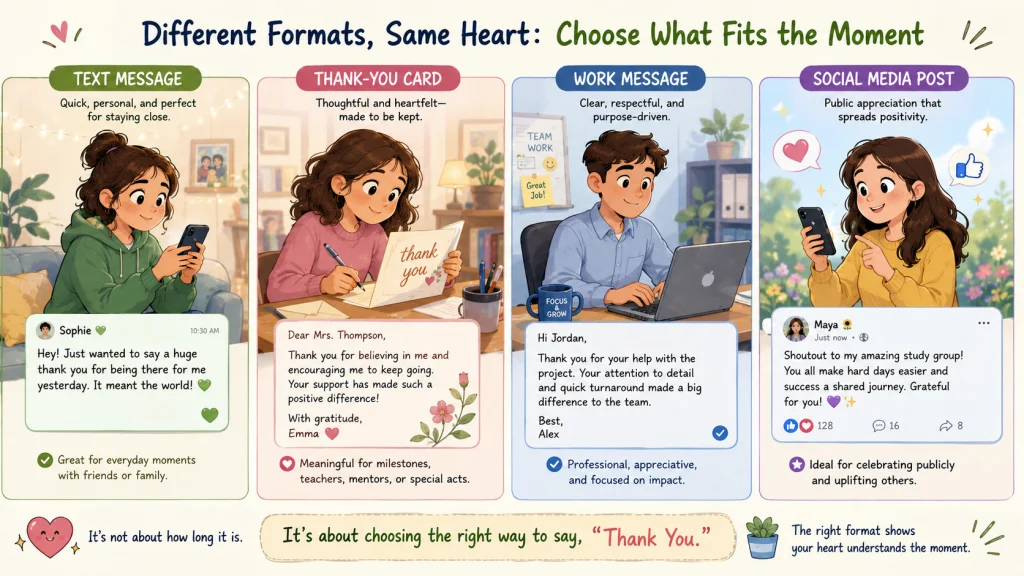
Short thank you messages get treated like one category online, as if a quick line of gratitude works the same no matter where it lands. It doesn’t. The three words that feel warm and complete in a text can feel a little bare on a card, where someone is holding a piece of paper and expecting at least a sentence or two. The same line that sounds friendly in a comment under a photo can come across as oddly casual in a work message, where the person reading it is scanning for whether you actually understood what they did for you.
I used to send the same kind of message everywhere, mostly because it felt efficient, and mostly it worked. But every so often it didn’t, and I noticed it was almost always because the format called for something slightly different than what I’d sent. A text wants immediacy. A card wants a little more shape, even if it’s only two lines. A quick professional thank you wants to name the thing clearly enough that the other person knows exactly what landed. And a public comment, the kind anyone scrolling past can see, wants to feel personal without being private. That’s the idea behind everything below: 55 messages, sorted by where you’re sending them, so the short version actually fits the moment instead of just filling the space where words are supposed to go.
For a Quick Thank You Text
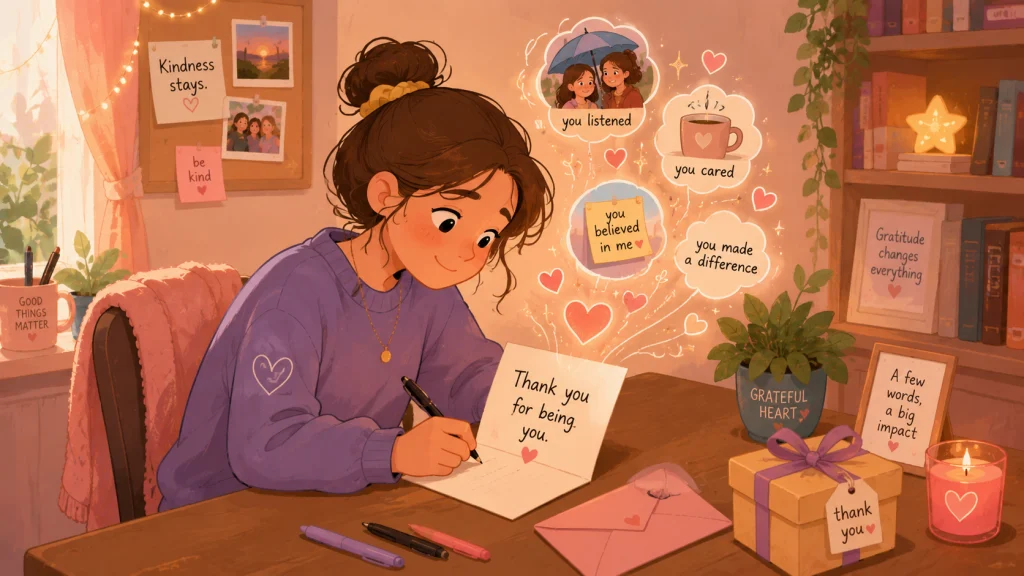
A quick thank you text doesn’t need to do much. The whole point of texting is speed, and a message that shows up within minutes of something happening carries its own kind of weight, regardless of how many words are in it. If a friend covers for you last minute, or someone sends you something thoughtful out of nowhere, the fastest sincere reaction is often the right one. A brief thank you message sent right then, while it’s still on your mind, usually means more than a longer one sent the next day.
What makes a short text land is usually one small thing: a hint of why you’re grateful, even if it’s just a word or two, rather than a flat “thanks.” A bare “thanks” can read as an afterthought, especially in a thread where you’ve been talking about something else entirely. Adding even a tiny detail, what it did for you or how it made you feel, turns a one-line thank you into something the other person will probably hold onto rather than scroll past. Here are some that work well in that quick, in-the-moment space:
- Thank you so much, that means a lot.
- You really didn’t have to do that. Thank you.
- Got it, thank you! You’re the best.
- Thanks for thinking of me today.
- This made my whole day. Thank you.
- Thank you, seriously. I owe you one.
- You’re a lifesaver. Thank you so much.
- That helped more than you know. Thanks.
- Quick message before I forget: thank you.
- Thank you for checking in on me.
- That was so kind of you. Thank you.
- Thanks for making today easier.
- I appreciate you more than this text can really say.
- More on this later, but for now: thank you.
- You read my mind. Thank you.
- Thanks, that’s exactly what I needed.
Any of these work as they are, but they get better with a name attached, either at the start or the end. “Thanks, that’s exactly what I needed, Maria” reads as a message meant for one person, while the same line without a name can feel like it could have gone to anyone. That small addition is often the difference between a text that gets a quick reaction and one that gets an actual reply back.
For a Short Thank You Card or Note
A card is a different kind of object than a text. Someone is holding it, which means even a short message inside it carries the weight of the fact that you took the time to write something down, find an envelope, and hand it over or mail it. Because of that, the bar for “short” shifts a little. A card with nothing but “thanks!” can feel like an afterthought, even if a similarly brief text from the same person wouldn’t. The good news is that one or two genuine sentences is plenty. You don’t need to fill the whole inside of the card.
If what you’re after is something longer, with more detail or a specific memory attached, what to write in a thank you card covers that fuller range. What’s below is specifically for when you want the card to say something real without saying very much: a short thank you card message that still feels like it was written by a person, in their own words, in the time they actually had.
- Thank you for thinking of me. It truly made my day.
- A small note for a big thank you.
- Your kindness did not go unnoticed. Thank you, truly.
- Thank you for being the kind of person who shows up.
- I’m so grateful for you. Thank you for this.
- Thank you for the thought and the time behind this.
- Just a quick note to say thank you. It mattered.
- Thank you for being part of this. I won’t forget it.
- This small card carries a big thank you.
- Thank you for your generosity. I’m still smiling about it.
- Words feel small here, but thank you.
- Thank you for going out of your way for me. I noticed.
- A heartfelt thank you, short but sincere.
- Thank you for being so thoughtful.
- Putting this in writing: thank you.
- Thank you for your kindness. I’ll carry it with me.
One thing I’d gently steer you away from: don’t open with “sorry this is so short.” I’ve done it myself, and every time, it pulls focus away from the thank you and onto an apology nobody asked for. A short card message doesn’t need defending. If it’s sincere, the length isn’t the part anyone will remember.
For a Professional Quick Acknowledgment
Professional thank yous live under a different kind of pressure. The person reading it is probably busy, and a message that’s too long can feel like it’s asking for more of their time than you meant to take. At the same time, a one-word “thanks” in a work thread can come across as dismissive, even when that’s the opposite of what you meant. The wider set of thank you messages for every kind of situation covers the full range, but for acknowledging something quickly at work, brevity is usually the goal, as long as it’s clear brevity rather than careless brevity.
What I’ve noticed works best in these is naming the thing you’re thanking someone for, even briefly, and then stopping there. “Thank you for the quick turnaround” tells the person exactly what registered with you. “Thanks for everything” tells them nothing, and it tends to read as something typed without much thought behind it, which, fairly or not, is often exactly how it’s received. A simple thank you message at work doesn’t need warmth layered on top of detail. The detail is the warmth.
- Thank you for the quick turnaround on this.
- Thanks for jumping in today. It made a real difference.
- I appreciate you taking the time to walk me through this.
- Thank you for the update, and for staying on top of it.
- Thanks for covering for me. I owe you one.
- Thank you for the feedback. I’ll follow up shortly.
- Appreciate the quick response, thank you.
- Thank you for making time for this on short notice.
- Thanks for your patience while we sorted this out.
- Thank you for the introduction. I’ll take it from here.
- Thanks for catching that. I appreciate it.
- Thank you for handling this so smoothly.
- Thanks again for today. It went well because of your help.
These work as standalone replies in an email or chat message, and they usually don’t need a sign-off beyond your name, if that. The goal is for the other person to read it in a couple of seconds and know you actually registered what they did, not just that you felt obligated to say something back.

When Short Is Exactly Right
There are three situations where I’d say a short thank you isn’t just acceptable, it’s actually the better choice. The first is when the moment itself is small. If someone passes you a napkin, holds a door, or sends a quick tip that saves you twenty minutes, a long thank you would feel mismatched to the size of what happened. Matching the length of your gratitude to the size of the gesture is its own kind of respect, even if nobody ever puts it that way.
The second is timing. A thank you sent the moment something happens almost always means more than a longer one sent two days later, because it shows the moment registered while it was still happening. The third is when you genuinely don’t have more to say, and padding the message would mean adding words that don’t carry anything. Saying less, on purpose, is part of what the small, ordinary messages that build daily connection are for: frequent, low-stakes acknowledgments that don’t need to be events. Here’s a quick way to think about how tone and length shift depending on where you’re sending something:
| Where it’s going | Tone | How short works | What to avoid |
|---|---|---|---|
| A text | Casual, immediate | One sentence plus a small detail | A bare “thanks” with nothing else |
| A card or note | Warm, a little considered | One to two genuine sentences | Apologizing for the length |
| A work message | Clear, efficient | Naming the thing and stopping there | Vague phrases like “thanks for everything” |
| A public comment or post | Light, visible to others | A short line with one personal touch | The same reply copied to everyone |
None of this is a formula. It is more a way of checking your instinct before you hit send. If what you’ve written matches the row it belongs to, it’s probably going to land the way you mean it.
The Last Word on Keeping It Short
A short thank you message doesn’t fix anything, and it isn’t supposed to. What it does, when it’s the right kind of short for where it’s going, is let someone know that what they did registered with you, in real time, without making them wade through more words to find that out. I’ve sent plenty of long, careful messages over the years, and some of the ones that meant the most, to me and to the people who got them, were still the shortest.
If you’re staring at a blank message right now, trying to decide whether what you’ve written is enough, it probably is. The right version, whether that’s for a text, a card, a work message, or a comment, is usually closer than it feels. Pick the one that fits where it’s going, add a name or a small detail if it needs one, and send it before you talk yourself out of it.
FAQs
🙏 Is a short thank you text rude?
Not on its own, no. What reads as rude is usually a flat “thanks” or “k” with nothing else attached, especially in response to something that took effort. Add even one small detail about what it meant, and a short text reads as warm rather than dismissive.
💌 What’s a good short message for a thank you card?
One or two genuine sentences are plenty. Something like “thank you for thinking of me, it truly made my day” covers both the gratitude and why it mattered, without needing to fill the whole card.
💼 How do I say thank you quickly at work without sounding cold?
Name the specific thing you’re thanking someone for, even in a few words, rather than a generic “thanks for everything.” A simple thank you message that points to what actually happened reads as appreciative, not cold.
📱 How do I thank people on social media without repeating myself?
Rotate between a small handful of short replies, and add one word or detail that’s specific to what each person said when you can. It doesn’t take much to make a brief reply feel personal rather than copied.
⏱️ Should I send a thank you text right away or wait until I have time to write more?
Send something short right away if you can. A brief thank you sent in the moment usually means more than a longer one sent days later, and you can always follow up with more detail afterward if you want to.
✍️ Do short thank you messages need to explain why I’m grateful?
Not at length, but a small reason helps. Even a few words about what someone did or how it made you feel turns a generic line into one that feels written for that person specifically.