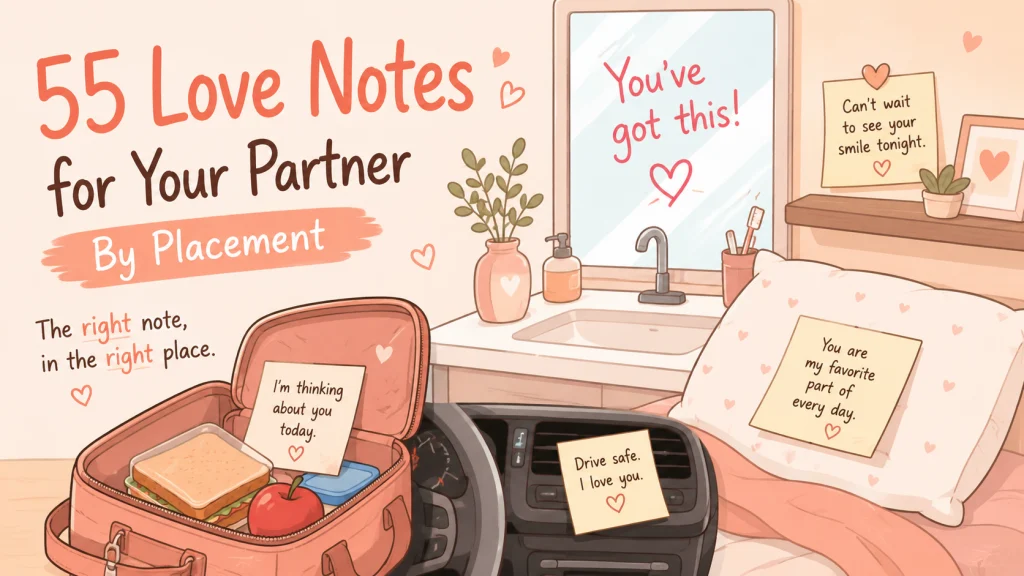
A love note is not just a text written on paper. Part of what makes it land, or miss, is where your partner finds it. This collection has 55 love notes for your partner, organized by placement, because the message you leave in a lunchbox should not read the same as the one tucked under a pillow at the end of the day. Each section is written with the specific context in mind: the tone, the timing, and how much space you realistically have. Take what fits and adjust anything that does not sound like you. For broader context, see love notes for partner.
Why Where You Leave It Changes the Note
Most love note collections give you a list and leave the rest to you. What they skip is the context the note lands in: who is around, what time of day it is, how much emotional bandwidth your partner has in that particular moment. A note found in a break room at noon lives in a different world than one discovered just before sleep. The placement changes what the note should be, not just where it sits. For related message ideas, see love notes to leave.
I realized this after leaving what was essentially the same message in two different spots on two different days. On the bathroom mirror at 7 in the morning, it felt like too much. In a coat pocket, found hours later and completely by surprise, the same words landed exactly right. That small difference changed how I started thinking about love notes. Not as things you write, but as things you leave. The leaving is part of the message.
Before the notes themselves, here is a quick reference for what tends to work where.
| Where You Leave It | Tone That Fits | Ideal Length | When It Is Found |
|---|---|---|---|
| Lunchbox or bag | Warm, light, brief | 1 to 2 sentences | Midday, often in public |
| Bathroom mirror | Encouraging, present | 2 to 3 sentences | Morning, before the day begins |
| Under the pillow | Tender, quiet | 2 to 4 sentences | Evening, end of day |
| In the car | Warm, sometimes playful | 2 to 3 sentences | Commute, alone |
| Around the house | Anything, surprise is the point | 1 to 3 sentences | Unpredictable |
None of this is a hard rule. A three-sentence mirror note can be exactly right on the right morning. But as a starting point, matching the length and tone to the context is the fastest way to make a note feel like it belongs there, rather than like something inserted without much thought.

Notes for the Lunchbox or Bag
These get found at noon, sometimes in a break room, sometimes at a desk, sometimes while rummaging through a bag for something completely unrelated. The best lunchbox notes are short enough to read in one glance and warm enough to carry for the rest of the afternoon. The goal is a quiet moment of feeling seen in the middle of a day that probably asks a lot.
The most common mistake here is writing something that belongs on a card and trying to compress it onto a small piece of paper. The feeling comes across as squeezed rather than concentrated, and it makes the person feel like they are supposed to do something with it emotionally at a moment when they cannot. What actually works is something specific and light: one honest sentence that sounds like you, that can be read in ten seconds and still linger for a while. These twelve are written with that in mind.
- I put an extra snack in because I think about you more than I say.
- Hope your day is going as well as you looked leaving the house this morning.
- You’re going to do great today. Just thought you should know.
- Saving my favorite person a seat at dinner. Don’t be late.
- Made this with love. Like everything I make for you.
- I thought about you this morning. I almost always do.
- Come home soon. The place is quieter without you.
- I packed the good cookies. You know why.
- Just a reminder in case the day makes you forget: you’re my favorite.
- I put this note in because I wanted to. No other reason.
- Your lunch. My love. Both in here waiting.
- I like knowing something from home is with you today.
Write them on a small folded piece of paper or a Post-it. Nothing that requires unfolding three times to read. The size of the note is part of the message too, and small done well beats long done carelessly every time.
Notes for the Bathroom Mirror
A mirror note is found first thing. Before coffee, before a plan for the day, often before your partner has fully decided how they feel about being awake. That makes it an unusual opportunity: a note there can set a different emotional tone than the one they were quietly dreading. It can also overwhelm if you misjudge the length, which is why two or three sentences tends to be the limit. Anything more turns into homework at 6:30 in the morning.
Write in dry-erase marker directly on the mirror when you can. A note taped to the glass works, though sticky notes have a way of falling at the worst possible moment. Leave it centered, not tucked in a corner where it might get missed. And keep the words themselves simple. The mirror note that works is not the one that says the most. It is the one that makes the person feel something before the day has had a chance to make them feel something else first.
- Good morning. I watched you sleep for a second before I got up. Still my favorite face.
- You don’t need to do anything differently today. You’re already enough.
- Whatever’s on your plate today, I’m in your corner.
- I noticed you were tired last night. I hope today is gentler.
- You look good. You always look good. But especially this morning.
- I’m not here right now, but I was thinking about you when I wrote this.
- Today is going to ask something of you. You have what it takes.
- I love you at 6 a.m. I think that says something.
- Go get it. I’ll be here when you get back.
- Some mornings I still can’t believe you’re mine.
If you leave these regularly, vary where on the mirror you put them. A note in the same corner every time stops being a discovery and starts being furniture. The small surprise of finding it in a new spot is worth the extra second it takes.

Notes to Leave Under the Pillow
These are found at the end of the day, in the quiet, in the transition between everything the day asked and the rest the night offers. The energy is completely different from a morning note. There is no urgency, no commute to get through, no agenda. A pillow note lands in the space your partner retreats to when things are finally finished, and that gives it a kind of intimacy that other placements do not have.
This is one of the few placements where you can afford a little more room. Three or four sentences works here in a way it does not at 7 in the morning. The note can be tender without feeling like too much, because the context holds it. The one thing to avoid is anything that asks the person to process something complicated before sleep. These ten lean toward warmth and quiet, which is what the end of a day usually needs most.
- I put this here so the last thing you feel tonight is that you are loved.
- I hope the day was kind to you. You deserve that.
- You worked hard today. Rest now.
- I thought about you a lot today. More than I said.
- Sleep well. I’ll be here.
- Whatever today was, it’s over now. This part is just us.
- I didn’t say enough today. So I’m saying it here: I love you.
- Close your eyes knowing someone is very glad you’re in this world.
- Tomorrow is a fresh start. Tonight, just rest.
- I like sleeping next to you more than I know how to say out loud.
Fold the note once and slide it just under the edge of the pillow, not so buried they have to hunt for it, not so obvious it looks staged. The small surprise when they reach for it is part of what makes the note feel like a gift rather than an assignment.
Notes to Leave in the Car
A car note is found during transition: the time between home and wherever the day is sending your partner. They are usually alone. The radio might be on, or not. There is something about that in-between space that makes a small note feel bigger than it would anywhere else. The person is already a little internal, already a little quiet with their own thoughts, and then there is your handwriting on the seat or dashboard.
The car is also one of the few placements where some lightness actually works well. A lunchbox note that leans too playful might land in the wrong moment. A pillow note that tries to be funny can feel out of place. But the car, with its privacy and its natural sense of movement, tends to hold a wider range. These ten run from warm to light, and if you want to take the car note further in a playful direction, the flirty messages collection has more that work well in that spirit.
- Drive safe. I need you to come home.
- This car has heard a lot of your singing. I think you’re great.
- Somewhere between here and wherever you’re going, know that I love you.
- I like thinking about you driving around with my note in here.
- Call me if the day gets long. Or just because.
- The commute is better with a secret. Here’s yours.
- You carry a lot. You don’t complain. I notice.
- Home is waiting. I’m waiting.
- I don’t say this enough: you’re easy to love.
- Put something good on. You’ve earned a nice drive.
Tuck the note under the wiper on the driver’s side, leave it on the passenger seat, or slide it into the sun visor. The visor works especially well because it gets found when your partner goes to flip it down, which tends to happen at exactly the kind of unexpected moment a note like this is built for.
Notes Left Around the House for No Reason
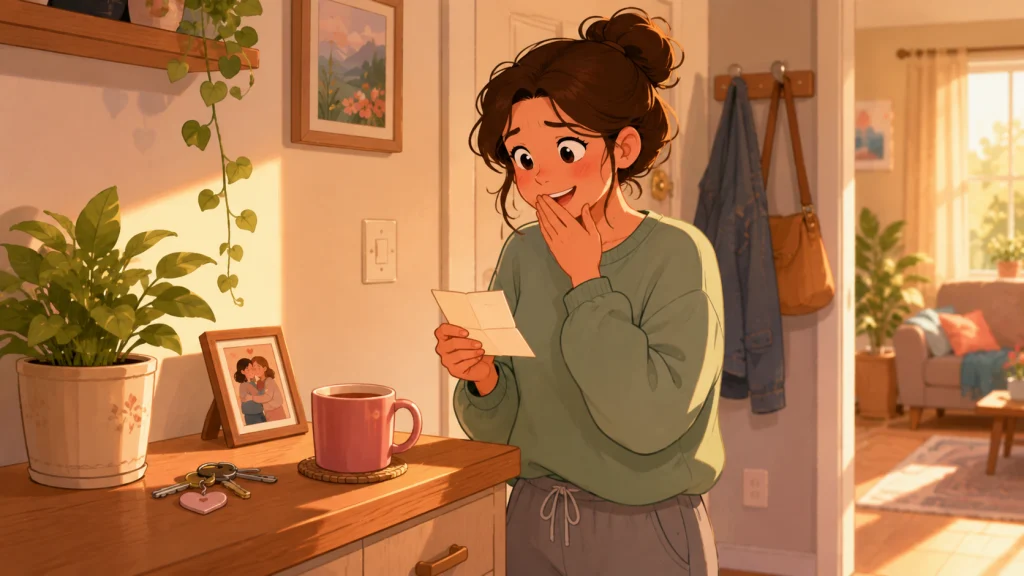
These are the ones I find most interesting to think about, and the ones that tend to get mentioned when people tell me what actually stayed with them. There is no occasion, no birthday, no reason being offered. The note is just there when the person opens a cabinet or picks up a book or reaches into a jacket pocket. The unexpectedness is the whole message before a single word is read. It says: I was thinking of you at a completely ordinary moment and decided to do something about it.
The mistake people make with no-occasion notes is feeling like they need to justify them. They write “I just wanted you to know” as an opener, which adds a layer of explanation the note does not need. Start with the thing you want to say. The person already knows you wanted them to know, that is why you wrote it. These thirteen are written that way, and if you want more in that same no-occasion, just-because spirit, the love and relationship messages collection covers a lot of that same territory.
- Found you. Well, found a spot you’d look. Close enough.
- This was here the whole time and you didn’t notice. Like a lot of good things.
- You’ll find this eventually. I was thinking about you when I left it.
- No reason. Just you.
- Reminder: you’re the best thing in this house.
- I left this here on a Tuesday for no reason at all.
- You didn’t ask for this note. That’s exactly why I left it.
- I love our ordinary. I love you in it.
- This is what it looks like when someone can’t stop thinking about you.
- Everything’s fine. I just love you.
- You’re the reason this place feels like home.
- I know you’ll find this when I’m not in the room. That was the point.
- Some things are easier to write down. This is one of them.
Good spots for love notes around the house: inside a cabinet they open every morning, slipped into a book they are currently reading, tucked under the phone charger, inside the pocket of a jacket they have not worn in a week. The longer it takes to find, the more surprised they tend to be, and surprise, even a small one, is part of what makes a note like this feel like something.
Final Thoughts: The Note That Gets Kept
From what I have found, the notes that stay with people longest are rarely the ones written at big moments. They are the short ones, the unexpected ones, the ones found on a random Wednesday in a coat pocket or behind a coffee mug. They stayed partly because of the words, but mostly because of the simple fact of them: someone thought of me and wrote it down. That is a different thing from a text. A text lives in a feed with a hundred other things. A handwritten note lives wherever the person chooses to put it, and people who keep them tend to keep them for a long time.
A note for your partner does not have to be eloquent. It does not have to say everything. It has to be honest enough that the person reading it feels, just for a moment, less alone in being loved by you. The placement helps shape that. But the fact of leaving it at all is most of the work.
FAQs
💌 What do you write in a love note for your partner?
Something honest and specific to them. It does not have to be long. One or two sentences that sound like you, something you have noticed about them or something you feel when you think about them, lands better than anything that could have been written for anyone. Generic warmth reads as generic. Specific warmth reads as real.
📝 How long should a love note be?
It depends on where the note is going. A lunchbox note can be a single sentence. A pillow note can be three or four. In general, shorter is almost always safer. If you can say it in two sentences, do not use five. The length of a note is not a measure of how much you mean it.
🗓️ How often should you leave love notes for your partner?
There is no right answer. Often enough that they feel thought of, infrequent enough that finding one still feels like a surprise. For some couples that is once a week. For others it is once a month. The regularity matters less than the sincerity, and a note that is left because you felt like leaving it will almost always read differently than one left out of habit.
🏠 Where are good places to hide love notes around the house?
Inside a cabinet they open every morning, tucked into a book they are currently reading, under their phone charger, or in the pocket of a jacket they have not worn recently. The best spots are the ones that get found at an unexpected moment, not the ones they check out of routine.
🖊️ Should love notes be handwritten or typed?
Handwritten when you can. Handwriting carries something printed text does not: it shows effort in the most literal sense, and it is unmistakably from you. If your handwriting is genuinely difficult to read, type it and print it on paper. What matters is that it exists in the physical world, not just on a screen.