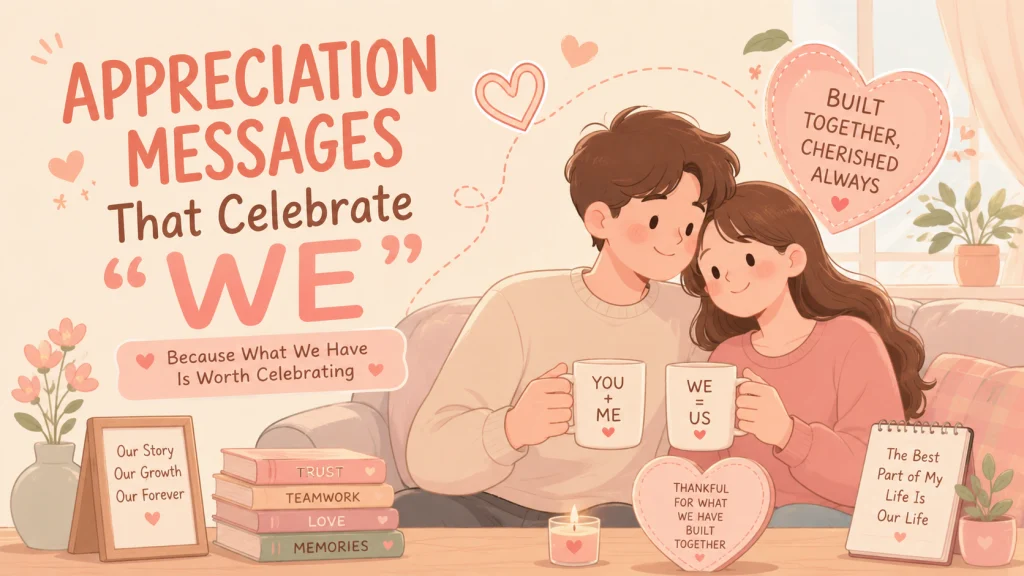
Most appreciation messages put the other person at the center: who they are, what they do, the qualities you love in them. This collection does something different. These sixty messages appreciate the relationship itself, what you have built together, how you have both changed, the specific life that only exists between the two of you. Whether it is an anniversary, an ordinary Thursday, or the morning after something hard, these are for the “we.”
What Most Appreciation Messages Are Missing
There is a message almost nobody sends. Not because people do not feel it, but because the language for it does not come easily. It is not quite “I love you” and it is not exactly “thank you,” though it carries both of those things somewhere inside it. It is something closer to: I see what we are together, and I want you to know I see it.
Almost every appreciation message that exists focuses on the person: their qualities, their impact on your life, what you feel for them. That is worth saying, and there is nothing wrong with any of it. But it leaves a different kind of message almost entirely unwritten: the kind that appreciates the relationship itself, the “we” as its own subject, separate from either of you alone. Partnership appreciation messages that treat the relationship as the subject, not just the people in it, are genuinely rare. This collection is built around that gap.

The “We” That Belongs to Both of You
When you say “I appreciate you,” the other person is the subject. That sentence points at them: their character, their choices, who they are independent of the relationship. Much of what matters in love belongs there. But it points in a different direction than what this collection is for.
When you say “I appreciate what we have,” you are pointing at something that did not exist before both of you built it. The trust that took time to earn. The shorthand that only works between you. The way you have learned to come back after a disagreement and still be okay. I noticed this gap when I was trying to write a message after something difficult had resolved between us. I wanted to say something about the relationship holding, not a compliment and not a declaration, something that acknowledged: we built something here, and it held. Everything I reached for turned into a message about the other person. It took real effort to find language where the “we” was the subject from the first sentence.
The mistake people make when writing this type of message is starting with the person and adding the relationship as an afterthought. It reads like a compliment with a footnote. If the message is about the “we,” let the “we” be the subject from the beginning. The person does not need to be at the center of the sentence for the message to feel warm toward them.
| The moment you are writing for | What to put at the center | Message type to reach for |
|---|---|---|
| After getting through something hard together | What it proved about the relationship | Built together / Good team |
| An anniversary or relationship milestone | What you have made over time | Milestone messages |
| A quiet day when you feel it | The relationship as a steady, constant good | Ordinary day messages |
| Noticing how being together has changed you | What the relationship has taught you both | Shaped by the relationship |
| No occasion, just want to say something | The simple fact of what you have | Short and sweet |
The sections below are organized by moment and tone. If you want something that focuses on the person rather than the relationship, there is a broader collection of love and relationship messages that covers that direction. What follows here stays with the “we.”

Messages About What You’ve Built Together
These messages put the relationship at the center: not what you feel for the other person, but what you have made together over time. The trust, the history, the specific kind of life that only works because both of you kept showing up for it. They work well when you want to say something that goes a little deeper than the everyday “I love you” without turning into a speech.
They also land well after something has been hard and held. After a stretch of distance. After any period where you came through it and found the relationship still standing on the other side. When you feel the weight of what you have built, these give that feeling a shape.
- What we have took time and honesty and a lot of showing up on days when it would have been easier not to. I do not take any of it for granted.
- I am not just grateful for you. I am grateful for this, for everything we have figured out together and everything we are still figuring out.
- We built something real here. It did not happen by accident, and I never want to act like it did.
- There is a version of my life without this, without us, and it looks a lot emptier. I am glad we chose each other and kept choosing.
- What I love most is not one thing about you. It is the whole thing we have made together, the rhythm, the shorthand, the way we have learned to do life side by side.
- I think about all the small decisions that led to this and I am grateful for every single one of them. We are a good thing.
- This is not just love. It is a foundation. We built that.
- I have been in this long enough to know that what we have is not common. I want you to know I know that.
- What we have created together, the life, the trust, the inside language we have developed, none of that existed before us. I love that it is ours.
- I think the best thing we ever did was decide that this was worth working for. And then actually do the work.
- There is a comfort in what we have that I do not have a full word for. I just know I would notice if it was gone. I never want to stop noticing it is here.
- Whatever we have been through, we kept building. That matters to me more than I usually remember to say.
These are not compliments. They are acknowledgments. And sometimes acknowledgment is the thing a relationship has been quietly waiting for, not more love, just the recognition that someone sees what the two of you have made.
Messages About How the Relationship Has Changed You Both
There is a specific kind of appreciation that comes from noticing who you have become inside a relationship. Not “you made me better,” which can read as gratitude for a service. Something more precise: this thing we built together has changed me, and I think it changed you too, and that is worth naming directly. If the you make me better messages you have found elsewhere feel too focused on the other person, these sit in different territory. The subject here is the relationship, not the person.
These work best when they come from real noticing. If you have become more patient, more honest, more able to sit with difficulty because you have had to figure it out alongside someone else, that observation belongs in the message. The ones below are written from that kind of noticing. They acknowledge growth without turning it into praise.
- Being in this has changed how I move through the world. I am more patient, more honest, more willing to sit with hard things. That is us.
- I became a better person somewhere inside this relationship. I do not say that to compliment you. I say it because it is true, and because it happened because of what we built together.
- There are things I know about myself now that I only learned because I was in this with you. That is not nothing. That is a lot.
- We have both changed. And I think we changed in directions that made us better. I am genuinely grateful for that.
- I used to be afraid of parts of myself I could not control. Being in this has made me less afraid. Not because you fixed me, but because what we built is safe enough that I could actually be myself in it.
- I have watched us grow into people who know how to love more carefully than we did when this started. I am proud of that.
- What we have has stretched me. Taught me things I was not expecting to learn. I would not trade any of it.
- There is a kind of knowing that only comes from time and honesty. We have that. I feel it.
- I came into this as one version of myself and I am a different version now. Mostly better. Some of that is mine to own. A lot of it belongs to what we have built together.
- This relationship has taught me things about love I could not have learned any other way. I am still learning them.
The line between “you changed me” and “being in this changed me” is subtle, but people on the receiving end feel the difference. These stay on the side that honors the relationship as its own thing, not a backdrop to a compliment.
We Are a Good Team
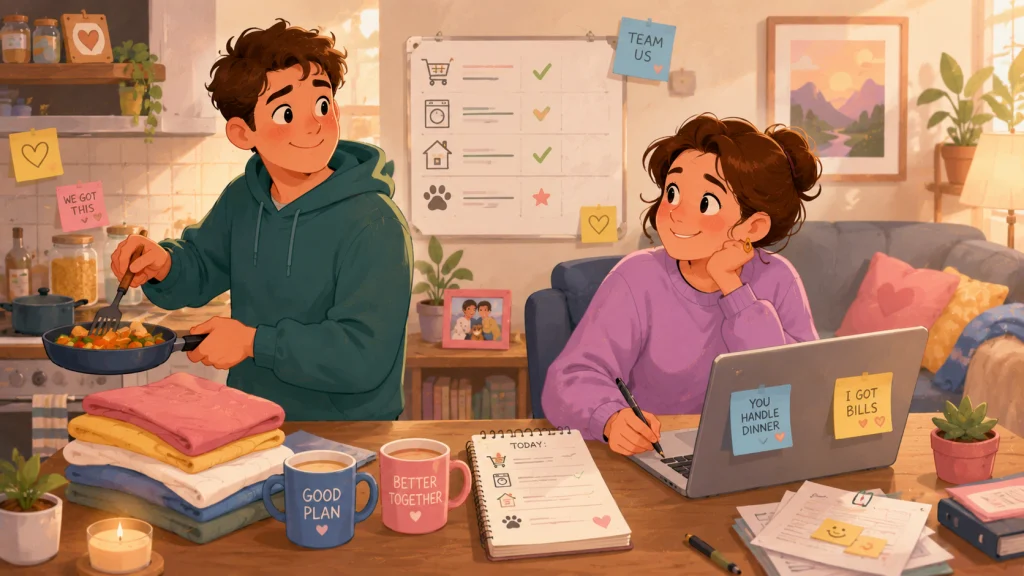
“We are a good team” is one of the most honest things two people can say to each other, and one of the least often said. It does not have the romance of a love declaration, but it carries something that declarations sometimes miss: real respect for how you actually function together when something needs to get through. It sees the coordination, the covering of each other’s gaps, the choice to handle things together.
These eight messages are for the moments that bring that feeling up. After a hard week where you both just handled it. After a decision made well together. After any stretch where you were reminded that you chose the right person to navigate things with. There is a specific intimacy in saying: I see how well we do this, and I do not want to take it for granted. ❤️
- We do not always agree, but we always figure it out. That is the thing I am most proud of about us.
- We cover each other’s gaps. I have noticed that, and I do not want to take it for granted.
- When things go wrong, I am always glad I am going through them with you. That says something.
- We are good at this. Not perfect, but genuinely good. And I think we keep getting better.
- I trust us. Not just you, not just me. Us. The way we work together when something actually needs working through.
- Nobody sees what we do behind the scenes to keep this going. But I do, and I want you to know I see it.
- We have gotten through things I was not sure we would get through. We got through them together. That matters more than I say.
- There is a specific kind of relief in knowing you are on my team. I feel it all the time, and I do not say it enough.
The “good team” message is one of the less obvious forms of love, but it is not a lesser one. Plenty of couples feel this and let it go unsaid. If you have been meaning to say it, one of these is probably close to what you meant.
For an Anniversary or a Relationship Milestone
Milestones tend to bring out the long message: the one that recounts the relationship year by year and ends with a declaration that could have been half as long. Some people mean every word and should send it. Others would rather say something brief and let the weight of the day carry the rest. These eight are for the second kind.
They are specific enough to feel real and short enough to land cleanly. An anniversary already carries context; the message does not have to do all of the work. For something that goes deeper into the emotional range of a long relationship, there is a full collection of long-term relationship love messages that covers that territory more fully. These stay tighter.
- I did not know what we would become when this started. Now I cannot imagine any of it differently. Happy anniversary to something I am genuinely proud of.
- We made it here. To this specific version of us, on this specific day. I do not take that lightly.
- Every milestone is evidence that what we have is real and that it lasts. I love that about us.
- I did not want to let this day pass without saying something. What we have is worth marking. Worth celebrating. Worth saying out loud.
- We have added another chapter and I think it is one of the good ones. Here is to more of them.
- I keep thinking about where we started and where we are now and feeling something I do not quite have words for. Pride, maybe. Gratitude, definitely. Both.
- If I could go back and choose again, I would choose us. Every version of this. Every year.
- This anniversary is not just about how long we have lasted. It is about what we have built along the way. And what we have built is worth celebrating.
Every year of something real is worth acknowledging. The message does not have to match the size of the milestone. A short honest sentence sent on the day lands harder than a long one sent a week later.
Short and Sweet: When You Just Want to Say It
Not every message needs a reason. Sometimes you feel it, the quiet appreciation for what you have, and you want to say something before the moment passes. These eight are for that. Short, warm, direct. The kind of thing you can send on a Wednesday afternoon with no occasion attached and have it land exactly the way you meant it.
There is something particular about the short “us” message. It does not feel rehearsed. It does not come loaded with the weight of an occasion. It just says: I was thinking about what we have, and I wanted you to know. These relationship appreciation messages, the ones with no occasion and no buildup, often mean the most precisely because nothing prompted them.
- What we have is good. I just wanted to say it.
- I appreciate us. Not just you. Us.
- We are a pretty good thing.
- Grateful for what we have built. More than I usually remember to say.
- I love what we are together.
- This, us, it is one of the things I am most certain about.
- What we have is rare. I know that.
- Every day I am glad this is what we chose.
Short messages about a relationship often hit harder than long ones. The brevity signals that you know exactly what you feel and are not scrambling to fill space. That clarity, when it comes to something this easy to feel and hard to say, carries its own weight.

For the Quiet Days When You Feel It Most
I have noticed that the moments I feel most grateful for a relationship are almost never the big ones. Not the anniversaries, but the unremarkable Tuesdays when something small happens and I think: I am glad this is my life. The big days carry their own recognition. The quiet ones need a little more prompting to say the thing out loud before the moment moves on.
These messages are for days that do not have a name but still feel like something worth marking. A little softer than the milestone messages, a little more personal than the short ones. The kind of thing you send on a Sunday morning or a Thursday afternoon when the ordinary life you have built together feels like exactly enough.
- Nothing big is happening today. I just noticed that I am happy, and that this is why. I wanted to tell you.
- Some days I look up from everything and I am just glad we have this. Today is one of those days.
- This is one of those unremarkable days I will probably still remember, because I noticed what we have and it felt good. So I wanted to say it.
- Not a special occasion. Just checking in to say: I still think what we have is one of the best things.
- There is something about the ordinary days that make me the most grateful. Anyone can love well on the big occasions. We love well on the regular ones too.
- I was just going about the day and realized I have stopped taking us for granted. That felt worth sharing.
- It does not need to be a milestone for me to want you to know: I think we are doing really well.
The best messages often do not wait for a reason. There is nothing to justify or explain. These do not need anything except that you felt it and decided to say it.
Lighthearted Messages for a Partnership That Does Not Take Itself Too Seriously
Not every relationship appreciation message needs to be quiet and careful. Some of the best ones are warm and a little playful, the kind that says “I love what we are together” without making the other person feel like they need to prepare an emotional response. These are for couples whose dynamic has room for humor alongside the honest stuff, which in my experience is most of the good ones.
They still mean everything they say. The lightness is not a way of avoiding the feeling. It is a way of expressing it in a register that feels closer to the actual texture of the relationship. If you and your partner communicate warmth with some humor built in, these will probably feel closer to your real voice than anything heavy.
- We are objectively a great team. I have data. Mostly anecdotal, but still.
- I want to formally acknowledge that we have figured this out better than most. No offense to everyone else.
- I do not know how we ended up this good at being us, but I am not questioning it.
- Whoever decided we should try this relationship thing, I would like to thank them. Oh wait, that was us. Good call.
- We should be studied. The way we work together is genuinely impressive.
- I looked it up and it turns out we are one of the better things. Confirmation bias, maybe. Still counts.
- I cannot believe we made this work. Proud of us. Genuinely.
Humor does not make these messages less real. It makes them more recognizable as something that belongs to a specific relationship, which is exactly the point of writing one of these in the first place.
Final Thoughts: The Relationship Deserves Its Own Words
The relationship you are in is its own thing. It has its own history, its own rhythm, its own logic that only makes sense from the inside. Most people who love each other well spend years expressing that love through action without ever putting words specifically to the thing between them. These messages are for the times when saying it directly feels right, when you want the relationship itself to be the subject, not just a backdrop to a compliment.
If you want appreciation messages that put the person at the center rather than the relationship, the full collection of romantic appreciation messages covers that angle across many different moments and tones. Whatever you send, the most important thing is that it sounds like you actually meant it. With this kind of message, you do.
FAQs
💬 What is the difference between appreciating a person and appreciating a relationship?
Appreciating a person puts their qualities at the center: who they are, what they do, how they make you feel. Appreciating a relationship puts the “we” at the center: what you have built, how you have both changed, what exists between you that would not exist without both of you in it. Both are worth saying. They just point in different directions.
💑 How do I make a relationship appreciation message feel personal instead of generic?
Add one detail that belongs only to your relationship: something you have been through together, a way you work that is particular to you two, a moment that only makes sense in context. Even one specific detail pulls a message out of generic territory and into something that could only exist between you.
📅 Do I need an occasion to send one of these?
No. The “ordinary days” and “short and sweet” sections are specifically for no occasion at all. Sending one on a random Tuesday can hit harder than sending one on an anniversary, because it says: I was thinking about us for no reason except that I wanted you to know.
🌱 Do these work for newer relationships, or only long-term ones?
Most of them work at any stage. The “built together” and milestone messages lean toward relationships with more history. The short, sweet, and ordinary-day messages fit anywhere. A newer relationship still has a “we” worth acknowledging, even if that “we” is only a few months old.
✉️ How long should a relationship appreciation message be?
Shorter than most people expect. The messages here average two to four sentences. Appreciation that runs long tends to drift into explanation, and the best messages do not need to explain themselves. Say the specific thing and stop before you over-qualify it.
😄 What if I want something warm but not heavy?
The lighthearted section is built for exactly that. Warmth and humor can live in the same message without canceling each other out. If your relationship communicates love with some lightness built in, leaning into that is not avoiding the feeling. It is expressing it in the voice the relationship actually uses.