
Saying Thank You at Work Is Its Own Skill
There is a version of the workplace thank you that almost everyone has sent at least once. It goes something like: “I just wanted to reach out and say a huge thank you, I honestly don’t know what I would have done without you, you are absolutely incredible.” The person on the receiving end reads it, feels vaguely uncomfortable, and moves on. The message said something. It did not land. Professional thank you messages carry a particular challenge because the relationship comes with unspoken rules about how much warmth is appropriate, what kind of specificity crosses a line, and how much of yourself belongs in a work exchange at all. Getting it right is not about finding the most polished phrasing. It is about reading the relationship honestly and saying something real within its actual limits.
What makes a professional thank you message work is the same thing that makes any thank you work: it has to be specific enough that the person knows you actually noticed what they did. “Thank you for your help” is technically correct but it floats. It could refer to anything. What lands is “thank you for staying late to pull those numbers before the deadline.” That sentence tells someone you saw them, not just that you were vaguely grateful for their existence. I have received both kinds, and the difference in how they feel is immediate. The first one is a courtesy. The second one stays with you.

The Gap Most Professional Thank You Messages Fall Into
The problem with most workplace gratitude is not that it is insincere. Usually the person writing it means exactly what they are trying to say. The problem is calibration. Too cold, and the message reads like a courtesy form, something you send because you are supposed to, not because it means anything. Too warm, and it makes the recipient uncomfortable, particularly if the relationship calls for some professional distance. The messages that work are the ones that find the register that fits the actual relationship: genuine, specific, brief enough to feel considered rather than effusive.
There is also the question of medium. A thank you sent by email sits differently than a message in a team channel, and a handwritten note is different again. The right tone often depends not just on what you say but where you say it. Something that reads as perfectly natural in a direct message can feel like a lot in a formal email thread. For situations where a physical note feels more appropriate than a digital message, the question of what to write in a thank you card is worth thinking through separately, because the format changes how the words land.
The table below is a rough calibration guide before you get into the messages themselves. It is not a set of rules. It is a way of checking whether the tone you are reaching for matches the relationship you are actually in.
| Relationship | Appropriate Tone | Ideal Length | What to Include |
|---|---|---|---|
| Close coworker, ongoing relationship | Warm, personal, direct | 3 to 5 sentences | The specific thing they did, acknowledgment of their time or effort |
| Boss or senior manager | Direct, respectful, not effusive | 2 to 4 sentences | What specifically they did, why it mattered to you |
| Mentor or advisor | Personal, honest, measured | 3 to 6 sentences | What shifted for you, a sign you are applying what they gave you |
| Project collaborator | Collegial, specific, warm | 2 to 5 sentences | Their specific contribution, how the work felt to do together |
| Client or external contact | Professional, genuine, brief | 2 to 3 sentences | The specific trust they extended, a forward-looking line if appropriate |
The “ideal length” column is the most useful one to pay attention to. Almost every professional thank you message can be improved by making it shorter. The instinct to qualify, expand, and hedge is understandable, but it usually works against you. The message that says one specific, true thing and stops there tends to read as more confident, more genuine, and more worth reading than the one that builds toward the same point over several sentences.
Thank You to a Coworker Who Helped You
The coworker thank you is probably the most common message in this category, and also the one most people write too vaguely. It tends to come out vague: “thanks for your help” is technically accurate but it does not tell the person that what they did actually registered. The coworkers who show up for you, especially when they had no particular obligation to do so, deserve a message that matches the specificity of what they gave you. These twelve versions try to give you that without crossing into the kind of language that makes a work relationship feel suddenly more personal than it was set up to be.
One thing I keep noticing is that the messages which land best are the ones that name the person’s time directly. In most workplaces, time is the thing people feel most protective of. When someone gives it to you generously, saying that you saw that, not just that you are grateful in the abstract, tends to mean more than any other version. The messages below include a few that do exactly that, and any of them will read better with one specific detail added that only you know.
Thank you for stepping in when I needed it most. You didn’t have to, and it made all the difference.
I really appreciate you taking the time to help me work through that. I was stuck, and you got me moving again.
Thank you for covering for me today. I owe you one, and I genuinely mean that.
I just wanted to say thank you. The way you showed up for me this week didn’t go unnoticed.
I honestly could not have gotten through that deadline without your help. Thank you.
Thanks for being so generous with your time. I know you’re juggling a lot, and you still made space for me.
You made a really stressful situation a lot more manageable. I’m grateful for that.
Thank you for answering my questions without making me feel like I was asking too many. It meant more than you know.
I wanted to follow up and say thank you properly. What you did for me was a real act of generosity.
Thank you for being the kind of coworker you are. Days like this one remind me how lucky I am to work alongside you.
I appreciated your patience with me today more than I said in the moment. Thank you.
You went out of your way when you didn’t have to. That’s the kind of thing people remember. Thank you.
The last message in the list is one you might send after some time has passed, not in the immediate aftermath of what happened. A thank you that arrives a few days later, when the person has probably already moved on, carries a different weight than the one sent in the moment. It says that you are still thinking about it. That is not nothing.

Thank You to a Boss or Manager Who Supported You
Thanking a manager is its own particular challenge. The power dynamic shifts the register, and the tendency is to overcorrect in one of two directions: either too stiff and formal, or too effusive in a way that reads as flattery. Neither one actually tells the person anything. The messages that work in this situation are direct, specific, and short. They name what happened, say that it mattered, and stop there before the message starts to feel like it is making more of the moment than the relationship can hold.
Managers are often thanked for the wrong things. People reach for “thank you for your leadership” or “thank you for your ongoing support,” when the thing that actually meant something was a specific decision they made, a moment they went to bat for someone in a room that person was not in, a difficult conversation they chose to have when it would have been easier not to. Naming the specific thing is almost always more meaningful than gratitude offered in the abstract. These twelve messages are built around that principle, and most of them become stronger with one real detail added about what your manager actually did.
Thank you for having my back on this. It meant a great deal to know you were in my corner.
I appreciate the trust you placed in me on this project. I won’t take it lightly.
Thank you for the feedback. It was honest and useful, and I’m already putting it to work.
I wanted to thank you for advocating for me. I don’t take that kind of support for granted.
Thank you for making time to check in this week. It made a real difference to know you were paying attention.
I’m grateful for the opportunity you gave me. I’ll do my best to make it worth your confidence.
Thank you for handling that situation with care. It was a difficult one, and you navigated it well.
I wanted to say thank you for the way you led this team through a hard stretch. It didn’t go unnoticed.
Thank you for your patience with me during the learning curve. I appreciate it more than I’ve said.
I appreciate everything you’ve invested in helping me grow in this role. Thank you.
Thank you for being direct with me. I know that takes something, and I’m grateful for it.
Working under your leadership has taught me more than I expected. I just wanted you to know that.
A note on timing: the last message on this list is the kind of thing you say at the end of a significant stretch, a project, a transition, a period of growth, not during it. Sent too early it sounds premature. Sent at the right moment, it is one of the more meaningful things you can put in writing to someone who has led you well.
Thank You for Professional Advice or Mentorship
Mentorship thank you messages are different from the others in this collection because what you are thanking someone for is rarely a single discrete moment. You cannot point to one thing the way you can with a coworker who covered for you. What you can point to is the effect: what you understood differently after, what you started doing differently, what shifted in how you approach something. That is the thing worth naming in the message. Not “thank you for being my mentor” as a general category, but “thank you for the conversation in October that made me rethink how I was showing up in those meetings.”
I have found that the messages people feel most awkward writing in a professional context are the ones that require admitting vulnerability: that they were uncertain, that they needed a different perspective, that someone else’s thinking changed theirs. Mentorship thank yous sit squarely in that territory. The honest versions require you to say, essentially, “I needed help and you gave it.” That is not a weakness to paper over. It is the point of the message, and the reason it carries weight when you say it plainly.
Thank you for taking the time to share your perspective. That conversation shifted something for me.
I’ve thought about what you said more than once since we spoke. Thank you for being so candid.
I didn’t realize how much I needed that conversation until it was over. Thank you for making the time.
Your advice has stayed with me. I’ve started applying it, and I can already see the difference.
Thank you for being honest with me. It would have been easier to say something more comfortable, and I’m glad you didn’t.
I want you to know that your mentorship has meant more to me than I’ve probably expressed. Thank you.
Thank you for treating me like someone worth investing in. That’s not a small thing.
I’ve learned more from watching how you work than from anything formal. I’m grateful for your example.
Thank you for seeing potential in me when I wasn’t entirely sure I saw it in myself.
The guidance you offered at a pivotal moment made a real difference. I want you to know that.
The last message works best when it arrives some time after the fact. A thank you sent immediately after a conversation can feel like a receipt: a confirmation that something was received. The one that arrives weeks or months later, when the effect has had time to become clear, says something different. It says that the impact was real enough to still be with you. That tends to mean more.
One version of this worth calling out separately: if the person you’re thanking just wrote you a reference letter, not just gave advice once, the thank-you carries an extra job — closing the loop on the favor itself. A reference-letter thank-you email follows a slightly different shape than a general mentorship thank-you, especially if you want to report back that it worked.

Thank You After a Collaboration or Project
The close of a project is one of the moments in professional life where gratitude actually has somewhere natural to go. Something was finished, something was made together, and that creates a window for saying things that do not always fit in the middle of the work. The messages in this section are built for that window: the day after a launch, the close of a long collaboration, the moment when the thing is done and you have a chance to say what it meant to work alongside someone before the next thing begins.
What gets missed most often in project thank yous is the specific contribution. “Thank you for all your hard work” is the version people reach for first, and it tends to land flat because it could apply to anyone on any project ever. What stays with someone is the message that names the actual thing they brought: the way they handled the friction at the halfway point, the piece of the work that would not have existed without them, the quality they showed up with consistently. These eleven messages are starting points. The one specific sentence you add from your own experience is what makes any of them worth sending.
Working with you on this was one of the best parts of the project. Thank you.
Thank you for your patience, your ideas, and your follow-through. This wouldn’t have landed the way it did without you.
I appreciated how you handled the hard parts of this collaboration. Thank you for keeping things moving when it wasn’t easy.
Thank you for being a true partner on this. The outcome reflects your work as much as mine.
I’ve worked on a lot of teams. This one was different, and a big part of that was you. Thank you.
Thank you for what you brought to this project. It raised the quality of everything we produced.
I want to say thank you for making this collaboration feel manageable even when it wasn’t.
Your contribution to this project was significant. I want to say it plainly: thank you.
Thank you for being someone who delivers, every time. This project confirmed that again.
We did something good here, and I’m grateful I got to do it with you. Thank you.
The way you showed up for this project made my job easier. I don’t take that for granted. Thank you.
If the collaboration was difficult in some way, if there were moments of friction or a stretch where things were genuinely hard before they came together, acknowledging that briefly is often what makes the thank you feel real rather than polished. You do not need to dwell on it. A single line that says “I know this wasn’t always easy” can change the entire weight of what follows.
Short Professional Thank You for Email
Not every thank you needs to carry weight. Some situations call for something brief: a quick acknowledgment after someone helped you in a thread, a follow-up after a meeting that went well, a note after someone responded faster than you expected. For those moments, the short version is not a lesser version of the real thing. It is the right thing. A two-sentence thank you that says exactly what it means will always outperform a paragraph that slowly builds toward the same point.
These ten are meant to be sent as-is or with one small adjustment for context. For situations where you are unsure whether to go longer, short thank you messages across different contexts can help you calibrate. But for most standard professional follow-ups, one of these will cover it.
- Thank you for your help with this. It made a real difference.
- I appreciate you making time for this. I know your schedule is full.
- Thank you for the quick turnaround. It was genuinely helpful.
- I just wanted to say thank you. You came through, and it didn’t go unnoticed.
- Thank you for taking the time. It helped me move this forward.
- I appreciate your support on this more than the brief message suggests.
- Thank you for following up. It took something off my plate at exactly the right moment.
- Your help made this easier than it would have been. I’m grateful.
- Thank you for being responsive. It made a difference in how this came together.
- I’m glad I could count on you for this. Thank you.
The sixth message on that list is particularly useful when the help was more significant than a short email can fully convey, and you want to acknowledge that gap directly. It gives the person a sense of the actual scale of what they did without making the message longer than the situation calls for.
Thank You to a Client or Business Contact
Business thank you messages operate in a specific register. There is an awareness on both sides that trust has been extended, that something real is at stake, and that the relationship has a professional dimension that shapes how words land. The best ones do not try to soften that dynamic or pretend it does not exist. They acknowledge it honestly: you brought this to us, you trusted us with it, and that matters. That is not a sales line when it is written with actual intent. It reads like what it is.
The version of the client thank you that most people recognize and most people write is the one that sounds like a form letter even when it has been personalized. “Thank you for your business, we value the relationship, we look forward to working with you again.” The template is there even when the specific words are different. What cuts through it is one sentence that could only be written for this specific client, about something that actually happened in the course of working together. That sentence does not have to be long. It just has to be true.
Thank you for trusting us with this project. We don’t take that lightly.
I wanted to reach out and say how much I appreciated your patience throughout this process.
Thank you for the opportunity to work together. I hope we have the chance to keep working together.
I appreciated your candor during our conversations. It helped us do better work. Thank you.
Thank you for your continued partnership. It means more than a routine renewal.
I’m grateful for the referral you sent our way. It reflects the kind of trust that matters to us.
Thank you for your flexibility during a difficult stretch. It made a real difference to our team.
Your feedback helped us improve. I wanted to say thank you for taking the time to share it honestly.
Thank you for the introduction. The relationship that came from it has been genuinely valuable.
I want to close this project by saying thank you. Working with you has been a genuine pleasure.
If you are writing one of these as a note rather than a message, the weight of a physical format changes how the words sit, and it is worth thinking through what the situation actually calls for before you choose the medium.
What Not to Write in a Professional Thank You
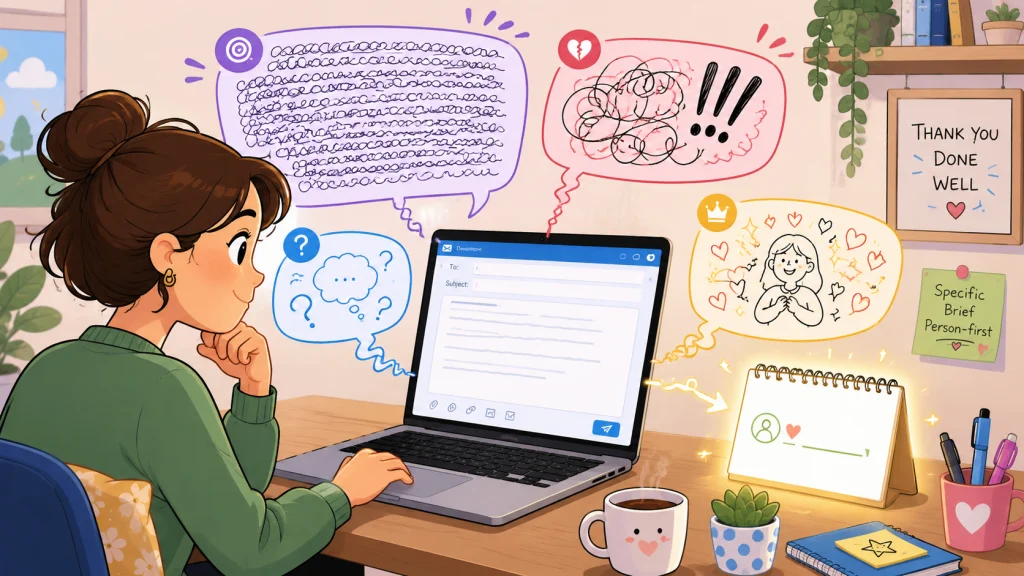
The mistakes people make most often in professional thank you messages are not failures of generosity. They are failures of calibration. The impulse behind every one of them is a good one. The problem is in how it comes out, too much, too vague, or off-register for the relationship. Knowing what to avoid is at least as useful as having the right words, because most of these patterns are things people reach for on instinct, especially when they feel strongly about what they want to express.
- “I cannot thank you enough” or “words cannot express.” These feel heartfelt when you write them and flat when someone reads them. They have been used so many times that they no longer carry the weight they once did. A sentence that names what specifically you are grateful for will always do more than one of these.
- Thanking someone for “everything.” Vague gratitude is easy to receive and just as easy to set aside. “Thank you for everything you’ve done” gives the person nothing to hold onto. Name the thing, even if it takes an extra ten words.
- Over-explaining why you are grateful. A thank you message that spends three sentences justifying itself before it arrives at the actual gratitude tends to read as anxious rather than sincere. The gratitude is the point. Get there without the build-up.
- Making the message about yourself. “I was so overwhelmed and I honestly don’t know what I would have done, it has been such a hard time for me…” The person you are thanking has disappeared by the second clause. Keep them at the center of the message. It is about what they did, not about how you felt.
- Excessive superlatives. “The most incredible,” “truly amazing,” “absolutely outstanding.” In a professional context, superlatives tend to read as performative. If something was genuinely excellent, say what made it excellent. That is the version that lasts.
The version people write first is almost always too long, too earnest, and too abstract. I know this because I have written it more than once. It comes from a good impulse: the need to make sure the person knows how much it actually meant. But in professional contexts especially, the message that says one specific, honest thing and closes there tends to do far more than the one that tries to say everything at once.
Final Thoughts: Gratitude at Work Is Worth Getting Right
The relationships we build at work are some of the most significant ones in a life, and they are also among the ones we are least likely to tend to deliberately. People are busy, the professional norms are often unclear, and there is always something more pressing than the thank you that has been sitting unsent for three days. But the professional thank you messages that do get sent, the ones that are specific and honest and brief, do something real. They tell someone that what they did was noticed. In most workplaces, that is not the default assumption. Saying it plainly, in writing, is worth the time it takes.
If you are looking at a wider range of thank you situations beyond the professional context, the full collection of thank you messages for every occasion covers the personal side of gratitude as well. Professional and personal gratitude are different skills, but they draw from the same source: the decision to say something real to someone instead of letting the moment pass. That decision is always worth making, and it matters in a work email just as much as it does in the small everyday messages that tend to get set aside until there is a specific reason to send them.
FAQs
💬 How do you say thank you professionally without it feeling awkward?
Be specific and be brief. The awkwardness in most professional thank yous comes from being too vague or too effusive. Name the actual thing the person did, say it mattered, and stop there. A two-sentence message that says something real will always land better than a paragraph that circles around the point.
📧 Should I send a thank you message to my boss by email or in person?
Either can work depending on the situation. Email gives the person time to receive it without pressure to respond immediately, which is useful when you are thanking them for something significant. In person is more natural for a quick acknowledgment after a meeting or a conversation. Match the medium to the weight of what you are thanking them for.
✍️ How long should a professional thank you message be?
Shorter than you think. Most professional thank you messages work best at two to four sentences. Longer messages start to feel like they are turning the gratitude into more of an occasion than the situation calls for. Say the specific thing, say it mattered, and close.
🤝 What do you write in a thank you message after a work project?
Name what the person specifically contributed rather than reaching for “thank you for all your hard work.” Then say what the experience of working with them was like, or what the outcome reflected about what they brought. Keep it to three to five sentences. The specific detail is what separates the messages people remember from the ones they forget within the hour.
❌ What should you avoid saying in a professional thank you?
Avoid phrases like “I cannot thank you enough” or “thank you for everything,” because both are vague in a way that lets the message float without landing. Also avoid over-explaining, making the message primarily about your own feelings, and stacking up superlatives. Specific and brief is almost always the right call.
💼 How do you thank a client professionally without sounding like a form letter?
Include one sentence that could only apply to this specific client and this specific situation. It does not have to be long. Something that names the trust they extended, the patience they showed, or the candor they brought to the process. That one sentence is what makes the rest of the message read as genuine rather than templated.
🕐 Is it too late to send a professional thank you message?
Usually not. A thank you that arrives later than expected often carries more weight than an immediate one because it signals that the impact stayed with you. Acknowledge the delay briefly if it feels right, then say what you actually want to say. Most people would rather receive it late than not at all.