Early relationship love messages have a calibration problem that most message collections never address: saying too much too soon creates pressure the other person is not ready for, and saying too little leaves the moment without anything real passing between you. The 65 messages here are sorted by stage, because where you actually are in a new relationship shapes what a message can honestly carry. Whether you are a few weeks in and still learning each other’s rhythms, navigating the uncertainty of not knowing if they feel the same, or sitting with a feeling that has grown into something you are ready to name, there is a section here for exactly that moment. For broader context, see love messages when youre falling for someone.
The Calibration Question Nobody Talks About
When you go looking for love messages while falling for someone, most of what you find is calibrated for the wrong moment. Either it reads like a two-year anniversary declaration or it is so careful it says almost nothing at all. The gap between “I like you” and “I love you” is where most of the real feeling lives, and where most people feel most lost. For a broader look at how love gets expressed across all kinds of moments and stages, love and relationship messages maps out the full range.
The version people reach for first is almost always too much. I know because I have written it. A long message with qualifiers and reassurances built in ends up reading less like honesty and more like anxiety. The other failure mode is going too quiet, keeping it vague because you do not want to be ahead of them. “I had a good time” when what you mean is “I cannot stop thinking about you” leaves the other person with no signal at all, and in early stages, signals matter more than most people admit.
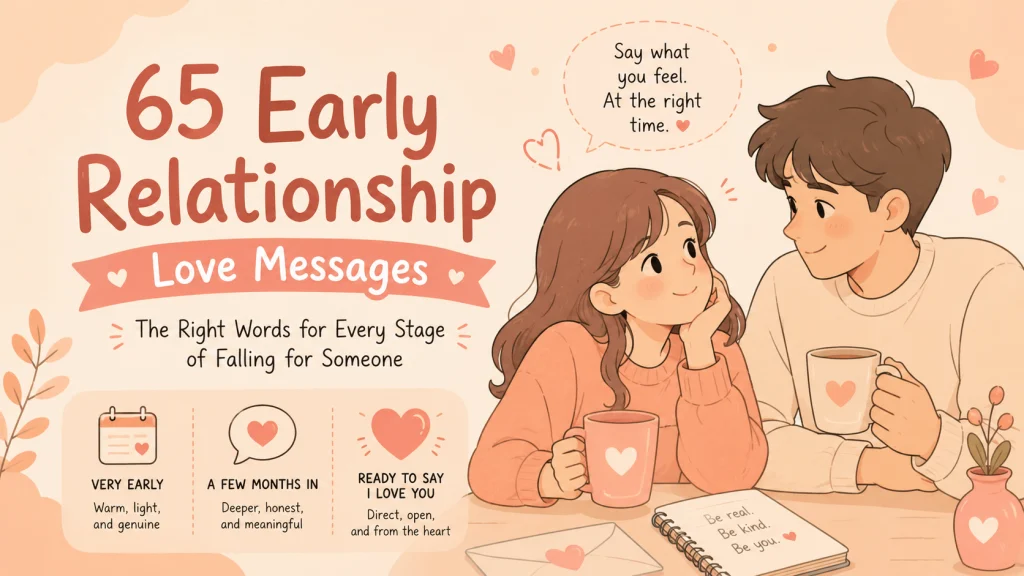
The calibration question, how much is too much too soon, looks genuinely different at each stage. A message that would feel completely right three months in would feel overwhelming in the first few weeks. The table below is a rough map of what tends to land well and what tends to land wrong at each threshold.
| Where you are | What tends to land well | What tends to overwhelm |
|---|---|---|
| Very early (first few weeks) | Warmth, noticing them, small honest observations, low-pressure honesty | Declarations, “I love you,” forever language, intensity that asks for a matching response |
| A few months in | Deeper feelings named directly, specific appreciation, honest acknowledgment of the growing thing | Future-planning language, permanence before it has been established between you |
| Ready to say “I love you” | Direct, honest, grounded, no pressure on the other person to respond a certain way | Ultimatums, needing them to match you, scripted declarations that leave no room |
The sections below follow these stages in order. Start with the one that honestly reflects where you are right now, not where you hope you are or where you think you should be. That is the only thing that makes a message feel real to the person reading it.
Messages for the Very Early Stage: Warm Without a Lot of Weight
The first few weeks of a relationship have their own tenderness. Everything is still new enough that you are paying close attention, noticing small things, reading into moments you would have let pass with anyone else. The messages that work at this stage are honest about that warmth without turning it into something the other person has to receive with equal weight. They say “I am noticing you” rather than “I need you to know the full extent of what I feel.”
These work because they are low-pressure by design. They invite the other person in without requiring them to match anything. For messages with a slightly lighter tone that still say something real, flirty messages can sit comfortably alongside these depending on where you and the other person are.
- “I keep catching myself smiling at nothing. I think it might be you.”
- “I’m not sure what this is yet, but I like where it’s going.”
- “Something about today made me want to tell you I’m glad I met you.”
- “I don’t want to make a big deal of it, but I’ve been looking forward to seeing you all week.”
- “I noticed I think about you in small ways throughout the day. Just wanted you to know.”
- “You make ordinary things feel a little better. I’m not sure how, but you do.”
- “I like talking to you. That’s probably obvious, but I wanted to say it anyway.”
- “I had a really good day, and a lot of it is because of you.”
- “Every time I see your name on my phone, I’m a little too happy about it.”
- “I’m trying not to read too much into everything, but I think I like you quite a bit.”
- “You’ve made this easier than I expected. I mean that as a very good thing.”
- “I don’t know what comes next, but I know I want you in it.”
That last one tends to surprise people because it sounds like it might be too much. In practice, it lands as open rather than heavy, because it is not asking for anything back. It is just telling the truth about a feeling, which is what early messages do best when they actually work.
A Few Months In: When the Feeling Has Had Time to Settle
At some point, the early giddiness begins to settle into something more specific. You know this person better. You have seen them in a wider range of moments: stressed, tired, laughing at something nobody else would find funny. What you feel is not just excitement at something new; it is something more deliberate. A kind of choosing. The messages in this section are for that stage. They are honest about depth without reaching for permanence before it has been established between you.
The mistake at this stage tends to go one of two ways. Either people are still writing as if it is week two, when the feeling has clearly become something more grounded. Or they jump ahead to language suited for a long-term relationship before that is actually where you both are. These messages sit between those two wrong turns.
- “I keep finding new things I like about you. I don’t think I’m done.”
- “Being with you feels familiar in a way I didn’t expect.”
- “I think about you the way you think about something that makes your day better. Quietly, but all the time.”
- “I know we haven’t put a name on this, but whatever it is, it’s the best thing going on in my life right now.”
- “You’re the first person I want to tell when something good happens.”
- “I’ve started thinking of things in terms of before I knew you and after. I like the after a lot better.”
- “A lot of my days are better because you’re in them.”
- “I’m not saying forever. I’m saying right now, with you, is really good.”
- “I haven’t said any of this out loud yet, but I’m falling for you. Slowly and completely. I think you should know.”
- “The more I know you, the more I want to.”
- “I don’t need this to be anything other than what it already is. What it already is happens to be really good.”
- “I like who I am when I’m with you. That’s not a small thing.”
That ninth one tends to be the hardest to send because it is the most direct. Most people at this stage are still deciding how much to show. Sending it anyway, when the feeling is genuinely there, is the kind of thing that tends to be remembered by both people for a long time.
The Message Before You Say “I Love You” for the First Time
There is a specific kind of message that lives in the space just before “I love you.” Not the declaration itself, but the one that signals something is coming, or holds the feeling you have not yet found the right moment to say out loud. These are not stalling tactics. They are honest acknowledgments that you are carrying something and you want the other person to know it exists, even if you have not handed it over completely yet.
I have been in that moment more than once, sitting with a feeling that seems too large for a text but too present to keep to myself. Sometimes the right message is not the full declaration; it is the one that says something significant is here, and I am working up to saying it properly. For the very different emotional register that comes once a relationship is more established, long-term relationship love messages cover that ground well.
- “I have something to tell you and I keep finding reasons to wait. I think I’m just scared you’ll say something back that changes everything.”
- “I’ve been sitting with a feeling for a while now. I think it’s time I stopped sitting with it and actually said it to you.”
- “I want to say something, and I want to say it right. Can I see you soon?”
- “There’s a word I keep stopping myself from using because it feels too big for a text. But I wanted you to know the feeling is there.”
- “I haven’t said this to many people and meant it. I mean it with you.”
- “I know we’re still figuring things out, but what I feel for you is not uncertain anymore. It’s decided.”
- “I keep almost saying something and then changing the subject. I don’t want to do that anymore.”
- “I need to tell you something. I’ll say it better in person, but I didn’t want to wait until then to tell you it’s coming.”
- “Whatever we call this, what I feel for you is bigger than I expected. And I think I’m ready to say what I actually think it is.”
- “I’ve been waiting for the right moment and I’ve realized there’s no perfect one. So: I love you. There it is.”
That last one is technically the declaration itself, but it belongs in this section because of how it arrives. It comes after all the waiting and all the almost-said moments, and it lands that way. The honesty of “there’s no perfect moment” is exactly what makes it feel real rather than rehearsed.
When You’re Not Sure If They Feel the Same
This is the section most people actually need and the one fewest message collections have. There is a specific kind of vulnerability in feeling something real for someone when you are genuinely uncertain whether it goes both ways. The pull to either hide it entirely or overexplain it is strong. Hiding it means the moment passes without anything honest exchanged. Overexplaining turns the message into something that feels less like honesty and more like a case being made.
What tends to work is honesty without demand. Saying what you feel while making clear, explicitly or by tone, that you are not putting pressure on them to match it. These messages do that. They are direct about the feeling and open about the uncertainty, which is a harder combination to land than it sounds. For more options across different dynamics and stages of love, love messages covers a much wider range of moments and relationships.
- “I know I might be ahead of you on this, and that’s okay. I just didn’t want to keep it to myself anymore.”
- “You don’t have to match what I’m feeling. I just wanted to be honest with you about where I am.”
- “Something’s been sitting with me, and keeping it in feels worse than saying it. I’m falling for you. No pressure on that.”
- “I’m not asking you to feel the same way. I just thought you deserved to know.”
- “I like you more than I planned to. I don’t know where you are with all this, but I figured honesty was better than pretending.”
- “I’ve been trying to act casual about how much I like you. I’m not sure it’s working.”
- “I might be way out ahead of you here. But I’d rather tell you than wonder forever.”
- “I’m not sure what you feel, and I’m not asking you to figure it out right now. I just wanted to say: this means something to me.”
- “I don’t need you to have an answer. I just didn’t want you to not know.”
- “I realize this might land strangely. But what I feel for you is real, and I wanted to stop hiding it.”
The pattern I keep seeing with these is that the ones including something like “no pressure” or “you don’t have to match this” tend to land better than the ones that just make the declaration and wait. Not because the feeling itself is too much, but because the other person needs room to respond honestly rather than react to something that feels like it requires a certain kind of answer.
Short Messages That Say More Than They Look Like They Do
Sometimes the most honest thing is also the shortest. A message that takes forty-five minutes to write and arrives as three sentences is not a failure; it is editing. In the early stages of a relationship especially, a short message that says exactly the right thing can land harder than a long one that says slightly too much. Brevity is its own kind of courage, because it does not let you hide behind qualifications and context.
These work because they do not explain themselves. They say the thing and trust the other person to feel it. That is a different approach from the longer messages above, and sometimes it is the more fitting one, particularly when the relationship is still new enough that a measured, unhurried message says more than a thorough one ever could.
- “I’m glad it’s you.”
- “You’re kind of my favorite thing right now.”
- “I like this. I like you.”
- “Every version of my day is better when you’re in it.”
- “I didn’t see you coming. I’m really glad you arrived.”
- “Just so you know: I’m in.”
- “You make me want to be around you more. That means something.”
- “I keep thinking about you. It’s a good problem to have.”
- “Whatever this is, I don’t want it to stop.”
- “I’m not sure I have words for this yet, but it’s good. Really good.”
- “Falling for you feels a lot like relief.”
That last one tends to catch people off guard in exactly the right way, because it names something true that is rarely said. The early stages of falling for someone can feel anxious and uncertain and almost exhausting in their intensity. When the feeling settles into something you trust, it really does feel like relief. Saying that is more specific than most early love messages manage to be.

After One of Those Moments That Makes It All Clear
There is a particular kind of message that lives in the hours after a really good time together, when the feeling you have been carrying quietly is suddenly a lot louder. You drove home thinking about something they said. The moment has passed, and now you are sitting with a version of yourself that knows something more clearly than before.
These messages work because they are grounded in something that actually happened between the two of you. The other person will feel that the message comes from a real place rather than a general warmth. That specificity is what separates something genuine from a message that could have been sent to anyone.
- “I keep replaying today. I think that says enough.”
- “I know I didn’t say it earlier, but tonight was one of those nights I’ll remember.”
- “I drove home smiling at nothing. Then I realized it was you.”
- “Today reminded me why I like you as much as I do. Which, for the record, is quite a lot.”
- “I meant to say this when we were together but I ran out of nerve: today with you was really something.”
- “Some moments just feel right. That was one of them.”
- “I was already falling, and then there was today.”
- “I’ve been trying to find the word for what tonight felt like. I think ‘good’ is underselling it.”
- “I’ve had a lot of good days. Today made the list.”
- “You’re making it very difficult to play it cool.”
There is a message I almost did not send once because I thought it would come across as too much, too soon. I sent it anyway, short and honest, and the person told me later it was one of the few messages that did not feel like something they were supposed to receive. The same principle applies here. The message that comes from something specific, sent because you mean it rather than because the moment demands it, is the one that tends to be remembered.
Final Thoughts: On Saying the True Thing at the Right Weight
The hardest part of writing a love message in a new relationship is not finding the right words. It is finding the right weight. The words that are honest about what you feel without putting something on the other person they are not ready to carry. That calibration is not something you can calculate from the outside. It comes from paying honest attention to where you both are, and then trusting yourself to say something true at that scale rather than at the scale you wish things already were.
What I have found, over and over, is that the messages people agonize over longest are usually trying to do too many things at once: express the feeling, reassure the person, preemptively answer any concern, and still sound effortless. That combination does not exist. The messages that actually work tend to do one thing honestly. They say what is true about this moment, at this stage, without reaching past it.
Sixty-five messages is a lot to sort through, but you probably already know which section reflects where you are. Start there, find the one that sounds like you, and change anything that does not. The goal is not to borrow someone else’s words. It is to find the shape of the thing you want to say, and then say it.
FAQs
💬 What do you say when you’re falling for someone but don’t want to scare them off?
Keep it honest and low-pressure. Say what is true without asking them to match it or respond a certain way. Something like “I like you more than I planned to” or “I don’t know where you are with this, but I wanted you to know where I am” gives them room to respond without putting them on the spot.
💌 How do you write a love message in a new relationship without coming on too strong?
Match the stage, not just the feeling. In the early weeks, warmth and honest noticing tend to land better than declarations. “I think about you more than I expected to” says something real without overwhelming someone who is still figuring out where they are. Short and specific almost always works better than long and thorough.
🤔 Is it okay to text “I love you” first in a new relationship?
Yes, if the feeling is genuine and you are ready for any honest response. What makes it land well is saying it without pressure attached. Something like “I wanted you to know, no need to say anything back right now” gives the other person room. Saying it in person usually works better for the first time, but a message can be right when the moment calls for it.
😅 What if I say too much in a love message and regret it?
If it was true when you sent it, it was not a mistake. Honesty in a new relationship is almost always better than staying quiet. If the message was more than the other person was ready for, that is information worth having. The way forward is the same: keep being honest, keep paying attention to where you both are.
📱 How long should a love text be in the early stages of a relationship?
Short is almost always better early on. Three sentences that say one true thing tend to land harder than a paragraph that qualifies itself. If you find yourself writing more than five or six sentences, step back and ask what the one thing is that you actually want them to know. Start there and stop when you have said it.
❓ What do you say to someone you’re dating but not officially together with yet?
Acknowledge the stage without making it awkward. “I don’t know what we’re calling this, but whatever it is, it’s really good” works better than either treating it as fully committed or pretending the feeling is not there. Honesty about the in-between is its own kind of intimacy.