“I love you” said a hundred times over can start to sound like a reflex rather than a feeling. Not because the feeling has gone anywhere, but because the phrase has worn smooth from use. These 75 messages are organized around the three things that actually restore weight to those words: specificity, surprise, and sincerity. Some will fit exactly. Most are better used as a starting point for the version that sounds most like you saying something you genuinely mean. For broader context, see i love you messages.
When “I Love You” Starts to Sound Like a Habit
There is a version of “I love you” that stops a person mid-thought. They read it and feel it, all the way through. And there is another version that slides past without registering, not because it is not true, but because it has been said so many times in exactly the same way that the phrase has become closer to a verbal habit than a piece of communication. I noticed this in my own life somewhere in the middle of a stretch where I was saying it twice a day to someone I loved genuinely, and slowly realized that neither of us was really hearing it anymore. What changed it was one message that named something specific about him, something particular I had noticed. He called within the hour. For related message ideas, see i love you text messages.
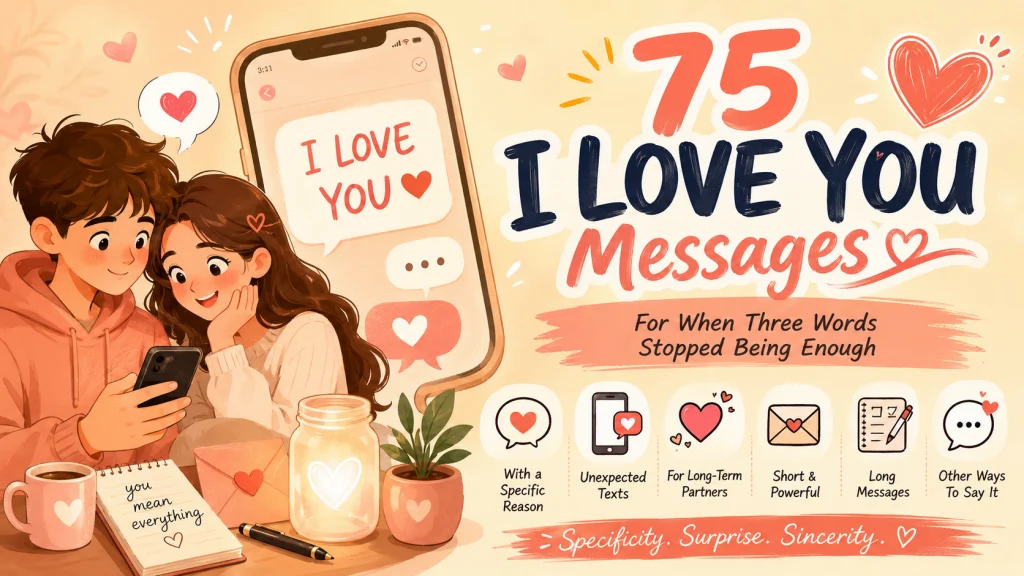
The pattern I keep seeing is that three things restore meaning to the phrase. Specificity: you are saying it for a particular reason, not in general. Surprise: you are saying it at a moment they are not waiting for it. Sincerity: you are dropping the habit version and saying the honest one. The messages below are organized around those three things. If you want a broader collection of love messages across different occasions and tones, that is worth exploring too. But if it is this phrase specifically that needs to land differently, read on.
| What you are trying to say | Which format fits |
|---|---|
| I love you, and here is exactly why | With a specific reason |
| I love you, and I just needed to say it today | Unexpected text |
| I love you, after everything we have been through | For long-term partners and married couples |
| I love you, quickly and honestly | Short and powerful |
| I love you, and I need you to actually feel it this time | Long, with context |
| I love you, but I need different words for it right now | Ways to say it without the phrase |
One thing worth saying before you scroll through any of these: the most effective message you can send is almost always the one that sounds most like you. Use these as a direction, not a script. The closer it gets to something only you would say to this specific person, the harder it lands.

“I Love You” with a Specific Reason
The most common mistake I see in love messages is the general version: “I love everything about you.” “You mean the world to me.” These are not wrong, but they are easy to write, which is part of why they rarely land. The version that actually reaches someone, whether you are writing it for him, for her, for a spouse, or for a partner of many years, is the one that proves you have been paying attention. Specificity is the signal. It tells them: I see you, not just the idea of you.
Think about the last thing they did that made you feel lucky. Start from that moment. The specific observation is almost always better than the general sentiment.
- I love you for the way you still ask me how my day was, even on the days when yours was worse.
- I love you for making the bed on mornings when I forget. I notice, even when I do not say it.
- I love you because you laugh at my jokes even when they are not that good. I know you know they are not that good.
- I love you for the version of me I am when you are in the room. That person is calmer. I like them more.
- I love you for every time you said nothing when nothing was the right thing to say.
- I love you because you remember the small things. The coffee order. The name of my difficult coworker. The thing I was worried about two weeks ago that I thought you had already forgotten.
- I love you for the way you change the subject when I am embarrassing myself, without making me feel embarrassed.
- I love you because after all this time, coming home still means coming to you.
- I love you for letting me be quiet sometimes without making it a thing.
- I love you for arguing with me like I am worth arguing with.
- I love you because you take me seriously even when I am being ridiculous.
- I love you for the look you give me across the room that means “I see you and I am on your side.”
- I love you because you made ordinary feel like enough.
- I love you for showing up, again and again, in ways that do not look dramatic but are everything.
- I love you because when I imagine what I want my life to look like, you are the part I am most certain about.
When you write your own version, fill in the blank honestly: “I love you because you…” and name the first thing that came to mind. The first answer is usually the truest one.
“I Love You” When They Least Expect It
There is something that happens when “I love you” arrives at a completely ordinary moment. A Tuesday afternoon. A random Thursday with nothing attached to it. The surprise is part of the message. It tells the other person: this is not occasion-driven. This came from nowhere because you are always somewhere in my head. These messages are short on purpose. The point is the arrival, not the length.
- Hey. Just this: I love you. No reason. Carry on.
- Thought about you just now, which is not unusual, but this time I wanted you to know.
- I was in the middle of something completely unrelated and the thought just arrived: I love you. No idea what triggered it. Did not want to keep it to myself.
- This is not a special occasion. I just love you and thought you should hear it today.
- I know we just saw each other. I love you anyway.
- You crossed my mind and I realized I had not told you lately. I love you.
- Not a big message. Just: I love you, and today felt like a good day to say it out loud.
- You are probably in the middle of something. I will be quick: I love you.
- There is no particular reason for this message. I love you. That is the whole message.
- I thought about you today and it made me happy, so I wanted you to know.
- I just love you. That is literally everything I had to say.
- Sending this for no reason except that I mean it. I love you.
The ones that work best here acknowledge the ordinariness of the moment. Not “I love you under this sunset” but “I love you, randomly, on a nothing afternoon.” That honesty is what makes it feel real rather than performed.

“I Love You” for Married Couples and Long-Term Partners
Long-term love is quieter, more practiced, and, if you are not careful, easier to say without feeling. This is not a failing. It is what happens when two people have spent years building a life together and the logistics have started taking up more room than the acknowledgment of what they built. These messages are written for love that does not need to prove anything but occasionally needs to say it out loud again, with some weight behind it. If you are navigating something harder right now, the writing on love and relationship messages covers those moments too.
These work best when at least one detail is swapped for something true about your relationship specifically.
- I would still choose you. After everything, in full knowledge of everything, I would still choose you.
- I love you in the way that has nothing to prove anymore. It just exists. Steady and certain.
- I love you for staying. For every day you chose this, even when it was not easy.
- I love you for the ordinary version of our life. The grocery runs. The Sundays. The nothing evenings. I would not trade any of it.
- I do not say it the way I used to, but I mean it more. That is what I want you to know.
- I love you in the way that feels like home. Not exciting every day. But real, and mine, and I am grateful for it.
- I loved you when it was easy and I love you now when sometimes it is not. That is the version of love I am proud of.
- I love you for all the times you handled something so I did not have to, and never asked for credit.
- I love you for growing with me instead of staying still. We are not the same people we were. I love who we became.
- You have seen the worst of me and stayed. I do not think I say thank you for that enough. I love you.
- I love you for every year we have gotten more honest with each other. That took something. I do not take it lightly.
- I still want to tell you things. After all of this. That is love, I think.
- I love you for making a life with me feel worth showing up for, even on the days I am hard to be around.
If any of these feel slightly off, use the sentence that comes closest and change one thing about it, one word, one specific reference, until it sounds like something you would actually send.
Short, Powerful “I Love You” Texts
Brevity is not laziness here. Sometimes a short message carries more than a long one precisely because it does not over-explain. It commits to what it is saying without hedging, without context, without building up to the point. The message lands because it is already the point. These work especially well when the relationship already has a foundation and the words do not need to come with a case made for them.
- I love you. Not as a habit. Still as a choice.
- You are my favorite part of any day you are in.
- I love you. The whole, messy, real version of you.
- Still you. After all of it, still you.
- I love you like I mean it. Because I do.
- You. That is the answer to most of my questions.
- You are not background noise to me. I hope you know that.
- I love you, and I would say it again, and again after that.
- There is no version of a good life that does not include you.
- I love you. Still. Always. Even now.
- I wanted you to know: I love you. Not because it is expected. Because it is true.
- I love you more than I am good at saying. This is me trying to close that gap.
If you find yourself writing something and then adding qualifiers and context, try cutting everything back to the one sentence you actually mean. That sentence, sent on its own, is almost always the better message.
Long “I Love You” Messages for When Three Words Are Not Enough
There are moments when the short version is not enough, when what you are trying to say is bigger than a phrase and the person receiving it deserves to feel the full weight of it. Long messages work when they are specific and when they say exactly what they mean and stop. The ones that miss usually try too hard. Each of these works best when you swap in at least one detail that is true for your relationship right now.
- I have been thinking about something. We have gotten into the rhythm of saying “I love you” the way you say “drive safe.” I do not want that. So I am saying it differently today. I love you because of how you handle things when they are hard. Because of what you show me about who I could be. Because being loved by you made me want to be better, and I do not think I have ever told you that directly.
- I know things have been off between us lately. Not broken, just off. And I wanted to say this clearly before we try to work through the rest: I love you. Not in spite of the rough stretch but with it, as part of the whole thing. You are worth this, and so is what we built together.
- I keep starting this message and then not sending it, which is honestly the most on-brand thing I do. So here it is, unedited: I love you. I love that you make me feel known. I love that you argue with me when I am wrong. I love that you are still here after everything that “still here” has meant for us.
- I am not good at this. You know I am not good at this. But I wanted to try to say it properly: I love you in the way that has gotten deeper over time, not louder. It does not look like it did at the start. It looks like knowing you. Like trusting you. Like wanting to be the person you think I am. That is what I have got. I hope it lands.
- You carried a lot this week. I watched you do it, and I did not say enough. So I am saying it now: I see you. I love you. And I am glad you are the person standing next to me while we figure this out.
- I am writing this because saying it out loud never comes out right. I love you in a way that has become so much a part of how I see the world that I sometimes forget to name it. You are the reason a lot of things are okay. I forget to say that. I should not.
- I did not fall in love with you all at once. It built slowly, and I think that is why it has stayed. The version of love I have for you now is bigger and more patient than the one I had at the beginning. Harder to say with the phrase we use a hundred times a week. So I am writing it out, which is my way of trying to say it like I mean it.
- There is a version of “I love you” I say in passing, almost without thinking. And then there is this version: the one I mean when I stop and look at the life we made and feel something close to grateful disbelief that this is mine. I love you, and I mean it in the second way today.
- I want to tell you something I do not say clearly enough. You make the person I am when I am with you someone I am proud of. That is rare. I know it is rare. I love you, and I wanted you to know that the love you give me does something. It changes how I move through the world.
- I love you, and I want to be specific about what that means right now: I am grateful you are mine. I am grateful we built something real. I am glad I get to grow with you, even when growing is uncomfortable. This is the long version of “I love you.” I mean every word.
If you are not sure which one fits, start with the one that addresses something true about your situation right now, a real thing that has been going unsaid. That specificity will carry the rest of it.

Ways to Say “I Love You” Without Using Those Words
Sometimes the phrase feels overused, not because the feeling has gone anywhere but because the phrase itself has worn out. In those moments, the most meaningful thing you can send is something that conveys the same thing from a different direction, something that only someone who genuinely loved another person could say. These messages do not use the phrase. What they try to do instead is name the thing beneath it: the choosing, the noticing, the particular kind of showing up that is love by another name.
- I want to tell you something and I cannot find the right words, so I am just going to say it plainly: I am so glad you exist.
- You make the hard parts easier and the good parts better. I do not take that lightly.
- You are the person I want to tell things to. That means everything.
- When something goes well, you are the first person I want to tell. When something goes wrong, same. I think that says it all.
- I would show up for you the way you show up for me. Every time, without question.
- You are not a small part of my life. You are the whole context of it.
- There is no version of where I want to go that does not have you in it.
- I think about you in the middle of things that have nothing to do with you. That is either love or something very close to it.
- When I imagine getting old, I imagine getting old with you. That is the clearest way I know to say it.
- I do not know exactly what the future looks like, but I know I want you in it. That is the whole thing.
- I am better for having known you. I will say that plainly, because it is true and I do not say it enough.
- Wherever I am, whatever I am doing, part of me is saving things to tell you. You are the person I want to share the world with.
- I chose you. I would choose you again. I plan to keep choosing you.
The version of love that shows up in attention and in choosing someone again and again is often the most recognizable kind. These messages try to put words to that version, the one that does not announce itself loudly but is present in every part of how you treat someone.
Final Thoughts: On Saying It Like You Mean It
“I love you” does not need to be reinvented. It has been doing real work between people for a long time. What it occasionally needs is to be said differently, at a different moment, with a different kind of care, so that the person receiving it can actually feel what you have been feeling all along.
Not every message here will fit. Some will feel too long, or not quite you, or slightly off for where your relationship is right now. That is fine. The right message is the one that sounds most like you saying something you genuinely mean, and these 75 are here to help you move closer to that version, not to replace the one only you can write. Pick the one that comes closest. Then make it yours.
FAQs
💬 What do you say when “I love you” starts to feel automatic?
The most effective shift is toward specificity. Instead of the phrase as a standalone, try adding a particular reason: “I love you because you…” and name something you noticed recently. That specific detail is what restores the weight to the words.
💌 How do you write a meaningful “I love you” text message?
Two things help: timing and specificity. A short, honest message sent at an unexpected moment, a Tuesday afternoon with no occasion attached, often lands harder than a carefully composed one on a birthday. Say something specific and say it when they are not waiting for it.
🤍 How do you say “I love you” without actually using those words?
Something like “you are the first person I want to tell things to” or “I would show up for you every time, without question” often carries the same weight. The version without the phrase works best when it says something only someone who truly loved another person would say.
💑 How do you say “I love you” to a long-term partner when it has lost its meaning?
Be honest about the distance between the habit and the feeling. Something like “I do not say it the way I used to, but I mean it more” acknowledges both what has changed and what has not. Long-term love does not need the phrase to sound new. It needs to sound true.
✍️ What actually makes an “I love you” message land?
From what I have found: specificity, surprise, and sincerity. Specificity means naming something real about this particular person. Surprise means saying it when they are not waiting for it. Sincerity means it sounds like you, not like what a love message is supposed to sound like. Any one of those makes a difference. All three together, and the message goes somewhere.
📱 How long should an “I love you” text be?
As long as it needs to be and no longer. A single honest sentence will almost always outperform a long message that hedges. If you find yourself building toward the point with a lot of setup, cut everything before the point and send that instead.