Most apologies begin in the wrong place. They begin with what happened, with reasons, with “I’m sorry for what I did.” These 55 i know i hurt you messages begin somewhere else entirely: with the other person’s pain, before anything else is said. This is the empathy-first step, the one that tends to get skipped in the rush to explain and apologize, and the one that tends to matter most to the person on the receiving end. These messages are for the moment before the explanation arrives, when the most honest thing you can offer is acknowledgment and nothing else.
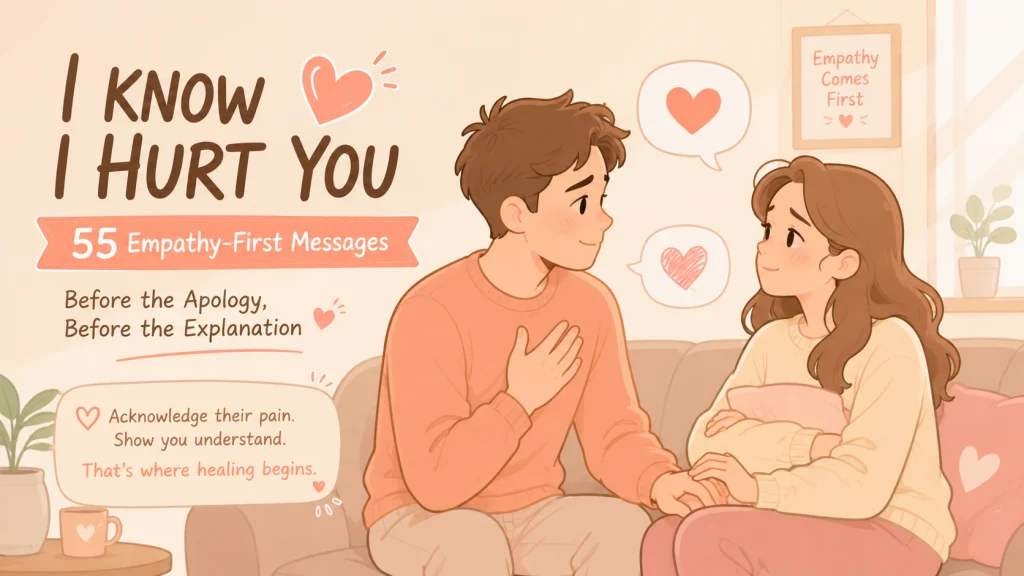
Before the Apology, Before the Explanation
I know I hurt you messages exist because sometimes the apology can wait. Not forever. But for a moment, the moment when the other person is still sitting with what happened, still feeling it, still wondering if you even understand what you did. That moment is not the one for explanations. It is not the one for context or backstory or reasons that made sense at the time. It is the one for acknowledgment.
There is a reason so many apologies land flat even when they are sincere. They start in the wrong place. They start with the person doing the apologizing, not the person who was hurt. “I’m sorry I said that.” “I didn’t mean for it to go that far.” “I was wrong and I feel terrible.” All of those things might be true. But they center the apologizer’s guilt, not the other person’s pain. And when someone is still hurting, what they need first is to feel seen, not to be told you feel bad about it.

Why Empathy Has to Come First
There is a pattern in how people apologize that I keep seeing, and it almost always goes the same way. The apology arrives first. “I’m sorry I said that.” “I’m sorry I let you down.” “I’m sorry it came out the way it did.” Sometimes the reasons follow. But the other person’s experience, what they actually felt and why it landed as hard as it did, tends to get left out entirely.
Empathy-first is different. It means that before you defend yourself or explain your intentions, you name what they went through. “I know I hurt you, and I can see how much.” “I know that what I said made you feel like you didn’t matter, and I understand why you’re angry.” It puts their experience at the center of the conversation before anything else gets placed there. That shift, small as it sounds, is often the thing that makes the difference between an empathy apology message that lands and one that does not.
I sent something like this once, after a disagreement that had gone quiet in a way that felt much worse than the argument itself. I did not explain what I had meant, and I did not apologize first. I wrote one sentence: “I know that what I said hurt you, and I’m not going to pretend it didn’t.” She wrote back within ten minutes. Sometimes the acknowledgment is the whole thing.
| Guilt-Led Opening | Empathy-Led Opening |
|---|---|
| “I’m so sorry for what I did.” | “I know I hurt you, and I’m not going to minimize that.” |
| “I didn’t mean for it to go this far.” | “I can see how much this affected you, and that matters to me.” |
| “I feel terrible about this.” | “Before I say anything else, I want you to know I see your pain.” |
| “I hope you can forgive me.” | “You don’t have to forgive me right now. I just need you to know I understand what I did.” |
| “It wasn’t my intention to hurt you.” | “My intentions don’t change what you felt, and I know that.” |
The left column is not wrong. Those are real apologies, and they matter. But when someone is still hurting, the right column is what they can actually hear. If you are ready to move toward a fuller conversation, the apology messages for relationships page covers every stage of that repair process. What follows here is specifically the first step.
Messages That Name Specifically How You Hurt Them
The most powerful thing you can do in an acknowledgment message is to name what happened in their experience, not yours. Not “I said something I shouldn’t have” but “I said something that made you feel like your feelings don’t matter.” The more specific you can be about what they felt, the more real the acknowledgment becomes. That specificity is what separates a message that lands from one that sounds like an apology but reads like a form letter.
These fifteen messages try to do exactly that. They are not apologies. They are acknowledgments, and there is a difference. An acknowledgment names the damage. An apology responds to it. Both matter, but this one comes first. If you are thinking about what to say as a follow-up, a sincere apology for a serious mistake covers the fuller conversation that tends to follow a moment like this one.
- I know I hurt you, and I know it wasn’t just the words. It was the fact that I said them at all.
- I can see that what I did made you feel like you weren’t worth being careful with. That is not something I take lightly.
- I know I hurt you when I walked away instead of staying. I understand now what that said to you.
- I hurt you by making you feel like your pain was something to get through, not something I was willing to sit with. I see that now.
- I know what I said made you feel invisible, and I am not going to tell you that wasn’t the effect it had. It was.
- I can see that my silence made you feel like you didn’t matter enough for me to say something. That was never true, but I understand why it felt that way.
- I hurt you by choosing something else over you when you needed me to choose you. I know exactly what that must have felt like.
- I know I hurt you when I dismissed what you were feeling instead of listening. You deserved someone who would stop and hear you out.
- I can see now that what I said made you question something you should never have had to question. I am sorry I put that doubt there.
- I hurt you by acting like the moment wasn’t a big deal when it was. I understand now how much my reaction cost you.
- I know I made you feel alone in something you should not have had to carry by yourself. That is on me, and I know it.
- I can see that I made you feel like you had to earn something you should have had without condition. That was wrong of me.
- I hurt you by saying what I said in the way I said it. The timing made it worse, and I should have known that.
- I know that what happened made you feel like your trust was something I treated carelessly. I understand why you feel the way you do.
- I can see that I hurt you in a way that made you question whether I actually see you. I do. I just showed it badly.

Messages That Hold Space for Their Anger
Anger is one of the hardest things to receive from someone you care about, especially when you know you are the reason for it. The instinct is to soften it, to reassure, to explain your way out of it. What tends to work better is letting it be there and saying so. These messages do that. They do not ask for calm. They do not suggest the person should feel differently. They simply make room for whatever the other person is carrying.
The test for whether one of these fits is simple: can you send it without needing anything back? If you can sit with not getting a response, or getting a hard one, then the acknowledgment is real. If you are writing to feel better yourself, it will read that way. The person on the other end can usually tell.
- I know you’re angry, and you have every right to be. I am not asking you to feel anything different right now.
- I know I hurt you, and if you need to be angry at me, I understand that. I am not going anywhere.
- You don’t have to forgive me yet. You don’t have to feel anything you’re not feeling. I just needed you to know that I see it.
- I know what I did made you angry, and I am not going to ask you to calm down or move past it before you’re ready.
- If you need space from me right now, I understand that too. I just wanted you to hear this first: I know I hurt you.
- I am not sending this to make you feel better. I am sending it because you deserve to know that I understand what I did.
- I know you might not be ready to talk, and that’s okay. But I needed you to know that your anger makes sense to me.
- I’m not going to tell you it wasn’t that bad, or that I didn’t mean it, or that it’ll be fine. I know I hurt you, and I’m sitting with that.
- Whatever you’re feeling right now, it’s yours to feel. I just wanted to say: I know I caused it, and I’m not pretending otherwise.
- I know I hurt you deeply. I am not here asking for forgiveness. I am here saying I see what I did, and I think your anger is fair.
- You have every reason to be where you are emotionally right now. I put you there, and I know that.
- I’m not going to ask you to make this easier for me. I hurt you, and you’re allowed to let that be hard for a while.
These are also the messages people tend to hesitate most before sending, because they offer no protection and ask for nothing in return. That is exactly why they tend to land differently than other things you might say.
When You Need to Say It Before You’ve Said Anything Else
Sometimes the hardest part of acknowledging you hurt someone is knowing how to open. Not the full message, just the first thing. These ten messages are built for that. They are not meant to carry the whole weight of what you need to say. They are meant to establish, in the first sentence or two, that you are starting from the right place: their experience, not your explanation.
Most people overthink the opening and underthink everything that follows. The work of acknowledging the pain I caused is harder than most people expect, not because the words are complicated, but because saying them clearly means not softening them with anything else. If you can get the first sentence right, the rest tends to find its shape more naturally.
- Before I say anything else, I want you to know that I know I hurt you. That’s the first thing.
- I’m not coming to you with reasons or explanations right now. I’m coming to say: I see what I did to you.
- I know I hurt you. I know it mattered. I’m not going to bury that under anything else.
- The first thing I want to say, before anything else, is that I understand the pain I caused. That’s where I want to start.
- I don’t want to get to the apology yet. I want you to know first that I see what you’re carrying because of me.
- I know you’re hurting, and I know it’s because of what I did. I needed to say that plainly before I said anything else.
- This isn’t the full conversation. This is just the part I needed to say first: I know I hurt you, and I’m not okay with having done that.
- I’ve been trying to figure out what to say, and I keep coming back to the same starting point. I know I hurt you. That’s the truth I need to lead with.
- Before I say another word, I want you to know that I understand the damage. I’m not going to gloss over it.
- I know I hurt you, and I know that saying so doesn’t fix it. But it is the only honest place I know how to start.
The connecting thread across all of these is the absence of self-protection. Each one opens with the other person’s experience and stays there long enough for them to feel it. That is what separates a genuine acknowledgment from a defensive one dressed in apologetic language.
Short Empathy-First Messages
Sometimes the shorter version is the more honest one. Not because brevity is always better, but because a long message, when someone is still hurting, can read like you are trying to fill the silence with words instead of sitting in it with them. A short i know i hurt you text does not need to do more than what it says. These are for the moments when a direct acknowledgment is exactly what the situation calls for.
The temptation with a short message is to feel like it is not enough, that the weight of what happened requires something longer. In my experience, the opposite is often true. A short, clean acknowledgment sent without qualifications or reasons can land harder than a paragraph that softens everything it says. The brevity itself signals something: that you are not trying to talk your way out of anything.
- I know I hurt you. I just needed you to know that I know.
- You’re hurting because of me. I’m not going to pretend otherwise.
- I know I caused this. I’m not going to dress it up.
- I hurt you. I see it, and I’m not okay with it.
- I know what I did, and I know what it cost you. I’m sorry I put you there.
- You didn’t deserve that. I know that now, and I should have known it then.
- I see your pain, and I know I’m the reason for it. That matters to me.
- I know I hurt you. No explanations. Just that.
- What I did hurt you, and I’m not going to try to explain it away.
- I know I hurt you more than you probably expected. I’m still sitting with that.

Messages for When They’ve Gone Quiet
Silence after a hurt is its own kind of communication. When someone stops responding, stops reaching out, goes to a place where they are no longer engaging with the damage, it usually means one of two things: they are protecting themselves, or they have given up waiting for you to see it. These eight messages are for that particular kind of quiet. They do not demand anything back. They do not require the other person to surface before they are ready.
They are also, in a way, the ones that require the most honesty from the person sending them, because they offer nothing in return. If the silence started with a specific conflict rather than a slow drift, messages after a fight speak to that particular weight and can help you find what to say once this first acknowledgment has landed.
- I know you’ve gone quiet, and I think I know why. I hurt you, and I’m not going to fill this silence with excuses.
- I know you might not answer this, and that’s okay. I just needed you to know that I know what I did.
- I’m not going to keep texting to fill the space. I just want you to know, whenever you read this: I see what I did, and I’m sorry I put you here.
- If you need me to be quiet for now, I understand that. But before I give you that, I need you to hear this: I know I hurt you.
- I don’t expect a response. I just couldn’t let the silence stay without saying this first: I know what I did, and I know it hurt.
- I know you’ve pulled back, and I understand it. I just needed to say this before I give you whatever space you need: I see the pain I caused.
- I’m not going to crowd you. But I couldn’t stay quiet and have you think I don’t understand what happened. I do.
- If the last thing I said before you went quiet was the wrong thing, I know that now. I see what I did, and I am not going to ask you to move past it before you’re ready.
When the relationship matters enough to reach across the silence, what you say first has to be worth the reach. If you are thinking about where the conversation needs to go after this moment, the broader world of love and relationship messages can help you find the words for what comes next.
Final Thoughts: The Part That Comes Before Everything Else
What I keep coming back to, after all of this, is how rarely people actually stop here. The empathy step gets treated as a preamble to the real thing, something to get through on the way to the apology. In practice, it often is the real thing. The moment when someone feels genuinely seen is frequently the moment the conversation can actually begin.
“I hurt you and I am sorry” are words that belong together eventually. But “I hurt you” is doing different work than “I am sorry,” and it matters which one arrives first. The apology asks for something, even if implicitly. The acknowledgment just stands there and tells the truth. That is what most people who are hurting need to feel before they can hear anything else you have to say.
These 55 messages are not scripts. They are starting places. You will need to shape them to fit the specific weight of what happened between you and the person you hurt. But the center of them does not change: see their pain before you say anything else. That is the whole thing.
FAQs
💬 What’s the difference between saying “I’m sorry” and “I know I hurt you”?
“I’m sorry” centers your guilt and asks, implicitly, for some kind of release. “I know I hurt you” centers the other person’s experience without asking for anything. Both matter, but when someone is still hurting, acknowledgment tends to land before an apology can. Starting with their pain, not your remorse, is the difference between being heard and being forgiven on your timeline.
😔 Should I explain myself at the same time, or keep them separate?
Keep them separate, at least at first. When an explanation arrives in the same message as the acknowledgment, it tends to dilute the acknowledgment. The person on the other end starts reading the reasons instead of feeling seen. Say “I know I hurt you” and let that be enough for now. The explanation has its own moment, and it will be better received once the other person knows you understand what they felt.
🤐 What if they don’t respond to my message?
Then you give them space. The acknowledgment was not sent to get a response. It was sent because they deserved to know you see what you did. No response is itself information, and it usually means they need more time. Sending a second message quickly to fill the silence almost always makes things worse. Send it, mean it, and wait.
❤️ Can these messages work for a friendship, not just a romantic relationship?
Yes. The emotional principle is the same regardless of the relationship type. Someone who is hurting because of something you did needs to feel seen before they can feel forgiven, whether that is a partner, a friend, or a family member. Most of these messages can be sent as written, or adjusted slightly to fit the specific relationship and what happened between you.
✍️ How do I make one of these messages more personal?
Name the specific thing. The more precisely you can describe what they felt, not just what you did, the more real it becomes. Instead of “I know I hurt you,” try something like “I know I hurt you when I said what I said in front of everyone, and I understand that it made you feel like I don’t respect you.” The specific detail is what makes an acknowledgment feel like it comes from someone who actually gets it.
⏳ Is there a wrong time to send one of these?
Yes. Right in the middle of an argument, when emotions are still running high, an empathy message can read as a de-escalation tactic rather than genuine acknowledgment. The best time is after things have settled enough that the other person can actually read what you are saying, but before so much time has passed that the silence itself has added to the hurt.