
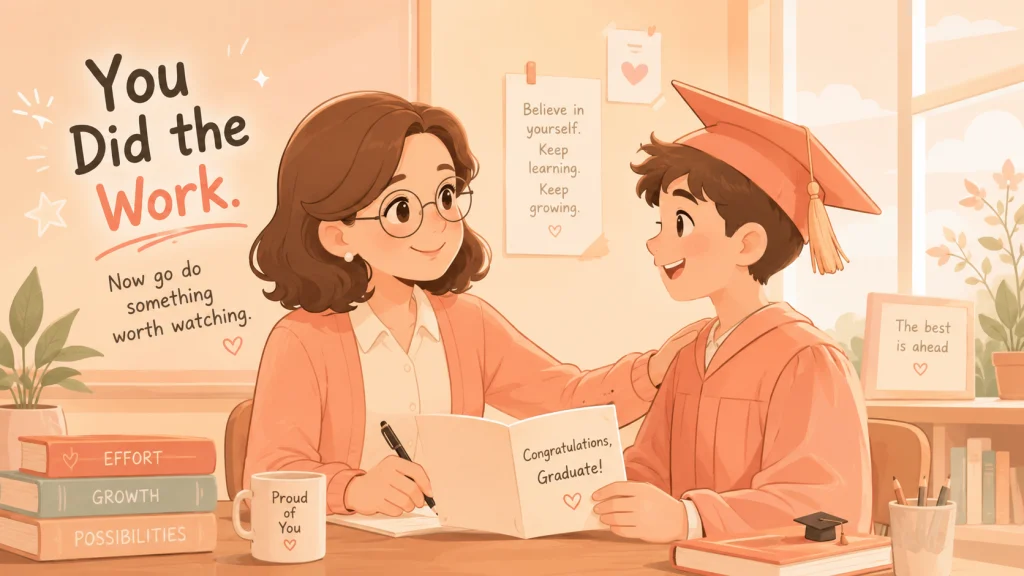
A graduation message from teacher to student holds something other messages cannot: the view of someone who watched a person grow intellectually, not just personally. You saw the moment a concept finally clicked. You noticed what they brought to a classroom that they may not have recognized in themselves. These 50 messages are organized by student type, so you can find the words that match what you actually witnessed, rather than reaching for something that could have come from anyone.
The View Only a Teacher Has
Writing a graduation message from teacher to student means starting from a place no one else can stand. You are not writing as someone who loves this person from birth, or who shares their history in a personal sense. You are writing as someone who watched them in conditions that required something real: effort, patience with confusion, the willingness to try again after getting something wrong. That is a narrower view than a parent’s, but in some ways it is a more honest one. For related message ideas, see teacher graduation message to student.
I think about this every time graduation arrives and I find myself staring at a card I am not sure how to fill. The impulse is to reach for something warm and general, something that sounds like it belongs on a printed card. But the thing that makes a teacher’s message worth reading is not warmth. It is specificity. You saw this person when they were confused, when they pushed through something hard, when they surprised you. That is the thing worth naming.
The sections below are organized around different student situations: short messages, messages for students who worked hard, messages for the whole class, and more specific ones for students who struggled or exceeded every expectation. If you are writing for a student you knew well, start with the section that fits them. If you are writing for a student you mostly observed from a distance, the shorter sections will serve you better. Either way, the goal is the same: say something true about what you actually witnessed.
Short Graduation Messages From Teacher to Student
Sometimes the most honest thing is also the most concise. These eight messages work for any student in your class, whether you knew them well or mostly watched them from the front of the room. They are not generic, but they are brief enough to work when you are writing to many students at once, or when you simply do not have much to add beyond what the moment itself already says.
Watching you get here was a privilege I did not take lightly. I hope you find work that asks something real of you.
You came in not knowing what you were capable of. You are leaving with proof. That is exactly what this was supposed to do.
I saw you do the work. That is the part that gets you everywhere from here.
Not everyone arrives ready. The ones who show up anyway are the ones worth remembering. You showed up.
Congratulations. What you built here was real, and it goes with you.
You sat in this room and did the work even when it was not interesting. That is rarer than people realize.
I hope what you carry out of here is not the grades, but the moment something suddenly made sense. That is the part that lasts.
Wherever you go next, you already know how to figure things out. That is no small thing.
Any of these can be made more personal with a single added sentence. If you remember a specific moment with this student, one sentence describing it will do more work than three additional paragraphs of general encouragement.
For the Student Who Worked Especially Hard
Some students make it look easy. Others earn it in a way that is visible to anyone paying attention. When you write to a student who genuinely labored over this, who came back after failing, who rewrote things and asked questions and stayed after class, the message has a different job. It is not just congratulation. It is acknowledgment of something specific that they may have been afraid no one noticed.
I have had students who carried so much weight while they were in school, and who never once asked for credit for it. A few lines naming what I actually saw from the front of the room meant more to them than the grade ever did. That was the thing they needed to hear: that the effort was visible, even when they thought it was not.
I watched you put in work that most people would have walked away from. What you built here was not handed to you. You earned it from the ground up, and that changes what it means.
There were moments this year when I was not sure you would make it through, and you knew it too. You made it through anyway. That is the part I want you to remember, not the result, but how you got there.
You asked better questions as the year went on. You stopped accepting the first answer that came to you and started looking for the one that was actually true. That is harder than most people realize, and you did it.
Congratulations. I saw the version of this that cost you something. That version is worth celebrating.
You did not give up when the material got hard, and it got hard. I noticed. The next place you go will notice too, eventually. But you already know how to wait for that.
The students who work this hard are not always the ones who look the most confident. You were proof of that. Keep going at exactly this pace.
I want you to know that I saw the long version of what brought you to this day. Not just the final result, but the drafts, the questions, the starts and restarts. Congratulations on all of it, including the parts no one else saw.
You reminded me why this work matters. Thank you for that, and congratulations.
Getting here required something from you that was not required from everyone. You gave it anyway. That is the quality that will carry you further than any grade or title ever will.
Not every student who earns something believes they deserve it. I hope you do. You put in the work. This is yours.
When writing to a student like this, specificity is everything. The moment you name something they actually did, or a specific struggle you watched them work through, the message stops being a formality and becomes something they will keep.
For the Whole Class
Not every graduation message is one-on-one. If you are writing something to be read aloud, displayed, or shared across a group, the challenge is different: you need something that lands personally without relying on individual detail. The messages below scale without feeling impersonal, because they speak to the shared experience of the room rather than to any one student’s specific story.
This class surprised me in the ways that actually matter. You pushed back when something did not make sense. You asked the questions that changed the direction of the room. Thank you for that, and congratulations.
I have watched a lot of students sit in these seats. What you did with the time was yours alone. Take it with you.
You came into this room with questions and you leave with better ones. That is not a small thing. Congratulations.
Whatever happens next, you have already proven that you can figure something out when you do not know how. Do that again and again. That is the skill that gets you through.
It was a privilege to be in the room when things clicked for you. I hope you remember what that felt like, because you will need to find it again in different rooms for the rest of your life.
Congratulations to all of you. You made something real here. The fact that it is over does not change that.
If you have a moment, adding one specific thing you remember about this class as a group will lift these off the page considerably. A detail that is true of them collectively, and only them, is worth more than the warmest general wish you could write.
For the Student Who Struggled to Find Their Footing
Some students spend most of the year uncertain of themselves. They are not disengaged, not difficult. They are just not sure where they fit, what they are actually good at, or whether this is the right path. Writing to a student like this at graduation is one of the more meaningful things a teacher can do, and one of the most underused. Because you are the person who watched them try, and you are the person who can name what you saw even when they could not.
A message to a struggling student is not the place for reassurance that everything will be fine. That is not what they need, and honestly, it is not yours to promise. What is yours to offer is the specific, honest thing you noticed: the effort they put in, the moment something changed, the quality in them that was always there even when they could not see it.
You spent a lot of this year looking for your place in the room. I want you to know: you had one. You may not have felt it, but from where I sat, it was clear.
Not knowing where you are headed is not the same as being lost. I hope you remember that when things feel uncertain. You are not lost. You are still finding it.
Watching you stay with something hard when you had every reason to stop was one of the more honest things I saw this year. Congratulations. That quality will get you further than any clear plan would have.
I hope wherever you go next, someone notices what I noticed: that you keep going. That you ask questions even when you are not sure of the answer. That you are more capable than you have given yourself credit for.
You made it to this day with more than you think. I mean that sincerely, and I do not say that to everyone.
These messages work best when they are paired with at least one specific observation. Even something as small as “You asked the question the rest of the class was afraid to ask” or “You rewrote that paper three times and it showed” takes a message like this from encouragement to testimony.
For the Student You Could Not Forget
Some students stay with you after the year ends. Not because of their grades or their behavior, but because of something harder to name: a way of thinking, a persistence, a question they asked in October that you are still turning over months later. If you are writing to one of those students, the message can afford to be a little more honest, a little more personal. They have already earned it.
I am careful about how I phrase this kind of message, because it can tip into something that sounds more like a burden than a compliment. The goal is not to tell a student that you expect great things from them in a way that piles on more weight. It is to name, as plainly as possible, what made them different, without making that difference into a demand.
You asked a question in class once that I wrote down after you left. I still have it. I hope you keep asking questions that people need time to catch up to.
There are students who remind you why this work matters, and then there are students who change the way you teach. You were the second kind. Thank you for that.
I will remember this class for a long time, mostly because of you. Not in a way that puts anything on you, just in the way that some people leave a room a little different than they found it. You did that.
I hope you know how rare what you brought to this room was. And I hope you keep bringing it, even when the next room does not immediately recognize it.
Congratulations. I have been watching you figure out how to use what you have, and it has been one of the more interesting things about this year.
You made me reconsider something I thought I understood. That does not happen often. I am grateful for it, and I hope you find people in your next chapter who challenge you back.
Whatever you end up doing, it will be shaped by the way you think, and the way you think is something I recognized in the first few weeks. Go do the thing that lets you use it fully.
If there is a specific moment, a specific thing they said or wrote, that stayed with you, name it. You do not need to frame it as praise. Just say what it was and what it did. That is enough.
For the Student Heading Somewhere Uncertain
Not every graduating student has a clear plan. Some of them are finishing school without the next step figured out, and a message that assumes otherwise can land wrong. If you know a student is heading into uncertainty, the message you write has a specific job: not to reassure them that it will work out, but to remind them of what they already have.
The version of this message that goes wrong is the optimistic one, the one that says something will come together without naming what makes you think so. What lands better is the honest thing: you watched this person handle confusion with something close to grace, and that quality does not disappear when the classroom does.
Not knowing what comes next is not the same as being unprepared. You have been building the skills for this kind of uncertainty all year. Trust that.
I hope you give yourself time to find the thing that fits you, because you have what it takes to do something specific and good. Do not settle for the first thing just because it is available.
Some of the best paths do not announce themselves at graduation. I think yours is one of them. Congratulations, and I mean it without condition.
You do not need a five-year plan. You need to keep doing what you did in this room: stay curious, stay honest about what you do not know, and do not stop until something makes sense. You will find it.
The question of what comes next is real, and I am not going to pretend it is easy. What I can tell you is what I watched you do this year, and what I watched you do was enough. You are ready, even if it does not feel that way.
Pay attention to what you keep coming back to, even when it does not seem practical yet. That pull is worth following. Congratulations on getting here.
I have watched you handle confusion with more grace than you probably realize. Whatever comes next, you already know how to sit with not knowing. That is more valuable than a clear plan.
For the Student Who Exceeded Every Expectation
This is a specific category, and I mean it literally: the student who started somewhere and arrived somewhere so far beyond it that the distance became its own kind of statement. Not the student who was always destined to do well. The student who changed the trajectory mid-path, who gave you something to point to when someone asks what the work is actually for.
Writing to a student like this carries its own risk. You want to honor what they did without piling on the kind of expectation that turns a compliment into pressure. The goal is to name the growth, honestly, without making the next chapter feel like it has to measure up to this one.
I want to tell you something I do not say often: I did not see this coming in exactly the way it arrived. You exceeded what I thought was the ceiling, and then you kept going. Congratulations.
I have seen what happens when someone turns in the draft and stops. You did not stop. You came back to it, reworked it, and handed in something that surprised me. That is the habit that will carry you further than any credential ever will.
You grew in ways that were visible from the front of the room. Not just in what you produced, but in how you thought. That kind of growth is not automatic. You chose it.
What you built this year is not just an achievement. It is proof of something about who you are. Carry that knowledge forward. It will matter more than the credential does.
Watching you go from where you started to where you are now has been one of the genuinely memorable things about this work. Thank you for giving me something like that to witness.
You set a standard for yourself that had nothing to do with what was required. I noticed. I hope you take that quality with you into every room you enter next.
Congratulations. You did something here that I will probably think about the next time I have a student who needs to believe it is possible. You made it easier for me to tell them yes.
How to Make a Teacher’s Graduation Message Feel Specific
The most common mistake I see in teacher graduation messages is using language that could have come from anyone. “Wishing you all the best in your future endeavors” belongs on a form, not a card. What makes a teacher’s message worth reading is the thing only a teacher could say: something about how this particular person worked, what they brought to the room, what shift you noticed that no one else was positioned to observe.
There is usually something, even for students you did not know well. A question they asked that stayed with you. The way they handled something hard. The paper they submitted late that was better than anything you expected. Those details, stated plainly, will always outperform a beautifully crafted sentence about potential.
| Student type | What to name | What to avoid |
|---|---|---|
| The high achiever | The quality of their thinking, not just the results | Expectations about their future that add pressure |
| The one who struggled | A specific moment they pushed through | Reassurances that everything will work out |
| The quiet one | What you noticed even when they were not performing | Phrases that sound like they only apply to loud students |
| The whole class | Something only this specific group did or said | Anything that could go to any class, any year |
| The uncertain one | What they demonstrated, not where they are headed | Optimism about a future they have not chosen yet |
The other thing worth knowing is length. A short, specific message will almost always outperform a long, general one. If you can say it in three sentences and mean every word, three sentences is the right length. None of the messages above earn their word count by saying the same thing twice, and yours should not either.
- Start with the specific before the general. Name what you actually saw, then move to the broader sentiment if it belongs there at all.
- Avoid “I know you will go on to do great things.” It is not yours to promise, and it often lands as pressure rather than encouragement.
- If you cannot remember anything specific about this student, say something true about the class as a whole rather than inventing a personal detail you do not actually have.
- Read the message out loud before you write it in the card. If it sounds like it belongs on a printed insert, you can do better.
- For teachers writing to many students at once, a single handwritten sentence added to the bottom of a shared message matters more than most people realize. It does not need to be long. One true observation is enough to transform a general message into something personal.
The instinct to go long usually comes from discomfort, from the feeling that a short message signals low effort. It does not. A message that is three sentences and specific is harder to write than a paragraph of general warmth, and the student can feel the difference.
Final Thoughts: What the View From the Front of the Room Is Worth
A teacher’s perspective on a student is different from a parent’s, different from a friend’s, and different from the story a student tells about themselves. You had a particular vantage point, and what you saw from it was real, even when it was ordinary. Especially when it was ordinary. The student who showed up quietly and did the work, the student who failed and came back, the student who asked the question that changed the direction of a class: those are the moments worth naming, because they are the moments no one else was in a position to see.
If these messages have been useful, they are part of a wider collection of graduation messages organized by relationship and occasion, for anyone trying to find the right words at this particular moment. And if you are thinking about messages for other moments worth marking, the celebration messages section covers the full range of occasions where words are asked to do the work of honoring something real.
Write the honest thing. Name what you actually saw. The student will know whether you meant it, and the ones who mattered will keep what you wrote long after the ceremony is over.
FAQs
🎓 What should a teacher write in a graduation card for a student?
Write something only a teacher could say. Name a specific moment you witnessed, a quality you noticed, or a shift in how they worked over the year. Avoid phrases about future success that could go on any card. The more specific and honest, the more it will mean.
✏️ How do I write a graduation message that does not sound generic?
Start with something you actually observed about this student, not something you would say to anyone. One specific detail does more work than three warm sentences that could appear on any printed insert.
💬 What can a teacher say at graduation that a parent cannot?
A teacher can speak to what a student was like when they were required to perform, to think, to push through something hard. Parents see the personal journey. Teachers see the intellectual one. Name what you saw from that specific vantage point.
📝 How long should a teacher’s graduation message be?
Short and specific almost always works better than long and general. Three to five sentences with one real detail will land harder than a full paragraph of encouragement that could apply to anyone. If it fits on three lines and you mean every word, that is the right length.
🤔 What if I did not know the student very well?
Say something true about the class as a group, or name something small you genuinely observed, even once. “You asked a question I still think about” is more meaningful than invented personal warmth.
🌱 How do I write to a student who struggled during the year?
Avoid promises about the future and focus on what you actually watched them do. Naming the specific effort or the moment they pushed through something hard is more powerful than reassurance that everything will be okay.