An apology love letter is not a longer text. It’s a different form, and the difference carries meaning before you’ve written a single word. What earns a letter over a text, how to structure one so it actually lands, and fifty templates across five complete letters, fifteen shorter situation-specific versions, card messages, and ready-to-use opening and closing lines: all of that is here.
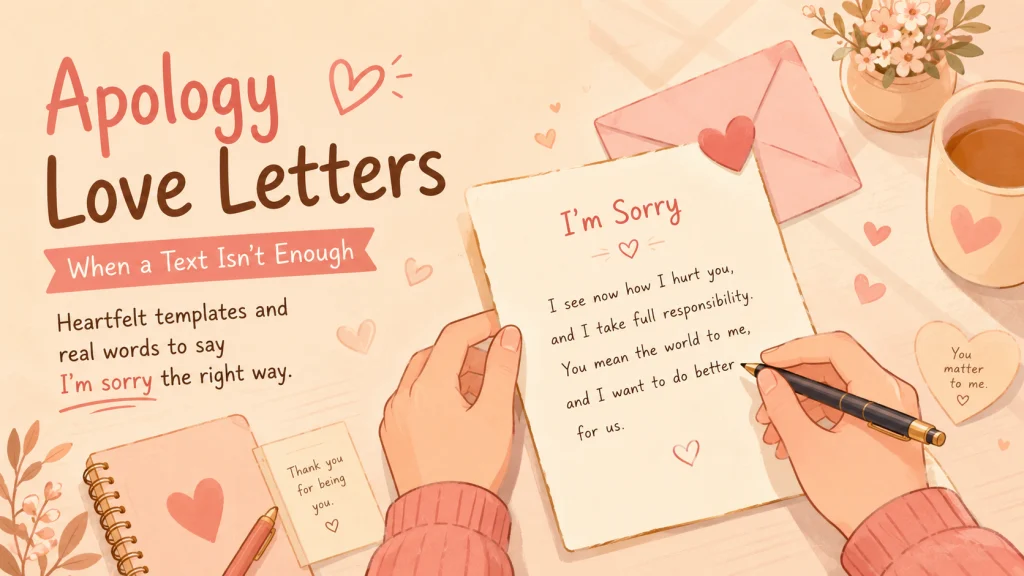
When a Text Isn’t Enough
An apology love letter to a partner is for the kind of moment that doesn’t fit in a message bubble. The kind that needs space to breathe, room to go somewhere honest, and the weight that only comes from something you actually had to sit down and write. Apology love letters exist for that second kind of sorry, not because longer always means more sincere, but because some situations have earned the longer form.
The distinction matters in practice. A text says: I’m sorry, I thought of you, here it is. A letter says: I sat with this. I came back to it. I rewrote it. The format itself is part of the message, and the person on the other end will feel the difference before they read a single word.
What Earns a Letter
Not every apology needs this format, and it’s worth being honest about that. A letter for something small can read as disproportionate, even a little manipulative, as if you’re using volume to compensate for something you haven’t actually worked through. The situations that earn a letter tend to be specific ones.
| A letter earns its length when… | A text is probably the right call when… |
|---|---|
| The situation has context that takes more than two sentences to explain honestly | The apology is for something small and recent |
| You said something that can’t be unsaid and you need to account for it fully | You’ve already talked it through and this is a follow-up |
| Significant time or silence has built up between you | The person has asked for space and a letter would feel like pressure |
| Your partner needs to see that you’ve actually thought about it | The relationship is early and a long letter might feel heavy |
| The moment calls for something they can read more than once | What you need to say can be said in three honest sentences |
I’ve sent both kinds, and the times I’ve gotten it wrong almost always went in one direction: reaching for a text when the situation was asking for more. Not because longer means better. Because some apologies need the room that only a letter gives them. If you’re unsure which one fits the moment you’re in, it helps to think about where this sits in the broader landscape of love and relationship messages. A letter is one specific tool for a specific kind of moment.
Five Complete Apology Love Letters
These are full templates, not outlines. Each one is organized around a specific situation, and each one can be used as written or adjusted to fit what actually happened between you. What they share is structure: they name what occurred without over-explaining, they stay on the other person’s side of the event, and they don’t end with a demand for anything back.
If what you’re looking for is a complete romantic apology letter for a serious situation, start here. The shorter options come later, and they have their place. But for the moments that have earned the full form, these are what that looks like.
1. After you said something you can’t take back
I’ve been trying to figure out what to say since the moment the words left me, and the honest answer is that nothing I write will undo them. I know that. I’m not writing this to undo them. I’m writing it because you deserve to hear more than a rushed sorry that doesn’t name what actually happened.
What I said was wrong. Not heated-moment wrong. Wrong in a way I should have caught before it came out, and I didn’t. I was angry and I reached for the thing I knew would land hardest, and I am ashamed of that, not because of what it cost us, but because of what it cost you.
You didn’t deserve that. I know the difference between saying something in the middle of a fight and meaning it, and I want you to know that I’ve spent every hour since wishing I could take those words back. I can’t. What I can give you is this: I understand what I did. I’m not going to pretend it didn’t happen or ask you to let it go before you’re ready to. I’m asking you to believe that it wasn’t who I want to be with you.
Whenever you’re ready to talk, I’ll be here. Not to relitigate it. Just to listen, and to do better.
2. After a silence you let go on too long
I know I’ve been quiet. Not the kind of quiet that means I’ve been processing, but the kind that means I was avoiding something I should have faced weeks ago. I let it go on longer than it should have, and by the time I knew I needed to say something, I didn’t know how to start. So I’m starting here.
The silence wasn’t about you. I want you to know that clearly, because in the absence of explanation you probably filled in your own, and I don’t want you carrying something that was never yours to carry. What was mine to carry, I didn’t carry well. I went inward when I should have stayed present.
I’m sorry for the distance. I’m sorry for letting it harden into something that felt harder to cross the longer it went on. I’m sorry for every time you reached toward me and I made it harder than it needed to be.
I love you. Not as a reason for any of this, but as the reason I’m writing it down. You’ve been patient with me in ways I haven’t earned. I’d like the chance to do better, if you’ll let me.
3. After you weren’t there when they needed you most
There was a moment, and you needed me to show up for it, and I didn’t. Not because I didn’t know, but because I made a choice I can’t defend. I’ve tried to find a way to explain it that would make it make sense, and I can’t. What I can do is tell you that I understand what my absence meant to you.
Missing that moment isn’t something I can undo. What I can tell you is what it’s cost me to sit with it. Not as a way of making this about me, but because I want you to know that I felt it too, and that feeling it has changed something in how I understand what you needed.
You deserved someone who showed up. I want to be that person for you. I’m not asking you to forget that I wasn’t, because I’m not going to forget it either. I’m asking for the chance to prove that what happened doesn’t have to be the whole story.
You’ve given me so much. I owe you more than I gave in that moment, and I’m sorry, in the full weight of the word, that I didn’t give it.
4. After you broke their trust in a significant way
I know what I did. I’m not going to open this by softening it or finding a frame that makes it feel smaller than it is. What I did was a breach of trust, and you had every reason to give me that trust, and I didn’t honor it. That’s the truth, and I’m starting here.
I’ve thought about what I’d want you to know if you never wanted to speak to me again, because I don’t take it for granted that you will. What I’d want you to know is that the failure was mine entirely. It wasn’t circumstance, and it wasn’t anything you did. I made a choice and it was the wrong one.
Trust takes longer to rebuild than it takes to break. I know that. I’m not asking you to decide anything today, or to extend anything you’re not ready to extend. I’m asking you to let this letter be what I couldn’t say well enough out loud: that I know what I did, I know what it cost you, and I’m not at peace with it.
If the day comes when you want to talk, I’ll be there. And if it doesn’t, I hope you find something that helps you heal the part of this that belongs to you. You deserve that, with or without me in it.
5. After emotional distance and unavailability
We’ve been in the same room for a long time now and I haven’t been fully present in it. I think part of me knew that and looked away, because seeing it clearly meant having to do something about it. This letter is me doing something about it.
I got lost somewhere inside myself, and instead of telling you that, I let you feel the distance without explanation. You probably tried to reach me in ways I didn’t fully receive. That’s not a small thing to have done to someone who loves you, and I want you to know I understand that now in a way I didn’t let myself understand before.
I love you more than I’ve shown lately. That’s not an excuse, it’s just a fact I let myself forget to demonstrate. You deserved consistency. You deserved the version of me that shows up, asks how you are and actually waits for the answer, and makes you feel chosen every day, not just occasionally.
I’m writing this because I want to change, and I wanted you to know before I tried, not after. I wanted you to see that I see it. That’s where this has to start.
What Makes an Apology Letter Work
The most common mistake in a long apology message for a partner isn’t the wrong word. It’s the wrong structure, usually in one of two forms: too much explanation that reads like justification, or too much feeling that circles around without ever landing on what you actually did. Both lose the person reading, and they’ll feel the moment it happens.
What tends to work is simpler than people expect. A letter that lands usually moves through four things, not necessarily labeled, just present in that order:
- Name what happened. Not softened, not framed. Say what you did in plain language. The more specifically you name it, the more the other person feels that you actually understand what they’ve been carrying.
- Account for impact, not intent. What you meant to do is less important here than what they experienced. Stay on their side of the event, not yours.
- Say what you understand now that you didn’t before. This is what separates a real apology from a repeat performance. Something has shifted in you. Name it.
- Give them room. Don’t end with a request for forgiveness. End with something that doesn’t require them to give you anything back right now. That’s the difference between an apology and a negotiation.
The places people go wrong: over-explaining why the situation happened (which reads as excuse-making even when it isn’t meant to), closing with a question that puts pressure on the other person to respond, and packing in so much emotional language that the actual content gets buried. If you’re writing more than three paragraphs, read it back and ask whether every paragraph does something the others don’t. If not, cut it.
15 Shorter Apology Letter Templates
These are for moments that are real and need a letter format, but aren’t at the level of a full-page response. One page or less: enough room to be honest, not so much that it becomes overwhelming. Each one is written for a specific situation and can be adjusted by changing the detail that makes it yours.
If you’re working through a pattern rather than a single moment, the apology messages for relationships section covers more of that territory and is worth reading alongside these.
After jealousy caused a fight
What I was feeling that day was fear, not anger, but fear came out looking like anger and it landed on you in a way that wasn’t fair. I know what I said. The jealousy was mine to manage and I didn’t, and you ended up carrying the weight of that. I’m sorry for what I said and for what it probably made you feel about yourself in that moment. That wasn’t right, and you didn’t deserve it.
After missing something important to them
I missed something that mattered to you, and I don’t want to minimize that with a quick sorry. That moment existed once and I wasn’t there for it. What I want you to know is that I understand it mattered, and that my absence wasn’t a reflection of how much you matter to me. Those two things being true at the same time is something I have to live with. I’m sorry I put you in a position where you had to feel one without the other.
After choosing work over them, more than once
I’ve let my work take up space that belongs to you, more than once and more than I can defend. I told myself it was temporary every time, and every time it wasn’t. You kept showing up for me while I was distracted, and that’s not a small thing to have done. I’m sorry for making you feel like second priority in a relationship where you should feel like the first thing I think about.
After walking out in the middle of a fight
Leaving the way I did wasn’t something I should have done. Walking away didn’t end the conversation for you, it just made you finish it alone. I wasn’t ready to hear what was true, and that’s a me problem, not a reason to leave. I’m sorry for the silence that followed and for making you wonder. I’m here now, and I’m listening.
After saying something hurtful in front of others
What I said in front of people wasn’t just hurtful, it was humiliating, and I know it. You shouldn’t have had to hold your reaction in that room. I handled something private in public and I have no good reason for it. I’m sorry. That version of me was thoughtless in a way you didn’t deserve, and I’ve thought about it every day since.
After breaking a specific promise
I made you a promise and I didn’t keep it. I could give you context, but I think what you need more than context right now is for me to say, plainly, that I let you down. I know what that promise meant to you. That’s part of what makes this hard to write. You trusted me with something specific and I didn’t honor it. I understand if it takes time before my word means what it used to.
After making a big decision without them
I made a decision that affected both of us without asking you first, and I realize now how that must have felt. Like I didn’t see this as something we’re doing together. I do. I just got inside my own head and made a move before I thought it through the way I should have. I’m sorry for not including you. That wasn’t a small thing, and I won’t treat it like one.
After minimizing what they were feeling
I dismissed what you were feeling, and I did it quickly enough that you probably felt like you weren’t worth a real response. That wasn’t fair. You came to me with something real and I made it smaller than it was, either because I didn’t want to sit in it or because I didn’t know how. Neither reason makes it okay. What you felt was real. I should have started there.
After a celebration you ruined
That was supposed to be a good day for you. I turned it into something else, and I know I can’t give you that day back. What I can give you is this: I know what I took away from that moment, and I’m sorry for it. You deserved better on a day that was supposed to be yours. It wasn’t a reflection of how I feel about you. It was me getting in the way of something good, and I hate that I did that.
After months of not being present
I haven’t been fully here, and I think we’ve both known that for longer than either of us wanted to say out loud. I’ve been in my own world and you’ve been patient about it in a way I haven’t earned. I want you to know that I see it, and that I don’t take what you’ve given me during that time for granted. I’m sorry it took this long for me to write it down.
After coming back when you had left
I left, and I know what that did. I’m not going to pretend the time away didn’t cost you something, or that coming back erases it. What I want you to know is that I’m here now because I chose it, not because I had nowhere else to go. That doesn’t mean you owe me anything. I just needed you to know the difference.
After an old wound that reopened
I know we said we were past it. Maybe we were, or maybe I let myself believe we were because it was easier. Either way, you shouldn’t have had to feel that twice, and the fact that it came back is on me for not doing enough with it the first time. I’m sorry it came back. I’m sorry it came back harder. And I’m sorry I didn’t see it coming when I should have.
After you didn’t hold them when they cried
You were hurting and I froze, and I’ve thought about that moment more than you probably know. I could feel the gap between us grow wider in real time and I still didn’t move. I don’t fully understand why, but I know it hurt you, and I know “I didn’t know what to do” isn’t good enough. You needed me to figure it out. I’m sorry I didn’t.
After being defensive every single time
I’ve noticed a pattern in us, and it has my name on it. Every time things get hard, I get defensive before you’ve even finished your sentence. You’ve been trying to talk to me and I’ve been shutting the door before you get through it. That’s not fair in a relationship that’s supposed to feel safe for both of us. I’m sorry for making you manage my reaction before you can even say what’s true.
After not saying “I love you” back when they needed to hear it
There was a moment and you said it, and I said nothing, and I know that landed somewhere. I wasn’t able to explain it then and I can’t fully explain it now. But I want you to know that what I feel for you hasn’t changed. I was somewhere inside myself I couldn’t get out of fast enough, and you paid for that. I love you. I needed to say it clearly, without any hesitation this time.
10 Apology Messages for Cards
These are shorter, meant to fit in a card or on a single piece of paper alongside something tangible. A card message isn’t a lesser apology. It’s a different delivery, and the constraint can work in your favor: there’s no room to over-explain, which means every word has to carry weight.
Among all the forms of apology letter writing for a girlfriend or boyfriend, a handwritten card is often the one people keep. Not because it said the most, but because the act of handwriting it said something the words alone couldn’t.
I didn’t say this well when I had the chance. I’m saying it now: I’m sorry, I know what I did, and you deserved better from me than what I gave you.
This isn’t everything I want to say, but it’s a start. I was wrong. Not circumstance-wrong. Just wrong. And I’m sorry.
You’ve been patient with me in ways I haven’t earned lately. I know that. This is me saying I see it, and I’m going to do better. I love you.
What I said was not okay. It wasn’t heated honesty, it was just unkind, and you didn’t deserve it. I’m sorry, and I mean that completely.
I’ve been carrying this for too long without saying it. I owe you an apology and I owe you better than what I gave you. You’ll have both.
I know I hurt you. I’m not going to dress it up. I’m going to say it clearly: I’m sorry, and I love you, and I want to do this differently.
The silence between us has been mine to break and I’ve been slow about it. Here’s the break: I was wrong. I miss you. I’m sorry.
I keep starting this and stopping it, so I’m just going to write what’s true. I let you down. That’s not who I want to be for you, and I’m working on it.
There isn’t a version of this that makes what happened okay. I just want you to know I understand that, and I’m not asking you to pretend otherwise. I’m sorry.
You gave me more grace than I gave you. I’m aware of that, grateful for it, and sorry it was necessary. You deserved better, and you’ll get it.
10 Opening Lines for When You Don’t Know How to Start
The beginning of an apology letter is where most people stall. They write “I’m sorry” and then delete it. They try to explain the situation and end up summarizing a fight they’re still too close to. What tends to work better is an opening that doesn’t pretend to have everything figured out. Start where you actually are.
- “I’ve been sitting with this for a while, trying to figure out what I actually owe you. What I owe you is this.”
- “I don’t want to start with ‘I’m sorry’ because I’ve said that before and you deserved more than those two words. So I’m starting here instead.”
- “There’s a version of this letter I’ve already written in my head a hundred times. This one is the honest version.”
- “If you’ve opened this, thank you. I know I don’t have the right to ask for your attention right now, and I know this isn’t a quick read.”
- “I need you to know something before you read any further: I’m not writing this to fix anything. I’m writing it because you deserve to hear it.”
- “I keep starting sentences and not finishing them because none of them feel true enough. So I’m going to try to write the true one.”
- “You asked me once why I find it easier to go quiet than to talk. I didn’t have an answer then. I think I do now.”
- “I’ve spent days thinking about what I’d say if I had the chance. This is it, and I’m not going to waste it.”
- “I know an apology isn’t the same as undoing what happened. I’m not writing this to undo it. I’m writing it so you know I understand what I did.”
- “There are things I should have said to your face. I’m saying them here because I couldn’t trust myself to say them without losing the thread.”
What all of these have in common: they don’t open with a defense, and they don’t open with a promise. They open with honesty about where the writer actually is. That’s enough to earn the next line.
10 Closing Lines That Don’t Ask for Anything Back
The end of an apology letter is where pressure tends to appear, usually in the form of a question: “Can you forgive me?” “Will you call me?” “Let me know what you’re thinking.” The problem is that those endings shift the weight onto the person who’s already been hurt. A good closing gives them room to feel what they feel without having to produce a response on your timeline.
- “I’m not asking you to respond right now. I just needed you to have this.”
- “You don’t owe me anything after reading this. I owe you the truth, and now you have it.”
- “Whatever you decide, I want you to know that writing this wasn’t about getting something back. It was about giving you what I should have given you before.”
- “I’ll be here when you’re ready. And if you’re not ready, I’ll understand that too.”
- “This isn’t everything, but it’s honest. And honest is where I should have started a long time ago.”
- “I love you. Not as a reason, not as an excuse. Just as a fact that doesn’t change.”
- “You deserve better than what I gave you. I’m still learning how to be better, but I wanted you to know I’m trying.”
- “There’s nothing else I can do with this except send it. So I’m sending it.”
- “I miss you. Not the comfortable version of you I’d gotten lazy with. The real you, who deserved more attention than I was giving.”
- “You gave me a lot. What I’m giving back is the truth, finally, even if it’s late.”
One small note on format: if you’re writing by hand, these endings often feel different on paper than they do on a screen. Something about ink slowing at the end of a page does some of the emotional work for you. That’s another reason a written letter is different from a very long text.
Final Thoughts: The One Thing a Letter Can Do That a Text Can’t
A text disappears into a thread. It sits between other messages, read in motion, easily scrolled past. A letter is its own thing. The person receives it the way you sent it, reads it in its own time, and can return to it. That permanence is worth something, sometimes more than you’d expect.
A heartfelt apology letter carries visible effort in a way that a text, however sincere, usually doesn’t. Not because of length, but because someone sat down and made something and then chose to give it away. That act matters, sometimes as much as the words themselves.
If you’re on the other side of something serious, or something quieter that’s been sitting unsaid for a long time, a letter is worth considering. From sincere apologies for serious mistakes to the everyday kind of failing that doesn’t have a clean name, all of it benefits from the format. Not because a letter fixes things, but because it shows someone the full shape of what you’re carrying. And that, sometimes, is the first real step.
FAQs
💬 What is the difference between an apology text and an apology love letter?
A text lives in a thread among other messages. A letter is its own thing, read in its own time, and can be returned to. The difference isn’t just length. It’s permanence, effort, and the signal that the situation earned more than a quick message. For anything significant, a letter usually carries more weight.
📝 How long should an apology love letter be?
Long enough to name what happened, account for the impact, and give the other person room. Most situations don’t need more than three or four paragraphs. If you’re writing more than that, check whether every paragraph does something the others don’t. Length isn’t the point. Honesty is.
✍️ How do you start an apology love letter?
Don’t open with “I’m sorry” as your first two words, and don’t open with an explanation of why things happened. Start with where you are: “I’ve been sitting with this for a while” or “I didn’t know how to start this, so I’m just writing what’s true.” Give them something real in the first sentence and they’ll keep reading.
🖊️ Should an apology letter be handwritten or typed?
Handwritten if you can. The act of writing by hand is visible effort, and that matters. But a typed letter delivered intentionally, printed and left somewhere, or sent as a standalone email, still carries more weight than a text. Format matters less than sincerity and intention.
⚠️ What should you not say in an apology letter?
Don’t use “but” in a way that cancels what came before it. Don’t explain circumstances so much that it sounds like excuses. Don’t end with a question that requires the other person to produce something for you right now. And don’t promise things you can’t control. Say what you know, name what you did, and leave them room.
💌 Can an apology love letter save a relationship?
A letter can’t save a relationship on its own. What it can do is give someone the full picture of where you are, which is more than most people manage to say in person. Whether that’s enough depends on the relationship, the situation, and the person reading it. The letter is a start, not a conclusion.