Anniversary messages sound like they should come naturally. One year, one relationship, one person you love. But the translation from feeling to words is where most people get stuck, and the difficulty is almost never about caring. It is about not knowing which direction to take it. The right message depends on who you are writing to, how long they have been together, what tone fits them, and what format will actually reach them. Start with the angle that matches your moment, and the rest gets easier from there.
Every Year of a Marriage Deserves Its Own Message
The people who struggle most with anniversary messages are rarely the ones who do not care. They are the ones who care too much and cannot figure out which direction to take it. A first anniversary and a fiftieth are both real milestones, but they ask for entirely different words. A message to a wife and a message to your parents require different registers. What works in a card sits differently than what works in a text. And some couples, some relationships, call for something funny, which is its own particular skill with its own particular ways of going wrong.
I have been in this spot enough times to know that the messages people regret sending are almost never the ones that were too short or too honest. They are the ones that were borrowed. The sentiment that sounded right from the outside but did not actually say anything about this person, this year, this specific thing they have built. Anniversary messages work when they feel like they came from someone who was actually there. Everything else, the beautiful phrasing, the polished grammar, all of it matters less than that.
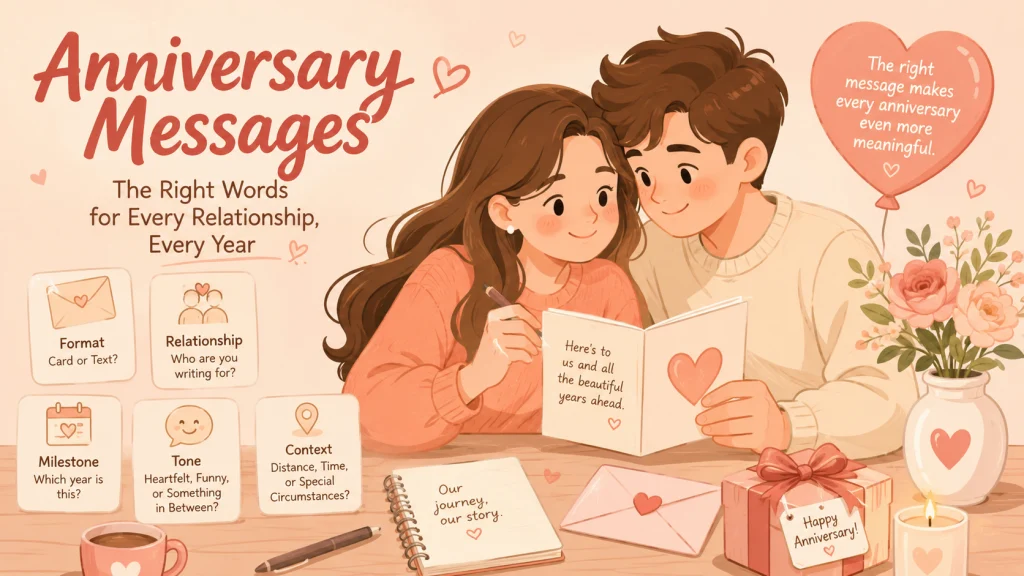
What follows is a way through. Each section below breaks down the anniversary message landscape by the question that usually shapes the message most: format, relationship, milestone, tone, or context. Find the one that fits and follow it from there.

When Format Shapes What You Can Say
Before working out what to say, it helps to think about where it will land. A card is a physical object. It gets held, sometimes kept. People tend to write more inside a card than they would in a text, and that instinct is almost always working against them. The messages that survive in someone’s bedside drawer are the honest, spare ones. Not the ones that filled every inch of available white space trying to match the weight of the moment with volume.
Short anniversary messages work under a different pressure. Less room means less room to meander, and that constraint tends to clarify things. When you cannot pad, you find out quickly what you actually wanted to say. A short message done well carries as much as a long one, with nothing extra for the person on the other end to wade through. I have found that the version people second-guess the most is usually the one that should have been sent.
If format is where you need to start, these two cover the range:
- What to write in an anniversary card, for when you have space and want to use it well without filling it.
- Short anniversary messages, for when brevity is the point and you want something that lands without explanation.
In either case, the test is the same: does it sound like it was written for one person, or assembled for the general idea of an anniversary?
By Relationship: Who Are You Writing For?
Who the message is for changes almost everything about what it should say and how it should say it. The level of intimacy, what is appropriate to name out loud, and what is better left implied all shift depending on the relationship. Writing for a partner is not the same task as writing for parents, and both of those are different from writing for a couple you love but whose marriage you are on the outside of.
For a partner, especially after a year that carried some weight, honesty tends to work better than flourish. The messages that hit hardest in those moments are the ones that say something specific, something that only someone who was actually there could have written. Glossing over difficulty and reaching for something generically romantic usually falls flat. Not because the romance is wrong, but because it misses the specific year.
Writing for parents is a different task entirely. You are observing a love you did not build. What you can offer is what it has meant to witness, and that turns out to be a more powerful angle than most people expect. The messages that land best from a daughter to her parents are the ones that say something real about what that marriage has shown her, not just that it has been long or admirable.
Writing anniversary wishes for a couple you care about asks for something else again: warmth, specificity, and enough restraint not to project your own feelings onto a relationship you are watching from the outside. The best messages in that register are short. They celebrate without overreaching.
- Romantic anniversary messages for a wife, for when the year deserves something more than something generic.
- Anniversary messages for parents, from a daughter, for the particular warmth of writing about a love you have witnessed.
- Anniversary wishes for a couple, for writing from outside the relationship, warm and specific without overstepping.
The register shifts with each relationship, but the underlying question stays the same: what is yours to say here, and what belongs to someone else to offer?

By Milestone: The Year Changes the Language
A first anniversary and a fiftieth almost require different vocabularies. The first year is early enough that the celebration still has something tentative in it, a recognition of what has started more than what has been built. There is often a mix of joy and something close to relief: we are here, we did this, and it is good. Messages for a first anniversary should hold both of those things without making either of them feel smaller than it is.
Silver and golden anniversaries are something else. By twenty-five years, a couple has lived through real things, moved, lost people, raised children or decided not to, changed in ways that neither of them could have predicted at the beginning. A message for a twenty-fifth that stays too surface-level, that leans on the number without acknowledging anything of the life behind it, reads as less than what the moment deserves. Fifty years asks for even more weight, delivered without tipping into sentimentality that belongs to no one in particular.
What I have noticed, across every milestone, is that the weight of a number can actually work against the message. When the occasion feels large, people reach for language that sounds equal to it, and that language tends to be the kind that could belong to anyone. The moments that read true are the ones that come down from the milestone and get close to something real.
- First anniversary messages, for the particular feeling of a year well spent together.
- 25th wedding anniversary messages, for a milestone that deserves more than a number.
- 50th wedding anniversary messages, for fifty years of something that earns real words, not borrowed ones.
The milestone matters. What happened inside it matters more.
When Funny Is the More Honest Choice
There are couples for whom a deeply sincere anniversary message would feel strange. Not because the love is not real, but because humor is how they speak to each other, and arriving on their anniversary with something earnest and polished would read as out of character. For those couples, funny is not a lesser option. It is the more accurate one, and in many cases, the more loving one.
Getting funny right in an anniversary message is harder than it sounds. Generic jokes about marriage being work, or about surviving another year, fall flat almost every time because they are not about anyone. What actually lands is specific: a reference, a callback, something that only makes sense to this couple. If you do not know them well enough for that level of specificity, lean toward warm and simple rather than reaching for humor that has no ground under it.
The right funny message, written for the right couple, is the one they will quote back at each other for years. It is worth the extra thought it takes to get there. Funny anniversary messages worth actually sending, for the couples who would want that over anything else.

When the Situation Is the Hard Part
Sometimes the difficulty is not the relationship or the milestone. It is the context. Two situations come up more than others, and both bring their own specific challenges: distance, and the workplace.
Long-distance anniversary messages carry an extra layer. The absence is already present, and the message has to do something in spite of that, without making the distance the entire point of what it is saying. The messages that work best in those situations are not the ones that dwell on being apart. They are the ones that focus on what still holds, the reasons the relationship is worth the difficulty. Writing toward the connection rather than around the gap changes the whole register of the message. I sent something like this once, from a city I did not live in yet, to someone I had been missing for months. I almost wrote about missing them. I wrote about something specific instead. It made all the difference.
Work anniversaries are an entirely different register. They are professional milestones, and the messages that fit them should stay in that lane: warm, personal where appropriate, but not intimate in the way a message between partners is intimate. The challenge is calibration. Too formal and it reads as a form letter. Too personal and it becomes uncomfortable. The right message acknowledges the milestone and the person without claiming more of the relationship than actually exists.
- Long-distance anniversary messages, for celebrating together when the distance is real but the connection is stronger.
- Work anniversary messages, written to feel genuine without overstepping what the professional relationship actually holds.
Context shapes what a message can do. Getting that right is part of writing one that actually works.
Final Thoughts: Pick the Angle and Trust It
The thing I keep coming back to is that the difficulty with anniversary messages is almost never the emotion. That part is usually already there. The difficulty is the translation: figuring out which angle to take, how much to say, and when to stop. That is what the sections above are here to solve. Find the situation that matches yours and let the specifics of that context do the rest.
Anniversary messages, like the best celebration messages, do their work quietly. The year, the relationship, the shared history: those are the details that carry weight, not the phrasing. When the message holds something true about the people it is for, the rest of it tends to fall into place.
FAQs
💬 What should I write in an anniversary message?
Start with something true, not something that sounds good. A moment, a detail, something that actually happened this year or over the years of this relationship. Reaching for the right-sounding phrase is usually what makes anniversary messages feel hollow. Writing toward what you actually know tends to fix that.
✍️ How long should an anniversary message be?
Shorter than your instinct says. Most people write too much because the moment feels large and they try to match it with length. A few honest sentences almost always land better than a paragraph that meanders. Say the thing, then stop.
💑 What do you say for a big milestone like 25 or 50 years?
Acknowledge the life, not just the number. Decades of marriage hold real things: moves, losses, changes neither person expected. Reference something specific to this couple, even one detail, and the message immediately rises above what anyone else might have sent.
😄 Is a funny anniversary message okay to send?
For the right couple, it is not just okay. It is the better choice. Humor is not a lesser form of affection. What matters is that the joke is grounded in something specific to them, not a generic quip about marriage that could apply to anyone.
📱 What is a good short anniversary message to send by text?
Something honest and direct. A single sentence that sounds like you is worth more than three polished ones that could have come from anyone. Write what you would actually want to hear and send that.
🏢 How do you write a work anniversary message that does not feel forced?
Mention one real thing: a contribution, a quality, something specific to this person’s work. Work anniversary messages go flat when they stay entirely abstract. One concrete detail is what makes the whole message feel like it was actually written for someone.