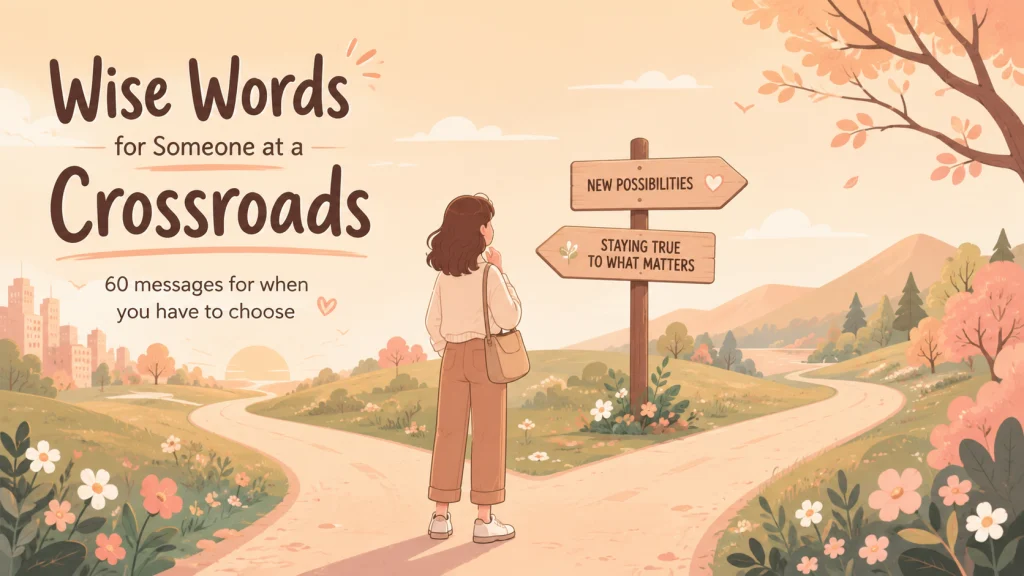
A crossroads is not the same as being lost. It means you have arrived somewhere that asks you to choose, and whatever you choose will carry real weight. The wisdom that belongs in that moment is different from general encouragement: it has to acknowledge both paths, the cost of not choosing, and the specific ache of having to give something up in order to have something else. These 60 wise words for someone at a crossroads are written for that particular feeling, organized by where the person actually is in the decision.
Why a Crossroads Calls for Something Different
Most hard moments ask you to endure. A crossroads asks you to decide. That distinction matters more than it looks, because the words that help someone get through something are not the same words that help someone choose something.
When someone is going through grief, they need to feel less alone in it. When someone is afraid, they often need to be reminded of their own capacity. But when someone is standing at a crossroads, what they are usually not missing is courage or company. They are standing between two real options, both of which cost something, and they cannot have both. “You’ve got this” lands flat there, because getting through it is not the question. The question is which one.
I have been at a few of these. Not the kind where one option was obviously better and I was just procrastinating. The harder kind, where both paths had something real to offer and choosing one meant genuinely letting go of the other. What helped, in those moments, was not reassurance. It was someone who could name the situation accurately: that this was a real choice, that both things were real, and that the difficulty was not a sign anything was wrong with me.
That is what crossroads wisdom has to do. It cannot pretend one path is obviously right. It cannot make the weight of the moment disappear. What it can do is sit with the person in the difficulty and say something honest about what the moment is and what it asks of them. The messages below are organized by where the person is in the decision, because that matters. Someone who sees both options clearly and still cannot move needs different words than someone who knows exactly what they want and is afraid to take it. And someone who has already chosen needs something different still.
For Someone Who Sees Both Paths Clearly but Cannot Choose
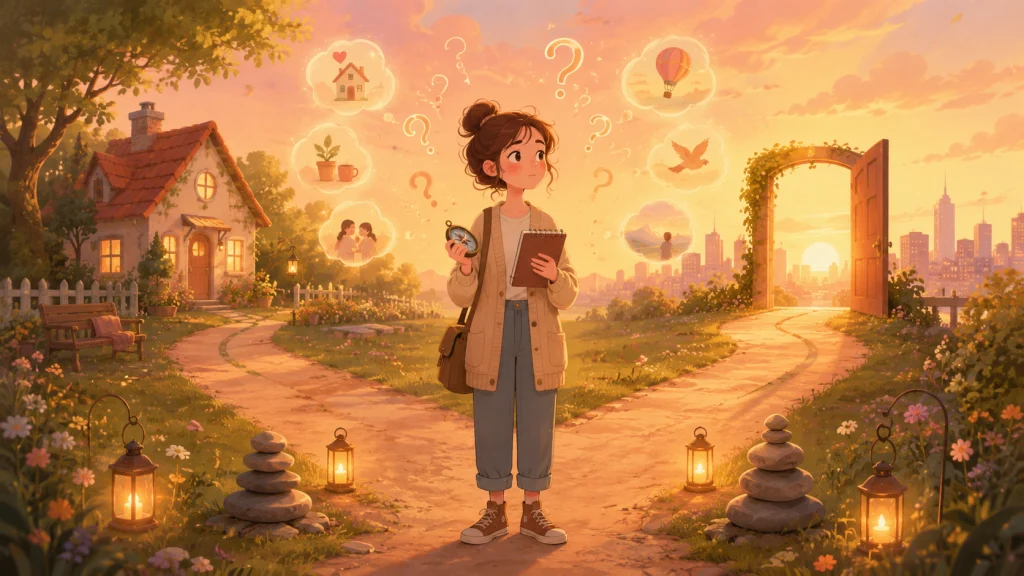
This is the hardest kind of crossroads, and I think it is the most misunderstood. It is not confusion. The person in front of you has thought this through. They understand both options, they can see the shape of each path, and they still cannot move. What they are sitting with is clarity without direction, which is its own specific kind of difficulty.
Most messages sent in this moment try to simplify it. “Listen to your gut.” “What would you tell a friend in the same position?” These are not wrong things, but they often miss the actual stuck point, which is that both paths feel true. The messages below try to hold that. They do not push toward one option or pretend the answer is obvious. They sit with the weight of having to choose at all.
- The fact that you cannot choose yet is not a failure of judgment. It is proof that both paths matter to you. That is important information about who you are.
- Two good options are still a gift. The difficulty is real, and so is that.
- Not every crossroads has a wrong turn. Sometimes the question is not which path is better, but which version of yourself you want to grow toward.
- You do not need certainty to move. You need just enough clarity to take the next step. The rest tends to become visible as you go.
- The care you are bringing to this decision says something about how you will live whatever path you choose.
- Most decisions that actually matter come without obvious answers. If this one felt easy, it probably was not the right size of decision for where you are in your life.
- Whichever path you take, you take yourself with you. That is both the reassurance and the full weight of the responsibility.
- There is a version of knowing that is not yet conscious. Sometimes you make the choice, and only then does the reason become clear.
- Not choosing is also a choice. I say that with love, not pressure. But it is worth sitting with honestly.
- The paths look very different from here than they will look from a year out. You do not need to see the whole road. Just far enough to take the first step.
- A decision this difficult is not a sign you are missing something. It is a sign you understand what is actually at stake.
- Everything that brought you to this crossroads is still with you. You are not starting from nothing.
- Weighing carefully is not the same as avoiding. But at some point the weighing has to stop and the walking has to begin.
- Whatever you choose, you will bring your whole self to it. That has always been the thing.
- A crossroads does not tell you which path is right. It tells you that you have arrived somewhere that matters. That is already something.
One pattern I keep seeing with people at this particular kind of crossroads: they ask others what they would do in the same situation. And almost without exception, the answer they get tells them nothing useful, because the other person is not them. The best thing you can offer someone here is not your read of their options. It is a message that helps them hear themselves more clearly.
For Someone Who Knows What They Want but Is Afraid to Choose It
This is a different situation, and it needs different words. The person here is not uncertain. They already know which path they want. What is holding them is fear, usually the fear of loss, of letting go of the alternative, of what other people will think, of being wrong in a way they cannot take back.
Telling someone their fear is unfounded does not help in this moment. The fear is not unfounded. It is an appropriate response to the size of the decision. What helps is something that holds both things at once: yes, this is frightening, and yes, you already know what you need to do. The gap between those two facts is where these messages try to live.
- You already know. I think you have known for a while. Fear is not the same thing as doubt.
- Wanting something this much, and still being afraid of it, is one of the most human things there is. It does not mean you should not want it.
- The fear will not go away before you move. That is just how it works. You walk toward it, and it changes shape.
- There is a version of you on the other side of this decision that you have not met yet. They are waiting.
- What you give up by not choosing is also something. Worth sitting with that honestly, not just once.
- Regret about not going tends to stay longer than fear about going. That is not a promise. It is just something I have found to be true, more than once.
- Every person who has ever chosen the harder path was afraid first. You are not an exception to how this works. You are right on time.
- Permission is not coming from outside. You are the only one who can give it.
- Choosing what you want for yourself is not a small act. Do not let anyone, including you, make it feel small.
- If the fear were simply gone tomorrow, what would you do? Hold that answer. It already knows something you are still working toward.
- The version of this decision you are running in your head is not the one you will actually live through. The real version will be harder in some ways and easier in others. But it will be real, which is more than the waiting is.
- You have talked yourself out of things before. You know how that tends to feel a year later.
- The courage to want something is not always the same as the courage to take it. You have already done the first half.
- Wanting the thing and being afraid of it at the same time does not mean you are not ready. It often means you are.
- There is something I have noticed about the moments just before someone finally goes: they almost always look like this. Not knowing. Waiting for a sign that does not come. And then going anyway.
That last one connects to something worth knowing. If the person you are writing for is right at that edge, the place between knowing and going, a message written specifically for that step can carry more than general encouragement. The leap of faith messages on this site are built for exactly that moment, the one right before someone who already knows finally goes ahead and does it.
For Someone Who Has Already Chosen and Needs to Trust It
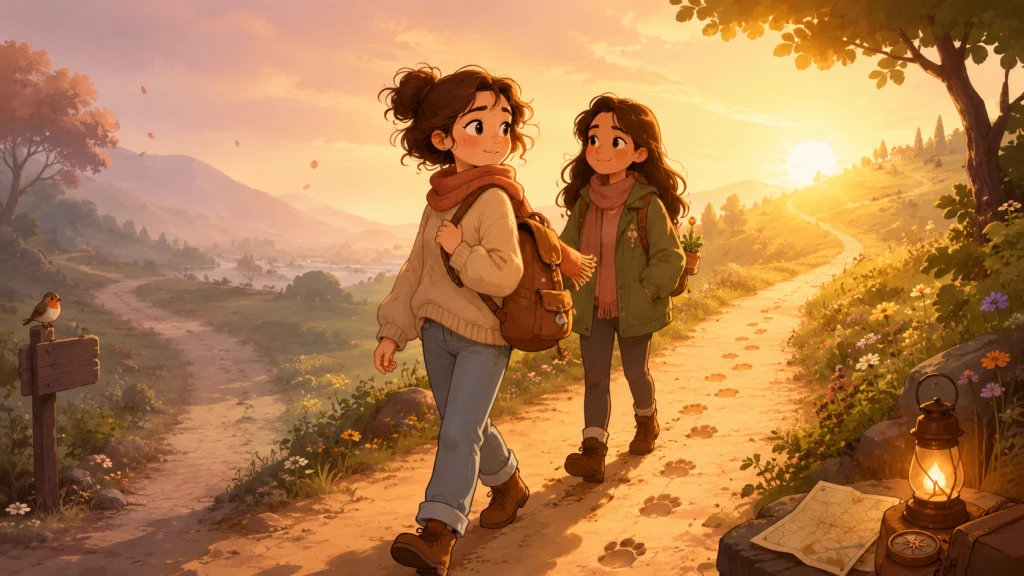
A crossroads does not always end cleanly. Sometimes a person makes the decision and then spends weeks revisiting it, measuring their path against the one they did not take. The choice is made. The direction is set. And they keep looking back.
Wisdom for this moment is not about the original decision anymore. It is about what follows every real choice: the commitment to walk the path you chose without keeping score against the one you did not. That is its own practice, and it deserves its own kind of words, ones that are not about whether they chose right, but about how to go forward from here.
- You chose. That is the first act of a long story. You do not have to write the whole thing from here.
- The path you did not take will always be the one you do not know. That is not a loss. That is just how choosing works.
- Trusting a decision is a practice, not a feeling. You do not wait until it feels right. You act as though it is, until it is.
- Looking back at the other path only makes sense if you are considering going back. If you are not, forward is the only direction that matters now.
- Second-guessing a careful choice is not wisdom. It is just an expensive way to spend the early days of a new beginning.
- The choice you made was made by the person you were, with the information you had. That person made the best call they could. Trust them.
- Every path has something the other one did not. You have started learning what this one holds. That is enough for now.
- Commitment is not certainty. It is deciding you will find out by going, not by wondering.
- The regret you are anticipating is not the same as actual regret. One is a feeling in the present. The other is information you do not have yet.
- You already did the hard part. The decision was the hard part. Walking it is just walking.
- Not every crossroads question gets answered at the crossroads. Some of them get answered by the path.
- The doubt you feel right now is not a sign you chose wrong. It is a sign you are paying attention. Keep going.
- The other path is not disappearing. It is just not yours anymore. There is a difference, and it matters.
- What you gave up to get here is real. So is what you gained. Let them both be true without making one of them win.
- Your choice was real. Now make it realer by walking it like you meant it. Because you did.
There is something worth saying here about what these messages are for. They are not reassurance in the hollow sense. They are not “you made the right choice” from someone who cannot possibly know that. They are a reminder that the work after the crossroads is different from the work of the crossroads itself, and that the person has already done the harder half.
Short, Decisive Words for the Moment of the Decision
Sometimes brevity is what lands. Not because the moment is small, but because a short sentence delivered with care and clarity can do something a longer message cannot. It leaves room for the person to finish the thought themselves.
These are written for a quick text, a handwritten note tucked somewhere they will find it, or a message sent without a lot of preamble. They are not thin. They just know how to carry something in fewer words.
- The choice you make will become clearer as you live it with care.
- Both paths are asking something of you. The question is which ask you are ready to answer.
- One day, you may understand this choice in a way you cannot from here.
- The weight of a decision is not a sign you should not make it. It is a sign you understand what is at stake.
- I do not know which path is right. I do know you are the right person to walk it.
- Crossroads are not problems. They are arrivals.
- Whatever you choose, I am here on the other side of it.
- You have more capacity for this than the fear is showing you right now.
- Choose and go. Correct as you learn more. That is all anyone ever does.
- The decision you are most afraid to make is usually the one that matters most.
- Not every choice needs to be the right one. It needs to be yours.
- Wisdom is not knowing which path to take. It is trusting that you can handle either one.
- You are not choosing between two futures. You are choosing which one to start building today.
- Standing here is not the same as being stuck. But moving is still better.
- Some questions do not get answered before you go. They get answered by going.
A short message like one of these often lands better than something longer when the person is in the middle of a decision and already carrying a great deal. The right words at a crossroads do not need to cover everything. They need to arrive in a way the person can actually hold. For a broader set of quotable wisdom across more moments than just this one, the full collection of words of wisdom is worth looking through if this is the kind of message you find yourself needing more than once.
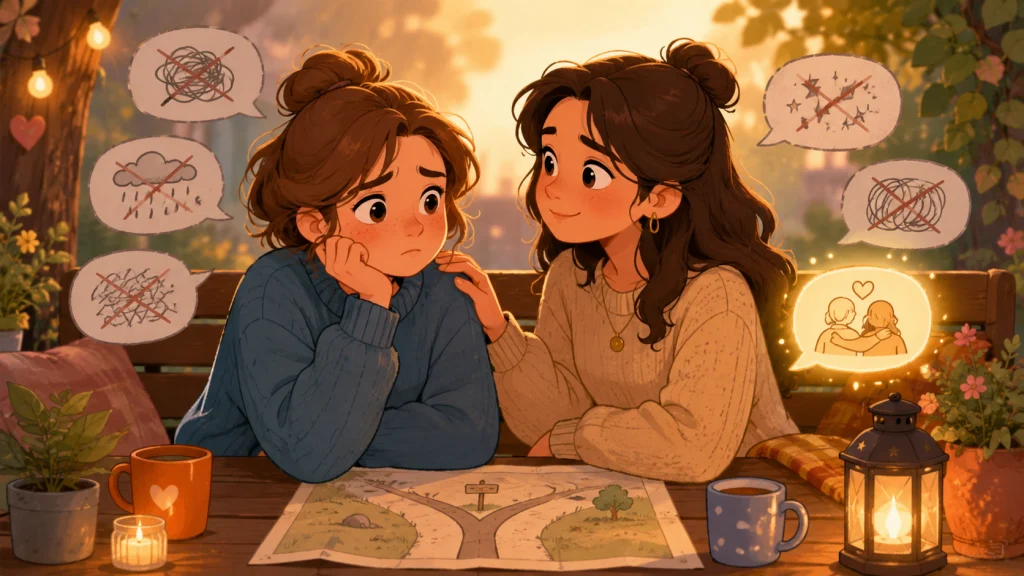
What Not to Say When Someone Is at a Crossroads
Knowing what to avoid is as useful as knowing what to send. Some messages, offered with the best intentions, make a difficult moment harder because they misread what the person in it actually needs. These are not unkind things. They are the kind of things people reach for when they do not know what else to say, and reaching for something familiar is easier than sitting in the difficulty alongside someone.
| What people often say | Why it misses | What lands better |
|---|---|---|
| “Follow your heart” | Assumes one path is the emotional favorite, which is often not true for a real crossroads | Acknowledge that both paths feel real, and the heart may have reasons it has not said out loud yet |
| “What would you tell your best friend to do?” | Redirects instead of holding space, can feel like advice dressed as a question | Just sit with the difficulty. Sometimes company is more useful than a reframe. |
| “You will know when you know” | Sounds patient but leaves the person exactly where they started with nothing to hold | Acknowledge that sometimes knowing is not the thing that moves you. Deciding is. |
| “Either way, it will work out” | Removes the stakes. It may not work out the same either way. That is exactly why it is hard. | Acknowledge that the stakes are real, and trust the person enough not to soften them too quickly. |
| “I could never do what you are doing” | Centers your experience at a moment when they need to feel capable, not compared | Reflect back what you actually see in them: steadiness, care, readiness they may not see yet |
The person at the crossroads can usually feel the difference between a message that sees them and one that fills the silence. Neither is a moral failure. But when you have the choice to offer something more specific, it is worth taking it.
Final Thoughts: A Crossroads Is Not a Problem to Be Solved
The instinct, when someone we care about is facing a big decision, is to help them make it. To offer our read of the situation, to point toward the option we would choose, to reassure them that one path is clearly better. That instinct comes from a good place. But it is usually not what the person at the crossroads actually needs.
What they need is someone who can hold the weight of the moment with them without trying to lift it away too quickly. A message that does that, one that acknowledges the difficulty without collapsing into it, that trusts the person to make the call, that is still there on the other side of whatever they decide, is worth more than any amount of unsolicited clarity.
The 60 messages here are not prescriptions. They are starting places. Find the one that fits the person in front of you, adjust it to match what you actually know about them, and send it. A message sent with that much intention is never the wrong move, even when the person on the other end has not made theirs yet.
FAQs
🤔 What do you say to someone who is facing a major life decision?
Acknowledge the weight of the moment without trying to resolve it for them. Something like “I can see how much this matters to you, and I trust that you will find your way through it” carries more than advice does. The goal is to make them feel less alone in the decision, not to steer it.
💬 How do crossroads messages differ from general encouragement?
General encouragement is about capability: you can handle it, you are strong, it will be okay. Crossroads wisdom is about the choice itself. It holds the fact that both paths are real, that not choosing is also a choice, and that the difficulty of the moment is not a sign something is wrong. The difference is that crossroads wisdom does not try to lighten the weight. It acknowledges it and stays.
🧭 Is it better to send something short or something longer when someone is at a crossroads?
Usually shorter. A person in the middle of a difficult decision is already carrying a lot. A short message that names the moment clearly is easier to receive than something long. If you have more to say, lead with the most important thing and let the rest follow in conversation, not in the message itself.
🔄 What if someone has already made their decision but keeps second-guessing it?
Avoid relitigating the decision with them. What helps more is something that looks forward: “You chose carefully. Now the path gets to show you what it holds.” That is more useful than reassuring them they definitely chose right, which is something neither of you can actually know yet.
😰 What if the person seems paralyzed and cannot choose at all?
Name what you see, gently. Something like “I notice you have been sitting with this for a long time. Not because you do not know yourself, but because both things matter to you. That actually tells you something.” Sometimes naming the stuck-ness honestly is the thing that finally moves it.
✉️ Can these messages work as texts or are they better as handwritten notes?
Both work. The shorter messages in the final group are built for a text. The longer, more personal ones fit a card or a note better. What matters more than the format is the timing: send something close to when the person is actually in the decision, not weeks after the moment has already passed.