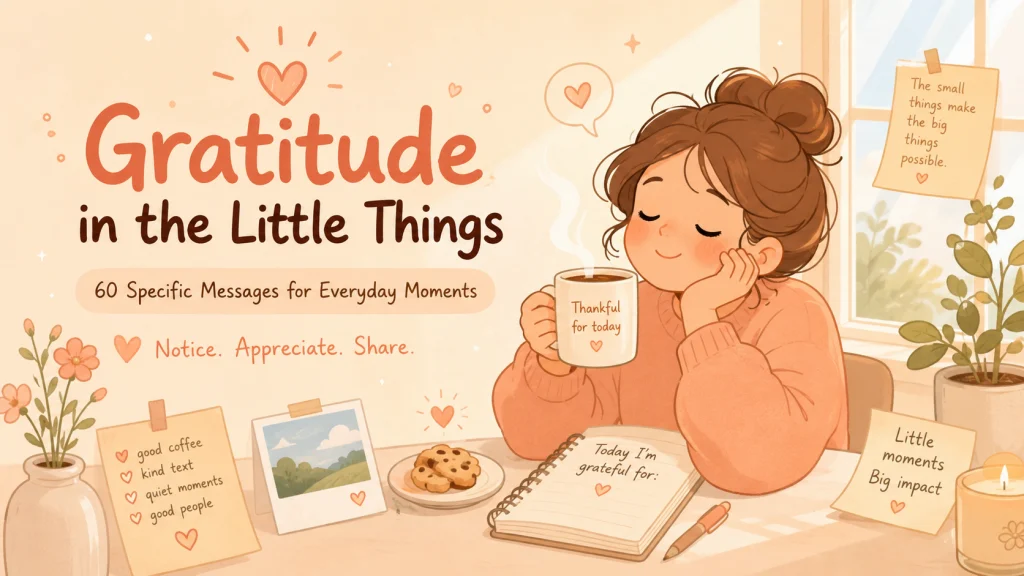
Vague gratitude feels good to write and lands almost nowhere. The messages that actually make someone feel seen are the ones that name something specific: the coffee that was exactly right, the way someone always texts back, the five quiet minutes between everything else. These 60 messages are organized around that smallest scale of everyday life, sorted into six categories so you can find the one that fits your moment. None of them are grand. That is the whole point. For broader context, see gratitude for the little things.
“Grateful for Everything” Is Grateful for Nothing
There is a version of gratitude that everyone knows how to write and almost no one wants to receive. “I’m so blessed.” “I appreciate all the little things.” “Grateful for this life.” These are not bad things to feel. They are just impossible for anyone else to hold onto, because they don’t name anything real. The person reading them has no idea what you actually saw, or noticed, or felt that day. It lands like a greeting card and disappears just as fast.
The version that lands differently is specific. Not “thank you for everything” but “thank you for remembering I don’t like cilantro and just not putting it in without making a thing of it.” Not “I’m grateful for the little things” but “I’m grateful the coffee was exactly the right temperature this morning and nobody knows that except me and now you do.” Specific gratitude creates a small moment of being witnessed. That is what makes it feel like something. The messages here are built around that principle, applied to the smallest possible scale: the sensory details, the ordinary comforts, the quiet moments and small gestures that make a life feel good in the background.
I started paying attention to this during a stretch of time when I was traveling so much that home was a concept more than a place. What I missed was not anything large. It was specific: the particular sound of a neighborhood at a certain hour, the coffee shop where they remembered my order, the way a certain friend always picked up on the second ring. When I eventually wrote to some of those people, the messages that got real responses were the ones that named something exact. Not “I miss you” but “I miss the way you always know when not to talk.” The difference was not in the sentiment. It was in the specificity.
The table below shows what this looks like in practice. The left column is the version most people reach for first. The right is the version that actually reaches someone.
| What people usually write | What lands differently |
|---|---|
| “I’m so grateful for the little things.” | “I’m grateful the coffee was exactly right this morning. Small thing. Made everything feel possible.” |
| “Thank you for everything you do.” | “Thank you for always texting back, even when you’re clearly busy. I notice that.” |
| “I appreciate you.” | “I appreciate the way you let there be silence and don’t try to fill it.” |
| “Grateful for good people in my life.” | “Grateful for the moment this afternoon where everything felt still. I wanted to name it before it disappeared.” |
The messages below are sorted into six categories, each one a different corner of everyday life. Some are for sharing directly with someone. Some are for yourself: a journal entry, a caption, a note you write because naming the thing is enough on its own. Use them whole or use them as a starting point. Either way, the job is the same: to notice something real and put it into words.

The Little Moments That Anchor a Day
These are the ones that happen before noon, or in a quiet five minutes you almost didn’t notice, or right at the end of a day when everything settles. They don’t require anything of you except to pay attention. And when you write them down, or send them to someone, something shifts. The moment becomes real in a way it wasn’t before you named it. That’s not nothing.
This is also where most people looking for gratitude messages start, and it’s where the gap is widest. The desire to say something is there. The specific language isn’t. These ten are meant to give you both at once.
- The coffee was exactly right this morning. Small thing. Made the whole day feel possible.
- That song came on right when I needed it. I know that sounds like nothing, but it felt like something.
- I stepped outside at the exact moment the air smelled like rain. Wanted to tell someone. So I’m telling you.
- The light through my window this afternoon was the kind you want to stay in. Grateful for that today.
- Woke up before my alarm and just lay there for a few minutes. Those are the quiet ones I forget to be grateful for.
- My commute was actually peaceful today. That almost never happens. I noticed it.
- There was a moment this afternoon where everything felt still. I wanted to name it before it disappeared.
- The first sip of tea this morning was exactly what I needed. Some mornings just start right.
- I had five minutes of doing absolutely nothing today and I am grateful for those five minutes.
- The day ended better than it started. That is not always guaranteed.
You don’t need to wait for something remarkable to send something like this. The unremarkable moment, named honestly, is often the one that sticks longest. It also tends to be the one the other person saves.
The Small Things About People in Your Life
This category asks the most of you as a writer, because generic appreciation slides off people like water. “You’re such a good friend” is true for a lot of people and feels true to none of them in particular. The thing that stays is when you name something exact: the small habit, the quiet gesture, the thing they probably don’t know you’ve been paying attention to. Most people never find out that someone noticed those details. These messages change that.
The mistake I see most often here is going for the big statement when the small one would hit harder. Once, there was a birthday message I almost didn’t send because I thought it would feel obligatory. I sent it anyway, just two sentences about one particular thing I loved about that person. She told me later it was the only one that year that didn’t feel like a form letter. The size of the gesture had nothing to do with it. The detail was everything.
- You always text back, even when you’re clearly busy. I notice that. I’m grateful for it.
- You remembered I don’t like cilantro. You didn’t make a thing of it. You just didn’t put it in. That means a lot.
- The way you laugh before the punchline of your own story. It’s one of my favorite things about you.
- You asked how I was and actually waited for the answer. Thank you for that.
- You remembered the small thing I mentioned three weeks ago. I wasn’t sure you heard it. You did.
- The way you make a room feel easier just by being in it. I don’t know how you do it, but I notice.
- You always refill my glass without asking. It’s such a small thing and it makes me feel so cared for.
- You let there be silence and you don’t try to fill it. That is a gift I don’t think I’ve ever said thank you for.
- You knew I was having a hard day before I said anything. You didn’t push. You just stayed close. Thank you.
- The small way you check in after something hard. Not a big gesture. Just a text. It always lands right.
These also work as notes left somewhere physical: written down and slipped under a door, left on a counter, tucked somewhere they’ll find it later. Sometimes the written version reaches people differently than the spoken one, especially for things that feel too quiet to say out loud.
The Ordinary Comforts You’d Miss If They Were Gone
There’s a particular kind of gratitude that only arrives when something is temporarily taken away. You don’t notice the hot water until the heater breaks. You don’t think about clean sheets until you’ve been traveling for two weeks and suddenly they’re all you want. The messages in this category are about catching that feeling before the absence happens. Gratitude in advance, almost. Or just gratitude while the thing is still here, still working, still yours.
Writing about these things, even to yourself, does something that a general “counting your blessings” practice doesn’t always do. It changes how you sit with the thing, even briefly, because you’ve had to put words around it. If you want small blessings messages that feel honest rather than hollow, this is a good place to start.
- Grateful today for a hot shower that stayed hot the whole time. I know. But I am.
- My blanket. My specific blanket. I would be a different person without it.
- Clean sheets. There is nothing that feels more like a reset.
- The fact that I have a quiet place to sit when I need to think. Not everyone has that.
- A working phone with a full charge. I take that for granted almost every day.
- Being able to cook something simple and have it come out right. Small victory. Real one.
- My own bed at the end of a long day. Grateful for it today in a way I usually forget to be.
- A drawer that has exactly what I need in it. The scissors are where the scissors should be. Today that felt like a miracle.
- The familiar smell of home when you walk back in after being away. I’m grateful for that, in particular.
- Comfortable shoes. I did not always have comfortable shoes. I try not to forget that.
These ten are quieter than the others, but they carry something real. The person who receives one of them usually knows exactly what you mean, because they’ve felt it too, and never said it out loud either.

Small Sensory Pleasures
These are the body-level things. The smell before the taste, the sound that sets a whole mood, the temperature of something at the exact right moment. They’re almost impossible to explain to someone who didn’t experience them alongside you, which is part of what makes naming them in a message feel so intimate. You’re letting someone into a private moment, something tiny and real that happened in your sensory world, and you chose to share it.
If you tend to live mostly in your head, writing these kinds of messages is worth practicing for that reason alone. They pull you into the present in a way that more abstract gratitude doesn’t. And if you’re sending them to someone else, they tend to land with a specific kind of warmth, something between “I was thinking of you” and “I wish you were here.” Both at once, sometimes.
- The smell of coffee before you drink it. Just the smell. That’s enough sometimes.
- A playlist that gets the order exactly right. Felt like it was made for today.
- Golden hour light on a building I pass every day. Today it looked different. Beautiful, actually.
- The weight of a good book in your hands before you even open it.
- The sound of rain when you’re inside. Grateful for both: the rain and the being inside.
- Biting into something warm and it being exactly as good as you hoped. That is a gift.
- The moment a room fills with the smell of good food and everyone relaxes at once. I love that moment.
- A song I hadn’t heard in years came on today and took me somewhere immediately. Grateful for that kind of memory.
- The feeling of warm sun on your face in the first real days of spring. I had been waiting for that.
- Cold water when you are actually thirsty. One of the best things there is.
These messages work especially well sent in the moment, right when the thing is happening. The real-time version carries the feeling better than the remembered version does later. Something about the immediacy makes it feel less like a reflection and more like an invitation.
Quiet In-Between Moments
Nobody talks about these enough. The two minutes you sit in a parking lot before going in anywhere. The gate at an airport before a flight, coffee in hand, nothing pressing. The long walk with no destination. These are the moments that look like nothing from the outside and feel like everything from the inside. They’re also the ones most easily swallowed by the next thing that needs doing, which is exactly why they’re worth naming when they happen.
Writing about them is a way of protecting them. Not literally, but experientially. When you put language around a moment, it becomes something you can return to. These messages are useful for that: sent to a friend as a quiet check-in, kept as a note to yourself, or shared as a caption that says less than it means. If you find yourself wanting to say more about this feeling, the collection on being present explores it from a different angle and goes deeper than a single message can.
- Sitting in a parking lot for two minutes before going in anywhere. Just sitting. Grateful for those two minutes today.
- The bus was quiet this morning. No one talked. It was peaceful in a way I didn’t expect.
- I had a whole hour where nothing needed my attention. I didn’t make it into anything. I just let it be.
- Sitting at the gate before boarding, coffee, no agenda. One of my favorite feelings.
- Waking up naturally before the alarm and just lying there. I love those unclaimed minutes.
- A whole evening with no plans. Not lonely. Just quiet. Grateful.
- A conversation that ended at exactly the right moment, before it ran out. You can’t plan those.
- The pause before something good happens, when you can feel it coming. I’m grateful for that feeling.
- Reading in the afternoon while it rained. Nothing happened and it was perfect.
- A long walk with nowhere specific to go. My mind sorted itself out without me trying.
The in-between moments are not the filler between the real parts of a day. Most of the time they are the real parts. The ones you carry longest, the ones that come back to you later when you least expect it.

The Unexpected Small Gifts
These are the unearned ones. The stranger who holds the door. The message that arrives at exactly the right time from someone who had no way of knowing you needed it. The line moving faster than expected, the meeting ending early, the thing you were dreading that turned out to be fine. None of them were guaranteed. You didn’t plan for them. They just happened, and for a moment the world felt loosely on your side.
Naming these feels almost superstitious sometimes, like saying it out loud will undo it. But what I’ve found is the opposite. When you write down the small unexpected gift, something in you begins to notice more of them. Not because they multiply, but because the act of naming trains your attention toward them. These messages are worth sending and worth keeping. If appreciating small moments is something you’re working toward, this category is where that practice becomes real and not just theoretical.
- A stranger held the door. I don’t know why, but it made me feel like people are basically okay.
- Someone laughed at the thing I said and meant it. You can always tell when someone means it.
- Got a message from someone I hadn’t heard from in a while: “Just thinking of you.” Perfect timing.
- The checkout line moved faster than I expected. I know. But today I noticed it.
- Found money in a jacket pocket I forgot about. Felt like a gift from my past self.
- Something I was dreading turned out to be fine. Better than fine, actually. Grateful for that surprise.
- A recommendation someone made offhandedly turned out to be one of my favorite things. Grateful they said it.
- The meeting ended early. Everybody was relieved. No one said it out loud but everyone felt it.
- Someone complimented something I made and I could tell they actually meant it. I’ll remember that one.
- A perfect day I didn’t plan for. One of those days that just turned out right.
These are also some of the best ones to send outward: name the specific thing, add “this reminded me of you” or “I wanted you to know I noticed,” and leave it there. Small observations offered to another person have a way of becoming the message they needed without either of you knowing it in advance.
Final Thoughts: The Smallest Things Are Not the Smallest Things
The idea behind all sixty of these is the same: the specific named thing matters more than the general feeling. “I’m grateful” closes a thought. “I’m grateful the coffee was right this morning and I had five minutes to drink it without anything interrupting” opens one. The second version lets someone into your actual day. It tells them you were paying attention. And in a world that moves fast and speaks in shorthand, that kind of attention is not small at all.
If any of these messages sparked something that belongs to your own life, that’s the one worth sending. Use the exact version, or change it until it sounds like you. The particular words don’t need to be right. The moment does. The message that names your actual day will always reach someone further than the one that could have been written by anyone, and that is as true for small things as it is for any of the harder ones.
If you want to widen the lens from small everyday moments to the larger things people often overlook, the count your blessings messages sit just next to this one in spirit. And if you’re looking for something that lifts rather than reflects, the uplifting messages on the site cover that different register well.
FAQs
💬 How do you say thank you for a small gesture without it sounding over the top?
Keep it short and name the specific thing. “I noticed you did X and I just wanted you to know I appreciated it” is better than any longer version. The smaller the gesture, the shorter the acknowledgment should be. You’re not writing a speech. You’re just letting them know you saw it.
✏️ How specific does a gratitude message actually need to be?
Specific enough that only the person you’re sending it to would recognize the moment. If someone else could have written the same message to a different person, it’s probably still too general. You don’t have to go overboard. Even one precise detail makes a real difference.
📱 Can I send one of these messages out of the blue, with no occasion?
Yes, and often that’s when they land best. Messages that arrive unexpectedly and name something real tend to feel more genuine than ones attached to an occasion. The timing doesn’t have to mean anything. The noticing is enough.
🌿 What if I want to express little things gratitude in general, not one specific moment?
The messages in “Quiet In-Between Moments” and “The Ordinary Comforts” work well for that. They describe a feeling or a type of moment rather than a single event, but they’re still specific enough to feel real. Pick the one that sounds most like your life and adjust from there.
🤍 Is it strange to send a message about something tiny, like a good cup of coffee?
Not at all. The tiny thing named honestly is often more touching than a big statement. People don’t expect someone to notice the small stuff. When you do, and you say so, it lands differently than any general expression of appreciation would.