“Think positive” is one of the most well-meaning things anyone can say, and in the wrong framing, one of the least useful. The problem isn’t the intention. It’s when positive thinking becomes a demand to feel differently than you do, rather than a quiet choice about where to put your attention. The 60 positive thinking messages in this collection are built on that second version: honest, grounded, and not asking anyone to pretend. Whether you’re sending one to a friend who’s struggling or writing something for yourself at the start of a hard morning, these are messages that know the difference between choosing your frame and ignoring your reality.
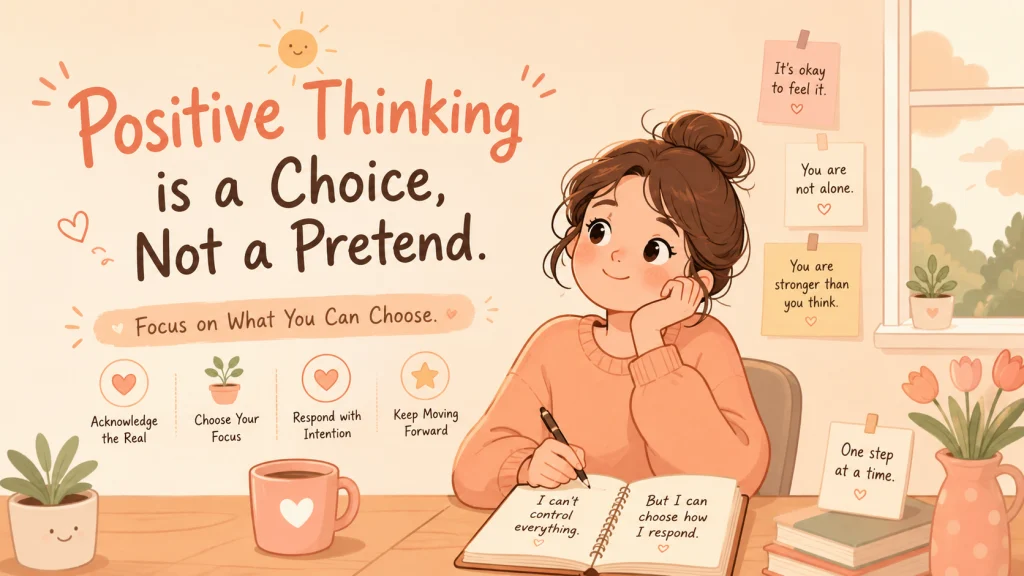
The Difference Between Positive Thinking and Pretending
I have a complicated relationship with positive thinking messages as a category. Not because I don’t believe in optimism, but because most of what gets called positive thinking is actually something else: pressure to perform a mood you don’t have, packaged as wisdom. “Good vibes only.” “Just choose joy.” “Think positive and it will all work out.” I have never been able to send one of those messages without feeling like I was doing something slightly dishonest, not about the person I was sending to, but about the situation they were actually in.
The version that circulates most, in wellness content and good vibes messages and quote collections, treats positive thinking as a destination. You get there by deciding to. What it doesn’t account for is that the hard thing is still there. The difficulty didn’t go anywhere. Telling someone to focus on the good without acknowledging the real is not positivity. It’s dismissal wearing a friendly face, and the person on the other end can usually feel the difference.
What I actually believe in is something quieter. Not that hard things aren’t hard. Not that the answer is always looking upward. But that within almost any difficulty there is a small space where you get to decide something: how you meet it, where you put your focus, whether you let the hard thing also be the only thing. That is not the same as denial. It’s the honest version of positive thinking, and it’s the only one I’ve ever found actually useful to send or receive.
The difference shows up clearly at the level of individual messages. The ones that fall flat skip over what’s real. The ones that actually land name what’s real and offer something true alongside it.
| Sounds positive, but… | Honest positive thinking |
|---|---|
| “Everything happens for a reason.” | “I don’t know why this is happening. I do know you’re not alone in it.” |
| “Just focus on the good things!” | “I’m not asking you to ignore the hard parts. Just to also notice what’s still there.” |
| “Stay positive, it’ll all work out.” | “I can’t promise it works out. I can promise I’m in your corner while you find out.” |
| “Don’t let it get to you.” | “Let it get to you if it needs to. Then decide what you do next.” |
| “You have so much to be grateful for!” | “This is hard, and real things in your life are still good. Both can be true.” |
Every message in this collection comes from the right column. None of them are trying to overwrite what someone is feeling. They are trying to offer a frame, alongside the feeling, that makes the next step a little more possible than it was before.

Positive Thinking Messages About Choosing How to Respond
These are the messages for when the situation is not in anyone’s control, but the response still is. Not “think positive” as a command, but “you still get to decide something here” as an honest observation. The messages that work in these moments don’t try to reframe the problem. They remind the person that the problem doesn’t get to make all the decisions.
I’ve found these work especially well when the other person already knows things are hard and doesn’t need you to tell them otherwise. What they need is a reminder that they haven’t run out of agency. The ten below acknowledge the difficulty first, then point, without forcing, toward what still belongs to the person receiving them.
- “I know this is hard. I’m not pretending it isn’t. I’m just choosing to believe you have what it takes to get through it.”
- “You don’t have to feel good about this. You just have to decide what you do next.”
- “The situation may not change right away. But where you place your attention can still change how you move through it.”
- “You’re allowed to be frustrated and still move forward. Those two things don’t cancel each other out.”
- “I’m not going to tell you to look on the bright side. I’m going to tell you that I’ve watched you meet hard things before, and I have no doubt you’ll meet this one too.”
- “Choosing how you respond doesn’t mean you’re okay with what happened. It means you’re not letting it decide what happens next.”
- “Some days the best form of positive thinking is just: I will get through today. That’s enough.”
- “Nothing about this is easy. Nothing about you is incapable of handling hard things.”
- “The thought I keep coming back to is not ‘this will be fine.’ It’s ‘I can handle what comes.’ That’s the difference.”
- “You don’t have to manufacture optimism. You just have to stay open to what’s possible.”
The seventh one is the message I reach for most in moments like these. It asks almost nothing and promises almost nothing, and that is exactly why it tends to land. When someone is already exhausted, a small bar is not a small thing. It’s the whole point.
Positive Thinking Messages About Finding One Good Thing
The version of positive thinking I trust most is not “count your blessings.” It’s smaller than that. Find one thing, today, that you’re genuinely glad happened. Not everything. One thing. It doesn’t have to be significant. The point is the act of looking, not the size of what you find.
I’ve sent versions of these when I know someone is in a hard stretch and I don’t want to pile on optimism but I also don’t want to leave them with nothing. They sit well alongside a real “how are you doing?” because they’re not pretending the answer is good. They’re just suggesting that something worth noting might exist alongside whatever the answer actually is. If this kind of noticing is something you and the other person come back to often, the broader practice of gratitude messages carries the same intention and goes further when the moment calls for it.
- “I’m not asking you to find the silver lining. Just one thing, today, that made it feel worth it to keep going.”
- “It doesn’t have to be big. A good cup of coffee counts. A text from someone you love counts. Whatever it is, hold onto that.”
- “Find the one thing that went right today. Not everything. Just one. That’s the whole practice.”
- “There is almost always something, even in the worst week. Finding it doesn’t mean the rest wasn’t hard. It means you refuse to let the hard parts be the only story.”
- “One small good thing every day adds up to something that starts to feel like a life you’re actually in, not one that’s just happening to you.”
- “I’ve been trying something: at the end of the day, I name one moment I’m glad happened. It doesn’t fix anything. But it changes the shape of the day, looking back.”
- “Not gratitude as a performance. Just one thing, honestly, that you’re glad exists today.”
- “The goal isn’t to convince yourself things are fine. The goal is to find proof that not everything is wrong. There’s almost always something.”
- “Somewhere in today there was a moment that asked nothing of you except to notice it. I hope you caught it.”
- “One good thing. Real. Specific. Yours. That’s all.”
The sixth message is the one I’ve actually used on myself, more than I’d expect to admit. There’s something about putting it in writing, even a single sentence in a note app at the end of the day, that makes it stick differently than just thinking it. The ritual matters almost as much as the message.

Messages That Hold Both Things at Once
These are the ones for when things are genuinely difficult and you don’t want to pretend otherwise. The difficulty is real. The belief that the person can get through it is also real. These messages don’t choose between the two. They hold both, which is the only way positive thinking rings true to me when the stakes are actually high.
What I’ve noticed is that most people reach for reassurance in hard moments and end up overcorrecting. They say “it’s going to be okay” because they want it to be true, not because they know it is. The messages below are honest about that uncertainty. They don’t promise an outcome. When the moment calls for something more specifically about what comes after difficulty, hope messages go further into that territory. But these ten are for right now, inside the hard thing, where the most useful message is one that simply confirms the person isn’t facing it alone.
- “This is hard and you are handling it. Both things are true.”
- “I’m not going to tell you it’s going to be okay. I’m going to tell you I’m in your corner while you figure it out.”
- “Bad days are allowed. Bad weeks are allowed. None of that changes the fact that you’re still here, still trying.”
- “The hard part and the hopeful part can exist at the same time. You don’t have to choose.”
- “Today was rough. That’s real. So is the fact that tomorrow is a separate thing entirely.”
- “You can be exhausted and still believe in yourself. They’re not mutually exclusive.”
- “Not every day needs a lesson. Sometimes it just needs to end, and the real win is that you made it through.”
- “There’s a version of strength that doesn’t look like anything from the outside. It’s just keeping your feet moving when everything says stop.”
- “I know you’re tired. I know it’s a lot. And I know you haven’t quit yet.”
- “This is harder than it should be. That doesn’t mean you aren’t exactly the person who can handle it.”
The last one is the message I almost didn’t write down the first time I thought of it, because it felt too simple. Then I sent it to someone in a genuinely awful stretch, and they came back weeks later to say it was the one they kept rereading. Sometimes simple is what lets the message stay with someone.
Optimistic Messages to Send a Friend
The moment people most want to send something supportive is usually the moment they feel most unsure about what to say. They want to be warm without being dismissive. They want to be present without overdoing it. They end up writing three drafts and sending nothing, or worse, sending something that lands on a note they didn’t intend. I know because I’ve done both.
The ten optimistic messages below are built for exactly that gap. They read well in a text, in a DM, in a short voice note written out first. They don’t require context you don’t have. They don’t try to fix anything. They just make sure the person on the other end knows someone is paying attention and believes in them. For situations where your friend is going through something longer and heavier, a look at uplifting messages for a friend covers the sustained support side of things in more depth.
- “I just wanted you to know I’m thinking about you today. No reason needed.”
- “You don’t have to have it figured out. I’m rooting for you while you work it out.”
- “I’ve watched you handle things that would have floored most people. I don’t think this one’s going to stop you either.”
- “You’re doing better than you think you are. I can see it even if you can’t right now.”
- “Sending you this because sometimes you need someone else to hold the belief that things can get better, when you’re too tired to hold it yourself.”
- “No advice. No pep talk. Just me, reminding you that you’re someone worth showing up for.”
- “I know it doesn’t feel like it from where you are, but from where I stand, you look like someone who’s going to be okay.”
- “I’m not going to tell you what to think or how to feel. I just wanted you to know that someone’s in your corner.”
- “You’ve earned every good thing that comes next. I hope something good is already on its way.”
- “Today I just needed you to hear: I see you. I’m glad you’re in my life.”
The fifth one is the message I’ve wanted to receive in hard moments and often didn’t know how to ask for. There’s something about naming it explicitly, that someone else is carrying the belief you can’t hold right now, that does something a standard “you’ve got this” never quite manages. It takes the burden of optimism off the person who’s already carrying too much.
Short Positive Thinking Messages for Any Day
Not every message needs to be long. Sometimes the most useful thing is something brief enough to send without overthinking it, honest enough to feel real, and open enough to fit almost any moment. These eight positive thinking texts are the ones I’d reach for when I want to say something true without making it a whole thing.
They work as a morning text, as something to drop into a group conversation, or as the kind of message you send to yourself as a reminder before something you’re not looking forward to. Short doesn’t mean thin. A well-chosen sentence can carry as much as a paragraph. Sometimes more. For a broader set of options in the same spirit, uplifting messages is worth a look alongside this one.
- “One foot in front of the other. That’s all this needs to be.”
- “Today doesn’t have to be great. It just has to be yours.”
- “You may not be where you hoped, but you’re still moving toward where you’re going.”
- “Something good is still possible today. That’s worth holding onto.”
- “You’ve made it through every hard day so far.”
- “Small steps still move you forward.”
- “Not every chapter needs to be good. It just needs to be honest.”
- “You may not have everything figured out, but you have enough to take the next step.”
The second one is the version of positive thinking I keep coming back to. “Today doesn’t have to be great.” That’s not pessimism. That’s permission. And on a lot of days, permission is more useful than encouragement.

Positive Thinking Messages for Yourself, Morning or Night
There’s a different texture to a message you write for yourself. It’s not about showing someone you’re okay. It’s not about performing a mood. It’s something quieter: a thought you put into words, usually at the beginning or end of a day, because the act of saying it changes how it sits in you.
I’ve kept versions of these in notes apps, on sticky notes, in the notes section of calendar events I was dreading. None of them pretend. All of them ask me to stay open to something, which is a different ask than staying positive, and one I can actually meet.
- “Today I will not pretend things are perfect. I will look for what’s true and good and real, and I will start there.”
- “I’m not going to have all the answers today. I am going to keep asking the right questions.”
- “Today gets a clean slate. Whatever yesterday was, it’s done.”
- “I am not behind. I am exactly at the point in the process I’m supposed to be at.”
- “I don’t have to feel ready. I just have to begin.”
- “Today I choose to notice what’s working, not only what isn’t.”
- “I’m allowed to have a hard day and still believe tomorrow might be easier.”
- “I made it to the end of today. That counts.” 🌙
- “I’m not trying to convince myself everything is fine. I’m trying to stay open to the possibility that something good is still ahead.”
- “Whatever this day holds, I am going to meet it as honestly as I can.”
- “I know what I’m capable of. I’ve seen it before. I’ll see it again.”
- “Not perfect. Present. That’s the whole goal today.”
The fourth one is the message I come back to most. “I am not behind.” It sounds simple. But for the particular kind of anxiety that comes from comparing your timeline to everyone else’s, it has a precision that broader encouragement doesn’t. Sometimes the message you need is surgical, not sweeping.
Final Thoughts: Honest Positive Outlook Doesn’t Need to Be Loud
The reason I’ve spent as much time as I have thinking about this is that I’ve seen both versions of positive thinking close up. The kind that dismisses, that papers over, that quietly communicates that your difficulty is a problem of attitude. And the kind that actually helps: the kind that says, I see what you’re dealing with, and I still believe you can find your way through it.
These 60 positive outlook messages are the second kind. Not an invitation to pretend. Not a demand to feel something you don’t. Just honest frames, offered at the right moment, that make the next step feel a little more possible than it did before. That’s the only thing I’d promise about any of them, and the only promise worth making.
If one of them says something close to what you’ve been trying to put into words, use it. Change it if you need to. The best ones are almost always the ones you make your own.
FAQs
💭 What is the difference between positive thinking and toxic positivity?
Positive thinking, honestly practiced, acknowledges difficulty and then asks what you can still choose within it. Toxic positivity skips the difficulty and asks you to feel something you don’t. The difference is whether the message invites honesty or replaces it.
🌱 How do you send a positive thinking message without sounding fake?
Acknowledge what’s actually happening first. Messages that skip straight to “you’ve got this” without naming the difficulty land as dismissive. The ones that feel real tend to hold both things: this is hard, and I believe in you anyway.
📱 What is a good short positive thinking text to send someone?
Something like: “You’ve made it through every hard day so far.” Or simply: “I’m in your corner today.” Short is fine. Honest is more important than long.
🌅 Can a positive thinking message actually help someone who is struggling?
It can, when it doesn’t minimize. The messages that help make someone feel seen and less alone. The ones that hurt make the struggle feel like a failure of attitude. The distinction is almost always in whether the message acknowledges the difficulty before trying to reframe it.
💌 How do you write a positive message that doesn’t sound like a quote poster?
Stay specific and stay grounded. “I believe in you” is generic. “I’ve watched you handle things that would have floored most people, and I don’t think this one stops you either” is specific. The more real the observation, the less it sounds like wallpaper.
🤔 Are there positive thinking messages that work for yourself, not just to send to others?
Yes, and they follow the same rule. The ones that work are specific, honest, and don’t demand a feeling you don’t have. “I don’t have to feel ready. I just have to begin.” That one is worth keeping for yourself.