Writing a thank you card sounds simple until you are sitting with a pen and a blank card and nothing comes. The words that land are not the grandest ones. They are the ones that name something specific: what the person did, how it changed things, and one sentence that looks ahead. Here are 70 messages for every occasion a thank you card might call for, along with the formula that makes any of them genuinely yours to use or rewrite from scratch.
What to Write in a Thank You Card
The thank you cards that get kept are not the ones with the most polished phrasing. They are the ones where the person reading can hear your voice, can feel the specific moment being named, and can tell the words were chosen for them and not assembled because something needed to be written. Knowing what to write in a thank you card is less about finding the perfect line and more about saying one true thing clearly. For related message ideas, see thank you card messages.
Most people go too long. I know because I have done it, writing a paragraph and then another and then rereading it and thinking: this sounds like I am auditioning for sincerity. The cards I have felt best about sending were short. One specific thing named, one honest line about what it meant, one sentence that closed it forward. The ones I received that I still think about follow the same shape, even when I did not notice it at the time.
The 70 messages below are organized by occasion. Take any of them as they are, or use them as a starting point and change what needs changing to make them yours. And before the lists, the formula, because that is the part the lists cannot give you on their own.
The Formula for a Thank You Card That Actually Lands
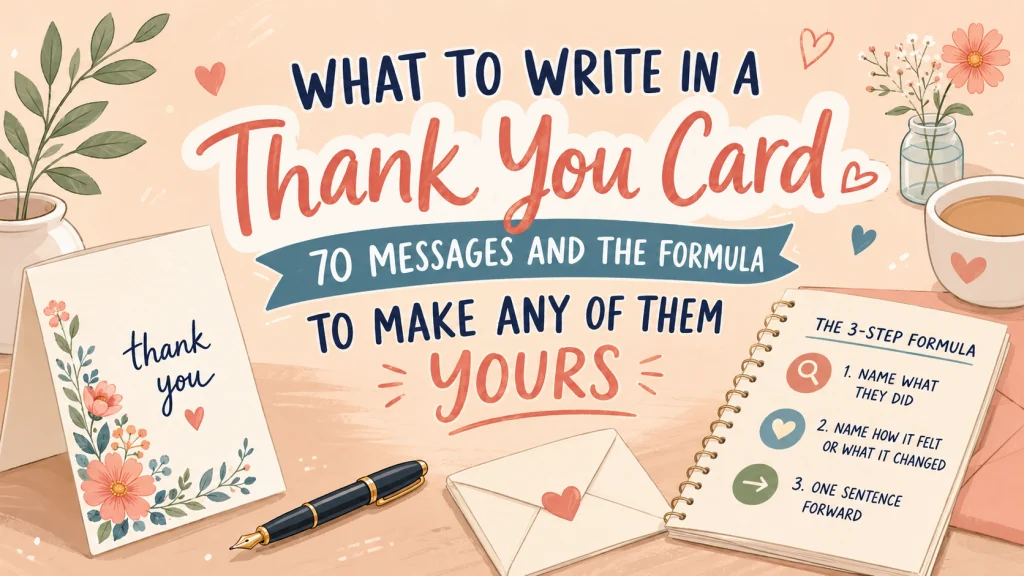
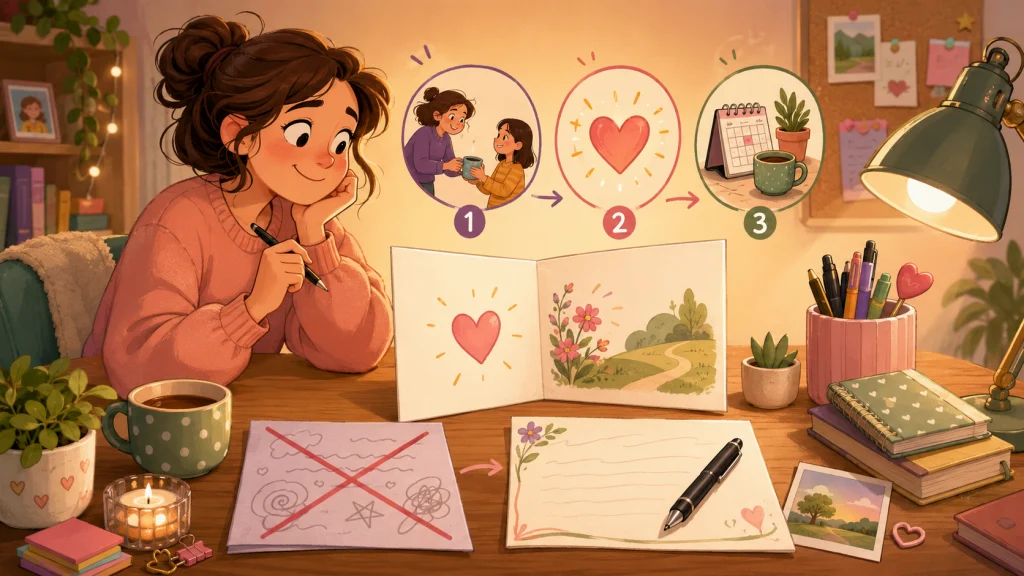
Every thank you card that works follows the same underlying structure, whether the writer knew it or not. Name one specific thing the person did. Name how it made you feel, or what it changed. Close with one sentence that looks forward. Three parts. That is the whole of it.
The reason this matters is that most cards collapse at step one. They say “thank you for everything” or “I am so grateful for your support” and stop there. These sentences are not wrong, but they do not sound like anything. They sound like a form email, and the person reading them can feel that. The formula is not a structure to fill in mechanically. It is a way of thinking about what the card actually needs to do.
| Formula step | What it looks like when it is vague | What it looks like when it is specific |
|---|---|---|
| Name what they did | Thank you for everything. | Thank you for driving two hours to help me move. |
| Name how it felt or what it changed | It meant so much to me. | It meant I did not have to do the hardest day alone. |
| One sentence forward | I appreciate you. | I am not forgetting that anytime soon. |
The vague version is not false. It is hollow in the way all interchangeable things are hollow. The specific version says something that could only be said by someone who was actually there. That is what makes a card worth keeping, and worth writing in the first place.
You do not need to write three sentences. Sometimes the formula collapses into one, if the sentence is specific enough. “Thank you for staying” does more work than a paragraph that talks around the same feeling. What you are looking for is the detail that makes the card sound irreplaceable, because it is.
Short Thank You Card Messages for Any Occasion
Short does not mean less. Some of these are a single sentence, and they earn it. The right short message gets read, felt, and remembered in a way that a longer one sometimes does not. These work across most occasions because they are built on genuine feeling without a specific situation baked in, which makes them easy to adapt. If you are working through a larger set of variations in this format, the short thank you messages collection has more options across several tones and relationships.
Pick the one that sounds closest to how you actually feel, and change any word that does not fit. These are meant to be the starting draft, not the final word.
- You showed up when it counted. I will not forget that.
- Thank you. Not the automatic kind. The kind where I mean every word of it.
- What you did made a real difference. I wanted to make sure you knew.
- I am so glad I have you in my corner.
- Grateful does not quite cover it, but it is where I will start.
- You did not have to do that. I am really glad you did.
- This meant more to me than I know how to put in a card this size.
- The kindness you showed me is not something I take lightly.
- Thank you, sincerely. That is the whole message.
- You made something hard a lot easier. That is not a small thing.
- I noticed. I appreciated it. Thank you.
- Some things you say once and mean forever. This is one of them.
The ones that work best in this format are the ones you do not over-qualify. “Thank you, sincerely” lands harder than “I just wanted to take a moment to say a sincere thank you for everything you have done.” There is real weight in restraint, if the restraint is honest. Trust the sentence and send it.

Heartfelt Thank You Card Messages
These go deeper. They are for the moments where a short line does not reach far enough, where the situation asks something more of you and you want the card to match that weight. Longer does not always mean better, but there are occasions where more room gives you more to work with. For a wider range of options in this register, the heartfelt thank you messages collection covers more ground across different relationships and occasions.
The pattern I keep seeing with heartfelt cards is that people go vague when they mean to go deep. They reach for large words, hoping the size of them carries the feeling, and end up with something that sounds like a greeting card and not like themselves. The messages below try to stay specific even when they are being sincere, because that combination is what actually moves someone.
- What you did for me sits in the category of things I will carry for a long time. Thank you feels small compared to that, but I mean it in the fullest way I know how.
- There is a version of that time that looked a lot harder, and then you showed up. You changed what it turned into.
- I have thought about what you did more than once since it happened. Not because I am dwelling on it, but because it was genuinely one of the kindest things anyone has ever done for me.
- You gave me something I did not know how to ask for. I am still figuring out how to thank you properly, so I am starting here.
- The thing about what you did is that it arrived at exactly the right moment. I do not know if you knew that, but I want you to know it now.
- I am someone who finds thank yous hard to write, which is probably why I have been putting this off. But I did not want more time to pass without saying: what you did was quietly, genuinely wonderful.
- You stepped in without being asked, without making it a thing, and without expecting anything back. That is not nothing. That is actually everything.
- Thank you for what you did, and for the way you did it. Both parts mattered.
- Some kindness you recognize in the moment. Some of it you only understand later. This was the second kind, and I am grateful for it either way.
- You did not make a big deal out of it, and I keep thinking about that. The quiet gestures are often the ones that mean the most.
- I have been trying to write this card for a week. Not because I do not know what I feel, but because what I feel is too large for a card. This is my best attempt anyway. Thank you.
- The care you put into this did not go unnoticed. It went deep.
- Some people say the right thing. Some people do the right thing. You managed both, and I am really glad you are in my life.
- I did not have words for what I felt at the time. I am finding them now, and they all come back to this: thank you for being who you are.
If you are taking one of these and making it yours, the line most worth replacing is the one I left general. Put in the specific thing they did, and the rest of the card does its own work. Specificity is not decoration here. It is what turns a sincere-sounding sentence into a sincere one.
Thank You Card Messages After Receiving a Gift
The thank you card after a gift is one of the most common and, I think, one of the most often fumbled. The two extremes people fall into: a three-word acknowledgment that sounds obligatory, or an over-the-top response that sounds like performing gratitude rather than feeling it. What works is somewhere in between, one true thing about the gift and one true thing about the person who gave it.
A note worth making: if you genuinely loved the gift, say that specifically. If you did not, say something true anyway. “This was so thoughtful” does not require you to love what you received. It requires you to mean it when you say it, which is a different thing entirely and almost always possible.
- This was so thoughtful. You managed to find exactly what I did not know I needed.
- I love it, and I do not mean that in the automatic way people say it when something needs to be said. I mean it because I have already used it twice.
- Thank you for this. You clearly put real thought into it, and it shows.
- You did not have to do this, and you definitely did not have to do it this well.
- I cannot tell you how much I love this. I can tell you I have already told three people about it.
- This is one of those gifts that is going to keep reminding me of you. Which, given that you are you, is a very good thing.
- You got it exactly right. I do not say that lightly, because getting someone exactly right is genuinely hard.
- Thank you for knowing me well enough to pick something like this.
- I did not expect this, which made it land even harder. Thank you for being the kind of person who thinks of others the way you do.
- The gift was wonderful. The fact that it came from you made it more so.
- It may take me a while to thank you properly. Consider this card the beginning.
- You always know how to make someone feel genuinely seen. This is a perfect example of that.
The last line in several of these does more work than it looks like it does. Connecting the gift back to the person giving it, what it says about them and not just what it is, is what makes a gift thank you feel personal rather than transactional. The gift prompted the card. The person earned it.
Thank You Card Messages After Someone Supported You Through a Hard Time
These are different from the others. When someone has held you through something difficult, the thank you card carries a different kind of weight. It is not just about what they did. It is about what it cost them to show up, and what it meant that they did anyway.

What tends to go wrong here is trying to describe the hard time in the card. You do not have to name what happened. The person knows. What you are saying is that you noticed how they showed up, and that you have not stopped noticing. That is the card. Everything else is optional detail.
- During the hardest stretch of that time, you were steady. I noticed. I will not forget it.
- You checked in when you did not have to, showed up when most people stayed quiet, and never made me feel like a burden. Thank you.
- What you gave me during that time was not advice or solutions. It was presence. That turned out to be exactly what I needed.
- I got through that in part because of you. I want you to know that plainly.
- The thing about going through something hard is that you find out who shows up. You showed up. Thank you.
- You sat with me in it rather than trying to rush me out of it. That kind of patience is rare, and I do not take it for granted.
- I am doing better now, and part of why is because you stayed. Thank you for staying.
- You said exactly the right thing at the right time, and then you let it breathe. That combination is harder than it sounds.
- When I was in the middle of it, I did not have the words. Now that I am on the other side, I wanted to say this: what you did mattered enormously.
- Not everyone knows how to be there for someone in a real way. You do. Thank you for being one of those people.
If you want to extend any of these into something longer, the place to add is in the middle. Name one specific moment: the message they sent at an unusual hour, the time they drove somewhere without being asked, the way they did not push when you needed space. That one moment makes everything else in the card feel true.
Thank You Card Messages for a Teacher or Mentor
A thank you to a teacher or mentor sits in a category of its own, because the impact often takes time to understand. By the time you know what someone taught you, months or years may have passed since the teaching itself. That is not a reason not to say it. If anything, saying it later with full understanding carries more weight than saying it early before you knew what stayed.
What I have found with these cards is that the most powerful thing you can say is exactly what stayed with you. Not “you were a great teacher” but “you taught me to ask one more question before deciding I understood something, and I still do that.” The specific thing is the point. Without it, the card sounds like appreciation. With it, it sounds like proof.
- I came into your class knowing very little and left knowing I had been changed in ways I am still discovering.
- Thank you for teaching me the subject. More for teaching me how to think about it.
- I am not sure you know the weight of what you did for me, so I wanted to say it directly: you made a difference.
- The way you pushed me when I was ready to settle stuck with me long after the class was over.
- Thank you for taking me seriously when I was still figuring out how to take myself seriously.
- I have had a lot of teachers. You are one of the ones I think about when something difficult finally gets clear.
- What you gave me was not just knowledge. It was the confidence to use it.
- I am writing this because I wanted you to know your work reaches further than the classroom.
- Thank you for the patience when I needed it, and the push when I needed that instead. You read it right both times.
- I will carry what I learned from you for the rest of my working life. That is not something I say about many people.
These work whether you are writing to a teacher from years ago or someone who has been mentoring you more recently. The principle is the same: name the specific thing that stayed, and say where it went. The person you are thanking spent time on you. Showing them where it landed is the most honest return on that.
Professional Thank You Card Messages
Professional thank you cards are their own kind of challenge. The register is different: you want warmth without overfamiliarity, specificity without revealing more than the relationship calls for, and genuine gratitude without it reading like a performance review. Threading that needle is harder than it sounds, but the same rule applies here as everywhere else: name the specific thing.
The most common mistake in professional thank you cards is being so careful about tone that the card ends up saying nothing at all. “Thank you for your time and expertise” is not wrong, but it could describe a transaction with anyone. The cards that work in a professional context still name something real, even if that real thing is professional. A good collection of thank you messages across different relationships and registers can help when you are navigating more than one context at once.
- Thank you for your time, your candor, and the care you brought to this. It did not go unnoticed.
- Working with you reminded me why good collaboration is so rare and worth seeking out. Thank you for making this feel like that kind of work.
- I appreciate the effort you brought to this. It made the difference on our end.
- Thank you for the referral. I know that comes with your reputation attached, and I do not take that lightly.
- Your support during this transition made a real difference to how it landed. I wanted you to know that directly.
- Thank you for covering when it mattered. That kind of reliability is not something I take lightly, and not something I will forget.
- The feedback you gave me was difficult to hear and exactly what I needed. I appreciate the honesty more than the easier version would have been.
- Thank you for the opportunity, the trust, and the space to do the work the way it needed to be done.
- I am grateful for the chance to work with someone who takes this as seriously as you do.
- What you shared in that meeting pointed me in a direction that turned out to be the right one. Thank you for that.
- Thank you for making the handover as smooth as it was. I know that took more work on your end than it appeared on mine.
- I wanted to say this in writing, because some things deserve a more permanent record than a quick message.
That last one is worth considering even when the occasion does not feel significant enough to warrant a card. Part of what makes a professional thank you card mean something is that you chose to write one at all. The choice itself is the statement.
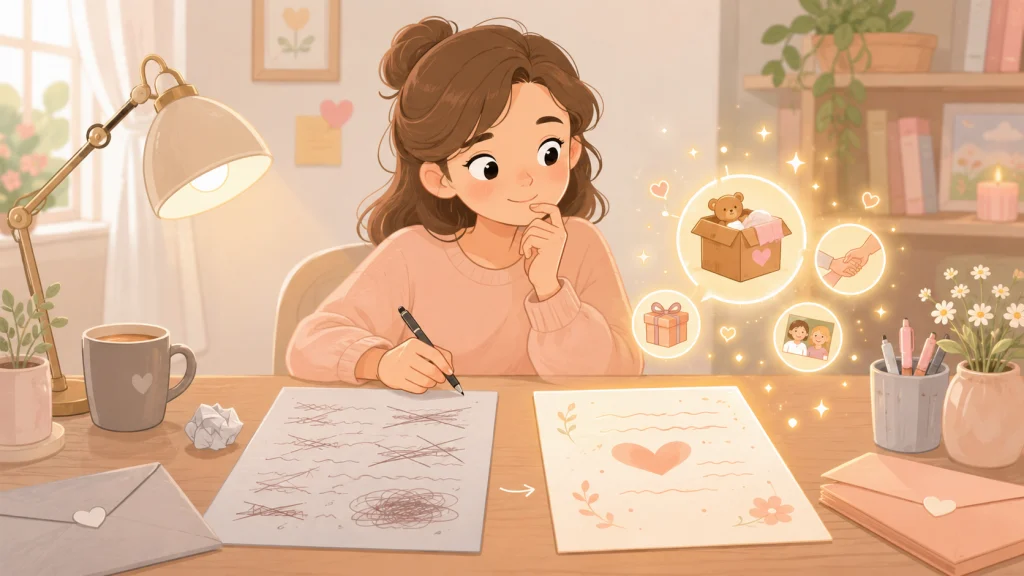
What Not to Write in a Thank You Card
There are a few phrases that turn up in thank you cards constantly, and while none of them are technically wrong, they reliably make the card feel less personal than it could be. They are worth recognizing before you sit down to write, because most people use them out of habit rather than intention.
“Thank you for everything.”
This is the most common one and the most diluting. It sounds comprehensive, but what it communicates is that you did not want to pick something specific. Everything is not a feeling. Everything is a category. If the person did one thing that mattered, say that one thing. The specificity is what makes it land, and the absence of specificity is what makes even sincere cards feel like they were written on autopilot.
It comes from a good place, which is worth acknowledging. People reach for “everything” because they mean a great deal and want the word to carry all of it. But “everything” carries nothing. A single specific moment carries more weight than you might expect, precisely because it proves you were paying attention.
“I just wanted to say…”
The word “just” shrinks whatever comes after it. It turns gratitude into an apology for taking up space. You are not just doing anything. You are writing a card because something mattered enough to write about, and that is worth treating as a complete statement on its own.
This one is a habit rather than an intention. Most people do not notice they write it until they read the card back. Read your draft before you seal it and cut every “just” that is doing this job. The sentence will be stronger without it every time.
“Words cannot express how grateful I am…”
And then they go ahead and try to express it for two more sentences. The contradiction undercuts the sentiment. If words cannot express it, do not say so in words. Find one specific thing you can say, and say that instead. That constraint is not a limitation. It is the form.
The honesty that works in thank you cards is not the honesty of saying something is beyond language. It is the honesty of naming the small specific true thing. “You drove through traffic on a summer Friday and helped me carry boxes for six hours” is not poetic. It is exactly true. That is what makes it something the person will not forget reading.
Final Thoughts: The Card Is Already the Effort
There is something about writing a card, by hand or otherwise, that carries weight just from the choice to do it. Texts disappear into conversation threads. An email gets archived. A card is a small, deliberate act of saying: this was worth more than a quick message, and so are you. That choice lands before a single word is read.
The 70 messages above are starting points, not scripts. Take the one that sounds closest to what you want to say, and change anything that sounds like someone else. Put in the name of the specific thing they did. Change the forward-looking sentence to something that belongs to your particular relationship with this person. And then write it down, because the message you keep almost sending is not the same thing as the one they actually receive.
For occasions that go beyond the card format, the daily messages section covers a wider range of everyday moments: the check-ins, the small celebrations, the texts that feel harder to write than they should. Gratitude in a card and gratitude in an ordinary message are not that different in what they ask of you. Name the thing. Say what it meant. Send it.
FAQs
💬 How long should a thank you card message be?
Three to five sentences is usually enough. If you have named what they did, said how it landed, and closed with one sentence that looks forward, you are done. Longer is not deeper. It is usually just more uncertain.
🖊️ What do you write when you have no idea what to say?
Start with the most specific thing you can remember: what they did, one small detail of it. The card almost writes itself from there. Not knowing what to say usually means not having picked one thing yet. Pick one moment and go from it.
🎁 Can you write a thank you card for a gift you did not love?
Yes. You do not have to say you loved the gift. Say what is true: that the thought behind it mattered, that the gesture meant something, that you are glad they were thinking of you. All of that can be completely sincere without requiring you to love what you received.
⏰ Is it too late to send a thank you card after a few weeks?
It is almost never too late. A card that arrives late and acknowledges it briefly is far better than no card at all. Most people are not counting the days. They are noticing whether you said something, not when.
💼 What should a professional thank you card actually say?
Name one specific professional thing they did, say what it meant to the outcome, and close simply. Warmth without overfamiliarity is the goal. “Thank you for your time” is fine. “Thank you for the candor in that meeting, it pointed me in the right direction” is better.
✍️ Does a thank you card have to be handwritten?
It does not, but handwriting carries a different weight because it is slower and harder. If the occasion is significant and the relationship is close, handwriting it says something before a single word is read. For professional contexts or quick acknowledgments, typed or printed is fine.