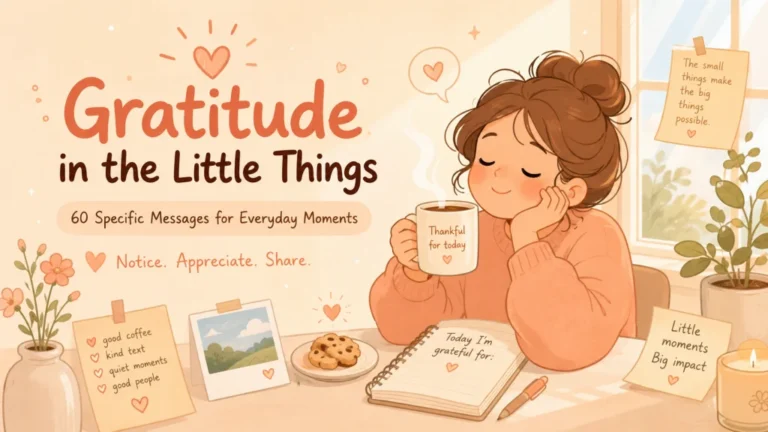
Gratitude messages are not just for thanking someone after they did something kind. They are for the quieter moments: noticing a person who keeps showing up, naming a small thing that made the day feel lighter, putting into words what you feel lucky to have. This page is the main space for that kind of writing, with messages for everyday appreciation, short texts for cards and quick notes, words for the people who matter most, and language for blessings that tend to go unnamed. Pick what fits your moment, and send it before the impulse passes.
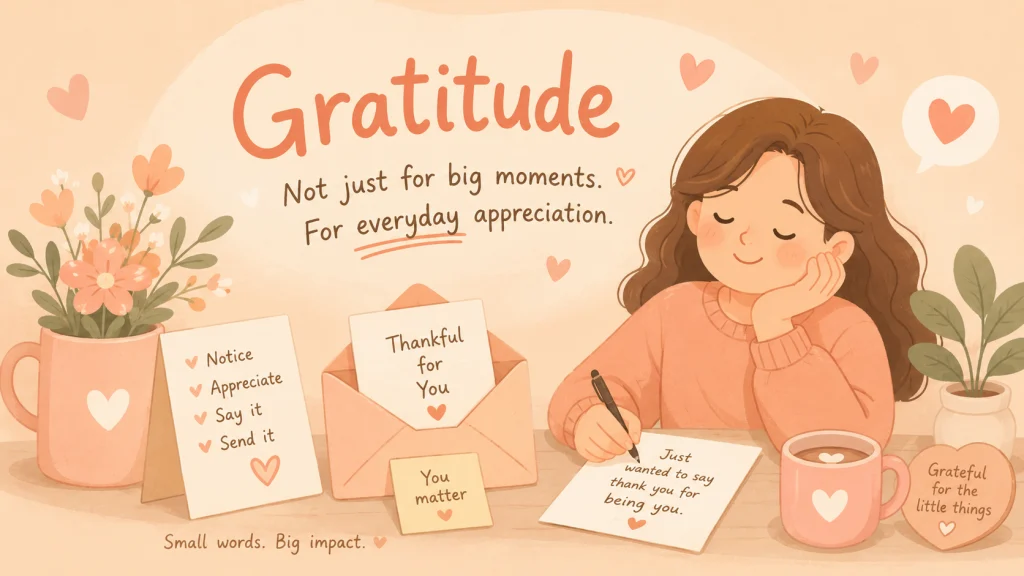
Gratitude Is Not Only a Response
Most people think of gratitude messages as something you send after. After the gift, after the favor, after someone went out of their way for you. Those messages matter, and there is a whole other page on this site dedicated to thank-you writing for exactly those moments. But the grateful messages I find myself returning to most often are the ones that do not wait for a reason.
That distinction shapes everything about how you write them. A response to a specific act is a thank-you note. What we are talking about here is broader: appreciation for a person, a moment, a season of life, a habit of noticing what is good before it passes without comment. The best gratitude messages I have ever received were not in response to anything in particular. They landed in my phone on an ordinary afternoon and made me feel like someone had been paying attention without being asked to.
That is the only job these messages have. They say: I see this. I am not taking it for granted. They do not need to be long or poetic. They just need to be true.

What Makes a Gratitude Message Land Instead of Float
The most common mistake people make with appreciation messages is staying too general. “I am so grateful for you” is a kind and true thing to say. It is also forgettable, because it could have been sent to almost anyone. What makes a gratitude message feel real is specificity: the particular thing you noticed, the exact quality you appreciate, the moment you are naming instead of the feeling you are describing in the abstract.
I have written enough of these to know the difference in how they land. A message that says “I have been thinking about how you always answer the phone, no matter when I call, and I just wanted you to know I do not take that for granted” does something a generic message cannot. It tells the person that you have actually been thinking about them, not just reaching for a kind phrase. That specificity is not hard to achieve, but it does require stopping for a moment and asking: what is the actual thing I want them to know I noticed?
The other thing that helps is keeping the message proportional to the moment. A short, honest sentence sent on an ordinary day carries its own kind of weight. You do not need a paragraph to make someone feel seen. Sometimes one clear, aimed sentence does more than five careful, wandering ones.
Gratitude Messages for Everyday Appreciation
These messages are for the ongoing, quiet appreciation that does not always have a named occasion. They work on a regular day, in a card sent for no reason, or whenever you feel the urge to say something real before the moment slips past. What makes them different from occasion-driven messages is that they are entirely unprompted, and that is exactly what gives them their weight.
- I keep finding myself grateful for the way things are right now, and I wanted to say it out loud before it passed.
- Not reaching out for any reason except that I am glad you are in my life.
- Some people make ordinary days better just by being part of them. You are one of those people for me.
- I do not say this enough, but I notice what you do. I am grateful for all of it.
- Thinking about how much easier things are because you are around. That is not a small thing.
- I am grateful for exactly this: quiet days, good people, and enough. That feels like a lot.
- You are one of the reasons this period of my life is going to be one I look back on with warmth.
- I have been paying attention, and what I keep noticing is how much I have to be thankful for. You are near the top of that list.
- Just wanted to name something good today: you, and the fact that I get to know you.
- Grateful is not always a big dramatic feeling. Sometimes it is just this, a quiet awareness that things are good.
- I am not waiting for a reason to tell you this. I appreciate you, regularly and without conditions.
- Some days the gratitude just sits there and waits to be said. Today I am saying it.
What these have in common is that none of them require a specific event. The message does its job precisely because it was sent out of noticing, not obligation. That difference is always felt on the other end, even if the person receiving it cannot quite say why it landed the way it did.
Short Gratitude Messages for Cards and Texts
Sometimes the message needs to be brief. A card has limited space. A text should not run on. Or you simply know that a short, direct message will land better than a longer one, because the relationship is the kind where you do not need to over-explain. These work for all of that, and most of them could be sent as-is or adjusted by a word or two to fit the person you have in mind.
- So grateful you exist.
- Thankful for you, always.
- You make things better. I hope you know that.
- Grateful for this, and for you.
- Life is genuinely good right now, and you are part of why.
- I notice. I appreciate it. Thank you for being you.
- Just grateful today. Thought you should know.
- Being around you is one of the things I count when I am counting good things.
Short messages like these work best when they are sincere and unhesitating. Brevity reads as confidence. It says: I did not overthink this, I just meant it. That is actually harder to achieve than it sounds, because the instinct when you care about someone is to say more, not less. But the ones that stay with people are usually the ones that said exactly what they meant and then stopped.

Grateful Messages for People Who Keep Showing Up
There is a specific kind of gratitude for the people who have been there consistently: not in one dramatic moment, but across seasons, through changes, in the ordinary ongoing way that is actually the hardest kind of showing up. This is not about a favor or a gift. It is about the accumulation of a person choosing to be present, again and again, when they did not have to.
I think about one person in my own life who has been present through every city I have lived in, every shift in direction, every period that looked nothing like the one before it. I never quite found the right words for what that kind of continuity meant. Eventually I stopped looking for perfect words and sent something true, something that named the specific quality rather than the general feeling. That was enough. More than enough, actually.
- You have been there through all of it. I do not think I say thank you enough for that.
- The fact that you are still here, still showing up, still checking in, means more than you probably realize.
- I have been thinking about how much has changed and how consistently you have been part of all of it. That is not something I take lightly.
- Some people are good for a season. You have been good for all of them. I am grateful for that.
- Thank you for being someone I can always come back to, no matter how long it has been.
- You are one of the people who makes me feel like I have a home, even when home is not a place. I am grateful for you.
- I know showing up does not happen automatically. You choose it, every time. That matters to me enormously.
- I have watched you be generous with your time and your presence for as long as I can remember. I just want you to know I see it.
- Grateful for the kind of friendship that does not need a lot of maintenance to stay real. That is what we have, and it is a rare thing.
- You are proof that some people genuinely stay. Thank you for being one of them.
These messages carry more weight when you name the specific quality you are grateful for: the consistency, the reliability, the fact that they pick up. Vague appreciation is kind. Specific appreciation is the kind that stays with someone long after the message has been read and the screen has gone dark.
Gratitude Messages by Relationship and Season
The messages you need tend to shift depending on who you are writing to and what the circumstances are. Sending grateful words to a sibling feels different from sending them to a close friend, and both feel different from trying to name something good during a stretch of life that has not been easy. What follows is a set of messages organized by those different contexts, so you can find the right fit faster.
For Family and Close Friends
The people we are closest to are often the ones we forget to thank, partly because the gratitude is so constant it starts to feel like background noise. These messages are a way of pulling it to the foreground, saying plainly what tends to go unsaid between people who know each other too well to be formal and sometimes forget to be explicit.
- I do not think I say this often enough: having you in my life is one of the things I feel genuinely lucky about.
- You are the person I call without thinking. That kind of ease is something I never want to take for granted.
- Grateful for you the way I am grateful for things I cannot imagine being without. That is the whole thing.
- Thank you for being someone I never have to explain myself to. That is a rarer gift than it sounds.
- I know we do not always say it, but I want to say it today: you matter to me more than I usually find the words for.
- Being family means a lot of things. The part I am most grateful for is that you chose to show up the way you do.
These work as texts, voice messages, or handwritten notes tucked inside a card with no occasion attached. The absence of an occasion is part of the point: you are saying it because it is true, not because a date on the calendar told you to.
For Hard or Uncertain Seasons
Gratitude in a difficult period is not about pretending things are fine. It is about finding what is still good inside a stretch of life that is otherwise hard, naming it honestly, and letting that count for something. The messages below are not relentlessly positive. They acknowledge the difficulty while still pointing at what remains worth holding onto.
- Things have not been easy lately, but I keep coming back to how grateful I am that you are in this with me. That is not nothing.
- I am not sure what this season is teaching me yet. But I know I am grateful you are on the other side of the phone when I need to figure it out out loud.
- Even in the middle of hard things, I find pockets of good. You are usually one of them.
- Grateful for the days that felt manageable, for the people who made them that way, and for the slow knowledge that this will pass.
- Some seasons teach you who your people are. I already knew you were one of mine. But this confirmed it.
- I am not going to say things are fine. But I will say that having your support makes a real difference, and I do not take it lightly.
Gratitude and difficulty can coexist. A message that acknowledges both is usually more honest than one that tries to be wholly positive, and the person on the other end can feel the difference between sincerity and performed cheerfulness.
For Someone Who Makes Your Life Noticeably Better
There is a category of person who improves the texture of daily life in ways that are hard to quantify but easy to feel. They might be a neighbor, a colleague, a friend you see often, or someone whose presence simply makes the ordinary parts of the day feel lighter. These messages are for them, for the kind of gratitude that is not tied to a single act but to an accumulated effect.
- My days are genuinely better when you are part of them. I do not think I tell you that enough.
- You are one of those people who raises the quality of a room just by being in it. I appreciate that more than you know.
- Something I have noticed: things just go better when you are around. I wanted to say thank you for that.
- Grateful for you in the everyday sense, not just the big moments. You make the whole thing better.
- You are the kind of person I feel lucky to know. That is all I wanted to say.
- I realized the other day how much lighter things feel when you are around. I just wanted you to know I notice that.
Messages in this category tend to land with particular force because they describe an effect rather than an event. The person you are writing to may not even realize they do this. Telling them is a gift of its own.

Messages About Blessings and the Little Things That Make a Life Feel Good
Not all gratitude is directed at a person. Some of it is more diffuse: a general sense of noticing what is good, the light at a certain time of day, a meal that turned out right, a morning that did not demand anything from you. Blessings messages try to name that kind of gratitude without letting it go vague. The challenge is saying something concrete enough to feel real without being so specific it only applies to one person’s particular Tuesday.
What tends to work is anchoring the message in a small, sensory detail and letting the larger feeling follow from it. “I am grateful for coffee that is exactly the right temperature and nothing urgent on the calendar this morning” is more interesting to read than “I am grateful for the little things.” Both are true, but only one of them is readable. If you want to go deeper into this kind of writing, the collection of messages about gratitude for small everyday moments takes this specific angle much further.
Today I am grateful for: the window light this morning, the fact that this coffee exists, and the knowledge that the people I love are okay. That is not nothing. That is almost everything.
I woke up thinking about how many small good things are just sitting there, waiting to be noticed. Today I am going to try to notice them. I hope you find a few of your own.
Messages like these, whether sent to a friend or kept as a private note, have a way of reorienting a day. They are less about the recipient and more about the practice of paying attention. If you are looking for words that go even further in that direction, the count your blessings messages collection covers this ground with more depth and more examples to choose from.

Presence, Joy, and the Gratitude That Comes from Paying Attention
Some of the most powerful appreciation messages are not explicitly about gratitude at all. They are about noticing: a moment that felt complete, a conversation that left you better than it found you, a day that did not demand anything extraordinary but somehow felt exactly right. Writing about those moments, even briefly, is its own form of gratitude. It says: I was here, I paid attention, I did not let this pass without naming it.
That kind of message tends to land differently from a straightforward thank-you. It is less of a transaction and more of an invitation. You are not just expressing appreciation; you are pointing at something and asking someone else to look at it alongside you. The writing about slowing down and being present explores that angle more, if that is closer to what you are trying to say. And if what you are after is something more like pure celebration of what is good, the joy messages collection is the right place to look.
What I keep finding, across all of this, is that gratitude and joy and presence tend to arrive together. You cannot really notice what is good without slowing down first. And when you slow down, you tend to find more than you expected. That is worth naming, in whatever words you have, to whoever would be glad to hear it.
Final Thoughts: Pick Your Angle and Say Something True
Gratitude is a broad word for a lot of different feelings. What you are after might be a message for a specific person who has been there for you through something. It might be a short line for a card that needs to say something real without saying too much. It might be a more reflective note about the kind of life you find yourself grateful for, with no particular recipient in mind. All of those belong here, and all of them are worth writing.
The one thing that runs through every category on this page, from the everyday appreciation messages to the blessings and the little things, is that the message works best when it is aimed at something specific. Name the person, name the quality, name the moment you do not want to let pass unacknowledged. Gratitude that points at something real hits the target. Gratitude that gestures at everything tends to land nowhere in particular, and the person on the other end can feel the difference.
You already know what you are grateful for. The collections below can help you find the right angle for it. Pick the one that feels closest, and send the message before the impulse has a chance to talk itself out of it.
FAQs
💬 What do you say in a gratitude message?
Name something specific: a person’s quality, a moment, or something you noticed that you do not want to take for granted. The more concrete you are, the more the message feels genuine rather than generic. One or two sentences that point at something real will almost always land better than a longer message that stays vague.
🙏 How do you express deep gratitude in words?
Deep gratitude comes through specificity, not length. Say what you are grateful for, why it matters, and what it would have looked like without it. You do not need elaborate language. What you need is honesty and a willingness to be direct about what the person or moment actually meant to you.
✉️ What is a short message of appreciation?
Something like: “You make things better. I hope you know that.” Or: “Thankful for you, always.” Short appreciation messages work best when they are confident and unhesitating. Write what you mean, keep it brief, and send it before you start second-guessing whether it is enough.
🌿 What is the difference between gratitude and appreciation messages?
In everyday use, they overlap considerably. Gratitude tends to focus on what you have received or noticed about your life more broadly. Appreciation often points more specifically at a person or their qualities. Both aim to say: I see this, and I am not taking it for granted. The distinction mostly matters when you are choosing which angle fits best for the message you want to send.
💛 Can I send a gratitude message for no reason?
Not only can you, it is often the most effective moment to send one. An unprompted message on an ordinary day carries a different kind of weight than one tied to an occasion. It tells the person: I was thinking about you not because I had to, but because I wanted to.
📝 How long should a gratitude message be?
As long as it needs to be and not a sentence more. For a text, one to three sentences is usually right. For a card, three to five. For a longer personal note, more is fine if every sentence is earning its place. The length should follow the depth of what you are trying to say, not a word count.