
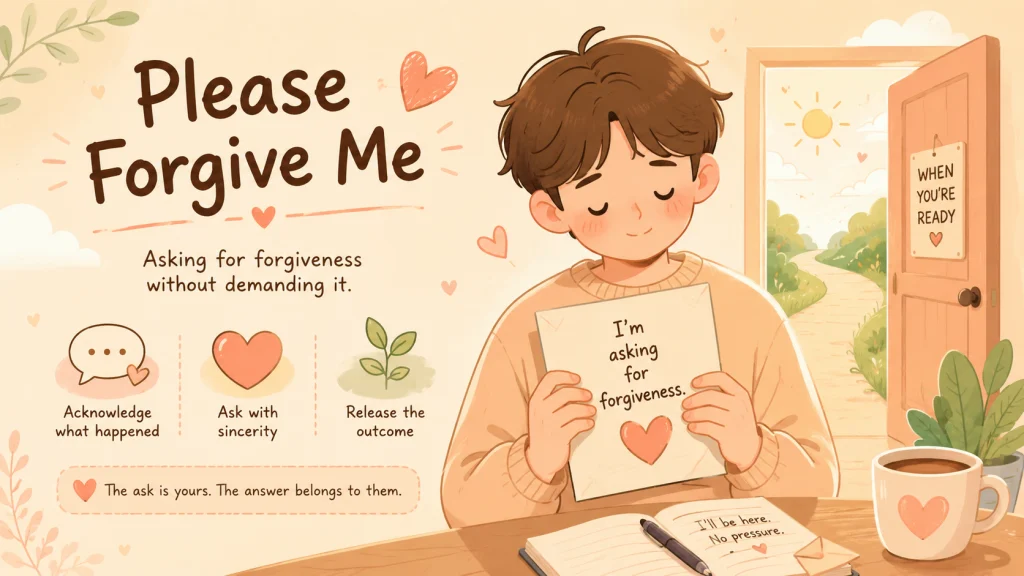
Asking for forgiveness is not the same as apologizing. The apology is what you say about what you did. The ask for forgiveness is what you say about what you want to happen next, and that is a harder thing to get right. These 60 please forgive me messages are built around one principle: you can ask for forgiveness without demanding it. The ask is yours. The answer belongs to them.
You will find messages here for every stage of that ask: the first time you say it, the moments when you want to give them room to breathe, the times when you have already apologized and are waiting, and the situations where a short text or a longer explanation is what fits the moment.
Asking for Forgiveness Is Not the Same as Apologizing
Most people treat these two things as one action. They apologize, and somewhere inside that apology is the implied request: now forgive me. But that framing puts the weight in the wrong place. The apology belongs to you. You own it entirely. What happens after it, whether the other person can forgive you, and when, and how, belongs entirely to them.
Separating those two things is harder than it sounds, especially when you are in the middle of it. Guilt has a way of making the other person’s forgiveness feel like the only thing that will make it stop. But asking for forgiveness to relieve your own guilt is not really asking for forgiveness. It is asking for permission to feel better. The person on the receiving end can usually tell the difference, even if they cannot name it.
These messages try to make the ask clearly and leave the answer genuinely open. Some are short. Some give more space for explanation. None of them are designed to pressure the other person into a response. That is the whole point of them.

When “Please Forgive Me” Goes Wrong
I have seen this pattern more than once in the messages people write when they are trying to ask for forgiveness: the message starts as an ask and somewhere in the middle becomes a case for why the person should forgive them. It shifts from “I am asking” to “here is why you should say yes.” That shift is usually invisible to the person writing it, but it changes everything about how the message lands.
A genuine ask for forgiveness does three things. It acknowledges what happened. It makes the request clearly. And it releases the outcome. Not performatively, not as a strategy, but genuinely. If the message you send is secretly designed to make it very difficult for the other person to say no, it is not really an ask. It is a pressure campaign dressed up as vulnerability.
That distinction, the one between asking and demanding, is what I keep coming back to when I think about what makes these messages work. The asking-without-demanding angle is mostly absent from what people find when they look for help in this territory, so that is the gap these messages are trying to fill. For the apology itself, before the ask, apology messages for relationships covers that stage in detail.
Messages That Ask and Release the Outcome
These are for the first, clear ask. They say what they need to say and stop there. The goal is not to convince the other person. The goal is to let them know the door is open without pushing them through it.
| Where you are in the process | Which section to use |
|---|---|
| Making the first clear ask, no strings attached | Messages that ask and release |
| They need space and you want to respect it | Messages that give space to process |
| You have already apologized and are following up | When you have already said sorry |
| You want something short, no occasion attached | Short texts |
| Time has passed and you are revisiting | When it has been a while |
| You need to say more than one or two sentences | Long messages |
- I am asking you to forgive me. I am not asking you to do it now, or on any timeline I set. I just want you to know the door is open whenever you are ready.
- I know I hurt you. I am not going to pretend otherwise or ask you to minimize it. I just hope that when enough time has passed, you will be able to forgive me. I will be here.
- Forgiveness is yours to give whenever you are ready, or not at all. I just wanted you to know I am asking for it.
- What I did was wrong. I have sat with that. If you can find your way to forgiving me, I would be grateful. If you need more time, I understand that too.
- I am not asking you to forget what happened. I am asking you to forgive me when, and if, you are able to. Those are different things.
- I hope one day you can forgive me. I mean that without any pressure attached.
- I know this is not something I can rush. I am asking for forgiveness and I am willing to wait for your answer as long as you need.
- You do not owe me forgiveness. I know that. I am asking anyway, because what we had matters to me more than my pride.
- I want you to know that I am sorry, and beyond sorry, I am asking you, genuinely, if there is a path toward forgiveness. I will follow your lead on where it goes.
- This is not me asking you to be okay with what happened. It is me asking if there is a way through it. When you know, I will be listening.
- I hurt you, and asking you to forgive me feels like the smallest and hardest thing at the same time. I am asking anyway.
- Please forgive me, if you can. Not because I deserve it, but because I still believe there may be something here worth handling with care.
The one I keep coming back to is the last one on that list. It shifts the frame away from what the sender earns and toward what the relationship may still be worth holding gently. That tends to land differently than a message that is only about accountability.

Messages That Give Them Space to Process
There is a specific situation where the worst thing you can do is follow up too quickly. The other person is still in it. They have not had time to sit with what happened, or with your apology, or with the question of whether forgiveness is even possible right now. Sending message after message asking them to respond is not patience. It is pressure.
These messages acknowledge that explicitly. They say: I am asking, and I am also stepping back. The phrasing matters here. “Take your time” can sound performative if it is followed immediately by more messages. “I am not going anywhere” lands better when there is actual evidence of that, when you actually stop contacting them and give them room.
- Take all the time you need. I am not going anywhere, and I am not going to ask again until you are ready to talk.
- You do not have to respond to this. I just wanted to put it out there: I am asking if you can find a way to forgive me, in your own time.
- I know you need space right now. I am not asking you to decide anything yet. I just wanted you to have this.
- Whenever you are ready, I am here. If you need weeks, take them. If you need months, I will still be here.
- I am not going to keep sending messages. I just want to say once, clearly: I am asking for your forgiveness, and I will respect whatever you decide.
- If you need to be angry for a while before you can even think about forgiveness, that is completely fair. I will wait.
- There is no rush. I am asking for your forgiveness when you are ready to give it, and not a moment before.
- I know that trust takes longer to rebuild than it took to break. I am prepared for that. I am not asking for an answer today.
- You can take this message or leave it. I hope you take it: I am asking you to forgive me, and I mean it without any conditions on your response.
- Forgiveness is not something I can ask you to produce on a schedule. I am just letting you know I am hoping for it, and I will wait.
What these messages do that most forgiveness asks do not is give the other person explicit permission to take their time. That permission, when it is genuine, can change how the whole conversation feels.
When You Have Already Said Sorry and Are Still Waiting
This is a specific and difficult position to be in. You have already apologized. You meant it. And now there is silence, or distance, or an answer that has not come yet. Following up in this situation requires care, because the line between checking in and applying pressure is thinner than it looks from the inside.
The key is to separate the apology from the ask for forgiveness. You have already said sorry; that stands on its own. What you are doing now is asking a different question. These messages try to make that distinction clear, rather than treating the follow-up as another apology, which can come across as re-opening the wound instead of waiting outside it. If what happened was serious enough that a single apology did not cover it, a more thorough apology for a serious mistake might be worth sending before you reach the forgiveness ask.
- I said everything I needed to say the other day. I just want to ask, quietly, if forgiveness is something you can see from where you are right now.
- I know I already apologized. I am not bringing it up again to relitigate what happened. I am just asking, as clearly as I can, for your forgiveness.
- The apology I gave you was genuine. This is separate from that. This is me asking, when you are ready, if you can let me back in.
- I have said sorry. I mean it more than I have ever meant those words. I am also asking something harder now: please forgive me. When you can.
- I am not going to rehash everything. I just want to know if there is a way forward. If forgiveness is possible, I am ready to meet it.
- You do not have to respond. But I wanted to say: I am still here, still hoping, still asking if you can forgive me.
- I know time needs to pass before this can be answered. I am not asking for an immediate answer. I am just keeping the question open.
- The apology was real. The asking is real too. Please forgive me, on whatever timeline makes sense for you.
- I keep thinking about what I said and whether I said it right. I think I did. Now I am asking the next question: can you forgive me?
- I am still thinking about what I did, and still wishing I could undo it. Since I cannot, I am asking: is there a way to forgive me? I will wait as long as it takes.
Short Please Forgive Me Texts
Sometimes the right ask is one sentence. Not because the situation is simple, but because everything important has already been said and adding more words would only obscure it. These short messages work best when the longer conversation has already happened, or when you want to say the thing plainly and let it stand without explanation.
Short does not mean casual here. A one-sentence ask for forgiveness, sent without decoration, can carry more weight than three paragraphs of justification. The brevity signals that you are not trying to talk them into anything.
- Please forgive me. I mean it completely.
- I hope you can forgive me. I understand if it takes time.
- I am asking for your forgiveness. No pressure on your answer.
- Forgive me, please. When you are ready.
- I hurt you. I know. I am asking if there is a way back.
- Please forgive me. Not asking you to forget. Just to forgive.
- I need you to know I am asking for forgiveness, not assuming it.
- I hope you can find a way to forgive me. I will be here.
- Forgiveness is yours to give. I am just asking.
- Please forgive me. That is all I am asking.
The ninth one is worth noting. “Forgiveness is yours to give. I am just asking.” It does something in nine words that most longer messages work hard to do: it separates your ask from their obligation. That framing is worth borrowing even when you write something longer.

When It Has Been a While and You Are Still Hoping
There is a version of this that happens months later, or even years later. The immediate conversation has settled. Life has moved on in most ways. But the unresolved thing is still there, and you want to say something about it without making it feel like you are dragging the other person back into something they have moved past.
These messages try to do that carefully. They acknowledge the time that has passed. They do not reopen the wound as though no time has passed. And they make the ask lightly, leaving plenty of room for the other person to say nothing at all. If what you are working toward is eventual reconnection rather than just closure, messages for making up after a fight covers that next stage once forgiveness has been given.
- I know it has been some time since what happened. I still think about it, and I still want to ask you, sincerely, if you can forgive me.
- Enough time has passed that I feel like I can ask this again without it seeming like pressure: is there any path toward forgiveness?
- I have not stopped thinking about what I did. I have also not stopped hoping you might be able to forgive me one day. I wanted you to know both of those things.
- I know we have both moved forward in a lot of ways. I just want to ask, while I still have the chance, if forgiveness is possible.
- The more time passes, the more I realize I owe you this question, not a demand, just a question: can you forgive me?
- I am not expecting a response. I just wanted to finally ask the thing I have been meaning to ask: please forgive me, if you ever can.
- I think about what I did to you more often than you might expect. I am asking, late as it is, if forgiveness is something you have found.
- It has been a while. I do not want to reopen anything painful. I just want to ask one more time, gently, if there is room for forgiveness.
- Time has a way of making things clearer. I see clearly now how much I hurt you. I am asking, even now, if forgiveness is something you can give.
- I know this might come as a surprise. I have been carrying this for a while. Please forgive me, if there is any part of you that is open to it.
When You Need to Say More Than a Line or Two
There are situations where a short message is not enough. The hurt was significant. The relationship is one where a two-sentence text would feel dismissive of everything that happened. Or you need to say the ask in a way that makes clear you have actually thought about what you did, not just about your desire to be forgiven.
These messages are longer by design. They are not scripts to copy word for word. They are closer to frameworks for how to make the ask when the stakes are high and you need the message to carry more weight.
I have been trying to figure out how to say this without making it about me, and I think the only way is to just be direct: I am asking you to forgive me. Not to excuse what I did. Not to pretend it did not hurt you. Just to hold it differently, when you are ready, and decide what moving forward means for you. I will not put a timeline on that. I just need you to know I am asking.
What I did hurt you in a way that I did not fully understand until afterwards. I have spent a lot of time sitting with that, not to make myself feel better but because I think you deserve someone who actually understands why they are sorry. I do understand now. And I am asking you, from that place of understanding, to forgive me when you are able to. There is no pressure in that ask, only hope.
I know that saying “please forgive me” can sound like a way of asking you to hurry up and be okay. That is not what I mean. What I mean is that I want you to know the door is open. That I am on the other side of it, still hoping. That whenever you are ready to walk through it, I will be there. That is all this is.
Forgiveness is hard. I know that. I am not asking for the easy kind that just makes discomfort disappear. I am asking for the real kind, the kind that acknowledges what happened and chooses to move past it anyway. I know that takes time. I am not here to rush it. I am just here to ask for it.
I am aware that asking for forgiveness when someone is still hurting can feel like more pressure at the worst possible time. I am trying not to do that. I am trying to ask in a way that gives you full permission to say not yet, or not at all. I just need you to know that I am asking because I care about us, not because I want to be let off the hook.
The thing about forgiveness is that I cannot make it only about what I want. It has to leave room for what you feel, what you need, and whether you are ready at all. I am asking because I believe there may still be something here worth caring for. If you do not feel that, I respect it. But I would rather ask gently than leave the question unsaid.
I keep thinking about what I would say if I only got one chance to say it clearly. I think it is this: I am sorry for what I did, and I am asking for your forgiveness. Not immediately. Not on any terms I set. Just when you are ready, and if you are ever willing. That is the ask. Everything else I will follow your lead on.
I do not want to make this a long explanation of my behavior, because I do not think that is what you need from me right now. What you need, I think, is to hear that I understand the impact of what I did, and that I am asking for forgiveness from that place of understanding rather than from a place of guilt-relief. I hope you can feel the difference. I hope, when you are ready, you can forgive me.
The last one in that set does something I think is worth naming: it distinguishes asking from guilt-relief. When you can say that clearly, in your own words, the person receiving it knows the ask is genuine. They know you are not just looking for the quickest way to stop feeling bad.

Final Thoughts: Make the Ask, Then Let It Go
The hardest part of asking for forgiveness is the part that comes after you send the message. You have said what you needed to say. The other person has it now. And you have no control over what happens next. That gap, the space between asking and receiving an answer, is where most people lose their footing. They follow up too quickly, or they interpret silence as rejection and send more messages, or they pull back so completely that the original ask gets lost.
What I have noticed is that the people who navigate this best treat their ask the same way after they send it as they said they would inside it. If the message says “take all the time you need,” and then three days later they send four more messages, the original message loses its meaning. The follow-through on patience is part of the ask itself.
Say it clearly. Say it once, or a small number of times that feels proportionate to the relationship and what happened. And then actually give the other person the space you promised them. That is not passivity. That is respect. And it is, in my experience, the thing most likely to leave the door open even when the answer is not immediate.
For the broader territory of love and repair in relationships, the full love and relationship messages collection has many more messages across every stage of a relationship, including the ones that come before and after this one.
FAQs
💬 What is the difference between apologizing and asking for forgiveness?
An apology is what you say about what you did. Asking for forgiveness is what you say about what you want to happen next. They are related but separate. You can apologize and not ask for forgiveness. You can ask for forgiveness after an apology that was already given. The ask comes after the apology, not inside it.
🕊️ How do you ask for forgiveness without sounding like you are pressuring someone?
The key is releasing the outcome inside the ask itself. Instead of “please forgive me” as a standalone demand, try “I am asking for your forgiveness, and I understand if you need time” or “this is the ask, and the answer is entirely yours.” Saying explicitly that you will wait, and then actually waiting, makes the message land differently.
📱 Should you ask for forgiveness by text or in person?
It depends on where the relationship is right now. If in-person conversation feels too charged, a text gives the other person room to read it and sit with it before responding. That can actually be kinder than putting them on the spot face to face. A message also lets you say exactly what you mean without the moment getting emotional before you finish.
⏳ How long should you wait before asking for forgiveness?
Wait until your apology has been received and the initial heat of what happened has had some time to settle. Asking for forgiveness in the immediate aftermath of a serious hurt often feels like you are rushing through the other person’s processing. Give it enough time that asking feels like a genuine reach rather than a continuation of the argument.
💙 What if they do not respond to your request for forgiveness?
Not responding is itself an answer, at least for now. It does not mean the door is permanently closed. It means they are not ready, or the hurt is still too present, or they need more time than you have given them. Sending more messages asking for a response usually makes things worse. Wait, give real space, and consider whether one more ask, much later, is appropriate.
🔄 Is it okay to ask for forgiveness more than once?
Once is usually right for the first ask. A second message, if significant time has passed and you still feel it is unresolved, can be appropriate. More than two tends to shift from asking to pressuring. The number matters less than the space between them and the tone of each one.