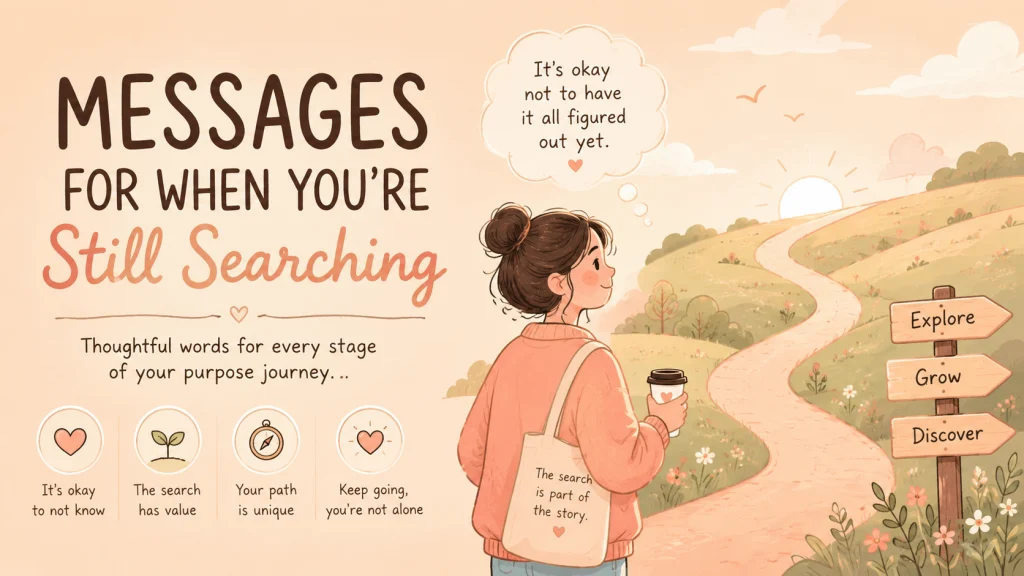
Most messages about finding your purpose are written for the moment after someone has already found it, the celebration, the cheering on, the relief. But that moment isn’t where most people actually are. These sixty are for the part before that: still searching, starting to wonder if the search itself means something, or picking up after something that used to feel like purpose is gone. None of them promise an answer is coming. They’re written for whatever stage of looking someone is actually in.
Most Messages About Finding Your Purpose Skip the Part That’s Actually Happening
Most messages about finding your purpose are written as if the purpose has already turned up somewhere and the only job left is to go get it. Go find what makes you happy. You have a purpose, you just have to discover it. Trust the process, it’ll make sense eventually. All of it treats the search like a waiting room, something to get through before the real part starts.
But most people sending or receiving a message like this aren’t standing at the end of that hallway. They’re somewhere in the middle of it, in the part that doesn’t have a name yet, where nothing has clicked into place and there’s no way to know if or when it will. That’s the part this list is actually for. Sixty messages, organized less around having the answer and more around whatever stage of not having it someone is actually in right now. If some of these sound less certain than what you’ve seen elsewhere, that’s on purpose.

Why the Search Itself Deserves Its Own Messages
Search for messages about life purpose and almost everything online assumes the same shape. There’s a stretch of struggle, and then there’s the answer: a calling, a passion, a “thing” someone was always meant to do. The struggle is the setup. The answer is the payoff, and once someone finds it, the story is treated as finished. Most messages are written for that finished version, congratulating someone on having arrived somewhere.
I think about a stretch of time I spent in a city I’d only meant to pass through for a few weeks, not really working toward anything, not really resting either, just present in a life that didn’t have a direction yet. A friend sent me a message that didn’t ask what I was figuring out or when I’d land somewhere. It said something close to, I think you’re exactly where you need to be right now, even if it doesn’t feel that way. I read it more times than I’d like to admit. It didn’t tell me my purpose was coming. It just stopped treating the not knowing like a problem that needed solving, and that turned out to be the part I actually needed.
That’s the gap most purpose messages miss. They’re written for the moment the searching ends, when for a lot of people, the searching is the part that lasts the longest, and often the part where a message actually lands. The sixty below are sorted around that idea, organized less by whether someone has found an answer and more by where they actually are while they’re still looking. A quick way to find the right purpose messages to start with:
| Where they are right now | Where to start |
|---|---|
| Still searching, with no real answer in sight | Messages for the middle of the search |
| Starting to wonder if the search itself means something | Messages that treat searching as the point |
| Lost something that used to feel like their purpose | Messages for someone starting over |
| Just need something brief, for any stage | Short messages for wherever they are |
Wherever someone lands in that list, the same thing holds underneath all of it. Nothing here promises that the search ends a certain way, or that it ends on any kind of schedule at all. What follows is built for people still inside it, starting with the place most people actually are: somewhere in the middle, without an answer, and without a deadline for finding one.
If Someone Is Still in the Middle of It
This is probably the most common situation, and also the one people get wrong the most without meaning to. Someone mentions they don’t know what they’re doing with their life, or that they feel behind, or that they’re not sure what they actually want, and the instinct is to respond with something hopeful: you’ll figure it out, everything happens for a reason, your purpose is out there waiting. Each of those is meant kindly. Each of them can also land like a deadline, quietly suggesting that the not knowing is a temporary problem with a solution already on its way, when for the person hearing it, the not knowing might just be where they are right now, with no particular end date attached.
The messages below try to do something different. None of them promise that an answer is coming, and most don’t mention an answer at all. What they do instead is notice the person: the fact that they’re thinking about this, asking the question, paying attention to something that matters, without turning any of that into a problem that needs fixing. Use one as it is, or as a starting point, and add whatever detail makes it feel like it’s actually about them.
- “You don’t have to know yet. The fact that you’re asking the question already says something good about you.”
- “I see how much you’re thinking about this. That’s not nothing, even if it doesn’t feel like progress.”
- “Whatever you’re looking for, you don’t have to find it all at once.”
- “You’re allowed to not have this figured out. Most people don’t. They just stop saying it out loud.”
- “I don’t know what your purpose is either, but I know you’re someone who keeps asking the question, and that matters.”
- “Take your time with this one. Some things aren’t supposed to be rushed.”
- “You’re not behind. You’re paying attention to something most people walk past.”
- “It’s okay if the answer doesn’t come the way you expected it to.”
- “I think the searching says more about who you are than the answer ever will.”
- “Whatever this turns into, I hope you remember how seriously you took it while you were figuring it out.”
- “You don’t owe anyone a five-year plan. You’re allowed to still be working this out.”
- “The fact that this matters to you, even when it’s hard, tells me something.”
- “I hope you give yourself the same patience you’d give a friend doing this.”
- “You’re not lost. You’re just in the part of the story that doesn’t have a name yet.”
- “Some of the most important things take the longest to become clear. I think this might be one of them for you.”
- “Whatever you find, I hope it feels like it was worth the search.”
Some of these will feel right for someone who’s just started wondering, and others for someone who’s been turning this over for a long time already. If what they’re chasing has more shape to it, a specific dream or direction they keep circling back to, messages about chasing a dream might say more of what you mean. For most people in the middle of this, though, the bigger shift isn’t about what they’re chasing. It’s in how the search itself starts to feel, which is where the next set comes in.

When the Search Itself Is the Point
There’s a shift that happens for some people partway through a search like this. The question stops being “when will I find my purpose” and starts being something closer to: is what I’m doing right now, while I’m still looking, already part of what gives life meaning? Not everyone gets there, and nobody can be talked into it before they’re ready. But for someone who’s already circling that idea, even without quite naming it, these messages meet them there instead of trying to wrap things up with an answer.
What makes a message like this work isn’t insisting that the search is enough, full stop, like something printed on a poster. It’s getting specific about what’s actually happening while someone looks: the way attention sharpens, the way small choices start to carry more weight, the way a person becomes slightly different just by taking the question seriously. That’s not nothing, even if it doesn’t come with a title or an answer attached to it yet.
- “Maybe the searching is the part that’s actually shaping you.”
- “What if this isn’t the waiting room before your life starts? What if it’s already part of it?”
- “I think the questions you’re asking right now are doing something, even if you can’t see it yet.”
- “You don’t need an answer to be living with purpose. You’re doing that right now, just by caring this much.”
- “The version of you who finally figures this out is being built by the version of you who’s still looking.”
- “Maybe purpose isn’t a place you arrive at. Maybe it’s what you’re doing right now, just by paying attention.”
- “I don’t think the search is in the way of your life. I think it might be your life, right now.”
- “Looking for meaning is its own kind of meaning.”
- “You’re not stuck before the story starts. You’re already in it.”
- “What if the point isn’t to find the answer, but to become someone who keeps asking the honest question?”
- “Some people spend their whole lives chasing an answer. You’re already doing the part that matters most.”
- “Maybe this season isn’t a delay. Maybe it’s the work.”
- “The searching is shaping how you see everything else, even the things that have nothing to do with it.”
- “I think you’re already living with purpose. You’re just calling it not knowing yet.”
- “Sometimes the most purposeful thing a person can do is keep asking the honest question, out loud, to someone who’s listening.”
- “Whatever this turns into one day, I think it’s already mattering now.”
If this reframe is the one that lands, for someone who’s starting to see the search itself a little differently, that shift in perspective is really what words of wisdom messages are built around more broadly, in case something wider along those lines fits the moment too. Not everyone gets to this place, though, and that’s completely fine. For someone who had something that used to feel like purpose and lost it, the starting point looks different.
For Someone Who Lost What Used to Feel Like Purpose
This is a different situation from the first two, and it deserves its own space. Someone here isn’t searching from scratch. They had something, a role, a routine, an identity, that gave their days a shape and answered, at least loosely, the question of what they were doing and why. And now that thing is gone: retirement, a job that ended, kids who’ve grown and moved out, a relationship that defined a chapter and then closed. The disorientation that follows isn’t really about not having a purpose. It’s about losing the one that was already there.
The instinct, often from other people, is to immediately start pointing toward what’s next: hobbies, new goals, a fresh start. Sometimes that’s welcome. Often it’s too soon, and it can make someone feel like the thing they’re grieving doesn’t get to be grieved before everyone moves on to whatever comes after. The messages here try to hold both at once: that what they had was real and mattered, and that they’re allowed to sit in the in-between for a while before anything has to come next.
- “I know this used to feel clear, and now it doesn’t. That’s allowed to be hard.”
- “Losing the thing that used to give your days their shape is its own kind of loss. I don’t think people talk about that enough.”
- “You don’t have to replace it right away. You’re allowed to sit with the empty space for a while first.”
- “What you had mattered. It still counts, even if it’s not what’s next.”
- “I think it makes sense that you feel a little unmoored right now. You’re not doing anything wrong by feeling that.”
- “The thing that used to answer who you are is gone, and that’s a real thing to sit with, even if nothing bad happened.”
- “You don’t have to know what comes next yet. You’re allowed to just be in this part for now.”
- “Whatever this becomes, I hope you remember that what came before was real too.”
- “I don’t think you have to rush toward a new version of the old thing. Some space first is okay.”
- “It’s strange to lose something you didn’t realize was holding you up until it wasn’t there anymore.”
- “You’re not starting from nothing. You’re starting from everything you already are.”
- “I hope you give yourself room to miss it, even while you’re looking for what’s next.”
- “This in-between part is real too, even if it doesn’t feel like it’s going anywhere yet.”
- “Whatever you find next doesn’t have to make up for what you lost. It can just be its own thing.”
If the person you’re thinking of is also stepping into something new at the same time, a different routine, a new place, an actual new chapter even while this loss is still fresh, messages for starting a new chapter might be worth sending alongside one of these, rather than instead of it. For everyone else, sometimes none of the above quite fits, and what’s needed is just something shorter. That’s where the last set comes in.
Short Messages for Wherever They Are
Not every moment calls for something long. Sometimes the right message is a line sent in the middle of an ordinary day, not a card or a letter, just something that says someone’s thinking of them. These work for any of the situations above: still searching, starting to reframe it, starting over, or somewhere none of those quite describe. None of them try to say everything, and that’s the point.
If even these feel like more than the moment calls for, or if what’s needed is something that lifts the mood right now rather than reframes anything bigger, uplifting messages might fit better today. But if a short line about purpose, however small, feels right, here are a few worth keeping nearby:
- “You’re allowed to be here, even if this season doesn’t make sense yet.”
- “I believe in whatever you’re working toward, even the parts you haven’t figured out yet.”
- “Wherever this goes, I’m glad you’re the one figuring it out.”
- “You don’t have to know it all today.”
- “I see you looking, and I think that says a lot about you.”
- “Whatever you find, I hope it feels like yours.”
- “Take your time. This isn’t a race.”
- “I think this matters, even if it doesn’t look clear yet.”
- “You’re allowed to still be figuring this out.”
- “Whatever this becomes, I hope it’s worth it.”
- “You’re doing better than you think you are.”
- “One step today is enough.”
- “I hope you find what you’re looking for, and I hope the looking meant something too.”
- “Wherever you land, I hope it feels honest to who you are becoming.”
A short message about your purpose doesn’t have to carry the whole conversation. Sometimes it’s just a placeholder for presence, a way of saying someone’s on your mind while the bigger conversation happens some other way, or doesn’t happen at all yet. Either is fine, and neither one is less than the other. What matters more is that it gets sent.

What a Message Like This Can Actually Do
None of these sixty messages about finding your purpose will tell someone what their purpose actually is. That was never going to happen, not because the messages aren’t good enough, but because that’s not something anyone else can hand over, in a text or anywhere else. What a message like this can do is smaller, and also more immediate. It can let someone know that the searching, the not knowing, or the starting over, isn’t something they’re doing alone or doing wrong.
That’s not a small thing, even if it doesn’t resolve anything. Most people in the middle of figuring out what they’re doing with their life aren’t actually looking for someone to hand them the answer. They’re looking for some sign that the question itself is okay to be sitting with for a while. If one of these does that, even for a moment, it’s done what it was for.
FAQs
🧭 What do you say to someone who doesn’t know their purpose yet?
You don’t have to hand them an answer, because there usually isn’t one to give. Something that simply lets them know you see them looking, without turning that into a problem, tends to land better than anything that promises a breakthrough is on the way.
💬 Is it okay to admit you don’t know what someone’s purpose is either?
Yes, and it often helps more than pretending otherwise. A message that sounds certain about something this uncertain can feel distant. One that’s honestly unsure, while still being warm, usually feels more real.
🌱 What’s a good message for someone starting over after retirement or a big life change?
Something that acknowledges what they had was real, rather than rushing them toward what comes next. A line like “what you had mattered, and you’re allowed to take your time with whatever’s after” says more than a list of new hobbies ever could.
✨ Is there a short quote about finding your purpose that doesn’t sound like a poster?
Most quotes that try to sum up purpose in one line end up sounding like something printed on a wall. A short, plain line works better, something like “you don’t have to know it all today” or “I think this matters, even if it doesn’t look clear yet.”
🤍 How do you support someone without pressuring them to figure things out?
Avoid anything that implies a deadline, like “you’ll find it soon” or “everything happens for a reason.” Try something that simply notices where they are right now, without trying to move them anywhere else.
🔄 What’s the difference between encouragement and pressure when someone is searching for meaning?
Encouragement notices where someone actually is. Pressure quietly implies they should already be somewhere else. The same words can land as either one, depending on whether they leave room for the person to still be searching.