Making up after a fight is its own stage, and it asks for different words than the apology did. The sorry has been said. What comes next is the bridge back: rebuilding the connection, not revisiting what happened. These 60 messages are written for that specific stretch, from the first reach after an apology is accepted to the quiet texts you send when things finally start to feel like yourselves again.

The Apology Has Been Said
Making up after a fight is not about accountability anymore. That part is behind you. It is about finding your way back to each other, and it starts the moment the apology lands and both of you agree to move forward. What nobody tells you is that this stage has its own particular awkwardness, its own blank message field, its own version of not knowing what to say next. For related message ideas, see making up messages after fight.
I have been in that space more than once. The apology goes well. The other person accepts it. And then there is this strange quiet where you both know things are okay, technically, but neither of you quite knows how to get back to just being yourselves again. The reconnection does not always happen automatically. Sometimes it needs a message. Something small, deliberate, human. Not another apology. Just a reach.

Making Up Is Not the Same as Apologizing
The apology is about what happened. It names the hurt, takes responsibility for it, and asks the other person to hear you. Making up is a different movement entirely. The goal shifts from accounting for the past to rebuilding the present. You are no longer trying to explain yourself. You are trying to get back to each other.
This distinction matters because the messages that work in each stage are not the same. If you are still working out what to say sorry for, or if the apology itself has not been given yet, the sorry messages after a fight are a better fit for where you are. And if you are specifically asking for forgiveness, please forgive me messages speak more directly to that moment. What the messages below assume is that the apology has already been given and received, and now you are both trying to figure out how to close the gap.
That gap is what most people underestimate. They say sorry, hear “it’s okay,” and then wait for things to feel normal on their own. Sometimes they do. But a lot of the time, one small deliberate reach, a text that says we are moving forward, is what actually gets you there.
| Where you are | What the message should do | What to avoid |
|---|---|---|
| Right after the apology is accepted | Signal relief and forward motion | Rehashing or re-explaining yourself |
| After some time and space | Reach back gently, low pressure | Acting like nothing happened, or like it is still happening |
| First normal check-in | Be as natural as you usually are | Making the ordinary message feel loaded or pointed |
| Hurt still present | Be honest about where you are without putting it on them | Rushing the other person or minimizing what they still feel |
| Almost back to normal | Notice it. Name it lightly. | Over-celebrating in a way that reopens the subject |
This is not a strict system. People do not move through these stages in order, and two people in the same relationship will often be at different points at the same time. Use it as a rough map, not a rulebook.
For Right After the Apology Has Been Accepted
These are messages for the moments immediately after you have both said what needed to be said and agreed to move forward. The tension has broken. Now you just need a first word that is not another apology. What tends to go wrong at this stage is exactly that: people say sorry again, either out of relief or habit, and it pulls the whole thing back open. The messages below do something different. They name the relief, signal that you are moving forward, and leave room for the other person to simply be okay with you again.
Some of these are warm. Some are almost practical. All of them are trying to take one step forward without looking backward. The fifth one, the dinner question, sounds almost too simple. I have sent a version of it. It works precisely because it does not perform any emotion. It just picks up where things left off.
- Thank you for hearing me. I don’t want us to stay in that place any longer than we have to. Can we just be us again?
- I’m glad we talked. I missed you even when you were right there.
- That was hard to get through, and I’m really glad we did. I love you.
- You didn’t have to forgive me, and you did. That means everything.
- Okay. Fresh start. What do you want for dinner?
- I feel like I can breathe again. Thank you for not walking away.
- We made it through that one. I’m not taking us for granted again.
- I know things might still feel a little wobbly. I’m here whenever you’re ready to just be normal again.
- I don’t need to keep picking it apart tonight. I just want to be with you.
- We’re okay. I needed to hear that. Thank you.
The goal at this stage is not to have the last word. It is to open the door back to ordinary life together, and sometimes the best way to do that is to walk through it without making a speech about it.
Reconnecting After Some Space
Sometimes the apology and the acceptance do not happen at the same time as the reconnection. A few days pass. You both needed to breathe. And now you are looking at your phone wondering how to reach back without making it feel like a whole thing again.
These messages are designed to be low-pressure. They do not demand a response in any particular emotional register. They just say: I have been thinking about you, and I am ready to find my way back if you are. The eighth one is the message I would send. Honest about how hard it is to say, sent anyway. That combination is what usually gets a reply.
- Hey. I’ve been thinking about you. I hope you’re doing okay.
- I know we needed that time apart. I’m glad it’s over. I miss you.
- I wasn’t sure when to reach out. I’m reaching out now.
- The quiet has been good, but I’m ready to be back.
- I don’t want any more distance between us than there has to be. Can we talk?
- I’ve been sitting with all of it, and what I keep coming back to is that I want us to be okay.
- Space was the right call. But I’ve been missing you more than I expected.
- I thought time would make this easier to say. It hasn’t really. But here I am anyway: I miss you, and I want us to be okay.
- I’m not sure where we left things, but I’d rather figure it out together than keep waiting.
- I know things are still a little tender. I’m not rushing you. I just wanted you to know I’m thinking about you.
Notice that none of these reopen the fight. They do not explain your position again or add new context. They just reach. That restraint is the whole point.

Making the First Normal Move
There is a specific kind of text that does not mention the fight at all. It just checks in. Asks about their day. Mentions something small. Reaches out the way you normally would, which is its own quiet way of saying: we are okay, and I am treating us like it. This is harder than it sounds, because everything feels a little charged right after a fight. But normal is what you are trying to get back to, and sometimes the fastest path there is to just act like you are already there.
What people most often get wrong here is over-explaining the ordinary text. They write “I know things are still a little weird, but I just wanted to check in…” and now the simple check-in has become another conversation about the fight. Send the ordinary message. Let it do the work on its own.
- Did you eat? I was thinking about ordering your favorite.
- There’s something I want to show you. Can I call you later?
- I saw something today that made me think of you. In the best way.
- I’m watching that show we said we’d watch together. Saving your episode.
- Hey, how was your day?
- I’m at the coffee shop. Wanted to ask if you wanted your usual.
- Can I come over? No agenda. Just want to be around you.
- There’s nothing specific. I just wanted to say hi.
After an apology has been accepted, what the other person often wants more than another conversation about it is evidence that you are still just you, and that the two of you are still just okay. A normal message is that evidence.
For When the Hurt Is Still There but You Want to Rebuild
Not everyone heals from a fight the moment the apology is accepted. Some things leave a mark that takes a while to fade, and trying to rush past that tends to make it worse. If you are in that space, or if you can tell the other person is, these messages are for that kind of honesty.
They are not reopening the conversation. They are not adding more to the pile. They are naming the truth of where things are while staying present. That combination, honest without being heavy, is what keeps the process moving without forcing it. The last message in this set is the one I have reached for most in moments like this. It does not claim that everything is fine. It says something truer than that.
- I know we’re not all the way back yet. I just want you to know I’m not going anywhere while we get there.
- I’m still a little tender, if I’m being honest. But I want us to keep going. I do.
- This is taking me a little longer than I expected, and that’s not on you. I just wanted to say I’m still here.
- I think we’re both still sitting with some of it. That’s okay. We don’t have to rush this part.
- Some days feel better than others. Today is a good one. I wanted to tell you that.
- I’m not over it yet. But I’m over wanting to be apart from you, and that feels like enough for now.
- We’re going to be okay. I really believe that. Even on the days when it doesn’t feel quite like it yet.
- I want to say the right thing and I’m not sure what that is. So I’ll just say this: I’m still choosing you.
These messages require a certain steadiness. You are not asking anything of the other person. You are just staying visible. In the right moment, that is exactly what is needed.

Keeping Things Light While You Find Your Footing
There is a version of reconnecting that does not carry any weight at all. Light messages, even gently funny ones, can do something earnest ones cannot: they remind both of you that this relationship has warmth in it, not just tension. A little levity, used at the right moment, is not dismissive. It is a signal that you are far enough through the hard part to breathe again.
That said, timing matters more here than anywhere else. These are for the moment when the serious part is genuinely done and you are both just trying to remember what it feels like to be easy with each other. Used too early, they can read as not taking things seriously. The seventh message is one I sent almost exactly as written, after a few failed drafts. The honesty of the process, admitting I had been typing and deleting, ended up being the thing that landed.
- Okay, new rule: we’re not allowed to fight about that ever again. Agreed?
- Just texting to say you’re still my favorite person. Even when we’re both a little impossible.
- I missed your laugh. Will you call me later so I can hear it?
- We’re going to look back on this and cringe so hard. I love us.
- I looked up flights to nowhere. Want to just leave for a weekend?
- Reminder: you’re stuck with me. Even after the really bad arguments.
- I keep starting texts and deleting them. So here’s the one I’m actually sending: I love you, and I’m glad we’re us.
- You know what I’ve realized? I care about us too much to stay distant for long. That’s probably not going to change.
The lightness has to be real, not forced. If you are still in it emotionally, save these for later. But when you are ready to be a little easy with each other again, this is where to start.
When Things Are Almost Back to Normal
There is a moment in the later stages of making up that deserves its own kind of message. You have not talked about the fight in a while. The tension has mostly gone. You catch yourself laughing together without thinking about it. And you want to say something, not to revisit what happened, but to mark the fact that you made it through.
These messages do exactly that. They are a light notice that things are good again. For a lot of people they are the hardest ones to send, because they feel vulnerable in a different way: not because of what was said, but because you are admitting out loud that this relationship matters enough to notice when it is good. That is worth saying out loud. You do not need a grand speech. A message like the third or fourth one in this set tends to land the best, quiet and honest and not a big deal about itself.
- This is the first time in a few days that things have felt like us. I wanted to notice it out loud.
- We’re almost back. I can feel it.
- You made me laugh tonight. I needed that more than I realized.
- I think we’re okay. Like, actually okay. Does it feel that way to you too?
- Today felt like a completely normal day with you. That was the best thing.
- I can feel it in how we’re talking again. Things are better.
- We did it. That was a rough one, and we did it.
- I’m putting this one in the “we made it through” column. I love you.
Not every fight needs a post-mortem. Sometimes the best closing message is one that just quietly says: we are good, and I noticed.
Short Texts for When You Don’t Need Many Words
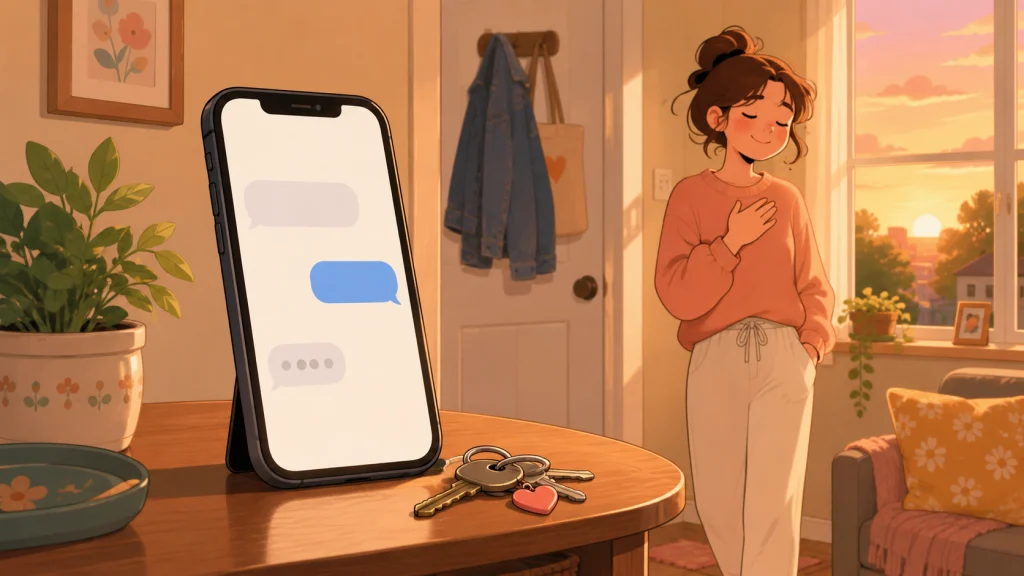
Sometimes the simplest reach is the right one. These are for the moments when you know what you feel but you do not want to make a whole thing of it. A text that says “I’m glad we’re okay” does not need to be longer than that. Brevity, when it comes from honesty, is its own kind of warmth, and it works at any stage of this process.
These are also low-stakes enough to send when you are still not sure exactly where things stand. They say something real without requiring the other person to respond at a particular emotional level. The last one does a lot with two words. “Still” is doing real work in that sentence. Through the argument, through the quiet, through the part where neither of you knew what to say. Still.
- Hey you.
- I’m glad we’re okay.
- Still thinking about you.
- Miss your face.
- We good?
- Coming home soon. Can’t wait.
- Thinking about you. That’s it. That’s the text.
- Love you. Still.
When in doubt, shorter is almost always better. The length of a message is not a measure of how much you mean it. 💙
Final Thoughts: Getting Back to Each Other
Making up after a fight is not a single moment. It is a sequence of small ones: the first message after the apology, the reach back after space, the ordinary text that helps things feel less broken because you are both trying again. Each one closes the gap a little more. None of them need to be perfect.
There is no exact right time to send these, and no magic wording that guarantees things will land. What matters more than the phrasing is the act of reaching out when you could have stayed quiet. Relationships do not heal themselves. They heal because someone decided to close the distance, even when they were not entirely sure it would work.
If you are still working through the wider territory of repair, the apology messages for relationships cover a fuller range of moments within this kind of work. And if you want to keep exploring what words can do between two people who care about each other, the love and relationship messages are a good place to keep looking.
FAQs
💬 What do you text someone after making up from a fight?
Keep it simple and forward-looking. You do not need to relitigate the fight or add another apology on top of the one you already gave. Something that signals relief or just a normal check-in does the job. “I’m glad we talked” or “What do you want for dinner?” is enough.
🤝 How do you reconnect with someone after a fight without it being awkward?
The awkwardness usually comes from making too big a deal of the reconnection. Act a little more normally than you feel, and the feeling tends to follow. One low-key message, asking how their day was or sharing something small, often does more than a long emotional text.
🔍 What is the difference between making up and apologizing after a fight?
The apology takes responsibility for what happened. Making up is the next stage: rebuilding the connection. Different words, different goal. You are no longer accounting for the past. You are trying to get back to each other.
⏱️ How long should you wait before reaching out after a fight?
There is no universal answer. Some people need a few hours. Some need a day or two. The right time is when you can reach out without wanting to continue the argument. If you are still in the emotional heat of it, waiting is usually the right call.
😶 What if you made up but things still feel tense?
That is normal. Acceptance and healing do not always happen at the same speed. Give it a little more time and keep reaching back in small ways. Something like “I know we’re not quite all the way back yet, but I’m here” can help move things along without forcing it.
✋ Should you be the one to reach out first after making up?
If you are ready and the other person seems to be waiting, yes. Whoever is ready first can make the first move. Making up does not require perfect symmetry. It requires one person to be willing to close the gap when they are able to.
🌧️ What if they accepted my apology but are still being distant?
They may need more time, or they may be waiting to see whether things are actually going to be different. The best response is continued, low-pressure reaching out. Not pushing for resolution. Not going silent either. Just staying present in small, consistent ways until the distance closes on its own.