There are two kinds of strength messages, and most of the ones you’ll find are the first kind: “you can be strong,” “you’ve got this,” words aimed at someone who’s still in the middle of something hard. This is the other kind. These are 65 inspirational messages about strength for someone who has already been through it, the kind that says “look at what you already carried” instead of “you can carry this.” If you’re writing to someone who’s been quietly holding it together longer than anyone realized, this is for them.
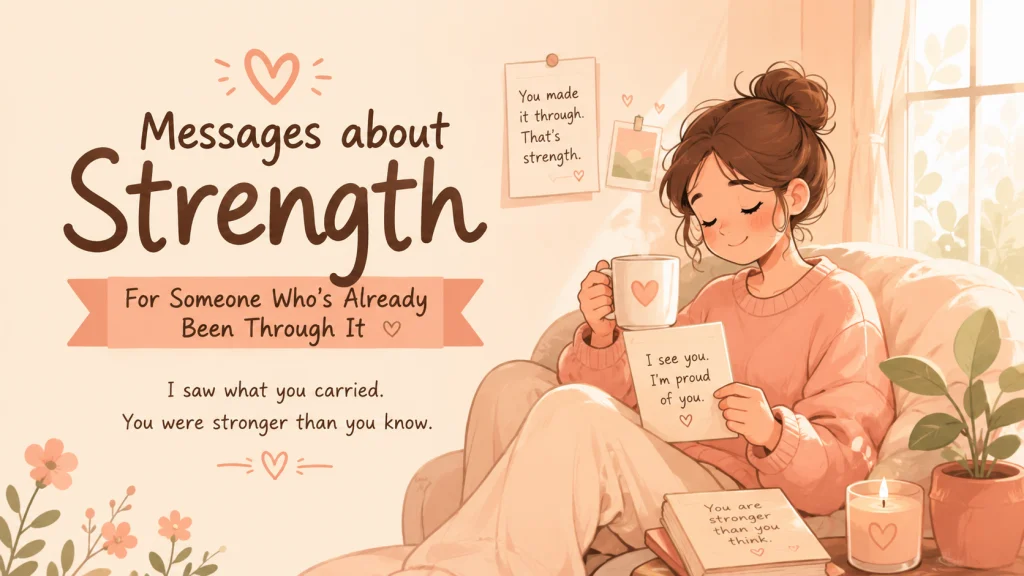
The strength someone already showed, not the strength they might find
Most messages about strength are written forward. They imagine someone standing at the edge of something hard, and they’re trying to push them toward it: you can do this, you’re stronger than you know, keep going. That’s not a bad instinct. But it misses a whole category of people who don’t need pushing forward, because they’ve already been through the thing. What they need is for someone to look back with them and say, clearly, I saw what that took.
That’s the gap most inspirational messages about strength don’t fill. If someone you know has come out the other side of something, a loss, an illness, a year that nearly broke them, the most meaningful thing you can say isn’t about their potential. It’s about what’s already true. They were strong. Past tense. Whether or not they’ve noticed it themselves yet is a different question, and one this covers too.

For the strength they’ve already shown
These are for the moment after. The diagnosis is behind them, or the divorce, or the year they don’t talk about much. Whatever it was, they made it through, and somewhere along the way they probably stopped noticing how much that actually took. A message that names it specifically, that says “I watched you do that,” tends to land harder than almost anything else you could say.
The trick with this kind of message is to avoid making it sound like a finish line. Strength that’s been earned doesn’t need a medal ceremony. It just needs to be seen.
- I’ve watched you carry something most people never have to, and you did it without ever once asking for credit. That’s strength. Real strength.
- You didn’t just survive what happened. You kept showing up, day after day, even on the days nobody saw. I see it. I always have.
- Some people talk about being strong. You just were, quietly, for as long as it took. That doesn’t go unnoticed.
- Looking back at everything you’ve carried this year, I don’t know how you did it. But you did. And it changed something in you that I think you’ll carry forever, in a good way.
- You already did the hardest part. Whatever comes next, you’re not starting from zero. You’re starting as someone who’s already proven what they can survive.
- There’s a version of you that existed before all of this happened, and a version that exists now. The second one is stronger, even if it doesn’t always feel that way.
- I think about everything you went through and I keep landing on the same word: strong. Not because you didn’t struggle, but because you kept going anyway.
- The strength you showed wasn’t loud. It was in the small things, getting up, showing up, holding it together when it counted. That kind of strength is the kind that lasts.
- You went through something that would have broken a lot of people, and somehow you’re still here, still kind, still recognizably you. That’s not nothing. That’s everything.
- Whatever you’re feeling now, know this: you made it through something that asked a lot of you, and you deserve to have that named.
- I don’t think you give yourself enough credit for what you got through. So let me say it plainly. What you did was strong, and it mattered.
- You carried more than anyone realized, for longer than anyone realized, and you’re still standing. That’s strength that doesn’t need explaining to anyone who’s paying attention.
- There were days you probably thought you were barely managing, but from where I stood, I saw someone doing the impossible one small step at a time.
- You may not have felt brave while it was happening, but bravery often feels like fear with no choice but to move. You moved. You made it through.
- I hope one day you can look at yourself with the same awe other people feel when they think about what you’ve survived.
For someone who doesn’t see their own strength yet
Some people carry something difficult and walk away thinking they just “got through it,” as if that’s a small thing, as if everyone would have done the same. I’ve noticed this a lot, actually, the people who handled the hardest things are often the last to call it strength. To them it just felt like survival, like there wasn’t another option.
If that’s where the person you’re writing to is, the message that helps most usually isn’t “you’re so strong.” It’s something closer to “what you’re calling ‘just getting through it’ was actually the hard part, and I want you to know that.”
- I know you don’t think of what you did as anything special. But from where I was standing, it was. You were strong, even when you didn’t feel like it.
- You keep saying you “just got through it,” like that’s nothing. It’s not nothing. Getting through it was the hard part, and you did it.
- Maybe it didn’t feel like strength while it was happening. It rarely does. But looking back, I hope you can see what I saw.
- You might not call yourself strong. I do. And I’ve watched you closely enough to know I’m right.
- Sometimes the people who’ve been through the most are the hardest on themselves about it. If that’s you, I want you to hear this: you did enough. You were enough.
- It’s strange how the people who handle the hardest things often think they didn’t do much. You did. More than you know.
- You don’t have to feel strong for it to be true. I’ve seen what you carried, and I know what it took.
- One day I hope you look back at this stretch of time and feel proud, not just relieved. Because what you did wasn’t just surviving. It was strength, even if it didn’t feel that way at the time.
- You keep waiting to feel like the strong one. From the outside, you already are. You have been for a while.
- If no one’s told you yet: what you went through, and how you handled it, was strength. Even the parts that felt like falling apart.
- You may remember the moments when you cried, froze, doubted yourself, or had no idea what to do next. I remember those too. And I still see strength in every one of them.
- Just because you didn’t have another option doesn’t mean it wasn’t hard. Sometimes strength is doing what has to be done while wishing you didn’t have to.
- I know you can see all the ways you struggled. I wish you could also see the courage it took to keep living through that struggle.
- You don’t have to rewrite the story and pretend you were fearless. You were human, hurting, and still here. That is more than enough proof.

For someone who is tired, but has kept going
There’s a particular kind of strength that doesn’t look like strength at all from the outside. It looks like exhaustion. It looks like someone who’s still showing up, still doing what needs doing, but who is clearly running on less than they should have to. If that’s the person you’re thinking of, a message about strength can feel like the wrong thing to say, like you’re asking them to keep being strong when what they actually need is rest.
The messages that work here do something slightly different. They acknowledge the tiredness first, without trying to talk someone out of it, and then point to the fact that they’re still here, still going, in spite of it.
- I know you’re tired. I’m not going to pretend you’re not. But I also know you’ve kept going anyway, and that’s its own kind of strong.
- You don’t have to have energy left over to be strong. Sometimes strength just looks like still being here, even when you’re running on empty.
- It’s okay to be exhausted by all of this. You’ve earned that. And you’ve also earned some recognition for how long you’ve kept going despite it.
- You’re allowed to be tired and strong at the same time. They’re not opposites. Sometimes they’re the exact same thing.
- I see how much you’re carrying right now, and I see that you’re still carrying it. That takes more than people realize.
- Some days, strength just means getting out of bed and doing the next thing. If that’s all today was, that still counts.
- You don’t have to be okay to be strong. You just have to be here, doing what you’re doing, the way you have been. And you are.
- I know it probably doesn’t feel like it from the inside, but from out here, watching you keep going through all of this, it looks like strength.
- You’re not failing because you’re tired. You’re human, and you’re still showing up. That’s the part that counts.
- Whatever today asked of you, you gave it, even on the days you had less to give. That’s not weakness running thin. That’s strength, still working.
- I hope you don’t mistake your exhaustion for defeat. Sometimes being this tired simply means you’ve been strong for a very long time.
- You don’t have to turn your pain into a lesson today. You don’t have to make it beautiful. You just have to know that getting this far took something real.
- If rest is what you need now, I hope you let yourself have it. Rest doesn’t erase your strength. It protects the person who had to use so much of it.
- There is nothing weak about needing a break after carrying more than your share. Even the strongest people deserve somewhere soft to land.

For the quiet strength no one noticed
Not every kind of strength comes with witnesses. Some of it happens in private, in a car before walking inside, in a bathroom with the door locked, in the quiet decision to answer one more email, make one more meal, or try one more morning. If the person you’re writing to has been strong in ways most people never saw, these messages help name that invisible work without making it feel dramatic.
- I know there were parts of this no one else saw. The private parts. The quiet parts. The moments you had to pull yourself together with no audience at all. I hope you know those counted too.
- Some of your strongest moments probably happened when nobody was there to praise you for them. I still want you to know they mattered.
- You did a lot of hard things without making them everyone else’s business. That kind of strength is easy to miss, but it deserves to be honored.
- I keep thinking about the quiet courage it took to keep going when no one knew how close you were to stopping.
- You shouldn’t have had to be that strong in silence. But you were, and I hope life gives you more gentleness now.
- The world may only see the version of you that made it through. I hope you know the unseen version, the one who kept choosing one more day, deserves love too.
- There is strength in surviving loudly, but there is also strength in surviving quietly. Yours has been quiet, steady, and deeply real.
- I know you smiled through some things that were not small. I know you kept going through days that asked too much. I hope you feel seen today.
- You didn’t need everyone to understand what you were carrying in order to carry it. That doesn’t make it lighter. It makes what you did even more remarkable.
- Some people never noticed how strong you had to be because you made it look calm from the outside. I noticed. And I know calm doesn’t mean easy.
- I hope you give yourself credit for the battles no one clapped for, the mornings no one knew were hard, and the strength you used when there was no one to impress.
- You have been strong in ways that were too quiet for most people to hear. But quiet strength is still strength, and yours has been extraordinary.
Short strength messages
Sometimes the moment doesn’t call for a paragraph. A short message, sent at the right time, can carry just as much weight, especially if the person you’re writing to is someone who tends to brush off longer, more sentimental words. These work as a text, a note tucked somewhere they’ll find it, or just a line you say out loud when the right moment shows up.
- You already did the hard part. I see that.
- What you’ve carried is more than most people ever will. That’s strength.
- You’re stronger than this moment, and you’ve already proven it.
- Tired and strong aren’t opposites. You’re both, and that’s okay.
- I know what this took from you. I see it.
- You got through it. That’s the strong part, even if it didn’t feel like it.
- Whatever you’re carrying, you’ve carried worse, and you’re still here.
- You don’t have to feel strong for it to be true.
- I hope you know how much strength it took to become this version of you.
- You made it through something that mattered. Please don’t make that small.
Saying it so it actually lands
The thread running through all of these is the same: strength, here, isn’t a wish for the future. It’s a fact about something that already happened. If you’re sending one of these to someone, it might help to think about which version of strength they actually need to hear right now, whether that’s recognition for what they’ve already survived, a nudge for someone who can’t see it in themselves, acknowledgment that being tired doesn’t cancel out everything they’ve kept doing, or a quiet reminder that the unseen parts counted too.
If the person you’re thinking of is in the middle of something hard right now rather than looking back at it, the framing shifts a little, and there’s a separate set of words built for that kind of moment in the section on uplifting messages for a friend going through a hard time. And if what you’re really after is something with a bit more weight behind it, the kind of line that sticks with someone beyond the moment it’s read, the wider collection of words of wisdom for difficult times is worth a look too. For more on the range of tones that fall under encouragement in general, from gentle to celebratory, the section on uplifting messages for hard moments covers that wider ground. And if hope, rather than strength, feels closer to what the moment calls for, there’s a dedicated set of messages about hope for difficult times as well.
FAQs
💪 What’s a good message to send someone about their strength?
Something specific to what they’ve actually been through, rather than a general “you’re so strong.” Naming the thing they carried, even briefly, makes the message feel earned instead of generic.
🤍 What do you say to someone who doesn’t realize how strong they’ve been?
Try telling them plainly what you saw, especially if they’ve been calling it “just getting through it.” Sometimes people need someone else to name it before they can see it themselves.
😔 Is it okay to call someone strong when they’re still struggling?
Yes, as long as the message doesn’t ask them to keep being strong right now. Acknowledging both the tiredness and what they’ve already carried tends to land better than focusing on either alone.
📏 How short can a message about strength be and still mean something?
As short as one sentence, if it’s specific. A brief line like “I know what this took from you” can mean more than a long message that could apply to anyone.
🌱 What’s the difference between “you can be strong” and “you already are”?
One is encouragement for something ahead, the other is recognition for something already done. Both have their place, but for someone who’s already been through the hard part, the second usually means more.