
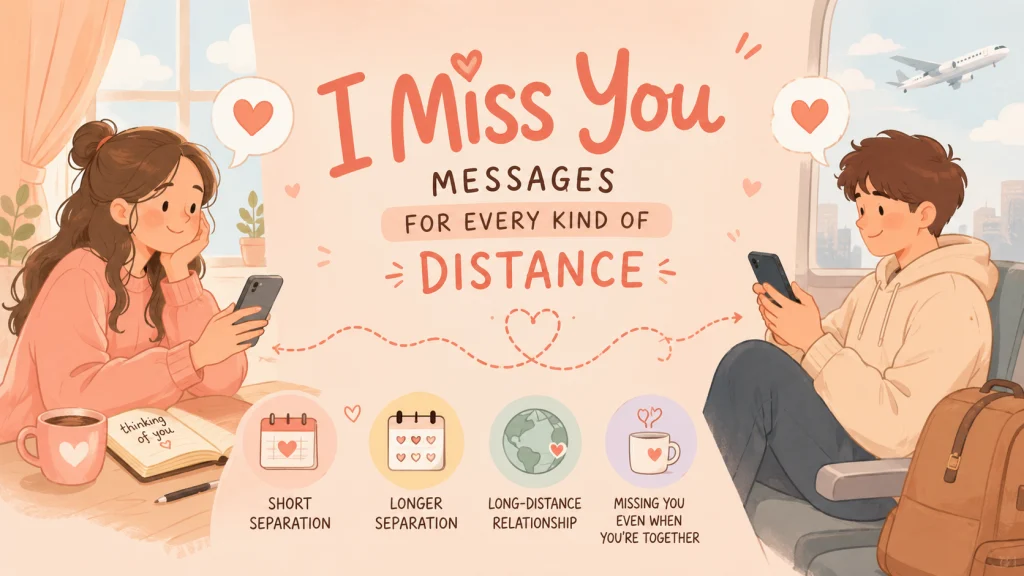
“I miss you” is one of the simplest things you can say to a partner, and also one of the most context-dependent. Missing someone who left this morning for a three-day work trip is a different feeling from missing someone you have not been in the same room as in four months. These 80 messages are organized by that difference: short separation, longer separation, long-distance, and the particular kind of missing that happens even when you just saw them. Find the one that fits where you actually are. For broader context, see i miss you messages.
Why the separation type changes everything
Most collections of “I miss you” messages organize by how intense the feeling is. Deep and aching at one end, light and sweet at the other. That makes sense as a way to sort, but it misses the thing that actually matters when you are sitting with your phone trying to figure out what to send: not how much you miss them, but what kind of missing this is. For related message ideas, see i miss you text.
Missing someone who is across the country on a work trip has a built-in end date. There is something almost tender about it, an ache that has a deadline. Missing someone in a long-distance relationship is different. It is slower, more textured, woven into the ordinary parts of the day in a way that the short-separation miss is not. And then there is the one that is hardest to name: missing your partner even though you just saw them, even though they are coming back tonight, even though nothing is technically wrong. That one is not about distance at all. It is about closeness, and what it does to you.
I have been on the wrong end of sending the wrong kind of message. Not wrong in content, just wrong in register. A message that was too earnest for a three-day trip. A message that was too light for someone who had been away for two months and was struggling with it. The feeling underneath was real both times. The message just did not match the weight of the moment. These sections exist to help with that.

I miss you messages for a short separation
These are for the work trip, the overnight, the few days apart that feel longer than they should because you are used to having them around. The tone here is warm but not heavy. There is an end date in sight, and the message can hold that without pretending the missing is not real.
The mistake most people make with short-separation messages is over-explaining the feeling. Something like “I have been thinking about you all day and the house feels so empty and I keep reaching for my phone” is honest, but it puts a lot of weight on a moment that does not quite need it. Say the one true thing. You do not need to catalogue it.
- The house is quieter than it should be. Come back soon.
- I keep noticing your absence in small places. Hurry home.
- Three days felt like nothing until you left. Miss you already.
- I miss you in the mornings especially. That is when I feel it most.
- Home is a lot less interesting without you in it. Just so you know.
- I did not realize how much of my day involves you until this part where it does not. Miss you.
- Missing you in a low-key, relentless kind of way. Which is my way of saying come back as soon as you can.
- You have only been gone a day and I have already had three moments where I wanted to tell you something. Miss you.
- I am fine. I miss you. Both things are true and the second one is louder.
- The bed is too big and the coffee tastes worse without someone to drink it with. Miss you.
- I keep looking at my phone expecting a message that only makes sense if you are here. That is how much I miss you.
- Safe travels. Come home to me when you are done. I will be here missing you the whole time.
Short-separation messages work best when they are a little specific. “The house is quieter than it should be” is more real than “I miss you so much.” The reader feels the detail. It shows them you are actually living inside the missing, not just reporting it.
I miss you messages for a longer separation
Weeks rather than days. Extended travel, work assignments, family obligations that pull them away longer than either of you expected. This is the separation that starts to settle in, the one where the end date is real but feels far, and the daily rhythm has shifted enough that you feel the absence in a different way.
What changes in a longer separation is the tone. The lightness of the short-trip message starts to feel thin after a few weeks. What this kind of missing needs is a message that acknowledges the duration without dramatizing it, something that says: I feel the time, and I am still here, and I am counting toward you.
- It has been long enough that I have started to notice all the things I take for granted when you are here. I miss every one of them.
- The weeks apart have made me better at appreciating you. I did not expect that. Miss you.
- I am doing fine. I just miss you in a way that does not go quiet.
- Every day gets a little easier and a little harder at the same time. I miss you and I cannot wait to have you back.
- We are closer to the end than the beginning now. That helps. You being far away does not. Miss you.
- I have been keeping a mental list of things I want to tell you in person. It is getting long. Hurry up and come home.
- The strangest thing about missing you for this long is that I have gotten used to it, and I still hate it every day. Miss you.
- Being apart this long teaches you things about yourself. What I have learned is that I want you around. Miss you.
- I am proud of you for doing this. I also miss you entirely. Both are true at the same time.
- The countdown is real and I check it more than I should. Miss you a lot.
If you are in a longer separation that has started to feel permanent, or if the two of you are navigating ongoing long distance rather than a fixed trip, the section below is closer to what you need.

I miss you messages for a long-distance relationship
Long-distance is its own thing. Not a separation from a life you share, but a relationship that exists across the gap, built in calls and visits and the particular kind of patience that love requires when it cannot be in the same room. The missing here is not about an end date. It is about the ongoing texture of loving someone you cannot reach.
I have noticed that the messages people in long-distance relationships most want to send are not the dramatic ones. Not “I cannot do this anymore” or “the distance is killing me.” Those are real feelings, but they are not usually what someone reaches for on a Tuesday afternoon when they just miss the person. What they want is something quieter. Something that says: I am thinking about you in the middle of an ordinary day, and you are not ordinary to me.
- I think about you during the parts of the day no one else would notice. The ordinary hours. I miss you in those especially.
- Distance has made me very good at missing you and very bad at pretending it does not matter. It matters a lot.
- You are the first thing I think about in the morning, which is both the sweetest and the most inconvenient thing about loving you from here.
- I miss you in a way that is entirely different from the kind of missing that has an end date. This one is just woven in. I am okay with it. I miss you.
- The worst part of long distance is not the distance. It is all the small moments I want to share with you that do not translate over a phone screen.
- Some days the miles between us feel manageable. Some days they do not. Today is the second kind. Miss you.
- I am building a whole life here and I keep picturing you in it. That is how much I miss you.
- You are present in every part of my day. I just wish you were physically here for some of them. Miss you.
- Missing you is not a problem I am trying to solve. It is just what it feels like to love you from a distance.
- I know the timing will work out eventually. Until then I am here, missing you more than I say out loud.
For longer messages and more context around what to say when long distance is hard, the collection of long-distance love messages covers what these shorter messages cannot always hold.
“I miss you even when you’re here” messages
This is the one that is hardest to explain. You saw them this morning. They are coming home tonight. There is no separation, technically. And yet there is something, a feeling of distance that has nothing to do with miles, a missing that lives inside closeness rather than across it. It might be a season of life where both of you are stretched thin. It might be a quiet drift that neither of you has named yet. It might just be that you love them so specifically that even a normal day apart feels like absence.
These messages are small by design. They are not trying to start a conversation about what is wrong, because often nothing is wrong. They are just trying to say: I notice you even when you are nearby, and I miss the version of us that is fully present with each other.
- I saw you this morning and I already miss you. That is the particular thing about loving you.
- We are in the same city and I miss you. That is either romantic or inconvenient. Maybe both.
- I miss you even on the days I see you. I am not sure if that is a complaint or a compliment. It is definitely true.
- Thinking about you in the middle of a day that should feel ordinary. Miss you.
- I miss the slow parts of us. The hours without plans. I miss you in that way right now.
- I do not need anything. I just wanted you to know that you crossed my mind and made me wish you were here. Miss you.
- Some versions of missing someone are not about distance. This is one of those. Miss you.
- I am just going about my day over here, missing you quietly. No big deal. Just thought you should know.
The proximity miss is the most underrepresented in most collections because it does not fit the obvious template of being physically apart. But in my experience, it is the most common one. The person you are with every day, the one you miss even when they are just in the next room. That kind of missing deserves words too.
Short “I miss you” texts
Sometimes the moment does not need more than a line. You are in the middle of something, or you do not want to start a whole conversation, or the feeling is simple and you just want to say it without turning it into an event. These are for that.
Short messages work because they do not ask anything of the other person. They land, they are true, and then the day continues. A short “miss you” sent at 2pm on a Wednesday is often more meaningful than a long message sent at the end of the night because it says: I thought of you in the middle of an ordinary moment. That is not nothing. That is actually everything.
- Miss you today. A lot.
- Thinking about you. That is all.
- Just wanted you to know you are missed.
- Come home soon. Everything is better with you in it.
- You crossed my mind and now I miss you. As usual.
- Miss you. That is the whole message.
- Thinking of you in the middle of the day, which I do more than you know.
- Not a big deal. Just miss you.
The last one is my favorite of the set. “Not a big deal. Just miss you.” It is disarming because it names the smallness of the gesture while still making the gesture. It does not demand a response. It does not create pressure. It just says: you exist in my day. I wanted you to know.
When you miss their voice
There is a specific kind of missing that is not about the person being gone so much as about sound. The way they laugh at something they find genuinely funny. The particular tone they use when they are telling you about their day. Their voice over a call is close but not quite right, the way a photograph is not quite the same as a face. These messages try to name that.
People do not usually say “I miss your voice” because it feels too small, too specific. But in my experience, specificity is exactly what makes a message feel real rather than borrowed. If you are reaching for your phone and what you are actually missing is the sound of them, say that. It lands differently than a general “miss you” because it tells them something true about how you carry them.
- I miss the sound of you. Not in a dramatic way. Just in the way that makes everything a little quieter than it should be.
- I keep thinking of things to say out loud to you, and then remembering you are not here. Miss you.
- I miss your voice. A call helps but it is not the same. You know what I mean.
- The apartment sounds different when you are not in it. I did not notice that before. Miss you.
- I miss hearing you talk about your day. Over a screen is fine. In person is better. Come back.
- There are moments in the day where I genuinely reach for you before I remember. Miss you in those especially.
- You have a specific laugh for things you find actually funny, not politely funny. I miss that laugh.
- Some things do not translate over a call. You are one of them. Miss you.
If you want to say this out loud rather than in a text, a voice note is worth considering. Something about sending your voice when you are missing theirs has a directness that a typed message cannot quite replicate.

When you miss home with them
This section is for a particular kind of missing that is about shared space rather than just the person. Missing the version of home that only exists when both of you are in it. The routines, the ordinary evenings, the specific warmth of a place that is yours together. It is its own thing, separate from missing them as a person, and it deserves its own words.
What tends to go wrong here is that people either go too broad (“I miss our life together”) or stay too on-the-surface (“miss our Netflix nights”). The messages that work are the ones that name one small, specific thing about shared life that the absence has made visible.
- I miss what the evenings feel like when you are home. This version is quieter and I do not prefer it.
- The place feels like a backdrop right now, not a home. You are the part that makes it feel like home. Miss you.
- I keep making enough coffee for two of us. I do not know why. Miss you.
- Dinner alone is fine. I just keep noticing that it is alone. Miss you.
- I miss the version of this place that exists when you are in it. It is a better version. Come back to it.
- The small routines we have built together are what I miss most. They are invisible until they are gone.
- I walked past your side of things this morning and it hit me again. Miss you more than I expect to, even now.
- Home is waiting for you. So am I. Miss you.
Missing the shared life is different from missing the person, even though the two overlap completely. It is worth naming the difference when you feel it, because it tells your partner something specific: not just that you miss them, but that the life you have built together is something you carry consciously.
Deeply romantic “I miss you” messages
Some separations call for something bigger. Not dramatic or overwrought, but genuinely open about the depth of what is there. These messages are for when you want to say more than “miss you” without turning it into something that requires a response or creates pressure. They are honest about the size of the feeling, but they hold it with some steadiness.
The line between deeply romantic and too heavy is mostly about what the message asks of the other person. A deeply romantic message says something real and then lets it rest. It does not ask to be comforted, does not suggest something is wrong, does not make the absent person feel responsible for the feeling. It just says: this is what loving you from here feels like. And then it stops.
- There is a specific kind of longing that only comes from loving someone the way I love you. I have been living in it since you left.
- I miss you in the particular way that makes me realize how much my life has changed since you came into it. That is not a complaint. That is the opposite of one.
- You are present in the quiet parts of my day, which are the parts that matter most. I miss you in all of them.
- Missing you feels like proof of something I already knew. This is not nothing. You are not nothing. Miss you.
- I did not know it was possible to miss someone this specifically until you. Every day apart, I find a new way to mean it.
- You have changed what ordinary feels like for me. When you are gone, ordinary goes back to what it used to be, and I do not want it. Miss you.
- The feeling of missing you and the feeling of loving you are almost the same thing. I am not sure where one ends and the other begins. Miss you.
- I carry you with me on the days we are apart, which is the romantic way of saying I think about you constantly and it helps and it does not help at all.
These work best when the two of you already speak at this register. If your relationship usually runs lighter, a message like this can feel like a shift in tone that needs explaining. Know your person and pitch it accordingly.
Playful “I miss you” messages
Not every “I miss you” needs to carry weight. Some relationships have a humor built into how they communicate, and forcing sincerity into a message that would normally be a little funny is its own kind of mismatch. These are for when you want to say the real thing and still sound like yourself.
Playful missing-you messages work when they have something true underneath the lightness. The ones that fall flat are the ones that use humor to avoid saying anything real. The ones that land are the ones where the missing is genuinely there, and the joke is just the delivery. There is a difference, and the person on the other end can feel it.
- I miss you in a completely reasonable, not-at-all-embarrassing way. Several times a day.
- The bed has too much room in it and I blame you entirely. Miss you.
- I have been talking to myself more than usual. This is your fault. Come home.
- I thought I would be fine. I am fine. I also miss you a lot. Both are true.
- Missing you is my least favorite hobby and you gave it to me. Rude. Miss you.
- I keep thinking of things that are funnier with you here. The list is getting embarrassingly long. Miss you.
- You are not here and I am only mostly okay with it. Mostly. Miss you.
- I did not realize how much of my entertainment was just having you around. Come back and be entertaining again. Miss you.

Playful messages are easy to get wrong in the other direction too. Going so light that it reads as indifference rather than ease. If your person is struggling with the separation, a fully playful message can land as not seeing them. Use these for the moments when you both know things are fine and the missing is the only thing in play.
Matching the message to the moment
Choosing the right message from the sections above is mostly intuitive, but there is one pattern worth naming explicitly. The length and weight of a “miss you” message should roughly match the weight of the separation. A three-day work trip message that reads like a long-distance love letter is going to land strangely, not because the feeling is wrong, but because the register is off. The other person gets the sense that something is being communicated beyond “I miss you,” and they are not sure what it is.
The reverse is also true. Sending a light, cheerful “miss you!” to a partner who has been away for six weeks and is having a hard time with it can read as not seeing them. Not matching the moment they are actually in.
| Situation | Tone that fits | What to avoid |
|---|---|---|
| Work trip, 1 to 3 days | Warm, specific, a little light | Heavy longing; LDR-register messages |
| Extended trip, 2 to 6 weeks | Honest acknowledgment of time, forward-looking | Too light (dismisses the duration); too heavy (adds pressure) |
| Long-distance relationship | Quiet, textured, present-tense | Messages that emphasize the problem rather than the connection |
| Proximity miss (same city, saw them today) | Small, low-key, no explanation needed | Messages that make the missing seem like a crisis |
| Any separation, you are struggling | Honest, direct, not performative | Minimizing the feeling to seem easier to be with |
None of this is a rule. Relationships have their own language, and yours might be one where a big, earnest “I miss you so much it is embarrassing” on day two of a work trip is exactly right. The table is a starting point, not a prescription. If you know your person well enough, you already know what they need to hear.
For the full range of missing-you content across different relationships and contexts, the wider collection of missing you messages has everything from the short and sweet to the ones for harder moments.
Final thoughts: Say the specific thing
The most common version of “I miss you” that falls flat is the one that is entirely general. “I miss you so much.” “I think about you all the time.” Both can be true. Neither of them is a message. They are feelings reported without a detail, without any evidence that the missing is real and particular to this person.
The messages above are organized by distance, but what makes each of them work is the same thing: they are specific. A detail about the morning. A reference to something only the two of you would understand. A small observation about the texture of the absence rather than its size. That is what turns “I miss you” from a phrase into something that actually lands. Say the one true, specific thing. The rest takes care of itself.
FAQs
💬 What is a good “I miss you” text to send your partner?
The best ones are specific to the moment you are in. “The house is quieter than it should be” lands differently than “I miss you so much.” Pick the one that names something real about your particular kind of missing right now, whether that is a short trip, a longer separation, or just an ordinary Tuesday. The sections above are organized by exactly that.
📱 How do you say “I miss you” without sounding clingy?
Keep it short and leave space. “Not a big deal. Just miss you.” says the thing without creating pressure. The shorter the message, the less it demands from the other person. A two-line text in the middle of the day reads as warmth, not need. What reads as clingy is usually over-explanation, the message that catalogues every feeling rather than naming one true thing.
❤️ What is a romantic “I miss you” message for him or her?
Romantic missing-you messages tend to be specific rather than grand. “You are the first thing I think about in the morning, which is both the sweetest and the most inconvenient thing about loving you from here” is more romantic than “I miss you more than words can say” because it has a detail. Find a true, particular thing and say that. That is where the romance lives.
🌍 What should I text my long-distance partner when I miss them?
Say something present-tense and specific. Not “I hate this distance” (which puts the weight on the situation) but “I think about you during the ordinary parts of the day” (which puts the weight on them). LDR messages work best when they close the gap rather than describe it. The long-distance section above has ten messages written specifically for that register.
🌙 How do I tell someone I miss them without making it weird?
Match the weight of the message to the weight of the moment. A light, short “miss you” on a Tuesday is not weird. It is the over-long message in a situation that did not call for it that reads strangely. If you are unsure, go shorter. One honest sentence is almost never weird. It is the over-explained version that tends to land oddly.
✈️ What is a good message for a partner on a work trip?
Keep it warm but not heavy. “Safe travels. Come home to me when you are done. I will be here missing you the whole time” works because it acknowledges the missing without turning it into a weight they have to carry while they are away. The short-separation section above has twelve options at this register.