
The most powerful morning message is the one nobody was expecting. Not the text on Valentine’s Day or the birthday morning call, but the ordinary Tuesday message that arrives with no occasion attached. These 60 good morning texts for no reason are organized by who you’re sending to, so you can find the right words for the specific person who crossed your mind this morning.

Why the Unprompted Morning Text Is the One That Actually Lands
Routine morning messages have their own value. The daily good morning to a partner, the weekly check-in with a parent, the birthday text that shows up because the calendar reminded you. None of those are meaningless. But they all happen because something prompted them.
The unprompted morning text is different. It happens because a person showed up in your thoughts before the day had given you a reason to think about them, and instead of letting that pass, you acted on it. That small act says something that most messages cannot: that someone matters to you when there is nothing to celebrate, nothing to fix, and nothing to ask for.
In my experience, the spontaneous messages are often the ones people screenshot and keep. Not because they are written beautifully, but because they arrived when the other person wasn’t expecting them, from someone who had no reason to reach out except that they wanted to. That reason, offered with no occasion attached, is the whole point.
Short Unprompted Morning Texts
These are for when you want to send something but don’t want to make it a thing. Short, low-pressure, honest. They work because they don’t ask for anything in return and don’t try to be more than they are. You thought of someone. You wanted to say so. That is the entire message.
Some people overthink the unprompted text because it feels strange to reach out with nothing to report. These are for those people. The message is the thing itself, not a setup for a longer conversation.
Any of these can be sent as-is. If you want to add something, keep it short. One detail, one observation, one small thing that makes it sound like you. That is all they need to be.

For a Friend You Want to Reconnect With
There is a particular version of this message that most people have sitting in draft form: the one to the friend you’ve slowly drifted from. Not because anything happened. Just because life moved and the rhythm changed and now weeks have passed and then months and it starts to feel too late to reach out without a reason.
A morning message is that reason. It doesn’t require an explanation and it doesn’t require the conversation to be long. It just has to land. The ones below are low-pressure enough that they open a door without demanding anyone walk through it.
If you want a broader range of options for this kind of reconnection, the good morning messages for a friend collection has more variations sorted by tone and relationship distance.
These are the kind that tend to get a “this made my day” reply, or no reply at all and then a long voice note three hours later. Either outcome is a good one. The reconnection doesn’t have to happen in a single message.
For a Family Member You Don’t Talk to Enough
The family relationship where things are fine but quiet is one of the more common situations I hear about. Nothing is wrong. You love each other. You just don’t say so unprompted. And then one morning, for no particular reason, you think of them, and you want to say something before the day absorbs you.
These messages are for that morning. They are simple and direct, which is usually the right register for family. People who love each other don’t need elaborate language to make it count. They need proof that someone thought of them on a day when they weren’t expecting it. 💛
The bracket in number eight is intentional. Fill it in. It takes two seconds and it makes the message specific in a way that a generic “family member” never is. Specificity is where the weight lives.
For a Romantic Partner Who Isn’t Expecting It
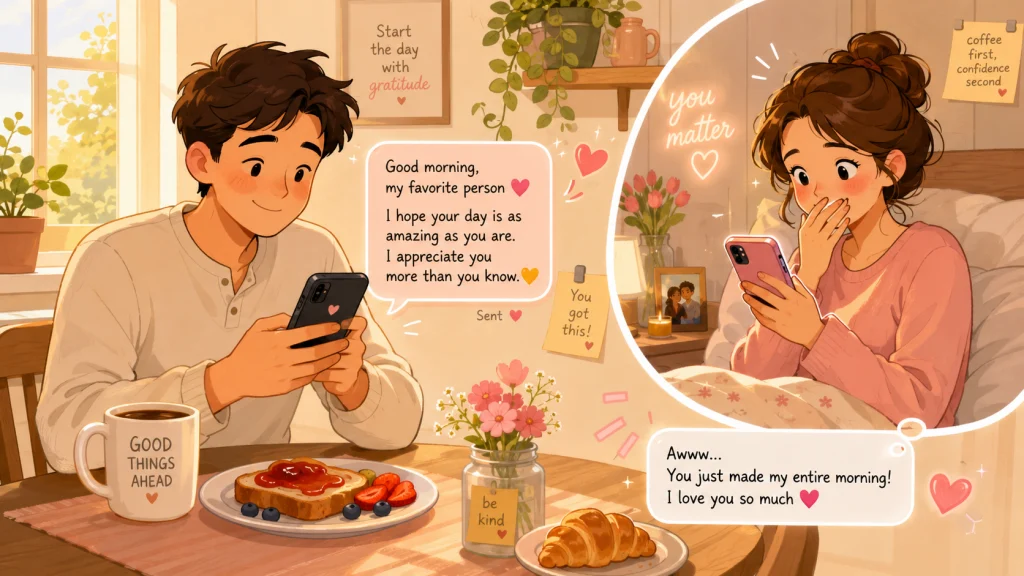
Long-term relationships develop rhythms, and those rhythms are good things. But they also create a baseline where messages become expected rather than felt. An unprompted morning text to a partner you’ve been with for years, on a morning with nothing special attached to it, is one of the quieter ways to break that baseline in the best direction.
I have sent this kind of message on mornings when nothing was happening and no particular feeling was demanding to be expressed. Just a small, honest reach across the morning. The response is almost always better than I expected, which tells you something about how rarely people do it.
Number four uses a specific weekday on purpose. Change “Wednesday” to whatever today actually is. The specificity of a real day instead of a generic placeholder is a small thing that makes the message land as real rather than composed.
For Someone Who Has Been Through Something and Needs to Know They’re Still Thought Of
This is the category people most often forget in the weeks after something hard happens. The initial flood of support comes, and then people move on, and the person who is still carrying it is left to do so more quietly. A morning message that arrives three weeks after the hard thing, with no prompting and no agenda, is often the one that hits hardest.
These messages don’t try to fix anything. They don’t offer advice. They just say: I haven’t forgotten. You don’t have to reply. I’m just here. That is usually exactly what is needed, and it costs almost nothing to send.
Consistent presence over time is what actually holds people through difficulty. The way these messages work together is the same reason that daily messages do more than any single well-crafted text can do alone.
The “no need to reply” framing in number three does a specific thing: it removes the obligation that often stops people from reaching out in the first place. If you’re worried about creating pressure, say so directly. The other person can reply when they’re ready.

For Someone You Just Thought of Out of Nowhere
Sometimes a person appears in your thoughts on a morning when nothing called them there. No shared memory surfaced, no event reminded you, they just arrived. This is the section for that. These messages are honest about exactly that experience, and they work because the honesty itself is the message: I thought of you, for no reason, and I wanted you to know.
These are the ones that tend to get the reply “I really needed that today,” which is something you could not have known when you sent it. That is the whole argument for sending the unprompted message in the first place.
Final Thoughts: The Reason Is Enough
There is a hesitation that stops most people from sending this kind of message. It sounds something like: why am I reaching out with nothing to say. But that framing is wrong. Sending a message because someone crossed your mind is not nothing. It is, in a way, the most honest version of what a message can be. You thought of someone, and you wanted them to know. That is the entire reason, and it is a good one.
The messages above are sorted to make it easy to find what fits. Take the ones that feel close, adjust the details so they sound like you, and send them before the day talks you out of it.
If you want to explore morning messages beyond the no-reason context, the full good morning messages collection covers more relationships, more situations, and more tones in one place.
FAQs
💬 Is it okay to text someone good morning for no reason?
Yes. That is exactly when to do it. A morning text that arrives with no occasion attached carries something that a prompted message rarely does: proof that someone was thinking about you before the day had given them any reason to. It doesn’t require an explanation and it doesn’t need to open a long conversation.
📱 What do you say in a random good morning text?
Keep it honest and keep it short. Something like “I thought of you this morning and wanted to say so” is often more effective than something elaborate. The message is not trying to be impressive. It is trying to communicate: you were in my thoughts, unprompted, and I wanted you to know. That is the whole thing.
💡 Why does an unexpected morning message mean more than a routine one?
Because it has no obligation behind it. Routine messages happen on schedule, or because a day requires them. An unprompted morning message happened because someone thought of you when they didn’t have to. The absence of a reason is the reason it lands so differently.
🤍 What is a good morning text just because for a friend?
“Good morning. I don’t reach out as much as I should. This is me starting to change that” is one that works well for a friend you’ve been meaning to reconnect with. For a friend you talk to regularly, something shorter tends to fit better: “Morning. Just thinking about you today. That’s all.” Low-pressure, honest, and easy to receive.
😶 What if I’m worried the random text will seem strange?
It almost never lands that way. People very rarely receive an unprompted message and think less of the sender for it. Usually the opposite happens. If you’re genuinely uncertain, “no reason to reply, just thinking of you” removes any pressure the other person might feel to respond, and it names the spontaneity honestly rather than leaving it to be interpreted.
⏰ When is the best time to send a just because morning text?
When you think of it. That is the actual answer. The best moment to send an unprompted message is the moment the person crossed your mind, because that is when the message is most true. If you wait to compose something, you will often wait until the impulse passes. Send it while it’s still the morning that prompted it.