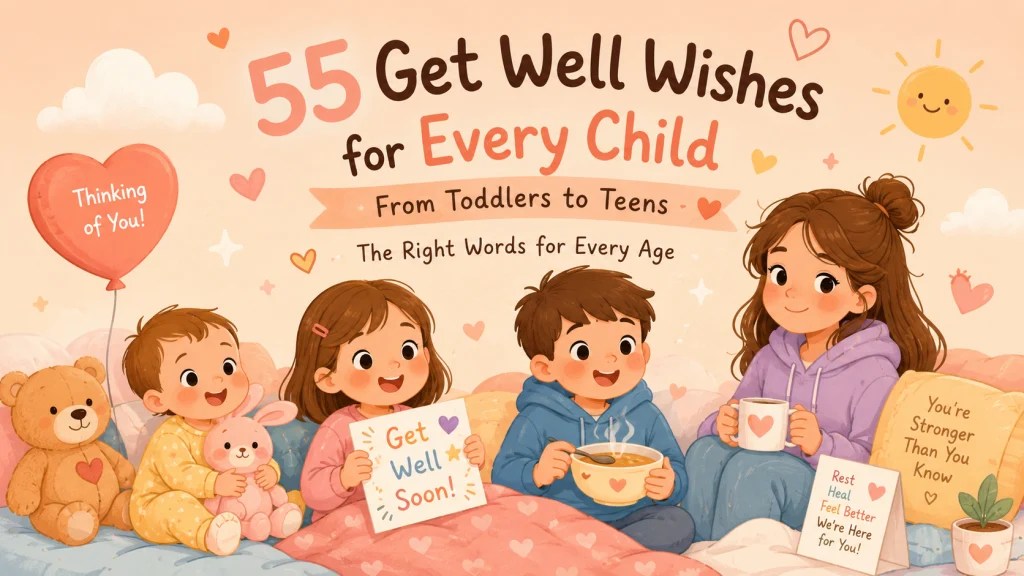
A sick child doesn’t need poetry. They need to feel loved, at exactly the level they can actually receive it, and that level changes completely depending on whether they’re three or thirteen. These 55 get well wishes for a sick child are organized by age because that’s the gap nobody else addresses: the same message that melts a toddler sounds condescending to a tween, and what a teenager wants to hear sounds like nothing you’d find on a pharmacy card rack. There’s also a section on what not to say, because some of the most well-meaning things adults tell sick kids land worse than saying nothing at all.
Why the Same Get Well Message Doesn’t Work for Every Child
I started noticing the pattern over time, watching adults send the same get well message to a six-year-old that they’d send to a colleague. “Wishing you a speedy recovery.” Technically correct. Completely wrong. A six-year-old doesn’t need a speedy recovery, or at least that’s not what they need to hear. What they need to know is that someone misses them, that things will be fun again soon, and that they’re not just quietly forgotten at home while the world keeps going. For related message ideas, see get well messages for child.
A toddler and a teenager are in different universes when they’re sick. The toddler doesn’t understand the words but can feel the warmth behind them, which means the message is really for the parent who reads it aloud. The ten-year-old wants something light and fun and a little silly. The teenager, stuck home with a fever and a bad attitude about it, needs someone to acknowledge that this genuinely stinks, without packaging that acknowledgment in forced cheerfulness. The child going through something serious needs something different still: presence without promises, warmth without false certainty.
Every message in this collection is written with a specific reader in mind. That’s what makes the difference between a message that lands and one that gets a polite smile and is immediately forgotten.

For Babies and Toddlers: Words From a Parent’s Heart
Babies and toddlers won’t read these. They won’t understand most of the words, and they definitely won’t parse your intention from a sentence. But the parent will, and sometimes that’s exactly who needs to hear something kind. A sick baby is exhausting and scary in a way that makes even practical people feel helpless. A message that acknowledges that, without trying to fix it, is genuinely useful.
These work as card notes, as captions for a photo you send to family, or as something to say out loud while you’re sitting next to a little one who’s too young to follow the words but isn’t too young to feel the warmth behind them. They’re also good to send to the parent directly, because a sick toddler almost always means a worried, sleep-deprived adult who could also use a kind word. 💛
- Little one, your whole world right now is rest and getting better. We’re right here while you do.
- You don’t have to do anything today except let your body heal. We’ve got everything else handled.
- Being sick is hard work for someone so small. You’re doing so well, and we’re so proud of you.
- We miss your laugh. Feel better soon, sweet one.
- Every time you sneeze, we love you a little more. Get well soon, baby.
- The house feels quieter when you’re not feeling well. Hurry up and get better so we can be loud together again.
- Rest today. Adventure tomorrow. We’ll be here for both.
- You have no idea how many people are rooting for you right now. Get well, little one.
- Being this loved might actually be the fastest cure. Feel better soon.
- You’re small and you’re sick and you’re still the bravest little person I know.
Short is always better here. A single sentence that feels real will do more than a paragraph that tries to cover everything. If you’re sending this to the parent rather than for the child, you can add one line for them specifically: “You’re doing a great job” goes a long way to someone who’s been up all night.
For Young Children Ages 6 to 10: Keep It Light, Keep It Fun
Kids in this age range are old enough to really feel the inconvenience of being sick, and young enough to cheer up quickly with the right words. What they want is simple: to know that you’re thinking about them, that their friends miss them, and that there’s something good waiting on the other side of feeling terrible. This is not the age for “I hope you’re resting and taking care of yourself.” That’s advice for adults who need reminding to slow down.
The messages that work here have energy. They’re playful without being loud, warm without being heavy. There’s a get well message I almost sent to a seven-year-old once that I drafted in the voice I’d use for an adult, and reading it back I couldn’t believe how stiff it sounded. Kids this age can feel the difference between something that was written for them and something that was written and then handed to them. These are written for them. 🌟
- Being sick is the worst. But you’re going to feel so much better soon, and then we can do all the things.
- We miss you! Everyone keeps asking where you are. Get better so we can hang out again.
- Your only job right now is to eat soup, watch movies, and get better as fast as possible. You’ve got this.
- I heard you weren’t feeling well. That’s no good. You need to feel better because we miss you!
- Even superheroes need a rest day. Get well soon.
- All your friends are saving the best stuff to tell you when you’re back. Get well fast!
- Being sick means you get the couch, the remote, and first pick of snacks. Might as well enjoy it while it lasts. Feel better soon!
- You are missed more than you know. Come back to us soon.
- We’re thinking about you. Eat your soup and feel better!
- Things aren’t the same without you around. Hurry back!
- Hope you feel better so fast it surprises everyone, especially you.
- Sending you warm thoughts and hoping this is over quickly. Soup, naps, and a fast recovery, in that order.
- You’re one tough kid. You’ll be back on your feet before you know it.
- Sick days sound okay until you’re actually having one. We’re thinking about you and hoping it goes fast!
A note in the mail is still magic for this age group. If you can pair one of these with a sticker, a small drawing, or anything they can hold, do it. The words matter, but so does the feeling of getting something in the mail that’s just for you.
For Tweens and Teens: They Know When They’re Being Talked Down To
This is the section most get well messages miss entirely. A thirteen-year-old stuck home sick, scrolling their phone, is not going to find comfort in “Feel better soon, champ!” They’ll register it as hollow and move on. What actually lands for this age group is something that treats them like a person dealing with something genuinely annoying, and acknowledges that without over-dramatizing it or covering it with artificial brightness.
What I’ve found is that the messages teenagers actually appreciate are honest, a little dry, and don’t try too hard. They should read like something a person you trust would say to you, not like a card printed by someone who imagined a generic sick person and wrote toward them. If you know the specific thing they’re missing while they’re home, a game, a practice, a thing they were looking forward to, mention it. That’s what separates a real message from a form one.
- Being sick when you have things to do is genuinely the worst. Hope you’re back on your feet fast.
- You’re allowed to be annoyed about this. Also, feel better.
- Missing things you were looking forward to because of a fever is so deeply unfair. Thinking of you.
- Rooting for you. Not in a cheesy way. In a genuine “I hope you stop feeling terrible” way.
- Being sick and stuck inside sounds miserable. Thinking of you and hoping today is easier than yesterday.
- You’ve got this. And by “this” I mean getting through the uncomfortable part and feeling like yourself again.
- Everyone misses you. Some of them are probably a little jealous too, but mostly they just miss you. Get well soon.
- The world doesn’t stop when you’re sick, which is the most annoying thing about it. But people notice when you’re not around. Feel better.
- Honestly, being sick is just unfair. Sending you good thoughts and hoping it’s over soon.
- Get well soon. Not just because you’re missed, but because feeling bad feels bad and you don’t deserve that.
- You’re handling this better than you probably think you are. Feel better, seriously.
- Hope you’re getting the rest you need and feeling like yourself again soon. Thinking about you.
- Sick days are only good in movies. In real life they’re just uncomfortable. Hope yours is almost over.
For teens, a text almost always lands better than a card. It feels casual, which is what they usually want. Short and direct matters here more than elaborate. Keep it real, keep it brief, and skip the exclamation points if your normal texting style doesn’t use them.
For a Child Who Is Seriously Ill: Acknowledge Without Frightening
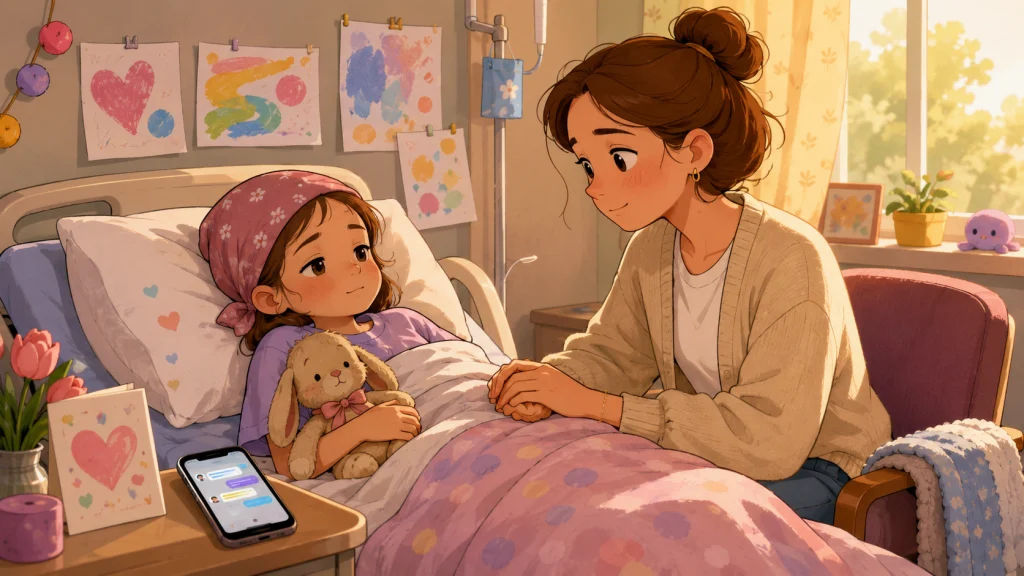
This is the hardest section to write, and the one where I see the most people freeze entirely. When a child is dealing with something more serious, an extended hospital stay, a diagnosis, an illness that’s going to take real time, the words feel impossibly high stakes. Say too much and it feels heavy. Say too little and it feels like you’re pretending. Say “everything will be okay” and you’ve made a promise no one can actually keep.
The thing I keep coming back to: say what you actually know to be true, and nothing more. You don’t know that everything will be fine. You do know this child is loved. You do know people are thinking about them. You do know they don’t have to go through this feeling unseen. Start there, and let the warmth carry the rest without reaching for certainty you don’t have. For a broader collection of words for difficult moments, the words of comfort section covers a wider range of situations where what you want to say is hard to put into language.
- You don’t have to be brave every minute. Just be you, and let the people who love you take care of the rest.
- We’re thinking about you every single day. You don’t have to do anything except let your body rest.
- There are a lot of people in your corner right now. More than you probably know.
- You are so loved. That part doesn’t change no matter what.
- We don’t have to pretend today is easy. We’re just glad you’re here, and we’re thinking of you.
- The hard part is hard. And you’re still here, still you, and still surrounded by people who love you.
- Sending you all the warmth we have. We’re thinking about you and rooting for you every single day.
- You don’t have to be strong all the time. We’re here, and we’re not going anywhere.
- We see you. We’re thinking of you. And we’ll still be here tomorrow.
These messages are meant for adults to send, either to the child directly or to the parents with a note that it’s for the child. When you’re uncertain about the right timing, sending to the parent gives the family control over when and how the child sees it. That small act of restraint is itself a form of respect.
What NOT to Say to a Sick Child: Three Things Adults Get Wrong
This part doesn’t show up in most get well collections, and it probably should. Messages fail not just when they’re cold or generic, but when they say something that sounds comforting from the outside and lands wrong on the inside. Most of these mistakes come from the same place: adults trying to make the situation feel smaller in order to make the child feel better. It almost always does the opposite.
| What adults often say | Why it doesn’t help | What to say instead |
|---|---|---|
| “You’ll be fine. It’s not that serious.” | Dismisses how bad they feel right now. Even a minor illness feels real and uncomfortable to a child in the middle of it. Minimizing the experience makes them feel unheard, not better. | “That sounds really uncomfortable. I hope you feel better very soon.” |
| “At least you get to stay home from school!” | Works as a comfort for about an hour. After that, being sick is just being sick, and for kids who like school or miss their friends, staying home is not the upside you think it is. | “Being home sick is really no fun. Thinking of you and hoping today goes by fast.” |
| “I’m sure you’ll be better in no time.” | Sounds kind, but it’s a promise you can’t actually make. For a child with a longer illness, this kind of certainty can feel isolating when the reality doesn’t match the timeline you set. | “We’re thinking of you and hoping each day gets a little easier.” |
The pattern underneath all three of these is the same: the adult is uncomfortable with the child being sick, and the message is as much about managing that discomfort as it is about helping the child. The fix isn’t more positivity. It’s honesty, a little warmth, and enough trust in the child to let them feel what they feel without being redirected away from it.
From a Classmate: What Kids Say to Each Other
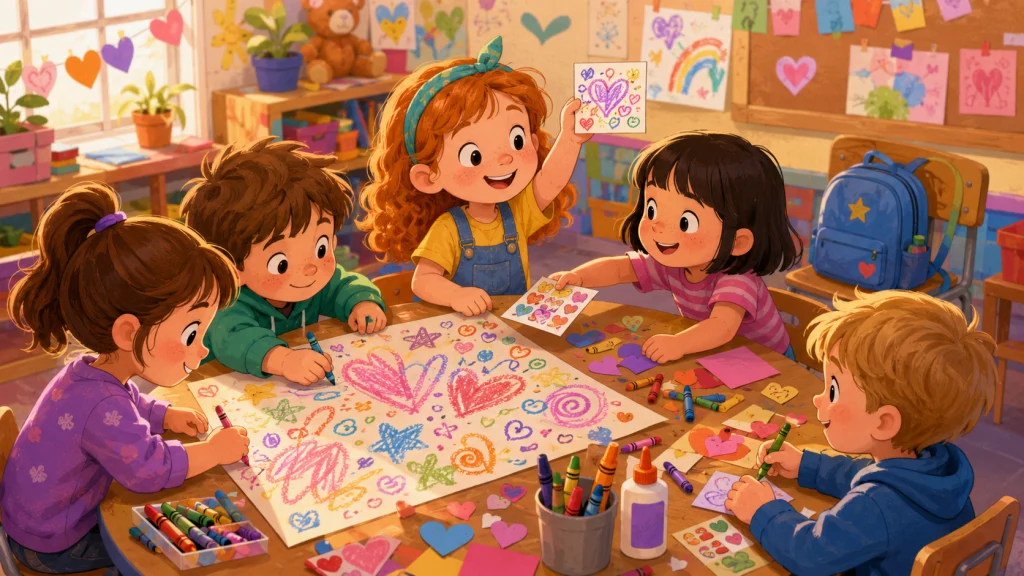
Sometimes the goal isn’t to write a message yourself. It’s to help a child write one, or to organize a class card that comes from the whole group. These are short enough for a child to write or say out loud, honest in the way only kids can be, and warm in a way that doesn’t try to be anything more than it is. A message that says “I miss you” from a real friend means more than almost anything an adult can write.
These work well as a class card, as prompts for a child who wants to reach out but doesn’t know where to start, or as short recordings that get sent as voice notes. For adult-written card messages to go alongside them, the collection of get well messages has options for different ages and relationships. 💌
- We miss you. Come back soon!
- Being sick is the worst. I hope you feel better really fast.
- Everyone in class is thinking about you. Hurry back!
- I saved you a spot. Get better!
- We did something funny today and I really wanted to tell you. Feel better so I can!
- Hope you feel better soon. Things aren’t the same without you.
- Sending you good thoughts and hoping today is better than yesterday.
- Get well fast. We need you back.
- Miss you tons. Feel better!
When a message comes from another child, the stakes feel lower and the warmth registers higher. Kids don’t overthink it the way adults do. “I miss you” from a classmate is straightforward and true and it lands exactly that way. If you can get even one friend to sign a card or record something short, it will do more than a longer message from anyone else in the room.
Final Thoughts: The Right Words at the Right Age
The version of this that goes wrong is when someone picks the nearest get well phrase and sends it without thinking about who is actually on the receiving end. A toddler and a teenager are not the same reader. A child with a cold and a child navigating something longer and harder are in completely different emotional places. A message that works for one can feel entirely wrong for the other, and the difference isn’t the words themselves so much as whether the words feel like they were written for this particular person.
What I’ve found, more times than I can count, is that the messages that stay with people aren’t the most eloquent ones. They’re the ones that felt specific. Age-appropriate, genuinely warm, and honest without being heavy. A child doesn’t need to be told everything will be fine. They need to feel, for a moment, that they’re not forgotten and that someone out there is thinking about them. That’s what a good get well message does. It’s a small thing, but in a day that isn’t going well, small things matter more than we usually give them credit for.
FAQs
💬 What do you say to a sick child to make them feel better?
Keep it simple, warm, and age-appropriate. For young kids, something playful and light works well. For tweens and teens, honest and direct is better than forced cheerfulness. The goal isn’t to talk them out of feeling sick. It’s to let them know someone is thinking about them, which is something no amount of positivity can fake.
🧒 What is a good get well message for a child who is 6 to 10?
Keep it fun and upbeat. Kids this age want to know they’re missed and that something good is waiting on the other side of feeling terrible. A little playfulness goes a long way. Skip anything that sounds like advice or has a serious tone, those work better for adults.
🏥 What do you write in a card for a child with a serious illness?
Say what you know to be true: that they’re loved, that you’re thinking of them, and that they don’t have to be brave every single minute. Don’t make promises about outcomes you can’t control. Focus on presence and genuine warmth rather than certainty. “We’re thinking of you every day” is real. “Everything will be fine” is not always yours to say.
🚫 What should you NOT say to a sick child?
Avoid minimizing how they feel (“it’s not that bad”), offering silver linings that don’t hold up (“at least you get to miss school!”), or making promises about recovery timelines you can’t guarantee. All of these try to make the situation smaller, which usually makes a sick child feel less understood, not better.
👫 What can a kid say to a sick classmate?
Kids do best when they keep it genuine and simple. “We miss you” and “feel better soon” from a real friend mean more than a polished message. If they can add one specific thing, “I saved your seat” or “I have something funny to tell you when you’re back,” even better. Personal always beats perfect.
✍️ How do you write a get well wish for a child you don’t know well?
When you don’t know the child well, keep the tone warm and general, and consider addressing the parent as much as the child. “Thinking of your whole family” is honest and appropriate when you don’t have the specific details to make it more personal. Short and sincere is always better than elaborate and impersonal.