Failure carries a particular kind of shame that most encouragement misses entirely, because most encouragement skips straight to “what comes next” before it has sat with “what just happened.” These 60 failure encouragement messages are organized around the opposite approach: acknowledge the hurt first, then move forward. Whether someone failed an exam, a business, a job application, or something they poured everything into, the right words start where the person actually is.
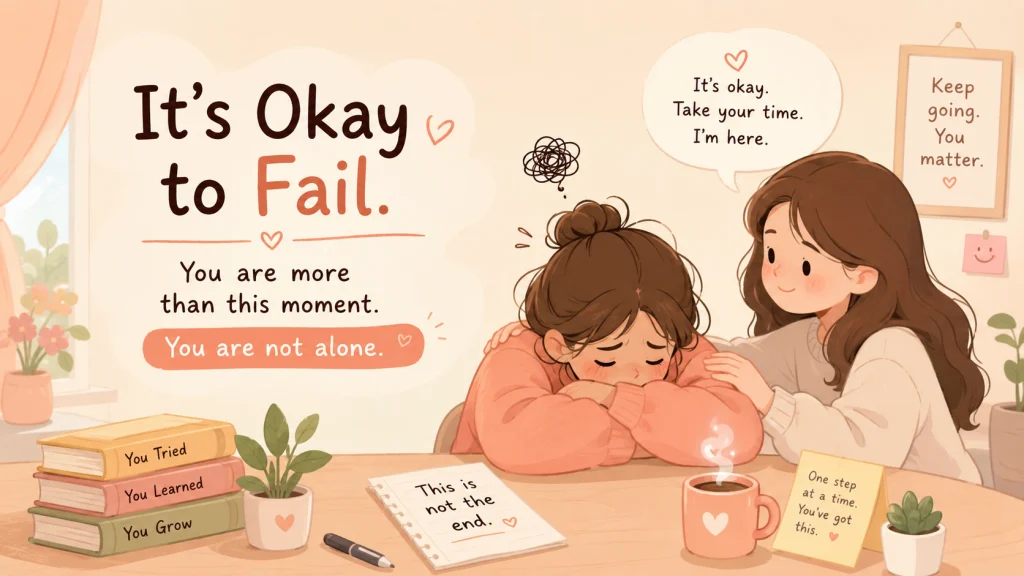
Failure Is Not the End. But You Cannot Say That Yet.
The instinct, when someone we care about fails at something, is to get them back on their feet as fast as possible. We reach for forward-looking words. “You’ll get it next time.” “This is just a setback.” “Everything happens for a reason.” We say these things because we mean well, and because sitting with someone in the actual weight of a failure is uncomfortable. It asks more of us than a quick pivot does.
But here is what I have found, more times than I can count: the message that actually lands is almost never the one that moves the person forward. It is the one that first makes them feel like someone understood how much it hurt. Failure has its own specific grief. If your words skip over that grief, even the warmest encouragement will feel hollow, and the person on the other end will feel that hollowness even if they cannot name it.
The 60 messages below are organized around that idea. They do not start with “you’ll do better next time.” They start where the person actually is, and they trust that forward momentum can come later, once someone feels heard.

Why “You’ll Do Better Next Time” Is the Wrong First Move
There is a reason so much encouragement after failure feels empty. It is not because the person saying it does not care. It is because they are offering the second thing before they have offered the first. The first thing is acknowledgment. The second thing is forward momentum. Almost everyone skips the first and goes straight to the second, and the person receiving the message can feel that skip, even when they cannot explain why the words landed flat.
I once sent a message to a friend who had just failed her licensing exam for the second time. I told her I knew she was going to get it on the next try. She thanked me, and then we did not really talk about it again for months. Later, she told me that what she had actually needed in that moment was someone to acknowledge that it was okay to feel terrible about it. She did not need a pep talk. She needed permission to be in the loss for a minute before she picked herself back up. That conversation changed how I think about every message I have written since.
Failure shame is also not the same as other kinds of hard moments, and the words you reach for need to reflect that. If someone loses a job, there is often an external story they can tell themselves: the company downsized, the role was cut, circumstances were outside their control. Failure tends to feel more personal. It attaches to the person’s sense of what they are capable of. The right words understand that distinction, and they do not accidentally make it worse by treating the failure as something minor to move past quickly. For situations where someone is struggling more broadly without a specific failure at the center, words of encouragement for hard times covers that wider emotional territory.
The sequence matters more than any single thing you say. Acknowledge the hurt. Stay there for a sentence or two. Then, only after that, say something about what comes next, if it even feels right to say it at all.
For an Academic Failure: Exam, Degree, or Credential
Academic failure carries a particular weight because so much of how we have been taught to measure our own capability gets tied up in it. A failed exam is not just a test result. For most people, it becomes evidence about themselves that they would rather not look at directly. The messages below try to meet that specific feeling without minimizing it or rushing past it.
These work for a failed exam, a licensing test, a degree program that did not end the way someone planned, or any credential that felt like the measure of something important. Adapt the language to fit what your person actually went through.
- I know how hard you worked for this. The result does not change any of that, and it does not change what I see when I look at the effort you put in to get there.
- This is not the whole story. But I am not going to tell you to skip past the part where it hurts, because that part is real and you earned the right to feel it.
- Failing something you studied that hard for is a specific kind of brutal, and I am not going to pretend otherwise. I am just here.
- You put in everything you had. That counts for something, even when the result does not show it. I am proud of the effort, even if the score does not reflect it yet.
- This was not a measure of your intelligence or your worth. I know that probably sounds like something people say. But I mean it, and I hope some part of you hears it right now.
- I am sorry. Not “I’m sorry, but here’s the bright side.” Just: I am sorry this happened, and it is okay to be upset about it.
- Give yourself today to feel exactly this bad about it. You do not have to be okay yet. Tomorrow is soon enough to think about what comes next.
- One result cannot measure everything you are capable of. I know it feels loud right now, but it is still only one result.
- I have seen how seriously you took this, and how much it mattered to you. That seriousness does not disappear because of one result. It will carry you forward when you are ready.
- This is one chapter, not the whole book. I know it feels enormous right now, and it is allowed to feel enormous. But it does not end here.
- You did not fail because you are not good enough. You failed because this specific thing was harder than it let on, or the timing was wrong, or a hundred other things that are not about your worth as a person.
- The fact that this hurts this much tells me how much you cared. That caring is not a weakness. It is the same thing that will get you there when you try again.
One thing worth avoiding in these messages: phrases like “at least you tried” tend to land badly after academic failure. They feel patronizing even when they are completely sincere. Stick with direct acknowledgment and let the person set the pace for when they want to talk about what comes next.

For a Failed Business or Professional Project
Professional and entrepreneurial failure is its own category. There is often financial loss tied up in it, but there is also the loss of a version of yourself you were working toward. The person who started a business had a vision. The person who poured months into a project that did not work out had a belief that it mattered. When those things collapse, the grief is layered in ways that a single message cannot fully reach, and it is better to acknowledge that honestly than to try to tidy it up.
These messages are for the entrepreneur, the project lead, the person who bet on something and watched it not pay off. They start with what is actually there before they reach for anything else.
- What you built was real, even if it did not end the way you wanted. The work you did, the problems you solved, the things you learned, none of that disappears because the business closed.
- You tried something that asked a lot from you. That matters, even if the ending hurts right now.
- I am sorry it ended this way. I know how much of yourself you put into this, and I know that kind of loss does not have an easy name. I am here.
- The courage it takes to start something is not canceled out by what happened at the end. You still had it. You still have it.
- You took a real risk on something you believed in. That says something about who you are, and it does not change just because the outcome was hard.
- This is not a verdict on your ability or your future. It is one project, with its own specific circumstances, and it ended. That is painful, and it is also not the end of the story.
- Give yourself room to grieve this properly. It deserves it. You put your heart into it, and what happened to it matters. Do not let anyone rush you past that.
- There is a kind of education that only comes from building something and having it not work. I know that is not a comfort right now. But what you learned from this is real and it is yours.
- I watched you work on this. I saw how seriously you took it and how hard you pushed. That version of you does not go away. It comes with you into whatever you do next.
- This chapter ended. The next one gets to be written by someone who already knows what this one cost, and that makes them harder to stop.
- You do not have to feel better about this yet. But I want you to know that failing at something ambitious says less about your ceiling than succeeding at something safe ever could.
- I am proud of you for trying. Not in a consolation prize way. In a genuine, this took guts and you did it anyway kind of way.
For Someone Who Gave Up, Not Just Failed
There is a difference between failing and stopping, and the shame that comes with giving something up is its own specific kind. The person who stopped is often harder on themselves than anyone else could be, because giving up carries a story that outright failure sometimes does not: “I had a choice, and I chose to quit.” The messages here are for that particular weight of self-blame, not for reigniting ambition, but for making someone feel less alone in the decision they already made.
Go gently here. These are not pep talks. They are a hand on the shoulder.
- Deciding to stop is not the same as failing. Sometimes the bravest thing you can do is recognize that something is not working and let it go.
- You do not owe anyone a version of yourself that keeps going when going is doing you harm. Stopping was a choice, and it was yours to make.
- I know you are being hard on yourself about this. I want you to know I am not. What I see is someone who tried, stayed longer than most would have, and made a hard call.
- There is no shame in recognizing when something is not right for you anymore. That kind of honesty with yourself takes more courage than most people give it credit for.
- You are allowed to grieve what you thought this was going to be, and you are also allowed to feel some relief. Both of those things can be true at the same time.
- Walking away does not erase the effort you put in. It just means this particular path ends here. That is not the same as you ending here.
- I am not going to tell you that you made the right call, because I know you are still working through that. What I will say is that I support you either way, and I am here while you figure it out.
- You showed up, you tried, and then you made the hardest kind of decision. That is not weakness. That is knowing yourself.
For a Failed Job Application or Interview
Rejection from a job you wanted carries a specific sting because it feels like a person, or a panel of people, looked at you directly and decided you were not enough. Logically, everyone knows that hiring is complicated and subjective and often has nothing to do with the quality of the candidate. But it rarely feels that way in the hours after the rejection email arrives.
These messages are for that specific gap between what you know and what you feel.
- Getting rejected from something you genuinely wanted is awful. I am not going to dress that up. I just wanted you to know I see how much you wanted it and I am sorry it did not go your way.
- One panel’s decision about one role on one day is not a complete picture of what you are worth. I know that is hard to feel right now, but it is still true.
- You put yourself out there. That takes something, and not everyone does it. Whatever happened in that room or on that call does not take that away from you.
- I know this makes the next step feel harder. But I also know what you bring, and one no does not erase that.
- I am sorry the answer was no. You deserved a real shot, and I hope you know that whatever they decided, I am in your corner.
- Do not let this one close you off. I know the temptation is to protect yourself from the next rejection by not trying as hard. Please do not. You are too good at what you do to hold back.

For a Close Friend: More Depth, Less Distance
When someone close to you fails at something significant, the message you send is different. You have history. You know what this specific thing meant to them. You can be more direct, more personal, and more honest than you can with someone you know at arm’s length. These messages are written for that kind of closeness, and they assume you have enough of it to go somewhere real.
Use them as a starting point and adapt them to your own voice and your own relationship. The version your friend needs is the version that sounds like you, not like a template.
- I know how much you wanted this. I know what it cost you to go for it. And I know this feels awful right now. I am not going to tell you it is fine, because it is not fine yet. But you are, and you will be.
- You are one of the hardest-working people I know, and I am saying that knowing what just happened. This does not change what I see in you. Not even close.
- I am not going to send you a list of reasons why this is actually good. I am just going to say: this sucks, I know it sucks, and I am here.
- You do not have to be brave about this right now. You do not have to have a plan or a silver lining or a lesson. You just have to get through today, and I will be here for that.
- I have watched you put yourself into things in a way that most people never do. What happened does not erase that. It does not even scratch it.
- You are allowed to be gutted by this. Please do not talk yourself out of how real this feels just because someone tells you to look on the bright side. Feel it. And know I am here while you do.
- This is not the version of you that I know. The version I know gets back up. But today is not about that. Today is just about the fact that you are down, and that is okay, and I am right here with you.
- I love you, and I am sorry this happened. That is all I have right now, and I hope it is enough.
- You gave this everything. I know that, because I was watching. And the fact that it did not work out does not mean the effort was wasted. It means the story is not done yet.
- Tell me what you need. If you need to talk, I am here. If you need to not talk about it at all, I am also here for that. Whatever helps, that is what we are doing.
- I am proud of you. Not “proud of you for trying” in a hollow way. Proud of you because you are someone who actually goes for things, and that is rarer than you think, and this does not change it.
- You are going to feel better eventually. I will not tell you when, because I do not know. But I know you, and I know that you do not stay down. Right now, though, we do not have to think about that. 💙
If you are looking for words across a wider range of hard moments beyond failure specifically, the full collection of encouragement messages covers more ground and gives you more to draw from depending on what your person is going through.
Short Encouraging Messages After Failure
Sometimes a long message is not what the moment calls for. Sometimes you want the person to know you are thinking about them without piling more words on top of something that already feels heavy. A short message that lands honestly will do more than a long one still searching for the right thing to say. These are brief, specific, and designed to reach without asking anything of the person reading them.
- I am proud of you for trying. Full stop.
- This is not where your story ends. I know it.
- You do not have to be okay right now. I just wanted you to know I am thinking about you.
- One door closed. You are still standing. That is enough for today.
- The fact that this hurts means it mattered. That matters too.
- You are not behind. You are just on a different schedule than the one you planned.
- Rooting for you. Always. Especially today.
- I do not have the right words, but I have a lot of care for you, and I wanted you to feel it.
- This is a hard day. You do not have to make it anything else.
- You showed up. You tried. I see that, even when the result does not reflect it.
The impulse to keep rewriting until a short message feels “enough” is almost always worth resisting. If it is honest and it comes from you, it is enough. Send it.
What Usually Goes Wrong When We Encourage Someone After Failure
The mistakes people make when writing these messages are almost always well-intentioned, and that is exactly what makes them hard to catch. The impulse to comfort is good. The execution is where things go sideways.
The most common mistake is offering the lesson too fast. “Everything happens for a reason.” “This will make you stronger.” “You’ll look back on this one day and be grateful.” These phrases land like someone skipping to the end of a movie before you have had a chance to sit with what happened. They are not wrong, exactly. They are just premature, and the person hearing them can feel the skip even when they cannot name it.
The second most common mistake is making it about what they should do next. “You should try again soon.” “You should take some time to reflect.” “You should look into other options.” Should is a word that puts the person to work immediately, and that is not what most people need in the first hours or days after something has fallen apart. The table below is a quick reference for what tends to land and what tends to miss, depending on how well you know the person.
| Relationship | What tends to land | What tends to miss |
|---|---|---|
| Close friend | Direct acknowledgment, permission to feel bad, something personal you know about them | Silver linings, premature encouragement, rushing them toward the next step |
| Family member | Unconditional support, presence over advice, low-pressure check-ins | Comparisons to past success, unsolicited plans, anything that implies “I told you so” |
| Colleague or work contact | Specific recognition of their effort, professional acknowledgment of what they contributed | Overly personal language, pity framing, excessive emotion they did not ask for |
| Acquaintance | Short and sincere, low-expectation message, acknowledgment without assumption | Presuming to understand exactly how they feel, long explanations about what they could do differently |
There is also a failure specific to message writing itself: over-explaining. People write more than they need to because they are uncomfortable with the silence, and the extra words end up diluting the sincerity rather than adding to it. The pattern I keep seeing is that a short, honest message almost always outperforms a long one that is still searching for what to say. If you are sitting there rewriting the same paragraph and wondering if it is enough, it probably is. Send it.
When the situation involves a job specifically, not just an application but an actual loss of employment, words of encouragement after job loss handles that particular emotional context more directly and gives you more specific language for that version of the moment.

Final Thoughts: Start With the Hurt
There is a message I almost did not send once to a friend who had just walked away from something she had spent two years building. I rewrote it four times because I kept trying to make it encouraging and it kept sounding hollow. What finally worked was the version where I stopped trying to be encouraging and just told her I was sorry and I knew how hard she had worked and I was right there. She called that night. Not to talk through her plan. Just to talk.
That is what most of these messages are trying to do. Not fix it. Not frame it. Not fast-forward through the hard part. Just make someone feel, for a moment, that they are not alone in what they are carrying. That is a small thing in the scope of a major failure. It is also the only thing a message can actually do, and it is enough to matter.
Start with the hurt. Stay there for a sentence or two. Then, only if it feels right, say something about what comes next. Every message here is built on that sequence, and any message you write can be too.
FAQs
💬 What do you say to someone who just failed an exam?
Start by acknowledging how hard they worked and how disappointing the result feels, before you say anything about trying again. Something like “I know how much you put into this, and I’m sorry it didn’t go the way you hoped” does more than “you’ll get it next time.” Let them feel heard before you offer anything forward-looking.
😔 How do you encourage someone who feels like a failure?
Skip the general reassurances and lead with something specific you actually see in them. “I’ve watched you work for this, and that counts” lands harder than “you’re amazing and you’ll be fine.” The more personal and specific it is, the more it will reach.
📱 What is a short message to send after someone fails?
Short and sincere beats long and searching. Something like “I’m proud of you for trying. I’m here if you need anything” is enough. You do not need to solve it in one text. You just need to let them know you saw them and you are still there.
🙅 What should you not say to someone who failed?
Avoid rushing them toward a lesson or a next step too quickly. “Everything happens for a reason,” “you’ll look back on this and be grateful,” and “you should try again soon” all skip over the grief they are still sitting in. Acknowledgment first. The forward-looking words can come later, when they are ready for them.
💼 What do you say to someone whose business failed?
Recognize what they built and what it cost them, not just the outcome. “What you created was real, even if it ended” lands better than pivoting immediately to what they should do next. Entrepreneurial failure carries financial and identity-level grief at the same time, and the message that helps sits with both of those before offering anything else.
❓ How do you respond to a job rejection message on behalf of a friend?
Keep it simple and direct. Acknowledge that the rejection stings, say something specific about what you know they brought to the process, and resist the urge to immediately reframe it as an opportunity. “I’m sorry, you deserved a real shot at that one” is often exactly enough.