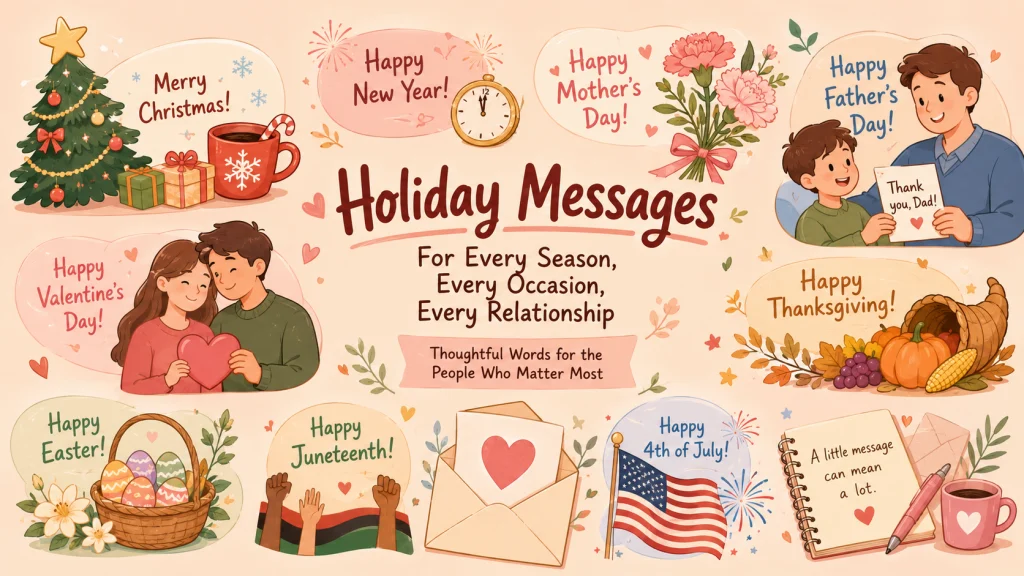
Holiday messages are not about finding perfect words. They are about showing up, in a real way, for the people who matter to you, at the moment the calendar gives you a reason. The messages people remember are rarely the most polished ones. They are the ones that felt personal enough that they could only have come from one person, to this person, on this particular occasion. Whether you are writing something for Christmas, looking for a way to say something real on Mother’s Day, or trying to mark Thanksgiving without sounding like a card from a stranger, what follows maps the holiday landscape and points you toward the right words for your moment.
A Holiday Message Is a Reason to Stay Connected. Most of Them Waste It.
The problem with holiday greetings is not that people send too many. It is that most of them say the same thing in the same way to the same people, year after year, and after a while the message stops being a message and starts being wallpaper. “Happy holidays, wishing you all the best” is kind. It is also forgettable in about three seconds. The holiday itself does the work of showing up on the calendar. What you write is supposed to do the work the occasion cannot do on its own.
I almost sent one of those messages on Christmas morning a few years ago. It started with “Wishing you and your family…” and I got about ten words in before I stopped and deleted it. Not because it was wrong, but because it was exactly what every other message in that person’s inbox was going to say. I started over. What I sent instead was specific to her, to that year, to a conversation we had had in October that she had not stopped thinking about either. She still mentions it. The holiday gave me the reason to reach out. What I said was the whole point.
That is the gap most holiday messages fall into. The occasion provides the opening. The message is supposed to do the rest. And what it requires, more than anything else, is a decision about who you are actually writing to and what you actually want them to feel after they read it.

Christmas and New Year: When Everyone Is Sending Something
Christmas is one of the holidays that produces the most messages and, probably, the most forgettable ones. The volume alone works against you. By the time someone gets to your text on Christmas morning, you are competing with every other person in their life who thought to reach out at the same time. That is a harder problem than it sounds, and it is why a Christmas message for family hits differently than the same words sent to a friend, which lands differently again from something sent with the clear intention of making someone laugh. The relationship changes everything, including what the message needs to be.
New Year sits in an unusual position. It is the holiday that asks the least of you emotionally and therefore often gets the least thought. The sentiment is the same for everyone. What makes it worth sending is how personal it feels: who you are actually writing to, and what you hope for them in the year ahead.
A New Year card message written for someone you love has room for that kind of weight. A broader round of New Year wishes sent to a wider circle asks for something different, something warm but efficient, something that reads as personal even when you are sending it to a dozen people in an afternoon. Both occasions reward a little more thought than they usually get. The effort does not have to be visible in the message. It just has to be there.
There is also room for humor inside Christmas, which gets underused because people default toward warmth and end up with something that sounds slightly ceremonial. A well-timed funny Christmas message does not undercut the holiday. It makes the person feel like you actually know them, which is its own kind of warmth. For Christmas texts sent to friends, the tone is usually more relaxed anyway, and humor fits more naturally than people give it credit for.

Mother’s Day and Father’s Day: The Messages That Sit Unsent the Longest
Of all the holidays that ask something of words, the parent holidays are the ones people draft and delete the most. Part of it is the complexity of the relationship. A parent-child bond carries years of context inside it, years of things said and unsaid, and when a holiday gives you the opening to say something meaningful, the weight of all that history can make it hard to know where to start. The message ends up too long, or too short, or it sounds like something lifted from a card display, and none of it quite captures what you were trying to say. The feeling is real. The words keep coming out wrong.
What I have found is that the relationship between sender and receiver matters more here than on almost any other holiday. A heartfelt Mother’s Day message from a daughter comes from a different place than what a son writes to his mom on Mother’s Day. Not better or worse, just different in tone and in what it tends to reach for.
The same holds for Father’s Day messages from a son to his dad, where the default tends toward understatement, and the challenge is saying something real without it reading like a prepared speech. Sometimes the hard part is not love. It is sounding like yourself while saying it. The message has to find the version of you that already exists between the two of you.
Valentine’s Day, Thanksgiving, and Easter: Love, Gratitude, and the Quiet Ones
Valentine’s Day tends to get one of two treatments. It either becomes an occasion for grand romantic statements that feel more like a performance than a message, or it collapses into something so understated that the person on the other end is left wondering if it even counted. What sits in the middle is harder to find but more lasting: something honest enough to feel like it came from you, and warm enough to land in the specific context of this relationship on this day. A Valentine’s Day message for a wife carries the particular weight of a long relationship behind it, years of knowing someone well enough that you do not need superlatives to say something that matters. That is not a constraint. That is actually a resource most people forget they have.
Thanksgiving occupies a different emotional register entirely. It is the holiday that is supposed to be about gratitude, and it often produces messages that are so vague they barely register at all. “So thankful for you” is true for a lot of people and almost never sticks. The Thanksgiving messages that actually work name what they are grateful for, specifically, in terms that belong to the relationship and not just to the occasion. They do not gesture at gratitude. They locate it in something real.
Easter tends to be quieter in terms of message volume, which is actually an advantage if you use it. A message sent on Easter lands in less crowded space than one sent at Christmas, and the bar is lower simply because most people do not bother. Whether you are writing to family, to a close friend, or to someone you want to feel remembered on a holiday they celebrate, the Easter wishes that land are about warmth more than spectacle. They do not need to be elaborate. They need to feel like they came from someone who was thinking of a specific person, not just observing the holiday.

Juneteenth and the 4th of July: When the Holiday Carries More Weight
Some holidays carry more history than others, and that history changes what a message needs to do. Juneteenth is a day with deep meaning, a day about freedom and memory and a reckoning with history that has not finished being reckoned with. Writing about it, or into it, asks for a kind of care that lighter celebrations do not require. Juneteenth quotes and messages that honor the day tend to stay close to what the occasion actually means, rather than reaching for the same celebratory language that works on other holidays. Borrowing that language can flatten something that deserves more. The specificity of the day is the point.
The 4th of July is a different kind of moment. It is celebratory by nature, communal, and generally lower stakes when it comes to what a message needs to carry. But even here, a 4th of July message that says something beyond a stock phrase tends to stay with the person who receives it. The bar is not high on this one. Most people send nothing, or they forward something they did not write. A few actual words directed at a person you actually know still lands like something, and that is more than most people manage.

Finding the Right Tone Before You Write Anything
One thing I keep seeing is that people start writing a holiday message before they have decided what they want it to feel like. They pick the occasion and start typing, and then they get stuck because the tone is off for the relationship, or the words sound too formal for someone they know well, or they are trying to say too many things at once. The message ends up somewhere in between, not quite warm enough to land, not quite brief enough to read as intentional. Most of the time, the problem is not the wording. It is that the decision about tone was never really made.
Before writing anything, it helps to answer two questions. Who is this actually for, and what do you want them to feel after they read it. Not what you want to say. What you want them to feel. That distinction is where most holiday messages either find their footing or lose it. The table below is not a rulebook. It is a starting point for that decision.
| Holiday | Relationship context | Tone that tends to work | What tends to go wrong |
|---|---|---|---|
| Christmas | Family, friends, colleagues | Warm, personal, specific | Too generic, sounds mass-sent |
| New Year | Everyone | Hopeful, brief | Empty well-wishing with no personal touch |
| Mother’s Day | Child to parent | Heartfelt, specific to the relationship | Sounds like a store-bought card |
| Father’s Day | Child to parent | Warm, often understated | Too brief, reads as obligatory |
| Valentine’s Day | Romantic partner | Honest, intimate, direct | Over-the-top or underwhelming, rarely in between |
| Thanksgiving | Family, close friends | Specific gratitude | Vague sentiment that could apply to anyone |
| Easter | Family, community | Gentle, warm | Forgotten entirely |
| Juneteenth | Community, friends | Meaningful, grounded in the day’s history | Borrowed tone from lighter celebrations |
| 4th of July | Everyone | Light, celebratory | Saying nothing when something small would have landed |
Tone follows relationship more than it follows occasion. The table above gives you a starting frame, but the best messages often break from what they are supposed to sound like in favor of what the person on the other end actually needs. That is a judgment call only you can make, because only you know the relationship.
What Usually Goes Wrong, and Why It Keeps Happening
Most holiday messages fail for the same handful of reasons. This is not about blame. People are busy, they are reaching for something fast, and the defaults are easy to grab. But naming the patterns makes it easier to write past them. From what I have seen, the problems almost always come from the same places.
- Starting with the holiday instead of the person. “Happy Thanksgiving!” is the opener of someone who has not yet decided what they are actually saying. The holiday can come anywhere in the message. It does not have to be the first word, and it probably should not be.
- Writing for the occasion instead of the relationship. What you would send to a close friend on Christmas is different from what you would send to a colleague or a distant relative. Same holiday, completely different message. Many people use the same version for everyone, and everyone can feel it.
- Over-explaining the sentiment. A long holiday message often buries the feeling under too many words. Short and specific almost always lands better than long and heartfelt. Trust the person to feel the warmth once you have given them something real to work with.
- Timing it for the actual day. A message sent on Christmas morning gets lost in a crowd of identical timing. The same message sent the night before, or even a few days earlier, lands in more space and gets more actual attention.
- Sending nothing because nothing felt perfect enough. An imperfect message sent with honesty is better than silence. This one is true without exception. The people in your life would rather hear from you imperfectly than not at all.
None of these are fatal mistakes, and none of them make someone a bad communicator. They are the natural result of reaching for a message under time pressure with no clear model for what a good one looks like. That is exactly the problem the right set of celebration messages can help solve, not by giving you a script, but by showing you what specificity and warmth look like in practice.
Final Thoughts: The Holiday Is the Opening. What You Say Is the Point.
Holidays give you a reason to reach out to people you love, people you have lost touch with, people you have been meaning to say something to for months. A reason is actually a useful thing to have when you are someone who tends to go quiet because the right moment never seemed to arrive. The calendar keeps delivering that moment, reliably, every year. What you do with it is still yours to decide.
From what I have found, the people who send the messages that actually stick are not the ones with the most elegant phrasing. They are the ones who decided the person was worth the effort of saying something real. The holiday names the occasion. The message has to find the person. Everything below exists to help you figure out what that looks like for the holiday in front of you.
Holiday Messages by Occasion
Each holiday below has its own emotional texture, its own relationship dynamics, and its own version of what tends to go wrong when the message is left to chance. The pages below go deeper into each one. Pick the occasion that fits where you are right now, and start there.
| Occasion | What you will find |
|---|---|
| Celebration Messages | Warm messages for any occasion worth marking, across all kinds of relationships |
| Christmas Messages for Family | For the people you see every year and the ones you wish you saw more often |
| Christmas Texts for Friends | Personal, warm, and written for someone who actually knows you back |
| Funny Christmas Messages | For when a little humor is the most honest kind of warmth you can offer |
| Heartfelt Mother’s Day Messages from Daughter to Mom | For daughters looking for words that say more than the card aisle ever manages |
| What to Write Mom on Mother’s Day from Son | Honest messages for sons who want to say something real and not sound rehearsed |
| Father’s Day Messages from Son to Dad | Warm, grounded messages for a relationship that often goes understated by habit |
| Happy Thanksgiving Messages | Messages that name specific gratitude rather than gesturing toward it |
| Valentine’s Day Messages for Wife | For long relationships that deserve something more than a default sentiment |
| Happy Easter Wishes | Gentle, warm messages for a holiday that too many people skip entirely |
| Happy New Year Card Messages | Written for someone specific, not for whoever happens to read it |
| Happy New Year Wishes for Everyone | Personal enough to feel individual, efficient enough to send to a wider circle |
| Juneteenth Quotes and Messages | Words that honor the meaning of the day rather than borrow tone from lighter occasions |
| 4th of July Messages | Something real to say to the people you are actually celebrating with |
FAQs
💬 What do you say in a holiday message when you have no idea where to start?
Start with the person, not the holiday. Think of one specific thing about your relationship with them and let that be the first line. The holiday becomes the reason you are reaching out. What you say is the actual message.
📏 How long should a holiday message be?
Shorter than you think. Two or three sentences that feel genuine almost always land better than a paragraph that tries to cover everything. Length is not warmth. Specificity is.
🤔 Is it okay to send the same holiday message to multiple people?
For a wider circle, yes. A version that reads as warm without being personalized is fine for people you are not close to. For the people who matter most to you, no. They will feel the copy-paste, even if they cannot name exactly what felt off.
⏰ When is the best time to send a holiday message?
A day or two before the holiday tends to land better than the morning itself, when everyone else is sending at the same time. That said, a late message sent honestly is still better than no message at all.
💙 What do you say in a holiday message to someone having a hard year?
Acknowledge the year without trying to paper over it. You do not have to force cheer into a message for someone who is struggling. Sometimes “I have been thinking of you” is the most honest holiday message you can send, and the one that lands the hardest.
🎄 Does every holiday call for a different kind of message?
The tone shifts, yes. Christmas and New Year lean warmer and more social. Mother’s Day and Father’s Day tend toward the heartfelt and specific. Juneteenth asks for more care and historical awareness than a light celebration. The relationship stays the same across all of them. The occasion changes what the message needs to carry.