“You are enough” is not a compliment. It is a correction for a specific belief: that worth is conditional, that belonging has to be earned, that love is something you prove your way into rather than something you already have. This collection gathers 70 you are enough messages organized by situation and relationship, from the friend who never stops pushing herself to the partner who can’t accept care without immediately repaying it. Use what fits, adjust what doesn’t, and send it before the moment to say it passes.

A Correction, Not a Compliment
Messages that say “you are enough” occupy a different space from other kinds of encouragement. Encouragement is forward-facing: it says you can do this, you’ll get there, I believe in what you’re working toward. Praise is backward-facing: it says look at what you’ve done, look at how far you’ve come. But “you are enough” does neither. It points at who someone already is, underneath everything they have or haven’t done, and says the worth is already there, not pending, not conditional, not tied to what happens next.
That distinction matters for a specific reason. For someone who has spent years privately believing their place in any room, in any relationship, in any life they are trying to build, has to be continuously re-earned, encouragement can accidentally confirm the same logic: keep going, do more, prove it again. What these messages are trying to do is step outside that loop entirely. The people who need them most are often the last to ask. Sending this before they think to need it is often when it does the most good.
What These Messages Are Actually Doing
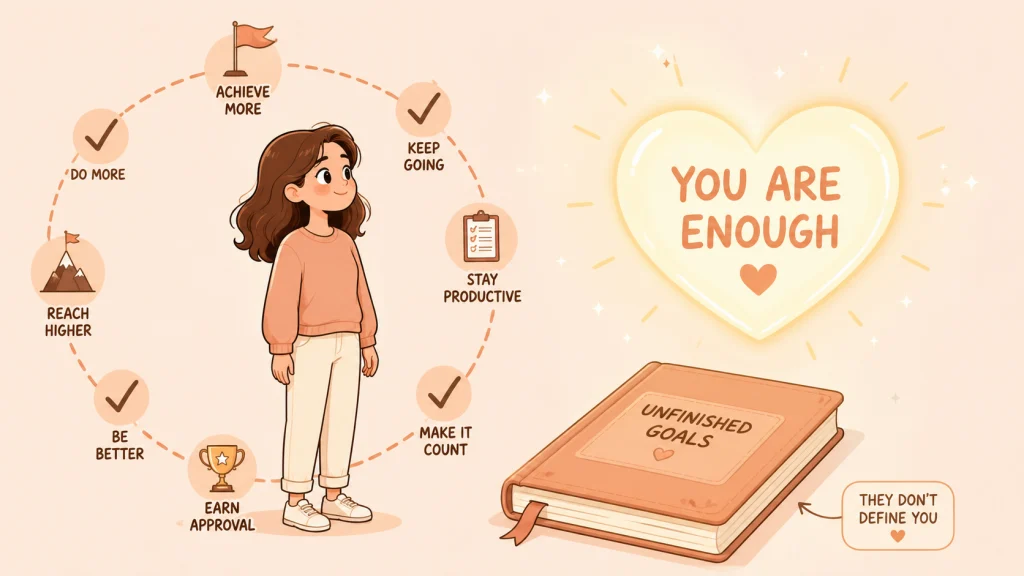
There is a category of encouragement that, without meaning to, keeps worth tethered to output. “You worked so hard.” “Look at how much you’ve accomplished.” All of those are kind things to say. But they leave a door open to the belief that has been causing the problem: that worth is something that can be reviewed and revised, that on a different day, with different results, the verdict might change. The messages in this collection are trying to close that door.
If you’re looking for a broader range of affirmations and supportive things to say, the collection of positive affirmations to send someone covers a wider range of occasions and relationships. What’s specific here is the framing: worthiness is not performance-based, not up for review, and does not change based on results. The table below shows how to match the message to the moment, because “you are enough” sounds different depending on what has just happened.
| The situation | What to reach for | What tends to miss |
|---|---|---|
| They just failed at something | Separate who they are from what happened | Silver linings, “you’ll do better next time” |
| They’re deep in comparison mode | Ground them in who they already are | Competing with the comparison (“you’re better than them”) |
| They never stop pushing themselves | Name the pattern gently, without pity | Telling them to relax or slow down |
| You want to say it unprompted | Brief, certain, no explanation needed | Over-explaining why you’re sending it |
| Their worth feels tied to their output | Separate the love entirely from the result | Praising their work ethic or recent wins |
That right column is worth keeping in mind before you write anything. “You are enough because of everything you’ve done” keeps worth tied to output. “You are enough because I’ve watched you grow” keeps it tied to progress. The messages below try to cut that logic out entirely, so what remains is just the person, and the plain statement that the person is enough.
For the Friend Who Never Stops Trying to Be More
This is the friend who shows up for everyone, asks for very little, and deflects a compliment before it can fully land. She works hard, harder than she needs to, because something underneath tells her the current version is not quite enough to keep. From the outside it looks like ambition. From the inside it is closer to fear. What she needs from you is not more praise for what she does.
- You don’t have to earn your place here. You’ve had it all along.
- I watch you work twice as hard as anyone in the room and still feel like it isn’t enough. For the record, it always has been.
- The version of you right now, without the next goal, without proving anything, is the version I show up for.
- You are not a project in progress that needs finishing before it can be loved. You are a person, and that is enough.
- I don’t need you to be more. You are already exactly who I would choose.
- You raise the bar on yourself every time you clear it. I want to say out loud what you’re not saying to yourself: you have already cleared every bar that matters.
- I’m not saving my care for some future, more polished version of you. I care about this one, right here.
- You apologize a lot, for being too much, for not being enough, for taking up space. None of those apologies were ever necessary.
- The tired version of you, the one with nothing left to prove or give, is still just as worth staying for.
- You don’t have to be impressive right now. You just have to be here.
That last one tends to land in a way longer messages don’t always manage. Removing “impressive” from the equation entirely cuts through to the belief underneath without giving her anything to argue with. Send it plainly, without explanation, and let it say what it says.
For the Person Who Doesn’t See What You See
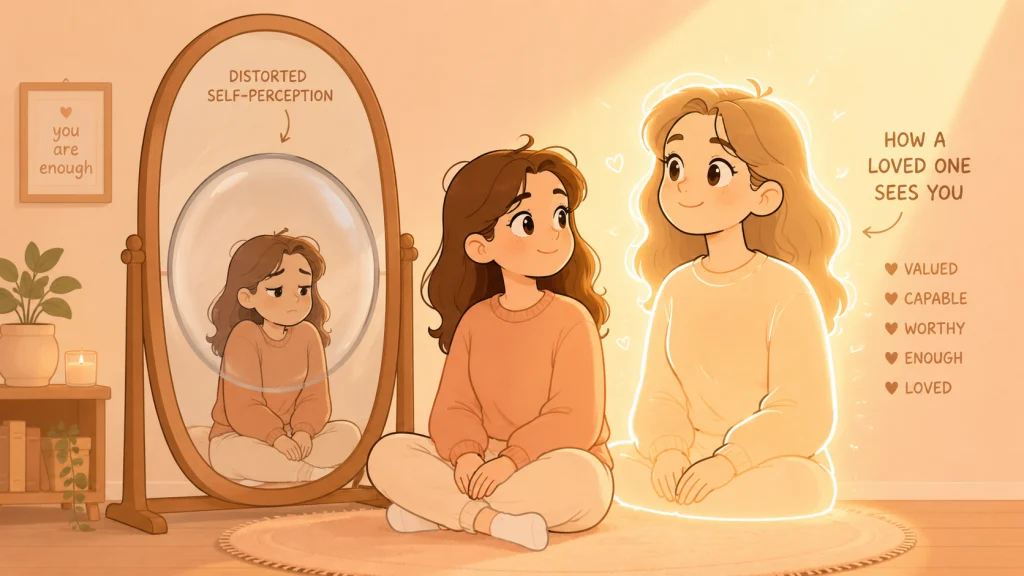
This is a specific kind of person to love. Not someone struggling in an obvious way, but someone who looks at themselves and finds a smaller, less remarkable version of what you see. The gap between their self-perception and what is actually there can be wide enough that compliments feel dishonest to them. They don’t distrust you. They just have a different data set, and it arrived earlier and repeated more often than yours did.
- I don’t know who told you that you had to be a certain way to deserve good things. They were wrong. You’re watching yourself through a lens that doesn’t match what the people who love you actually see.
- I wish you could see yourself the way I do. Not the doubt, not the list of things you think you’re failing at. Just you, as you actually are.
- The gap between how you see yourself and how I see you is significant. I am firmly on the side that thinks you’re extraordinary.
- You look at yourself and find all the places you fall short. I look at you and find someone I would choose, every time, exactly as they are.
- If I listed everything I value about you, you’d tell me I was exaggerating. I am not exaggerating. This is just what is true.
- You are more than you are giving yourself credit for. That is not encouragement for its own sake. It is accurate.
- The things you call flaws, I tend to call the most interesting parts of you.
- I hope one day you can land softly inside yourself without needing to fix anything first.
- Other people’s certainty about you is waiting for you to catch up.
- You have been enough all along. The evidence has always been there. You’re just too close to see it clearly.
That second-to-last one came from a real conversation. She spent years not quite believing the people who loved her saw her accurately, assuming their warmth said more about them than about her. When she finally caught up to what they had always known, she said it felt less like discovery and more like remembering something she had known once and then lost.
For Someone Who Just Failed at Something That Mattered
This is where the message gets harder to write. Failure feels like evidence to someone who already believes their worth is conditional, and anything you say that keeps worth tethered to performance, even kindly meant, feeds the loop. The most common mistake here is well-intentioned: praising the effort, finding the silver lining, pointing to the future. All of those keep worth connected to doing, which is exactly the belief that needs interrupting.
- I know that didn’t go the way you wanted. And I’m not going to tell you it doesn’t matter. What I will tell you is that who you are is not determined by how this one thing went.
- One failure is not a verdict. It is one thing that didn’t work, at this particular moment, in this particular form. That is the whole story.
- You are allowed to be disappointed. That’s honest. What I don’t want you to do is take this as proof of something. It isn’t.
- The fact that it didn’t work out doesn’t change what it meant that you tried.
- You are not less because this didn’t go your way. You are exactly as much as you were before.
- I’m not watching you differently today than I was yesterday. Nothing about how I see you has changed.
- Fail, rest, come back. You are still you throughout all of it. That part doesn’t change.
- This didn’t break anything that matters. You are still whole.
The shortest one there, “you are still whole,” was something I almost left out because it felt too small. In practice, the smallest version of this message is often the one that actually gets read when someone is sitting with a disappointment they have no words for yet. Short and certain can reach places that long and careful cannot.

For Someone Stuck in the Comparison Loop
Comparison is its own specific shape of not-enough. It has a target: someone who seems further along, doing it better, living a version of life that feels out of reach. No amount of actual accomplishment fixes it, because the comparison just moves to the next person on the list. Messages that try to win the comparison on your friend’s behalf miss the point entirely. “You’re better than them” keeps the whole framework intact. The goal is not to win the climb. It is to step off the ladder.
- Comparison will take everything from you if you let it. You are not behind. You are on a path that doesn’t look like anyone else’s because it was never supposed to.
- The people you’re measuring yourself against are measuring themselves against someone else. This goes all the way down. Step off the ladder.
- You are not a smaller version of someone doing it better. You are a complete version of yourself.
- The things you have that you tend to overlook, because they don’t photograph well, are the things I keep thinking about when I think about you.
- Somewhere someone is quietly wishing they had what you have. I know you don’t feel that right now. But it is true.
- You are enough as you are. Not almost enough, not enough once you reach the next thing. Right now, as you are.
- You don’t have to catch up to a life that was never yours.
- The highlight reel you’re comparing yourself to is not someone’s real life. Yours is real. That makes it more valuable, not less.
- I know the gap between where you are and where you think you should be feels enormous. From the outside, I see someone who has already done more than they realize.
- You are not falling behind. You are living a life that doesn’t look like someone else’s, and that is exactly as it should be.
The one about the highlight reel is simple, but I find it cuts through in a way more personal messages sometimes don’t. Naming the mechanism of the comparison, not just the feeling it produces, gives someone something concrete to push back against. The feeling is just weather. The mechanism is something they can actually decide to step away from.
For the Person Who Ties Worth to What They Produce
For some people the belief that worth must be earned shows up most clearly in their relationship with rest. They have to earn it. They feel guilty when they take it. From the outside this looks like strong work ethic. From the inside it is a kind of exhaustion that doesn’t go away, because the standard keeps moving. Most encouragement aimed at people like this makes the problem slightly worse, because praising their results reinforces the same logic. These messages try to locate worth somewhere the work can’t reach.
- I love you on the days when nothing gets done. On the slow days, the failed days, the days when you close your laptop and feel like you have nothing to show for it. The love is not conditional on the output.
- You are not your productivity. That might sound obvious. I don’t think you believe it yet. I’m saying it anyway.
- Everything you’ve accomplished is real and it matters. But that is not why you matter. You were worth everything before the first item on that list existed.
- Rest does not have to be earned. You are allowed to stop.
- Your worth is not up for review at the end of the quarter. It was never performance-based. I wish someone had told you that earlier.
- The version of you that achieves nothing today is just as worthy of love and space as the version that clears the whole list. I mean that completely.
- You don’t have to produce anything to deserve to be here. You are enough exactly as you are right now.
- The quiet version of you, the one that isn’t working on anything, is still someone I would stay for.
“Rest does not have to be earned” reads as obvious when you say it out loud. For someone whose whole internal structure is built around justifying their place, it is anything but obvious. Send it plainly without softening it or explaining it. The directness is what makes it land. An explanation would give them something to argue with. The plain statement gives them nothing to argue with except the belief itself.
For a Partner Who Needs to Hear This
In a close relationship, the belief that worth must be earned takes a particular shape. A partner who over-apologizes for needing things. One who can’t accept care without immediately trying to reciprocate. One who is quietly braced, always, for the day you realize they are not enough. The fear is not dramatic. It just sits there underneath everything, making love feel like a loan rather than a given.
- I don’t love you because of what you do for me. I love you because of who you are when you’re not doing anything at all.
- You don’t have to make yourself worth loving. You already are. That hasn’t been in question for me in a long time.
- I’m not waiting for a better version of you. I chose this version. I keep choosing it.
- You are allowed to take up space here. You are allowed to need things. That has never been too much.
- There is nothing you could fail at that would change how I see you. I need you to believe that.
- The parts of you that you are most ashamed of are the parts I am most certain about staying for.
That last one is the most direct, and the hardest to receive for someone who has spent time believing their flaws are the reason they will eventually be left. Use it only when you mean it completely, because anything less than full honesty will be felt immediately. When you mean it fully, it reaches somewhere very little else does.

Short “You Are Enough” Texts to Send Right Now
Sometimes the moment doesn’t call for a paragraph. Sometimes a phone buzzes at exactly the right time and the only thing someone needs to read is a few words that interrupt the loop they have been running in all day. These are short “you are enough” texts for that kind of moment: brief, certain, carrying exactly what they need to carry and nothing more. ❤️
- You are enough. Not almost. Not close. Enough.
- You don’t have to earn this. You already have it.
- I see you. All of it. And I’m staying.
- You are more than enough, and I need you to hear that today.
- The love isn’t conditional. It never was.
- You are allowed to stop proving yourself.
- Enough isn’t a ceiling you’re trying to reach. It’s where you already are.
- You don’t have to be different for me to choose you.
- I don’t need a better version of you. I need this one.
- You are worthy of good things, right now, as you are.
The third one, “I see you. All of it. And I’m staying,” tends to land harder than it looks. It names the fear underneath the whole pattern: that being fully seen leads to being left. Eleven words that counter that directly. Use it when you know that is the actual thing they are afraid of, when the issue is not failure or comparison but the belief that truly knowing someone means eventually leaving them.
When You Want to Say It Without Making It a Whole Thing
Not every message has to arrive with weight. Sometimes the most useful thing is to say it plainly, without a reason, without a build-up, as though it is simply a fact you are reporting because you thought they should have it. These are the messages that land on an ordinary Tuesday, out of nowhere, and do something precisely because nothing prompted them. They say: I think about you when everything is fine.
For a wider range of messages like this, including ones that don’t fit any particular occasion, the collection of positive messages for the people you care about covers moments where kindness doesn’t need a reason. What’s here is specifically for the worthiness question: for the person who needs to hear they are enough before they’ve done anything to earn the reminder.
- Just thinking about you today, for no particular reason. You matter to me not for anything you do, just for who you are.
- I don’t say this enough: you are genuinely one of the people I’m glad exists.
- You don’t owe anyone a more impressive version of yourself. Not even me.
- There’s nothing about you I would trade. Not the parts you’re proud of and not the parts you’re still figuring out.
- I know you’ve been hard on yourself lately. I don’t have a fix for that. I just want you to know that from where I’m standing, you are doing more than fine.
- You are enough even when you don’t feel like it. Especially then.
- I keep thinking you don’t know how good you are. This is me telling you.
- There is nothing you need to fix before you deserve kindness. You deserve it now, as you are.
The second one, “you are genuinely one of the people I’m glad exists,” is the kind of message people hold onto for a long time. It says nothing about performance, nothing about potential, nothing about what someone contributes. It just says: I am glad you are here. In a world that measures everyone constantly, that turns out to be a more complete and harder thing to say than most of us remember to say.
Final Thoughts: Send It Before the Moment Closes
The most common reason these messages don’t get sent is not that the person doesn’t want to say it. It’s that they keep waiting for the right moment, the right phrasing, or the certainty that it will land exactly as intended. And then life moves, and the moment passes, and the person on the other end never gets to know that someone was thinking about them in exactly this way.
What I have found, over time, is that the imperfect version sent almost always does more than the perfect version that stays in drafts. The people who need these messages most are not waiting for polished. They are waiting for real. A message that sounds like you, that says one true thing, is the one they will come back to. Among all the “you are enough” quotes to send, the one that lands is the one that sounds like a person they actually know.
You don’t have to say it perfectly. You just have to say it.
FAQs
💬 What do you say to someone who doesn’t think they are enough?
The most useful thing is something that separates their worth entirely from what they have or haven’t done. Skip the praise and skip the pep talk. Try something direct: “You don’t have to earn your place here. You’ve always had it.” The goal is to interrupt the belief, not reinforce the performance loop.
🤍 How do you tell someone they are worthy without it sounding hollow?
Specific almost always outperforms general. Instead of “you are so worthy,” name the pattern you’ve actually noticed: the over-apologizing, the overworking, the way they deflect before a compliment can land. It reads as something you observed, not something you said because it seemed right.
📱 What is a good short “you are enough” text to send right now?
A few that tend to land: “You don’t have to earn this. You already have it.” Or, if the fear underneath is about being truly seen: “I see you. All of it. And I’m staying.” Short and certain almost always outperforms long and careful when someone is in the middle of doubting themselves.
🔄 What should I text someone who keeps comparing themselves to others?
Avoid trying to win the comparison on their behalf, because “you’re better than them” keeps the whole framework intact. Try stepping off the ladder instead: “You are not falling behind. You are living a life that doesn’t look like someone else’s, and that is exactly as it should be.”
💼 What do you say to someone who ties their worth to their job or productivity?
Remove performance from the equation entirely. Praising their work ethic accidentally reinforces the belief. Try: “I love you on the days when nothing gets done. The love is not conditional on the output.” Say it plainly without softening it. The directness is what makes it land.
✉️ Is it okay to send a “you are enough” message out of the blue?
Yes, and unprompted is often when it does the most good. A message with no occasion attached says something different from one sent in response to a visible struggle. It says: I think about you when nothing is wrong. That turns out to be a genuinely meaningful thing for someone to know.