When someone you care about is going through something hard, the message that helps most is rarely the one that tries to fix it. It’s the one that says, plainly, that the situation is hard and that you’re not going anywhere. Below are 80 words of encouragement for hard times, organized by what they actually do: naming the difficulty, offering presence without conditions, giving someone a low-pressure way to feel less alone. There’s also a short section on the phrases that tend to backfire, even when they come from a good place, along with what tends to work better instead.
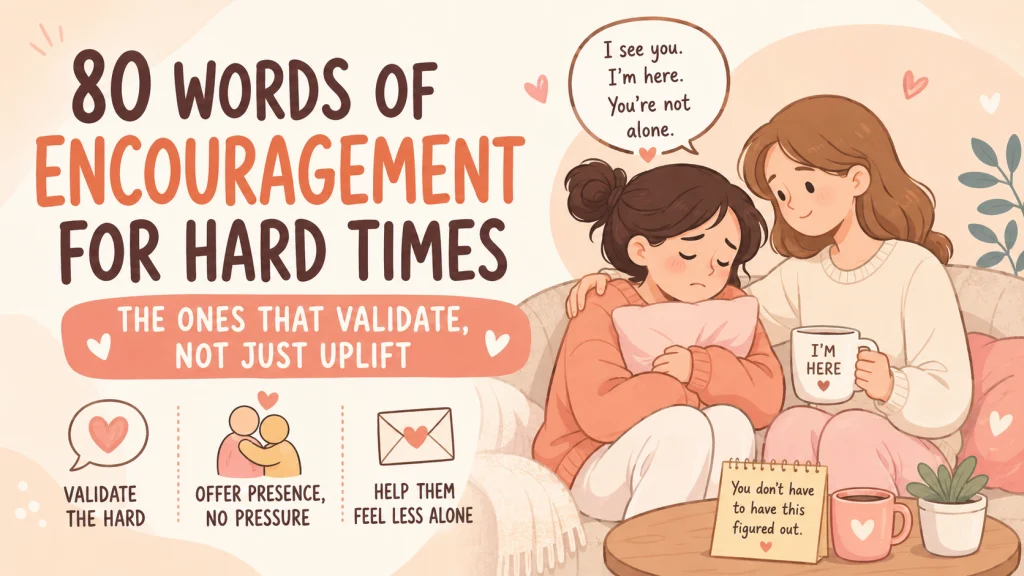
Why “you’ve got this” isn’t always the kindness it sounds like
Most words of encouragement for hard times follow the same script: stay strong, you’ve got this, everything happens for a reason. I’ve sent versions of that script myself, usually in a bit of a panic, because I didn’t know what else to say and silence felt worse than saying something forgettable. What I’ve found, more times than I’d like to admit, is that those messages tend to land somewhere between hollow and slightly off, not because the person sending them doesn’t care, but because they skip past the part where the situation is actually hard. The messages that help do something different. They start by admitting the hard part is real, and then they stay.
There’s a difference between a message that validates and one that redirects. Redirection usually comes from a good place. Nobody wants someone they love to keep hurting, so the instinct is to point toward relief, toward a brighter way of looking at things. But when someone is in the middle of something hard, being nudged toward the bright side can feel like being told their reaction is the problem. A message that validates does the opposite. It says, in effect, that what someone is feeling makes sense, and that they don’t have to feel anything else for your benefit.
The messages below are organized around that idea. If you’re someone who tends to freeze up entirely when a friend is struggling, it might help to start with what to say when you don’t know what to say, since most of what follows grew out of exactly that starting point: not knowing, and saying something honest anyway.

Messages that say “I see how hard this is”
These messages do one thing: they name what’s happening as hard, without adding anything else. No silver lining, no “but at least,” no quiet suggestion that things could be worse. Just an acknowledgment that what someone is dealing with is genuinely difficult, and that you’ve noticed.
A lot of people skip this step because it feels like it might make things heavier, as though naming the hard part will somehow make it more real. In my experience, it’s the opposite. Most people already know exactly how hard things are. What they’re often missing is someone else saying it out loud, so they don’t have to carry that part of it alone too.
- I know this is genuinely hard, and I’m not going to pretend it isn’t.
- What you’re carrying right now is a lot. I see that.
- This is one of those situations where there’s no quick fix, and that’s okay.
- I’m not going to tell you it’ll be fine, because I don’t actually know that. But I do know you’re not facing it alone.
- You don’t have to have this figured out right now. Honestly, none of us would.
- This sounds exhausting, and you’ve been carrying it for a while now.
- I keep thinking about what you’re going through, and I’m not sure how you’re managing it.
- It’s okay if today is just a get-through-it kind of day.
- You’re allowed to be upset about this. Anyone would be.
- I’m not surprised you’re struggling right now. This is a lot to deal with.
- There’s nothing easy about what’s happening, and I’m not going to act like there is.
- I wish I could make this easier for you. I can’t, but I’m here.
- You don’t have to put on a brave face with me.
- This is hard, full stop. No silver lining required.
- I can see how much effort it’s taking you just to get through the day right now.
- You’re not overreacting. This is a genuinely difficult situation.
- I won’t pretend to know exactly what this feels like, but I know it’s heavy.
- It makes total sense that you’re struggling. This would be hard for anyone.
- I’m thinking about you today, and I know today might be one of the harder ones.
- You don’t owe anyone an explanation for how you’re feeling right now.
- This is the kind of thing that takes time, and there’s no rushing it.
- I’m not going anywhere, no matter how long this takes.
Pick whichever of these sounds like something you’d actually say out loud. The wording matters less than the fact that you’re not trying to talk someone out of how they feel. If one of these helps, words of comfort tend to work along the same lines, in case you want more once this one has landed.
Words that offer presence without asking for anything back
The messages above name the hard part. These do something slightly different: they offer to be there, without making that offer conditional on the other person responding, feeling better, or being good company. That last part matters more than people tend to realize.
When someone is going through something hard, replying to texts can feel like one more task on a list that’s already too long. A message that quietly removes the obligation to respond, while still making it clear you’re there, tends to land better than one that, even gently, expects something back. These are built for exactly that.
- No need to reply to this. Just wanted you to know I’m thinking of you.
- I’m here whenever you want to talk, and just as okay if you don’t.
- You don’t have to update me on how you’re doing. I just wanted you to know I’m around.
- If you want company, I can come sit with you. If you want quiet, that’s fine too.
- I’m not checking in because I expect an answer. Just wanted you to feel a little less alone today.
- Whatever you need, even if it’s nothing, I’m here for it.
- I’ll keep checking in. No pressure to respond every time.
- You don’t need to be “good company” right now. I’m not here for that.
- I’m a phone call away, day or night, no explanation needed.
- If today’s a bad day, that’s allowed. I’m still here either way.
- I’m not going to ask if you’re okay, because I know the answer might be complicated. Just know I’m thinking of you.
- Take whatever time you need. I’m not going anywhere.
- I can bring food, sit with you, or just leave you alone, whatever feels right.
- You don’t have to entertain me or fill the silence. I’m okay with quiet.
- I know things are hard right now. I’m here, in whatever way is useful, or not at all if space is what you need.
- If you need a distraction, I’ve got time. If you need to talk, I’ve got that too.
- I’m sending this so you know someone’s thinking of you, not because I expect anything back.
- Whenever you’re ready, I’ll be here. No rush.
If you send one of these and don’t hear anything back for a while, that’s not a sign it didn’t matter. Often it’s the opposite. The messages that say “no need to reply” are frequently the ones people come back to later, once they finally have the energy to respond.
Short encouragement for the days a full message feels like too much
Some days, even reading a long message takes more energy than someone has to spare. On those days, something short does more good than something thoughtful and detailed, because it doesn’t ask anything of the person receiving it. These are built to be read in a second, with nothing required afterward.
Short doesn’t mean less effort on your end. If anything, it can take more restraint to leave something this brief, especially if your instinct is to explain why you’re sending it, or to soften it with extra context. Resist that instinct here. Let it stay small.
- Thinking of you today. 💛
- You’re not alone in this.
- Sending you strength for today, whatever that looks like.
- Here for you, always.
- No words, just love.
- Today might be hard. I’m with you.
- You’ve got people who care, even on the hard days.
- Just a reminder: you matter.
- One hour at a time today, that’s enough.
- You don’t have to be strong right now.
- Thinking about you more than usual lately.
- It’s okay to rest today.
- You’re allowed to not be okay.
- Sending you something soft for a hard day.
- I’m here. That’s it. That’s the message.
- However today goes, I’m with you.
These work especially well as a check-in sent without expecting a conversation to follow, a small signal that someone’s on your mind, sent and then left alone. That’s really all encouragement needs to do when someone’s at their limit: arrive, and ask nothing in return.
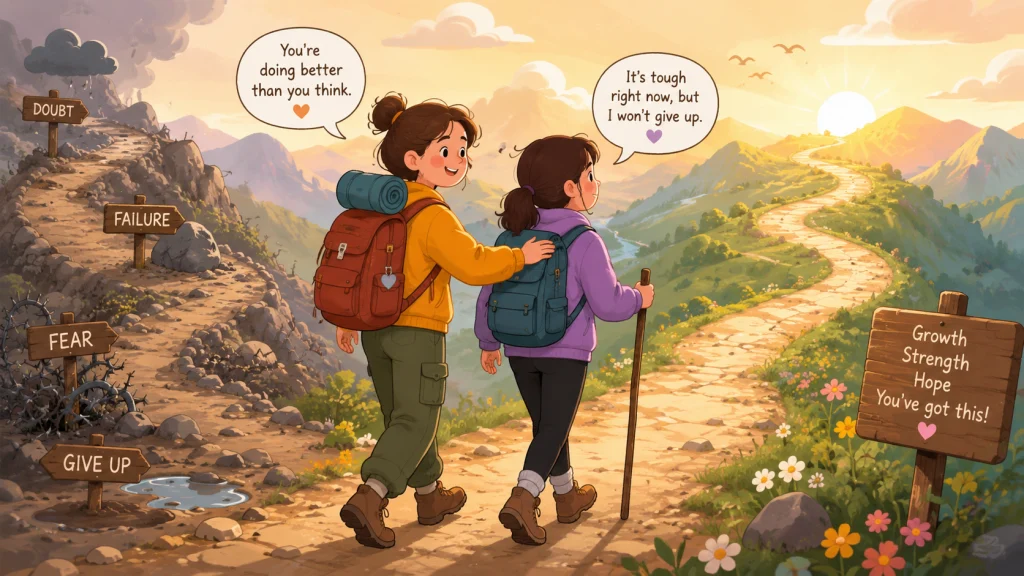
When you’ve stood where they’re standing
If you’ve been through something similar to what someone you care about is going through now, that experience can be useful, but only if it’s offered carefully. The goal isn’t to compare situations or imply you know exactly what they’re feeling. It’s to let them know that someone who’s been somewhere dark before is choosing to stay close now.
There’s a message I sent to someone once, after a stretch where I genuinely didn’t think I’d feel like myself again. I didn’t tell them it would pass, because in the moment, I didn’t fully believe that either. I just told them I remembered what this particular kind of awful felt like, and that I wasn’t going anywhere. They told me afterward it was the only message that hadn’t tried to talk them out of how bad things were.
- I’ve been in a version of this before, and I remember how lonely it felt. You’re not as alone as it feels right now.
- I’m not saying I know exactly what you’re going through, but I’ve been somewhere close enough to recognize the weight of it.
- When I went through something like this, the thing that helped most wasn’t advice. It was someone just staying close. So that’s what I’m doing.
- I remember wishing someone would just say “this is awful” instead of trying to fix it. So: this is awful, and I’m here.
- I’ve sat where you’re sitting, and I know it doesn’t feel like it’ll pass. It does, even if it takes longer than anyone wants it to.
- I don’t have a tidy comparison to offer, just the fact that I’ve been low before, and people staying close mattered more than anything they said.
- If it helps at all, I didn’t have the right words either when I went through something similar. I just had people who stayed.
- I’m not going to compare situations, but I know what it’s like to feel like you’re the only one who can’t get it together. You’re not.
- Something like this happened to me once, and what got me through wasn’t “staying positive.” It was someone showing up without being asked twice.
- I won’t pretend my experience was the same as yours, but I remember what it felt like to need someone to just sit with the hard part. I can do that.
- I’ve had stretches like this where every day felt the same shade of gray. They don’t stay that way forever, even if it’s hard to believe right now.
- When things were hard for me, the message I needed wasn’t “it’ll get better.” It was “I’m still here, however long this takes.” So: I’m still here.
If things have been hard for someone for a long stretch, not just a rough week but an ongoing weight, encouragement messages for someone with depression might be worth a look, since what tends to help shifts the longer something goes on.
For the person who isn’t ready to talk yet
Not everyone wants to talk about what’s going on, and that’s not the same as not wanting support. These are messages for someone going through a hard time who needs to know you’re there, without the pressure to explain anything right now.
This matters especially in the first stretch after something happens, when a person might still be working out what to even say about it, if anything. A message that doesn’t require a response gives them room to just receive it, without having to manage your reaction to their reaction on top of everything else.
- You don’t have to talk about it. I just wanted you to know I’m thinking about you.
- No pressure to respond, or even to read this closely. Just know I care.
- I’m not going to ask what’s going on. Just wanted to say I’m here whenever, if ever, you want to talk.
- If you need space, take it. I’ll still be here when you’re ready, however long that takes.
- I won’t push. I just didn’t want you to feel like nobody noticed.
- Whatever’s going on, you don’t owe me details. I’m still in your corner.
- I know sometimes the last thing you want is to talk about it. That’s fine. I just wanted you to feel less alone.
- You don’t have to explain anything to me. I just wanted to check in, gently.
- Take all the time you need. This isn’t going anywhere, and neither am I.
- I’m not expecting a reply. Just wanted you to know someone’s thinking of you today.
- If silence is what you need right now, that’s okay. I’ll be here when that changes.
- I noticed things seem hard right now. You don’t have to talk about it, but I wanted you to know I see it.
Even if you don’t hear anything back, sending one of these isn’t wasted. People remember who reached out during the quiet stretch, long after the louder, more urgent messages have faded.
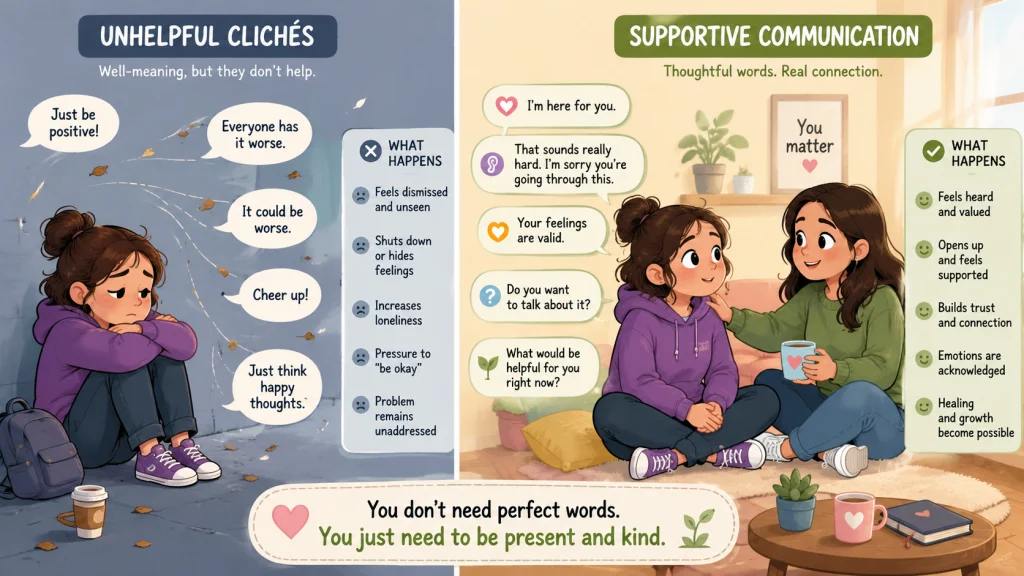
What not to say, even when it’s well-meant
Most of the phrases that land wrong come from a good place. Nobody sends “everything happens for a reason” because they want to hurt someone. They send it because it’s what they’ve heard, what sounds comforting, what fills a silence that feels uncomfortable to leave open. The trouble is what these phrases quietly ask of the person hearing them, often without either person realizing it.
The uplifting words for hard times that get repeated most often are frequently the ones that land worst, because they’re built to redirect rather than validate. Here’s a quick look at some of the most common ones, and what tends to work better in their place.
| What people often say | What it can sound like | Try instead |
|---|---|---|
| “Everything happens for a reason” | Their pain has a hidden purpose they should be looking for | “I don’t know why this happened, and I’m not going to pretend to” |
| “Stay positive” / “Just stay strong” | Struggling is something they’re failing at | “You don’t have to be strong with me” |
| “At least you still have…” | The hard part should be canceled out by something else | “I know that doesn’t make this any easier” |
| “You’ve got this!” | They need to handle it alone, and handle it well | “You don’t have to have this figured out” |
| “Time heals everything” | They should wait this out quietly, on their own | “This will take whatever time it takes, and I’ll be here for it” |
None of this means walking on eggshells, scanning every sentence for a hidden way it could go wrong. Mostly it means slowing down for a second before sending the first line that comes to mind, the one that’s been said so many times it barely registers as words anymore. If you’re genuinely unsure what to say to someone struggling, the safest option is usually the most honest one: “I don’t know what to say, but I’m here.”
The message that matters is the one you actually send
None of the eighty messages above will fix what someone’s going through, and I’d be doing exactly the thing I warned against earlier if I told you otherwise. What they can do is something smaller, and I’d argue more useful: they can make someone feel less alone for as long as it takes to read a text. That’s not nothing. I’ve been on both ends of that exchange, the sending and the receiving, and the messages that stayed with me were never the cleverest ones. They were the ones that admitted something was hard and then didn’t disappear afterward.
If you’re still not sure which message to send, pick the one closest to what you’d actually say if you were sitting across from this person. Send it, and if you can, come back again in a few days with something just as small. The wider set of encouragement messages on this site covers more specific situations, support messages for hard times that fit a particular kind of loss or struggle, if nothing here quite matches what someone’s going through. But most of the time, honest and present beats specific.
FAQs
💬 What’s a good message to send someone going through a hard time?
The messages that tend to help most name the difficulty directly and offer presence without conditions, something like “I know this is hard, and I’m here” rather than “stay strong.” You don’t need anything elaborate. Honest and short usually beats long and polished.
🚫 What shouldn’t you say to someone who’s struggling?
Phrases like “everything happens for a reason,” “at least you still have…,” and “stay positive” tend to minimize what someone’s feeling, even when they’re meant kindly. If you’re not sure, skip the silver lining and just acknowledge that the situation is hard.
📱 Is it okay to text instead of calling when someone’s having a hard time?
For a lot of people, yes, and it’s often easier on both ends. A text doesn’t ask for an immediate response or the energy to hold a conversation, which makes it a low-pressure way to let someone know you’re thinking of them.
🤍 What if I don’t know exactly what’s going on, but I can tell something’s wrong?
You don’t need details to send something supportive. A message like “I don’t know what’s going on, but I wanted you to know I’m here” works fine without an explanation, from either of you.
⏳ How often should I check in with someone going through a hard time?
There’s no fixed schedule, but a short message every few days, especially once the first wave of attention from other people has faded, tends to mean more than people expect. Early support often comes fast and then drops off quickly.
🕊️ What if someone doesn’t respond to my message?
That’s normal, and it doesn’t mean the message missed. Plenty of people read supportive texts during hard times without having the energy to reply, and they often remember them later, sometimes for a long time.