You are holding a card, or a blank text thread, and you know you want to say something to someone who is not feeling well. The trouble is that “not feeling well” covers a lot of ground. A friend with a bad cold needs something completely different from a coworker who just had surgery, and both of those are worlds away from someone facing a diagnosis that scares everyone involved. For broader context, see what to write in a get well card.
I have written all three of those messages, more than once, and I have learned that the words that work for one almost never work for another. A cheerful “feel better soon!” lands fine for a cold. Send that same line to someone who just found out they need chemotherapy, and it can feel like you have not understood what is happening to them at all. For related message ideas, see get well card messages.
Why “get well soon” does not fit every situation
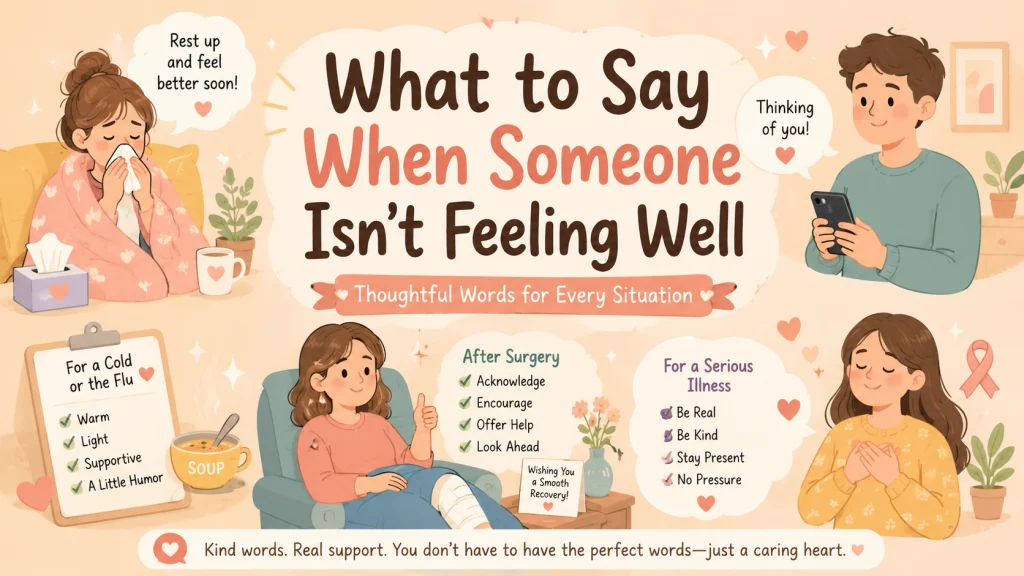
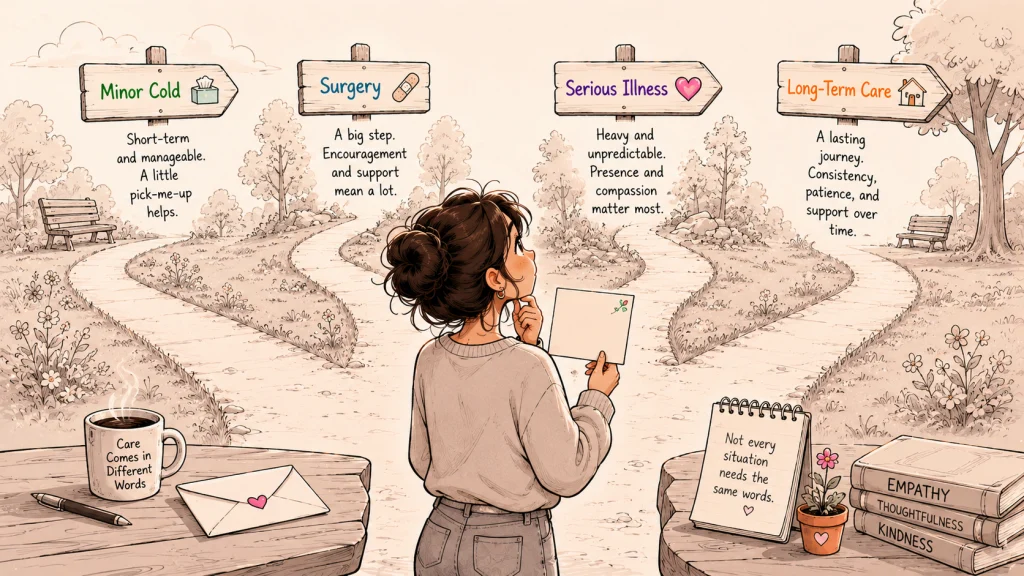
Most advice on this topic treats illness as one thing. It is not. A cold is temporary and mildly annoying, so a light, warm message fits perfectly. Surgery comes with a recovery timeline and often some fear underneath the bravery, so the message needs to acknowledge both the procedure and the road back. A serious illness changes the whole emotional register, and “get well soon” can sound like you are rushing someone through something they cannot rush. Long-term or chronic conditions are different again, because “soon” might not be part of the picture at all.
So before you write anything, it helps to be honest with yourself about which version of sick you are actually writing for. That one decision shapes almost everything else, including the tone, the length, and whether you mention recovery at all.
When it is a cold, the flu, or something minor
This is the easiest category, and also the one people somehow overthink the most. I think it is because we feel like we should say something meaningful, even when the situation does not call for meaning. It calls for company. The person is on the couch, probably bored, possibly a little sorry for themselves, and a message that is warm without being dramatic does exactly what it needs to do.
I once sent a friend a message that just said I had heard she was down with a cold and that her plants were probably enjoying the extra quiet. She told me later it was the only message that day that did not sound like it came from a sympathy card. That is the bar here. Light, specific, a little funny if it fits, and not heavier than the situation actually is.
- “Heard you are under the weather. Hope today involves a lot of soup, a lot of blankets, and absolutely zero responsibilities.”
- “Sorry you are feeling rough. Take the day, ignore your phone, and let yourself be useless for a bit.”
- “Sending you the energy to make it through this without losing your sense of humor. Feel better soon, friend.”
- “You have my permission to do nothing today. Rest up and let me know if you need anything dropped off.”
- “Hope you feel a little more human soon. Until then, I fully support naps, snacks, and pretending the laundry does not exist.”
- “Sorry you got hit with whatever is going around. I hope it passes quickly and leaves you with at least one good excuse to rest.”
- “Thinking of you and hoping today is a little easier than yesterday. Rest hard and recover slowly if you need to.”
- “Feel better soon. I hope someone is bringing you soup, tea, or whatever makes being sick slightly less annoying.”
What I would avoid here is anything that sounds like you are diagnosing them or offering remedies they did not ask for. Nobody wants unsolicited advice about zinc supplements when all they wanted was a “feel better.”
When someone is recovering from surgery
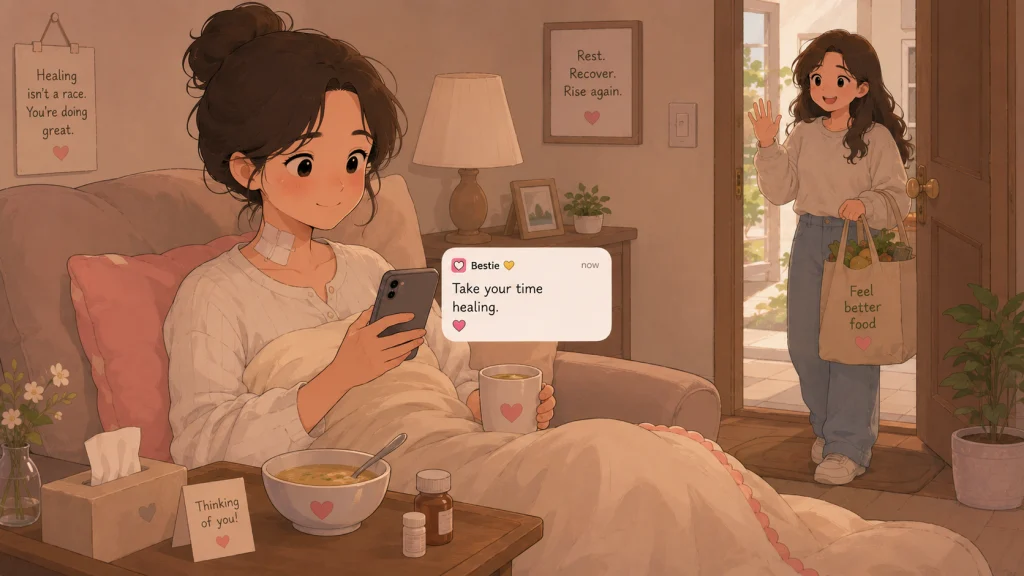
Surgery sits in an odd middle space. It is usually planned, often expected to go well, and yet the person going through it is dealing with something real: pain, limited mobility, the strange vulnerability of being put under anesthesia and waking up changed in some small way. A message that treats it like a minor inconvenience misses that. A message that treats it like a crisis can make them feel like things are worse than they are.
What tends to work is acknowledging both the procedure itself and the recovery ahead, without making either one the whole message. I sent something like this to a friend after a knee surgery, and what she told me afterward stuck with me. She said most messages either ignored that she had just had surgery at all, or made it sound like she had survived something dramatic. Mine, she said, was the only one that just talked to her like a person who would be okay but might need a few weeks to get there.
| What to include | Why it helps |
|---|---|
| A direct mention of the surgery | Shows you are aware of what they actually went through, not guessing |
| An honest nod to recovery time | Removes the pressure to “bounce back” faster than they can |
| An offer that is specific, not vague | “I can drop off groceries Thursday” is more useful than “let me know if you need anything” |
| A line about what comes after | Gives them something to look forward to once recovery is done |
With those pieces in mind, a message can sound something like this:
- “Thinking about you as you recover from surgery. However long it takes, take it. I can come by next week if you want company, or if you would rather have quiet, that is fine too.”
- “Glad the surgery is behind you. The recovery part is its own thing, so be patient with yourself. I am around if you need anything, even just someone to complain to.”
- “Hope the worst part is over and the healing part goes smoothly. Let me bring dinner over this week, no need to plan anything.”
- “I am really glad you are through the surgery. Now I hope you can give yourself permission to heal at the pace your body needs.”
- “Thinking of you today and hoping each part of recovery gets a little easier. No rushing, no proving anything, just healing.”
- “I know recovery can feel slower than people expect. I hope you have plenty of rest, help, and small signs that things are moving in the right direction.”
- “So glad the procedure is done. I hope the next few days are gentle on you, and I am here if you need food, errands, or a quiet visitor.”
- “Wishing you a smooth recovery and a lot of patience with yourself. Healing is still work, even when everyone else thinks the hard part is over.”
The thread that runs through all of these is that they leave room for the recovery to take however long it takes. Nothing pushes, nothing rushes, and nothing assumes the hard part is already finished.
When it is something more serious
This is the part where “get well soon” stops working, and most people know it without being able to say why. The phrase implies a finish line, and with a serious illness, nobody actually knows where that finish line is, or whether there is one at all. Saying it anyway can come across as either naive or like you have not absorbed how serious things are.
I will say clearly here that I am not a doctor, a counselor, or anyone qualified to tell someone how to feel about a diagnosis. What I can offer is what I have noticed about the messages that land in moments like this, and the ones that do not.
The messages that land tend to do less, not more. They do not try to fix anything, predict an outcome, or compare the situation to someone else’s. They simply say that you are thinking of the person, that you care, and that you are there in whatever way is useful, even if that just means sending another message next week.
I do not have the right words for everything you are facing right now, and I am not going to pretend I do. I just want you to know I am thinking about you, and I am here, for the small things and the big ones, for as long as you need.
A version like that can be sent as is, or adjusted to sound more like your own voice. What matters most is that it does not promise an outcome you cannot promise, and it does not put the burden on the person to respond or to feel a certain way about what you said.
- “I heard about your diagnosis, and I have been thinking about you ever since. I do not know what the days ahead look like for you, but I am not going anywhere.”
- “You do not need to respond to this. I just wanted you to know I am holding you in my thoughts, today and in the days that follow.”
- “Whatever this looks like for you, I am here for it. Lean on me as much or as little as you need.”
- “I know there is nothing simple about what you are facing. I just want you to know you are loved, you are not alone, and I am here in whatever way helps.”
- “I wish I could take some of this weight off you. Since I cannot, I will keep showing up in the ways I can.”
- “There is no pressure to answer this. I just wanted to send love and remind you that I am thinking about you, not just today, but through all of this.”
- “I am here for the practical things, the quiet things, and the hard things. You do not have to make this easier for anyone else.”
- “I care about you so much. I will not pretend to know exactly what to say, but I will keep caring, checking in, and listening.”
If the illness is long-term or chronic, the same care matters, but the wording often needs to change. “Soon” can feel wrong when someone is living with something that may not simply pass. In that case, steadiness usually means more than cheerfulness.
- “I know this is not something that disappears after a few days of rest. I just want you to know I am still here, and I will keep being here.”
- “You do not have to be positive for me. I am here on the hard days too.”
- “I know some days may be better than others. I am thinking of you on all of them.”
- “No pressure to update me or explain how you are doing. I just wanted to remind you that you are cared for today.”
One thing I would gently steer away from is any comparison to someone else’s experience with the same illness, even if it is meant to be hopeful. “My aunt had the same thing and she is fine now” can feel dismissive of how different every situation is, even when the intention behind it is kind.
When the person who is sick is a child
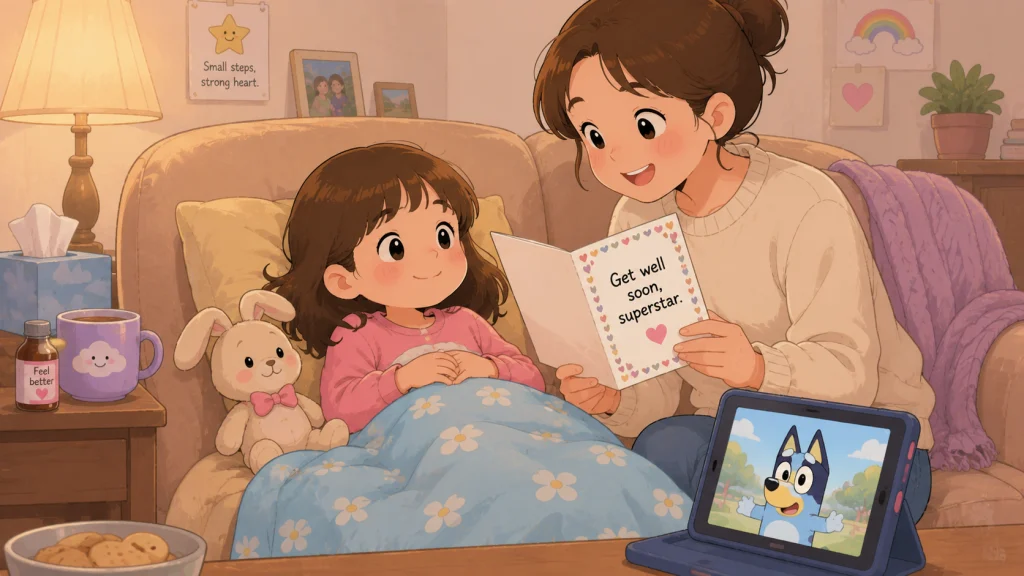
Writing to a sick child is its own small art form. They are not going to read a card the way an adult does, and the people who will probably read it to them, or for them, are usually exhausted parents who are just trying to get through the day. A message that is short, warm, and slightly playful does more for everyone than one that is long and earnest.
I think the mistake people make here is writing to the parents instead of the child, even when the card is addressed to the child. The result is something that sounds like a sympathy note for adults with a child’s name pasted on top. Kids respond to things that feel like they are for them: a silly line, a small joke, something that makes them feel like a person and not a patient.
- “Hope you feel better soon so you can get back to being your usual troublemaker self. We miss the chaos.”
- “Heard you have been resting up. That sounds like a pretty good excuse to watch extra cartoons, if you ask me.”
- “Sending you a virtual high five for being so brave. Get well soon so we can do something fun together.”
- “Your friends miss you at school. Get better soon, but also, enjoy the extra snacks while you can.”
- “I hope every day feels a little better and a little less boring. We are all cheering for you.”
- “Get well soon, superstar. The world needs your energy back, but only when you are ready.”
For very young kids, a short message that a parent can read aloud works better than anything elaborate. The point is not the wording. It is the fact that someone outside the house was thinking about them.
When humor is the right medicine
Funny get well messages work best with people who use humor to cope, and who you know well enough to be sure a joke will land the way you intend. They do not work for serious diagnoses, and they do not work for people you do not know well. Within those limits, though, a well-placed joke can do more than any sincere message ever could.
I sent a friend recovering from a minor outpatient procedure a message joking that he finally had a good excuse to ignore everyone’s texts for a few days. He said it was the first thing that made him laugh since the procedure, and that it felt better than every “thinking of you” message combined. The humor worked because it was specific to him, and because the situation genuinely was not serious.
- “Hope you are milking this for all the sympathy and snacks it is worth. You have earned it.”
- “Get well soon, mostly so you stop having a legitimate excuse not to text me back.”
- “I would send flowers, but I figured you would rather have someone admit how dramatic you have been about this cold.”
- “Rest up. The world can survive a few days without your opinions on everything.”
- “Wishing you a speedy recovery, because honestly, your couch has had enough of you.”
- “Feel better soon. I need you back at full strength so I can make fun of you properly.”
If you are not sure whether humor fits, it usually does not. The people who would appreciate a joke tend to be the same people who would tell you, plainly, “do not get sappy on me.” If that is not the relationship you have, warmth without the joke is the safer and kinder choice.
When it is a coworker or your boss
Work relationships add a layer of awkwardness to almost everything, and getting well wishes are no exception. Too casual, and it can feel out of place. Too formal, and it can feel like it came from HR rather than from you. The sweet spot is professional warmth: friendly enough to feel genuine, restrained enough to fit the relationship you actually have.
I think the safest approach is to keep it short, mention that things are covered if that is true, and avoid asking any questions about what is wrong. Curiosity, even well-meaning curiosity, can feel like pressure to explain something a person may not want to explain to a coworker.
- “Hope you are feeling better soon. Things are covered here, so do not worry about a thing until you are back.”
- “Sorry to hear you are under the weather. Take the time you need, we will catch you up whenever you are ready.”
- “Wishing you a quick recovery. Let us know if there is anything we can take off your plate while you rest.”
- “Thinking of you and hoping your recovery is smooth. Please do not worry about work right now.”
- “Wishing you rest, recovery, and a much easier week ahead. We are all looking forward to having you back when you are ready.”
- “Hope you feel better soon. Take care of yourself first, and we will handle things here.”
For a boss specifically, the tone can stay almost identical, just slightly more concise. A short, sincere message is far more appropriate than something that tries too hard to sound personal with someone you mostly know in a professional context.
What not to write, and why people write it anyway
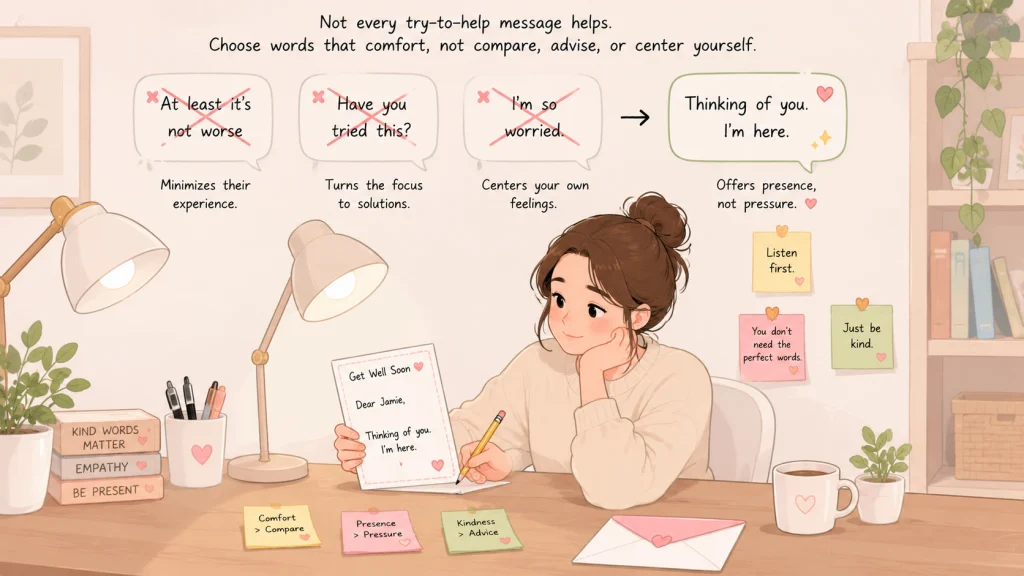
Most of the messages that miss the mark are not written by careless people. They are written by people who care a lot and do not know exactly how to show it, so they reach for the first thing that sounds caring. Here are the three traps I see most often, and what tends to work better instead.
- “At least it is not worse.” This is meant to offer perspective, but it minimizes what the person is actually going through. Instead, focus on what they are feeling now, not on how things could theoretically be worse.
- Unsolicited advice or remedies. Recommending supplements, diets, or “have you tried” suggestions can come across as a lack of trust in whatever care they are already receiving. A simple message of support does not need a solution attached.
- Over-explaining your own feelings. Long messages about how worried or sad you are can shift the focus onto you, when the moment is supposed to be about them. A shorter message that centers on the person you are writing to almost always lands better.
None of these come from bad intentions. They come from wanting to say something useful and reaching for whatever feels closest at hand. Slowing down for even a minute, and asking what this specific person, in this specific situation, would actually want to hear, usually points you somewhere better.
The one thing that matters more than the wording
After everything, the version of “sick” you are writing for matters more than the specific words you choose. A message that fits the situation, even if it is simple, will land better than a beautifully written message that is tone-deaf to what someone is actually facing. If you are ever unsure, lean toward saying less, and toward leaving room for whatever the person is feeling, rather than telling them how to feel about it.
If you are looking for more ways to put any of this into words, there are get well messages for every situation to browse, along with short get well messages for when you want to keep things brief, messages for someone facing a serious illness if that is the situation you are in, and words of comfort for moments that call for something gentler than “get well soon.”
FAQs
💌 What do you write in a get well card for someone you do not know well?
Keep it short, warm, and general. Something like “Wishing you a smooth recovery” works well when you do not know the specifics, and it does not require you to ask any questions you might not be comfortable asking.
🤕 What should you avoid writing to someone who is seriously ill?
Avoid phrases like “get well soon,” comparisons to other people’s experiences with the same illness, and anything that predicts how things will turn out. Simple, present-focused messages tend to feel the most genuine.
😂 Is it okay to send a funny get well message?
It can be, if you know the person well and the situation is not serious. Humor works best with people who already use it to cope, and it should never replace warmth entirely if you are unsure how it will be received.
🧒 What do you write in a get well card for a child?
Keep it short, playful, and addressed to the child directly rather than to the parents. A small joke or a line about missing them at school usually means more than a long, serious message.
🏥 How do you write a get well message after surgery?
Acknowledge the surgery directly, give them permission to take however long they need to recover, and if you can, offer something specific like bringing food or running an errand rather than a vague “let me know if you need anything.”
👔 What is appropriate to write to a coworker who is sick?
Keep it brief and professional but still warm. Wish them a smooth recovery, let them know things are handled while they are out, and avoid asking what is wrong unless they have already shared that with you.