You don’t need the right words. You need to stop letting the fear of the wrong ones keep you silent. What to say when you don’t know what to say usually has less to do with vocabulary and more to do with permission, the permission to show up imperfectly instead of not showing up at all. I’ll walk through what I’ve learned actually helps when someone is struggling and you have no idea what to offer them, including specific lines you can borrow, when silence is the better move, and the few things that almost always make a hard moment worse.

You Don’t Have to Find the Perfect Words
You don’t know what to say. That’s the whole problem, and it’s also exactly why you’re here. What to say when you don’t know what to say isn’t really about finding clever language, it’s about realizing that the not knowing is normal, and that showing up matters more than getting the words right. I have sat with that exact paralysis more times than I can count, staring at a blank text box, deleting and retyping the same sentence, convinced that if I just thought a little longer I would land on the thing that fixed it.
There is no sentence that fixes it. That’s the part nobody tells you upfront. The person you’re reaching out to isn’t waiting for a perfectly constructed message, they’re noticing whether you reached out at all. What I have found, over and over, is that an honest, slightly clumsy message sent within the hour does more than a polished one that takes three days to write because you were waiting to feel ready.

Why Silence Feels Safer (And Why It Usually Isn’t)
The fear of saying the wrong thing is, in my experience, the single biggest reason people say nothing at all. It feels safer to wait. It feels safer to send a vague “thinking of you” and move on, or to say nothing until you’ve figured out the exact right phrasing. I understand the instinct completely, because the stakes feel high when someone you care about is in pain and you don’t want to make it worse with a clumsy sentence. But that instinct, left unchecked, turns into weeks of silence dressed up as caution.
Here’s the truth underneath all of it: presence matters more than perfect words, almost every time. The pattern I keep seeing, in my own life and in the messages people send me about theirs, is that the friend who said “I don’t know what to say but I’m here” is remembered far more warmly than the one who said nothing while privately composing the ideal message in their head. Words when nothing seems right don’t need to be eloquent. They need to exist, and they need to arrive while the moment is still happening, not after it has already passed.
This sounds simple, but in practice it’s the hardest thing to act on. Knowing that presence beats perfection doesn’t make the blank text box less intimidating. It just means the bar you’re trying to clear is lower than you think it is, which is, honestly, good news.
When Saying Nothing Out Loud Is the Right Call
Not every hard moment needs language. Sometimes the most caring thing you can do is sit next to someone, bring them food without commentary, or simply stay in the room a little longer than feels necessary. There’s a kind of support that doesn’t run through sentences at all, and pretending it has to be put into words is part of what makes this feel harder than it needs to be.
I think about a friend whose father had just gone into hospice, and I drove an hour to sit in her kitchen and make tea I knew she wouldn’t drink. I didn’t say anything close to profound. I just stayed past the point where leaving would have been easier for me. She told me months later that she didn’t remember a single thing I said that day, only that I was there and didn’t rush to fill the quiet. That’s the part people underestimate: silence shared with someone is completely different from silence that comes from avoiding them.
A Simple Way to Stop Overthinking It
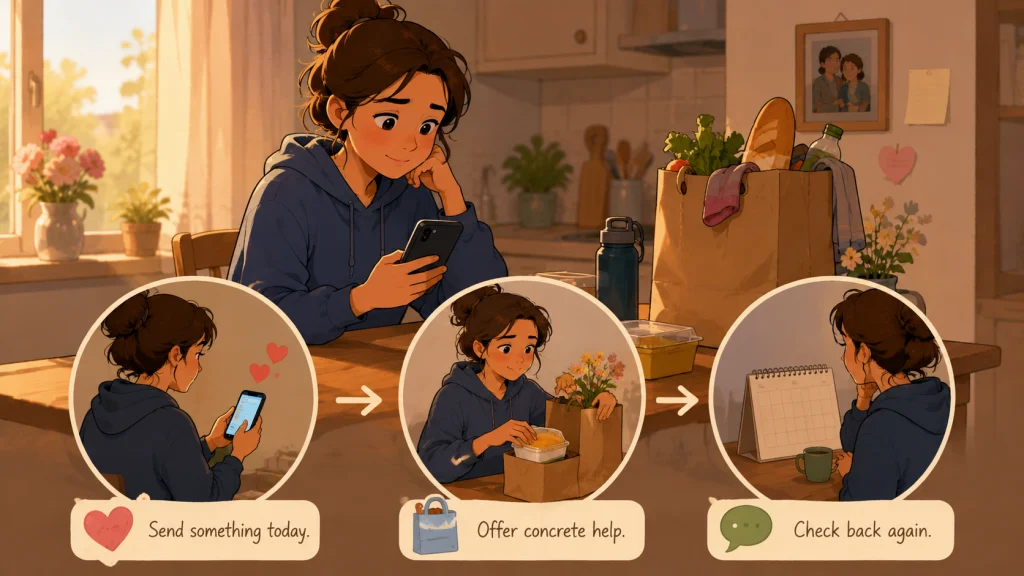
Here’s something that has helped me more than searching for the one perfect sentence: breaking the moment down into three small moves instead of treating it like a performance you have to get right on the first try. Most of the freezing happens because we’re trying to solve a feeling that doesn’t actually need solving, when really the only job is to make contact.
The three moves are simple on purpose. Send something today, even if it’s only a sentence, because today beats perfect every single time. Offer one specific thing you can actually follow through on, instead of a vague “let me know if you need anything,” since specific is easier for someone to accept when they’re overwhelmed. Then check back again in a day or two on your own, rather than waiting for them to reach out first, because the people in the middle of something hard rarely have the energy to ask twice.
- Send something today, even if it’s short.
- Offer one concrete thing, not a vague offer.
- Check back again without waiting to be asked.
None of this requires you to know what’s wrong, or to have said anything brilliant the first time you reached out. It just requires you to keep showing up in small, doable pieces instead of waiting for one perfect message to carry the entire weight of the moment.
What to Say When You Genuinely Don’t Know What They’re Going Through
Sometimes you know something is wrong, but you don’t have the details, and you don’t want to ask in a way that feels intrusive or forces them to explain before they’re ready. In that gap, the goal isn’t to guess at specifics. It’s to make it clear you’ve noticed, and that you’re available whenever they want to fill you in, or not.
- I don’t know exactly what’s going on, but I noticed, and I’m thinking about you.
- You don’t owe me an explanation. I just wanted you to know I’m here if you need anything.
- Whatever this is, you don’t have to carry it alone if you don’t want to.
- I can sit with you for a while, no pressure to talk.
- I can tell something’s hard right now. I’m not going anywhere.
- You don’t have to talk about it for me to show up for you.
- I’m bringing food by Thursday. No need to explain anything, and I can leave it at the door if you’d rather not talk.
- I can handle one practical thing this week if you tell me what feels heaviest.
Notice none of those require knowing the situation. That’s intentional, because waiting for full context before reaching out is one of the more common ways people stall and end up not reaching out at all. If you want a wider set of language for moments exactly like this, there’s a fuller collection of comforting words for someone going through something hard that’s worth keeping bookmarked for the next time you’re stuck.
Saying “I Don’t Know What to Say” as the Message Itself
One of the things I’ve come to believe, the more of these moments I’ve sat through, is that admitting you don’t have the words is itself a perfectly good message. It reads as honest rather than as a failure. People can tell the difference between a message that was labored over for effect and one that simply tells the truth about how hard this is to talk about, and the second one almost always lands better.
When someone is struggling and you have no words, you don’t have to pretend you’ve figured out the perfect thing to say. You just have to be honest about not having it figured out, while still showing up. That distinction is the whole thing.
- I don’t know what to say, but I didn’t want that to stop me from reaching out.
- Honestly, I’ve been trying to write this message for twenty minutes and nothing feels right. I’m here anyway.
- I don’t need you to explain this perfectly. I just want you to know I care.
- There’s nothing I can say that fixes this, but I didn’t want you to feel like no one noticed.
- I keep starting and deleting this message because nothing feels big enough. So I’m just sending it.
- I wish I knew the right words. I don’t, but I’m still here.
Things That Are Almost Always Safe to Say
There’s a category of language that works across nearly every hard situation, not because it’s clever, but because it focuses on connection instead of trying to interpret or fix what’s happening. The safest messages tend to share a few things in common: they don’t guess at how the person feels, they don’t offer advice, and they leave room for the other person to respond however they need to.
| When you’re not sure what’s going on | What tends to help most |
|---|---|
| They’ve shared very little detail | Acknowledge without asking them to explain |
| You’re not sure if they want to talk | Offer presence without requiring a reply |
| The situation feels heavy or serious | Skip advice, lead with simple care |
| You’re worried about saying the wrong thing | Keep it short and let it be imperfect |
With that in mind, here are lines that hold up almost anywhere, even when you’re working with very little information about what someone is actually facing.
- I’m thinking about you today.
- Sending you love right now.
- I’m here, whatever you need.
- You don’t have to go through this alone.
- Would it help if I checked in again tomorrow, or would quiet space feel better?
- I’m here with you in this, even from a distance.
- Whatever you’re feeling right now is okay.
- I’m not going anywhere.
- You’re not alone in this.
- I’m not going to try to fix this. I just want to stay close.
If you want a broader set of phrases built specifically for the heavier stretches of someone’s life, there’s a fuller collection of encouragement for hard times that pulls together language for exactly these moments.

Simple Gestures That Say What Words Can’t
Sometimes the most useful thing isn’t a sentence at all. A gesture can carry weight that a message can’t, partly because it doesn’t ask the other person to read or respond to anything. It just shows up.
- Drop off food without making them talk about why.
- Send a voice memo instead of text, so they hear your voice, not just words on a screen.
- Show up and do something practical, like dishes or errands, without asking what they need first.
- Sit with them in silence, without filling the quiet just to feel useful.
- Send something small that reminds them of a good memory you share, with no message attached.
None of these require you to know exactly what’s wrong. They just require you to be willing to be a little inconvenienced on someone else’s behalf, which is, in my experience, what people actually remember.

Three Things That Make It Worse
There are a few patterns I see again and again, almost always coming from people with good intentions, that end up landing badly. None of them happen out of carelessness. They happen because the person sending them is anxious and trying too hard, which is its own kind of human and forgivable, but worth naming anyway.
- Comparing it to something you went through. It can come from a real desire to relate, but it shifts the focus onto you instead of them.
- Offering advice before being asked. Most people in a hard moment want to feel accompanied, not managed.
- Disappearing because you’re scared of saying the wrong thing. Silence reads as absence, even when it isn’t meant that way.
If you want a closer look at exactly the kind of language that tends to backfire in serious situations, there’s a breakdown of what not to say in a sympathy card that goes into more detail on phrases worth avoiding.
Final: What Showing Up Actually Looks Like
How do you support someone when you don’t know what to say? You stop waiting to feel ready. You send the imperfect message, you sit in the uncomfortable silence next to them, you bring the food without an explanation. None of it requires certainty about what they’re going through or confidence that your words are exactly right. It just requires you to act on the caring you already feel instead of letting it sit unsent. They may not remember your exact words a year from now. What they’ll remember is that you didn’t disappear.
If you’re looking for more language to keep on hand for the next time you freeze up, there’s a wider set of encouragement messages for hard moments worth saving. And if you’re ever unsure whether something crosses a line, it’s worth a quick look at what not to say in a sympathy card before you hit send.
FAQs
💬 What do you say to someone going through something you don’t fully understand?
Acknowledge what you do know, even if it’s just that something is hard, and let them fill in the rest if they want to. You don’t need full context to show up.
🤍 Is it okay to just say “I don’t know what to say”?
Yes. Saying it honestly, followed by some version of “but I’m here,” usually lands better than a message that tries too hard to sound perfect.
🕯️ Should I text them or just show up in person?
Either can work. A text is lower pressure and easy to send right away. Showing up in person says more, but only offer it if you mean to follow through.
🤝 What if I say the wrong thing by accident?
Most people forgive an awkward but well-meaning message far more easily than they forgive silence. A clumsy “I’m here” still counts as showing up.
📱 What’s a safe message when I have almost no information about what’s going on?
Something simple like “thinking about you today, no need to respond” works almost anywhere, because it offers care without requiring details or a reply.